
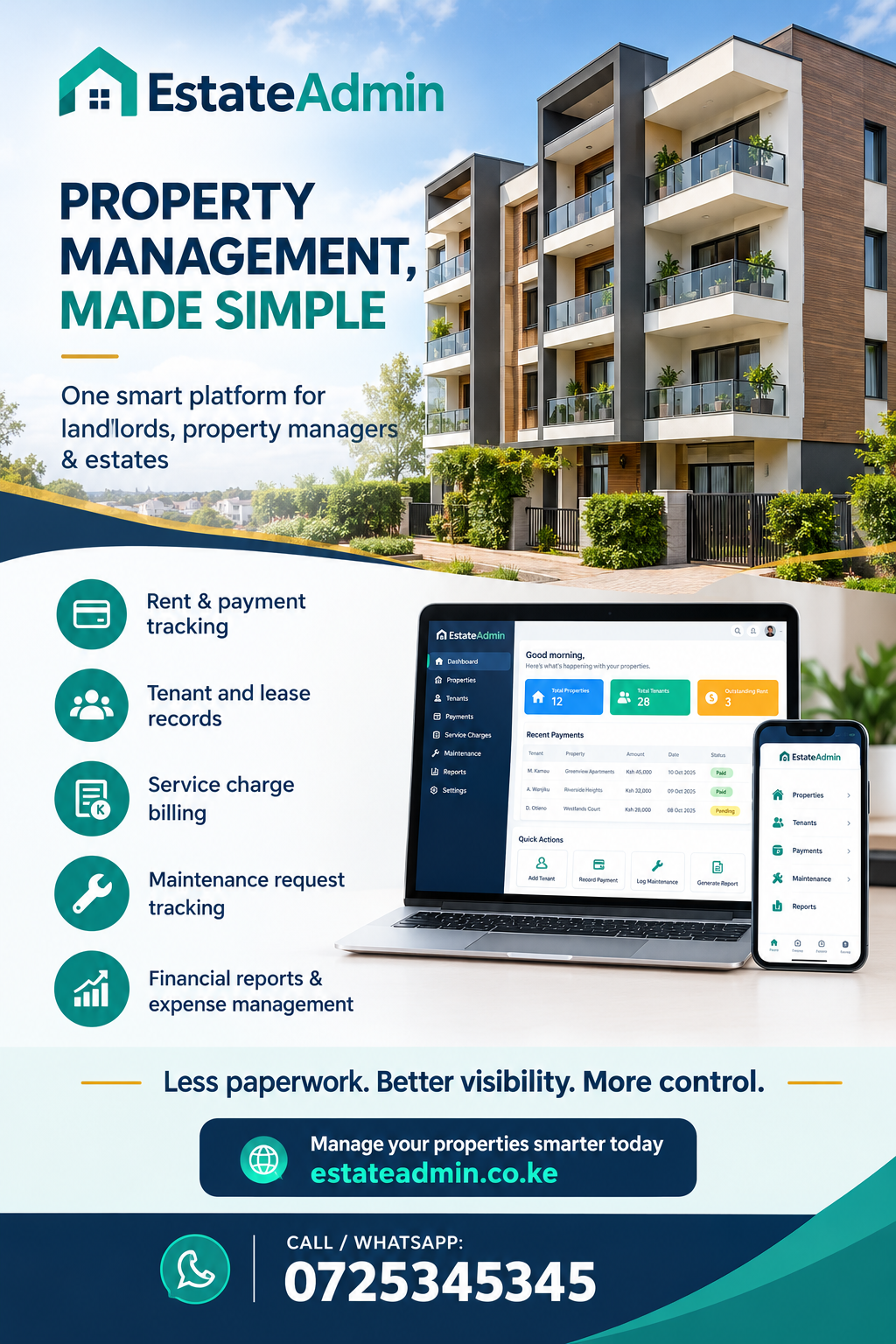
Estate Insurance Management Software Kenya: A Complete Guide to Managing Property Insurance
Property insurance can be difficult to manage when an estate contains multiple buildings, shared facilities, equipment, contractors and different insurance policies. For property managers, estate administrators, management committees and property owners, keeping accurate records of coverage, premiums, claims and renewal dates is essential. Estate Insurance Management Software Kenya provides a focused starting point for understanding how digital estate administration can support insurance recordkeeping, improve visibility into property risks and help management teams maintain better control over insurance-related responsibilities.
An estate may have insurance for residential buildings, offices, lifts, generators, water pumps, perimeter walls, shared parking areas and other common assets. Each asset can have different replacement values, risks and maintenance requirements. When information is stored in paper files, spreadsheets, email conversations and individual employees’ phones, it becomes difficult to establish which assets are insured, which policies are approaching expiry and whether outstanding claims have been resolved.
Insurance administration also affects financial planning. Estate managers need to understand premium costs, payment deadlines, policy conditions and the financial implications of uncovered losses. They must be able to produce records for committees, auditors, insurers and property owners when questions arise.
A structured digital approach can make these responsibilities easier to coordinate. Estate Insurance Management Software Kenya is a relevant search term for exploring how insurance information can be organized alongside wider estate management processes, including asset registers, financial records, maintenance schedules and administrative reports.
This guide explains the role of insurance management in Kenyan estates, the records property managers should maintain, the features worth considering in an estate administration platform, and the practical steps involved in improving insurance oversight. It also covers common implementation mistakes, data protection, budgeting, claims management and questions that estate committees should ask before adopting a digital solution.
The goal is straightforward: help estate management teams make informed decisions, reduce avoidable administrative errors and maintain clearer records of how their properties and shared assets are protected.
1. Understanding Estate Insurance Management
Estate insurance management is the process of organizing and monitoring insurance arrangements for a residential, commercial or mixed-use property. It includes documenting insured assets, maintaining policy details, tracking premium payments, monitoring renewal dates, recording incidents and coordinating claims.
The process involves more than storing insurance certificates. Management teams must understand what each policy covers, which assets it applies to, the limits of protection, the applicable excess or deductible, and the conditions that must be met when reporting a loss.
A residential estate with several apartment blocks, for example, may have building insurance, public liability cover and insurance for selected shared equipment. A commercial complex may require different arrangements because of its tenants, business activities, machinery and public access areas.
Estate Insurance Management Software Kenya is one way to frame the search for digital tools that could help organize these responsibilities. However, estate managers should assess the actual features offered by a provider instead of assuming that every property management system includes a dedicated insurance module.
What does insurance management involve?
A complete insurance administration process commonly includes:
-
Maintaining a register of insured buildings and assets.
-
Recording insurer and broker contact information.
-
Storing policy numbers, schedules and certificates.
-
Tracking commencement dates and renewal deadlines.
-
Recording premiums, payment dates and supporting receipts.
-
Documenting incidents that may lead to claims.
-
Tracking claim submissions, correspondence and settlements.
-
Reviewing exclusions, limits and special policy conditions.
-
Preparing insurance reports for management committees.
-
Maintaining an audit trail of updates and approvals.
These responsibilities often overlap with maintenance, procurement, accounting and compliance. For instance, an inspection may identify a damaged water pump that needs repair and could also require notification to an insurer, depending on the circumstances and policy terms.
Why digital records matter
Digital recordkeeping makes it easier to retrieve documents, compare information and identify outstanding tasks. Rather than relying on a single administrator to remember every renewal date, a properly configured system can help staff monitor deadlines and assign responsibility.
Estate Insurance Management Software Kenya can be used as a search phrase when investigating software options for these workflows. Before choosing a solution, confirm whether it supports insurance-specific records, document attachments, reminders, permissions and reporting, or whether these tasks would need to be handled through general administrative features.
2. Why Kenyan Estates Need Better Insurance Oversight
Kenyan estates vary considerably in size and management structure. Some are small residential developments managed by committees, while others have professional property managers, multiple buildings and extensive shared facilities.
Despite these differences, they share several insurance administration challenges.
Multiple assets and policies
A large estate may contain apartments, access gates, lifts, generators, boreholes, pumps, perimeter lighting, offices and recreational facilities. Not every asset will necessarily be covered by the same policy.
Managers must understand the relationship between each asset and the relevant policy. Otherwise, an assumption that a building policy covers every shared facility could lead to unpleasant surprises after an incident.
Estate Insurance Management Software Kenya is a useful keyword for researching digital approaches to property administration. A suitable platform should help managers link asset records to relevant policy documents where the provider supports that functionality.
Missed renewal dates
Insurance policies generally operate for defined periods. If renewal dates are overlooked, an estate may experience a gap in coverage or face delays while new arrangements are finalized.
A spreadsheet can record dates, but it depends on staff maintaining the file and checking it consistently. A system with configurable reminders and assigned responsibilities can provide a more dependable process.
For example, a management office could review upcoming renewals at 90, 60 and 30 days before expiry. These intervals are administrative planning choices rather than universal legal requirements; the appropriate schedule depends on the estate’s policies and procurement procedures.
Incomplete documentation
Insurance documents may be scattered across email accounts, filing cabinets and external service providers. This can make it difficult to retrieve the latest policy schedule or establish whether a premium was paid.
A centralized repository can help authorized staff find documents more quickly, provided that files are properly named, access is controlled and backups are maintained.
Limited visibility for committees
Estate committees need sufficient information to make decisions without reviewing every document individually. They may need to know which policies are active, what renewals are due, how much has been spent and which claims remain unresolved.
Estate Insurance Management Software Kenya can help frame the search for a platform that connects insurance administration with broader estate reporting, although the exact reporting features must be verified with the supplier.
A useful report should distinguish confirmed facts from pending actions. For example, a policy awaiting payment should not automatically be presented as fully renewed.
3. The Role of Digital Software in Insurance Administration
Insurance administration often depends on information that is already held elsewhere in an estate’s management records. Building details may sit in an asset register, premium payments in accounting records, maintenance information in work orders and incident reports in security logs.
A digital approach can bring these records into a more coordinated workflow. The value lies in making relevant information easier to access and act upon, rather than simply transferring paper documents onto a computer.
Estate Insurance Management Software Kenya represents a search opportunity for understanding how administrative software concepts may be applied to structured records. For an estate, however, the chosen platform must fit property management requirements and should not be selected merely because it offers generic document storage.
Centralized insurance records
A centralized record should identify each policy and provide a clear summary of its essential details.
Useful fields include:
-
Policy reference number.
-
Insurance provider or broker.
-
Policy type.
-
Insured building or asset.
-
Coverage commencement and expiry dates.
-
Insured value and applicable limits.
-
Premium amount and payment status.
-
Deductibles or excess amounts.
-
Relevant exclusions and special conditions.
-
Document location.
-
Responsible staff member.
-
Renewal and review status.
The system should allow authorized employees to locate a policy without searching through multiple unrelated folders.
Estate Insurance Management Software Kenya is another relevant search phrase when comparing administrative software options. The practical question is whether a provider can demonstrate an effective way to maintain, search and update these records.
Automated reminders and task assignment
A reminder is useful only when someone is responsible for acting on it. Insurance renewal workflows should therefore identify both the deadline and the person expected to complete the next step.
A typical workflow might involve checking the existing policy, confirming the insured values, requesting quotations, obtaining committee approval, arranging payment and saving the renewed documents.
The software should make the current status visible so that management can distinguish a task that has been started from one that has actually been completed.
Estate Insurance Management Software Kenya is a useful search term for exploring digital administration concepts, but the estate manager should verify that the selected platform can support the specific insurance workflow required.
Document retrieval and version control
Policy schedules and endorsements can change over time. Keeping an old certificate without clearly marking it as superseded may cause staff to rely on outdated information.
A good document management process should retain historical records while making the current approved version easy to identify. It should also capture the date of an update and, where appropriate, the person who made it.
Estate Insurance Management Software Kenya can serve as a keyword for researching digital record management, but insurance-specific suitability must be evaluated separately.
Reporting and management visibility
Reports should turn detailed records into information that supports decisions. An estate committee might need a list of policies expiring in the next three months, a summary of premiums paid during the year, or a register of claims awaiting action.
Useful reports should be accurate, dated and easy to reconcile with supporting documents.
Estate Insurance Management Software Kenya is a relevant phrase for researching digital management approaches. When assessing a provider, request a demonstration using realistic sample records rather than relying only on promotional descriptions.
4. Essential Features to Look For
Not every property management application is designed to manage insurance. Some focus primarily on rent collection, tenant communication or service charge billing. Others provide broader asset and document management tools that can be adapted to insurance workflows.
The right choice depends on the estate’s size, its risk profile and the administrative tasks that must be supported.
Insurance policy register
The foundation is a register that stores the main details of every policy. It should be possible to search by policy number, insurer, property, asset or renewal date.
Managers should be able to distinguish building insurance from liability cover, equipment policies and other arrangements. They should also be able to record the assets covered by each policy without creating confusion when an asset has more than one relevant form of protection.
Estate Insurance Management Software Kenya is a useful keyword for investigating digital administration tools, but a supplier should confirm whether its product offers a dedicated policy register or requires a configurable alternative.
Asset register integration
Insurance records are more useful when they can be linked to a reliable inventory of estate assets.
An asset register might contain:
| Asset information | Example |
|---|---|
| Asset identifier | PUMP-004 |
| Asset description | Main water supply pump |
| Location | Plant room, Block B |
| Acquisition date | Date recorded in the asset register |
| Replacement value | Latest approved valuation |
| Maintenance status | Operational or requires attention |
| Insurance reference | Linked policy number, where applicable |
| Supporting documents | Purchase invoice, valuation or inspection record |
The values in this example are illustrative. Actual valuations should be established using suitable evidence and professional advice where required.
Estate Insurance Management Software Kenya can help frame research into integrated recordkeeping, but managers should verify whether asset records can be linked directly to insurance policies and supporting documents.
Renewal calendar
A renewal calendar should show upcoming deadlines and the status of each renewal. Ideally, it should also allow staff to assign tasks and escalate overdue actions.
The calendar should not imply that a policy is renewed simply because a reminder was acknowledged. The renewal process should be completed only after the necessary documentation and payment status have been checked according to the estate’s procedures.
Estate Insurance Management Software Kenya is a relevant search phrase when exploring software-supported scheduling and administration. Confirm whether reminders are configurable and whether they can be assigned to particular users.
Claims tracking
Claims can involve several stages, including incident reporting, evidence collection, notification to the insurer, submission of required documents, follow-up correspondence and settlement review.
A tracking record should show the incident date, claim reference, relevant policy, documents submitted, outstanding requirements, correspondence and current status.
Estate Insurance Management Software Kenya is included here as part of the requested link rotation, not as an endorsement of that website for estate insurance. When evaluating products, prioritize demonstrable property administration and claims-tracking capabilities.
Premium and payment records
Managers need to know what premiums are due, what has been paid and which supporting documents are available.
A useful system should distinguish an invoice received from a payment authorized and a payment completed. Where the software connects to accounting records, the estate should still reconcile those records with receipts and insurer confirmations.
Estate Insurance Management Software Kenya is another phrase in the required link sequence. Its inclusion does not establish that it offers insurance functionality; confirm product relevance and capabilities directly.
Access controls
Insurance records can include financial information, building security details and sensitive incident documentation. Access should therefore be limited according to each employee’s responsibilities.
For example, an administrator may update policy records, a finance officer may reconcile premium payments, and a committee member may view reports without being allowed to alter financial transactions.
Estate Insurance Management Software Kenya can be used in keyword research, but the actual provider should be assessed for user permissions, activity logs, backup arrangements and data security.
5. Types of Insurance Estate Managers Should Review
The appropriate insurance arrangements depend on the property, the insured parties, contractual obligations, applicable law and the risks involved. A software platform can help organize records, but it cannot independently determine which policies an estate legally requires or guarantee that coverage is adequate.
Building insurance
Building insurance may protect against specified physical damage to insured structures, subject to the policy terms. Depending on the policy, this could include certain events involving fire, storms or other covered perils.
Managers should confirm which structures are included, how the insured value was determined, what exclusions apply and whether shared areas are included.
Estate Insurance Management Software Kenya is a relevant phrase for researching insurance record management. The system should make it easy to connect each building to its supporting policy documents.
Public liability insurance
Estates with visitors, contractors, delivery personnel and shared facilities may need to consider liability exposures. The appropriate cover depends on the circumstances and the advice of a qualified insurance professional.
Management should understand who is insured, what activities are covered and what notification requirements apply after an incident.
Estate Insurance Management Software Kenya can be used to explore broader digital management concepts, while the suitability of any specific product should be confirmed independently.
Equipment and machinery insurance
Lifts, generators, pumps and other shared equipment can represent significant replacement or repair costs. Depending on the asset and policy, specialized equipment cover or machinery-related protection may be relevant.
The asset register should identify the equipment, its location, its value and the policy under which it is insured.
Estate Insurance Management Software Kenya is a useful keyword for investigating digital asset records. A manager should verify whether the chosen platform can maintain equipment inventories and link them to insurance documentation.
Theft and property damage cover
Some estates may require insurance arrangements relating to theft or damage to specified property. Cover varies by policy and may depend on security arrangements, exclusions, declared values and other conditions.
Managers should avoid assuming that every theft or damage incident will be covered. They should consult the actual policy wording and contact the insurer or broker when clarification is needed.
Estate Insurance Management Software Kenya is another link in the prescribed rotation. When comparing solutions, focus on whether the system can retain incident records, supporting evidence and relevant policy references.
Contractor-related risks
Contractors may introduce additional risks when undertaking electrical work, plumbing, construction, painting or equipment maintenance.
Before work begins, an estate may need to review contractual insurance requirements, contractor documentation and relevant safety procedures. The required checks depend on the type of work and the agreement in place.
Estate Insurance Management Software Kenya is a useful phrase for the required search-link sequence. A suitable administration process should keep contractor records organized and make supporting documentation retrievable.
6. Managing Insurance Renewals Without Last-Minute Pressure
Renewals are easier to manage when they are treated as a planned process rather than a single deadline. Starting early gives the estate time to review its assets, compare available options, clarify coverage and obtain any required approvals.
Step 1: Review the existing policy
Read the current policy schedule and relevant wording. Confirm the insured parties, property descriptions, coverage limits, exclusions and renewal date.
Identify changes that have occurred since the previous renewal, such as new equipment, renovations, changes in occupancy or modifications to shared facilities.
Estate Insurance Management Software Kenya is a relevant phrase for researching digital administration workflows. Any platform selected should make current policy records easy to retrieve.
Step 2: Update asset information
Check whether the asset register reflects the current state of the estate. Remove or archive records for disposed assets, add new acquisitions and verify important property details.
Where valuations are needed, obtain suitable professional advice rather than relying on outdated purchase prices or unsupported estimates.
Estate Insurance Management Software Kenya can be used in the broader keyword research sequence, but managers should confirm that the selected system supports their actual recordkeeping needs.
Step 3: Request quotations and clarification
Where appropriate, request quotations or renewal terms from insurers or brokers. Compare the scope of cover, exclusions, deductibles, limits, conditions and service arrangements, not merely the premium.
A lower premium is not automatically better value if it comes with significantly different coverage or restrictions.
Estate Insurance Management Software Kenya is included according to the requested rotation. Insurance quotations and recommendations should still come from suitably qualified providers.
Step 4: Obtain the necessary approvals
Follow the estate’s governing documents, procurement rules and approval process. Record the decision, the approved cost and the person or body responsible for authorization.
Clear records help prevent misunderstandings about who approved a policy and which terms were accepted.
Step 5: Confirm payment and documentation
After approval, verify the payment process and obtain the appropriate documentation from the insurer or broker. Update the policy register only when the relevant details have been confirmed.
Step 6: Close the renewal task
Save the current policy documents, update the renewal date, record the payment status and assign the next review date. Retain historical records according to the estate’s document-retention policy.
Estate Insurance Management Software Kenya can serve as a keyword for researching software-supported renewal workflows. The key objective is a complete, traceable record of the renewal from initial review to final documentation.
7. Insurance Claims Management After an Incident
An insurance policy becomes particularly important when an incident occurs. A burst pipe, fire, storm, equipment failure or other event can disrupt residents, damage shared property and create unexpected costs.
The management team’s response should prioritize safety, timely communication and compliance with the applicable policy conditions. Software can support the administrative process, but it does not replace professional assessment, emergency response or the insurer’s claims procedure.
Record the incident promptly
The incident report should include the date, location, description of what happened, affected assets and immediate actions taken. Where appropriate, authorized staff can attach photographs, inspection reports, contractor assessments and witness statements.
Records should be factual. Staff should distinguish what they observed directly from information reported by another person.
Estate Insurance Management Software Kenya is a useful search phrase for investigating digital recordkeeping that may support incident administration. Confirm that the chosen platform can attach evidence and associate the incident with the relevant asset and policy.
Notify the insurer or broker
The estate should follow the notification requirements in the policy. Delays can create complications, particularly when the policy specifies deadlines or procedures.
Managers should record when notification was made, who received it, any reference number provided and any additional information requested.
Maintain a claim file
A well-organized claim file may contain:
-
Initial incident report.
-
Relevant policy schedule.
-
Photographs and inspection records.
-
Repair estimates and invoices.
-
Insurer correspondence.
-
Claim submission documents.
-
Requests for additional evidence.
-
Assessment reports.
-
Settlement communications.
-
Final payment or closure records.
Access to these files should be restricted to authorized personnel.
Estate Insurance Management Software Kenya is a relevant phrase for researching digital claim administration. Before adopting a system, establish whether it offers claim-status tracking or only general document storage.
Track outstanding actions
A claim can remain unresolved because documents are missing, an assessment is pending or the insurer requires clarification. A simple status field is useful, but a responsible person and next-action date make it more practical.
For example, the system could record that an inspection report is due from a contractor and assign a staff member to follow up. This creates accountability without implying that the insurer has approved the claim.
Reconcile the settlement
When a claim is settled, compare the payment or repair arrangement with the insurer’s settlement documentation. Record any applicable excess, excluded expenses or differences between the estimated and approved costs.
If the claim is disputed, the estate should follow the relevant complaint or dispute-resolution process and obtain professional advice where necessary.
Estate Insurance Management Software Kenya can be used to explore whether a broader estate administration platform supports the reporting and document-control processes associated with claims. Actual functionality must be confirmed with the provider.
8. Connecting Insurance Records With Estate Finances
Insurance is both a risk-management responsibility and a budgetary commitment. Premiums must be planned for, approved and recorded alongside other estate expenses.
When insurance records are disconnected from financial management, committees may struggle to establish the total cost of coverage or determine whether an expense has already been paid.
Insurance budgeting
The annual budget should identify expected insurance expenditure, the relevant policies and the period each expense covers. Managers should distinguish confirmed premiums from provisional quotations and estimated future costs.
If the estate has several policies, a consolidated schedule can help the committee understand the combined financial commitment.
Estate Insurance Management Software Kenya is included in the requested link rotation, but this does not imply that the site provides estate insurance budgeting. A prospective provider should demonstrate the relevant capabilities before being considered.
Payment tracking
For each premium, record the amount invoiced, payment due date, approval status, amount paid and supporting receipt. If payments are made in instalments, the system should show the outstanding balance and subsequent deadlines.
Where the estate uses accounting software, avoid creating conflicting financial records. Decide which system is authoritative for each type of information and establish a clear reconciliation process.
Service charges and insurance costs
Depending on the estate’s legal arrangements, lease terms and governing documents, insurance expenditure may form part of the costs allocated to owners or occupiers. The basis for any allocation should be verified rather than assumed.
Management should be able to explain how an approved expense was recorded, what supporting documents exist and how it was treated in the estate’s accounts.
Estate Insurance Management Software Kenya is another search phrase for researching administrative software, but managers should confirm whether the product can support their particular budgeting and reporting process.
Financial reporting for committees
A useful insurance report might include:
| Report item | What it tells the committee |
|---|---|
| Total premiums | The recorded cost of insurance for the selected period |
| Outstanding payments | Premiums awaiting payment or reconciliation |
| Upcoming renewals | Policies requiring attention |
| Claim status | Open, pending or closed claims |
| Unresolved documentation | Missing or outdated records |
| Budget comparison | Actual expenditure compared with approved allocations |
These reports are most useful when they can be traced back to source documents and reconciled with the estate’s accounting records.
Estate Insurance Management Software Kenya is part of the required link rotation. The appropriate system should provide the reporting functions the estate needs without overstating what the underlying records can prove.
9. Asset Valuation and Coverage Adequacy
An insurance register is only as useful as the information behind it. Incorrect asset descriptions, outdated valuations and incomplete property schedules can make it harder to determine whether insurance arrangements remain suitable.
Managers should therefore review insured values whenever there are significant changes to the property or when a scheduled review is due.
Understand replacement value
The original cost of an asset may not equal the amount required to replace it today. Construction costs, labour, materials, equipment availability and other factors can change over time.
For buildings, the appropriate valuation basis depends on the policy and the advice of qualified professionals. Land value, building reinstatement costs and other valuation concepts should not be treated as interchangeable.
Estate Insurance Management Software Kenya can be used as a search phrase when researching digital asset documentation, but valuation decisions should be supported by appropriate professional evidence.
Record changes to the estate
Extensions, renovations, new equipment and changes to shared facilities can affect the accuracy of insurance records. Managers should establish a process for notifying the responsible insurance professional when material changes occur.
For example, after installing a new lift, the estate should update the asset register and review whether the existing insurance arrangements remain appropriate.
Review limits, exclusions and deductibles
A policy may impose limits on particular types of loss or exclude specified events. The excess or deductible can also affect the amount the estate must contribute when making a claim.
Management should not judge adequacy solely by the headline insured value. The policy wording and the estate’s actual exposure matter.
Estate Insurance Management Software Kenya is a relevant phrase for researching record-management approaches. The system should make it possible to retain the policy wording and supporting valuation records so they can be reviewed when necessary.
Avoid assuming that every asset is covered
A building policy may not automatically cover every item inside a building or every piece of equipment serving the estate. The relationship between the asset schedule and policy terms must be confirmed.
A periodic review should identify assets that have no clearly documented insurance reference, while recognizing that not every asset necessarily requires a separate policy.
Estate Insurance Management Software Kenya is included as part of the specified linking order. Its presence in this article should not be interpreted as a recommendation or confirmation of insurance-related features.
10. Risk Registers, Maintenance and Prevention
Insurance is one part of a wider risk-management approach. Preventing incidents, maintaining equipment and documenting safety checks can help an estate manage risks more effectively.
A risk register identifies potential hazards, assesses their possible consequences and records the actions planned to manage them.
Build a practical risk register
Common estate risks may include water leaks, electrical faults, lift breakdowns, fire hazards, drainage problems, unauthorized access and deterioration of shared infrastructure.
The register can record the location, risk description, priority, responsible person, planned action and review date. It should be updated when conditions change or an incident reveals a new concern.
Estate Insurance Management Software Kenya is a relevant search phrase for exploring digital recordkeeping. If a platform supports risk registers, managers should check whether risk records can be linked to maintenance tasks and insurance documents.
Connect inspections with maintenance
Routine inspections can identify problems before they develop into larger incidents. For example, a technician may notice signs of water leakage near electrical equipment or discover that a fire door is not closing properly.
Inspection findings should be assigned for action, with completion evidence retained. Staff should not mark a problem as resolved until the appropriate checks have been completed.
Keep evidence of preventive work
Maintenance invoices, service reports and inspection certificates may help demonstrate that the estate has carried out relevant work. Whether such records affect a particular claim depends on the circumstances and the policy terms.
Estate Insurance Management Software Kenya can serve as a keyword for investigating software-supported documentation. A suitable platform should help staff retrieve maintenance evidence without mixing it up with unrelated insurance records.
Learn from incidents
After an incident, management should review what happened and determine whether changes to maintenance, security, staff training or contractor supervision are needed.
This review should focus on practical prevention rather than assigning blame without evidence. The results can inform the next maintenance plan and risk review.
Estate Insurance Management Software Kenya appears here because the article follows the requested website rotation; it is not being presented as an established estate insurance solution. For risk management, select a provider that can demonstrate relevant functionality.
11. Data Security and Confidentiality
Insurance records can contain policy documents, premium information, claims correspondence, photographs and details about building vulnerabilities. Protecting these records is therefore an important part of selecting and operating an estate administration system.
Digital storage does not automatically make information secure. The estate must consider user access, authentication, backups, retention and the procedures used when employees leave or change roles.
Apply role-based access
Employees should have access to the records they need for their responsibilities. An accounts officer may need payment information, while a maintenance contractor may need a limited set of work-related documents.
Administrative privileges should be restricted, and changes to important records should be traceable where the platform supports activity logging.
Estate Insurance Management Software Kenya is included in the requested link sequence, not as a verified security recommendation. Any prospective supplier should explain how permissions and administrative access are managed.
Protect sensitive documents
Use strong authentication where available and avoid sharing accounts among several employees. Files should be transferred through approved channels, and unnecessary copies should not be left on personal devices.
The estate should also establish a procedure for securely removing access when a staff member or contractor no longer needs it.
Review backups and recovery arrangements
A backup is valuable only if it can be restored. Management should understand how frequently information is backed up, who is responsible for recovery and how the provider handles service interruptions.
The estate should also retain access to essential documents through an appropriate contingency arrangement.
Estate Insurance Management Software Kenya is another phrase in the prescribed link rotation. During procurement, ask suppliers to explain their backup and recovery arrangements in terms that the management committee can understand.
Consider Kenyan data protection requirements
Where personal data is processed, an estate should assess its obligations under Kenya’s Data Protection Act, 2019, and applicable regulations. The exact obligations depend on the organization, the information involved and the processing activities.
Managers should establish suitable access controls, document-handling practices and retention procedures. If the estate is unsure about its legal responsibilities, it should seek advice from a qualified professional or consult the Office of the Data Protection Commissioner.
Estate Insurance Management Software Kenya is included as part of the requested keyword-link rotation, while compliance decisions should be based on the applicable law and the estate’s circumstances.
12. Choosing the Right Software for a Kenyan Estate
Selecting a platform requires more than comparing feature lists. The solution should fit the estate’s management structure, existing records, budget and day-to-day processes.
A small residential development may need a searchable document register and renewal reminders. A large commercial estate may require more advanced asset tracking, user permissions, financial reporting and connections to existing accounting tools.
Establish the estate’s requirements
Before approaching suppliers, list the problems that need to be solved. This helps the committee distinguish essential features from optional extras.
Consider the following questions:
-
How many buildings and shared assets must be recorded?
-
How many policies and insurance providers are involved?
-
Who will update the records?
-
Which staff members need access?
-
Are reminders and task assignments required?
-
Must insurance records connect to accounting or maintenance systems?
-
What reports does the committee need?
-
How will historical documents be retained?
-
What happens if the system becomes unavailable?
-
Who will provide training and technical support?
Documenting these requirements makes demonstrations more meaningful because each supplier can be evaluated against the same criteria.
Assess ease of use
A feature-rich platform may still fail if staff find it difficult to operate. Administrators should be able to enter policy details, attach documents and update renewal statuses without an unnecessarily complicated process.
Ask suppliers to demonstrate common tasks using sample estate records. Include a new policy, an upcoming renewal, an incident report and a request for a committee report.
Check compatibility with existing tools
An estate may already use accounting software, spreadsheets, email or a maintenance management application. The chosen system should fit these arrangements as far as practical.
Where integrations are advertised, confirm what information is exchanged, whether the integration requires extra fees and how errors are handled.
Avoid assuming that two products can exchange data merely because both are described as cloud-based.
Understand the total cost
The cost of a software solution may include more than its initial subscription. Depending on the provider, there may be implementation fees, data migration charges, training costs, additional user fees, integration expenses and support charges.
Ask for a written breakdown of the expected costs over the intended contract period. Also clarify the procedure for exporting records if the estate changes providers.
13. Implementation: Moving From Paper Files to Digital Records
A successful implementation begins with accurate information and clearly assigned responsibilities. Uploading every available document without reviewing it can simply reproduce existing confusion in a new system.
Phase one: Audit existing records
Gather current policies, certificates, premium receipts, claims correspondence, asset registers and renewal schedules.
Identify duplicate documents, missing records, expired policies and inconsistencies between policy schedules and estate assets. Do not assume that a document is current merely because it is stored in the latest folder.
Create a list of unresolved issues and assign responsibility for investigating each one.
Phase two: Standardize the information
Agree on consistent naming conventions for buildings, assets, policies and documents. For example, the estate could use a unique identifier for each building and a separate reference for each policy.
Standardized records reduce confusion when several employees manage related information.
Where a detail cannot be confirmed, label it as unverified instead of entering an assumed value.
Phase three: Configure the system
Set up user accounts, access permissions, policy categories, document folders and renewal reminders. Decide which staff members can create records, approve changes and generate reports.
Test the setup using a small group of records before migrating the full estate register.
Phase four: Migrate and verify documents
Transfer the required information and check it against the original records. Confirm that policy numbers, dates, premium amounts and insured assets have been entered correctly.
Open a sample of uploaded files to ensure that the documents are readable and attached to the correct records.
Phase five: Train users
Training should cover the tasks employees perform regularly. Staff should know how to locate a policy, record a payment, report an incident, update a renewal and produce a report.
Provide written instructions for routine tasks and identify a person who can help when questions arise.
Phase six: Review performance
After implementation, review whether reminders are being acted upon, whether records are complete and whether committee reports are useful.
The estate should also identify any unnecessary administrative steps and adjust the workflow where appropriate.
14. Common Mistakes to Avoid
Even a suitable platform cannot compensate for poor administrative practices. The following mistakes can undermine insurance oversight.
Relying on reminders without assigning responsibility
A reminder does not renew a policy or arrange a payment. Each important task needs an owner, a deadline and a clear completion requirement.
Storing documents without checking their accuracy
A folder containing hundreds of files is not necessarily a reliable record system. Managers should verify that documents are current, correctly named and associated with the right property or policy.
Confusing a quotation with confirmed cover
A quotation is not the same as an issued policy. Likewise, a payment instruction does not necessarily establish that payment has been received or that all required documentation has been issued.
Record the status accurately and confirm important details with the insurer or broker.
Ignoring policy exclusions
Management teams should not rely exclusively on policy summaries. Relevant exclusions, limits, conditions and deductibles must be reviewed when assessing the scope of cover.
Failing to update asset values
Changes to buildings and equipment can make historical records less reliable. Establish a process for reviewing asset information when significant changes occur and at appropriate intervals.
Giving everyone unrestricted access
Broad access can increase the risk of accidental edits, unauthorized disclosure or deletion of important records. Assign permissions based on responsibilities and review them when roles change.
Choosing software based only on price
A low subscription cost may not reflect the total cost of ownership. Training, support, implementation and data migration can affect the overall value of a solution.
The committee should compare the full cost against the expected administrative benefits and the estate’s actual requirements.
15. Measuring Whether the New Process Is Working
After introducing a new process, management should establish a small set of practical performance indicators. These help determine whether the estate is maintaining better control of its records.
Possible indicators include:
| Indicator | What to monitor |
|---|---|
| Record completeness | Proportion of required policy fields completed |
| Renewal preparedness | Renewals reviewed before their deadlines |
| Payment reconciliation | Premium payments supported by appropriate records |
| Claim follow-up | Open claims with a recorded next action |
| Document retrieval | Time required to find selected records |
| Asset documentation | Assets with verified insurance references where applicable |
| Task completion | Overdue actions assigned to responsible staff |
| Report reliability | Reports reconciled with underlying records |
Set realistic targets after establishing a baseline. For example, the estate can measure how long it currently takes to retrieve a policy document and then review whether the new process reduces that time.
Performance indicators should support better decisions rather than encourage staff to mark tasks complete prematurely. Accuracy, accountability and reliable documentation matter more than a dashboard that looks impressive.
16. Practical Example: Managing Insurance Across an Apartment Estate
Consider a hypothetical apartment estate in Nairobi with several residential blocks, a gatehouse, shared parking, lifts, water pumps and a standby generator.
The management office keeps policy documents in a filing cabinet, payment receipts in accounting folders and maintenance reports in email. The administrator maintains a spreadsheet of renewal dates, but it is not consistently updated.
During a routine review, the committee discovers that the asset list includes an old generator that has been replaced. A new water pump is missing from the register, and a claim relating to water damage has not been updated for several weeks.
The problem is not necessarily that the estate lacks insurance. It is that management cannot quickly establish whether the records accurately reflect its current position.
The committee decides to improve its administrative process.
First, the management office compiles all current policies and checks the details against the original documents. Next, staff review the asset register and identify equipment that has been acquired, replaced or disposed of.
The office creates a renewal calendar, assigns responsibility for each upcoming deadline and records the status of premium payments. It also creates a claims register showing the incident date, policy reference, documents submitted and outstanding actions.
The committee receives a monthly report covering upcoming renewals, unresolved claims, missing documentation and premium expenditure.
When the new pump is added to the asset register, management checks its documentation and discusses the relevant insurance arrangements with the broker. The existing water damage claim is reviewed, and the person responsible for obtaining the outstanding report is recorded.
These actions do not guarantee that every future loss will be covered or that every claim will be paid. They do, however, provide a clearer administrative record and make it easier to identify issues requiring attention.
The same principles can be adapted to commercial properties, gated communities and mixed-use developments, provided that the process reflects their individual risks and contractual arrangements.
17. Frequently Asked Questions
1. What is estate insurance management software?
It refers to digital tools used to organize insurance-related information for property assets. Depending on the application, these tools may support policy registers, renewal reminders, document storage, premium tracking, incident records and claims reporting. Some functions may be provided through a broader property administration platform rather than a dedicated insurance module.
2. Why do property managers in Kenya need digital insurance records?
Digital records can help property managers retrieve policy documents, monitor renewal dates, reconcile premium payments and track unresolved claims. They can also improve the consistency of reports provided to management committees. The benefits depend on accurate data, appropriate staff training and a reliable process for updating records.
3. Can insurance management software track policy renewal dates?
Yes, if the selected application includes configurable date reminders or task scheduling. Managers should confirm whether reminders can be assigned to specific employees and whether overdue tasks can be identified. A reminder should support the renewal process, not be treated as proof that coverage has been renewed.
4. Can a property management system handle insurance claims?
Some systems provide incident registers, document attachments and task tracking that can support claims administration. Others may offer only general document storage. Before purchasing, confirm whether the software can link an incident to the relevant policy, record correspondence and display outstanding actions.
The insurer’s own claims requirements and procedures must still be followed.
5. Does insurance software determine whether an estate has sufficient cover?
No. Software can organize asset information, display policy limits and flag missing records, but it cannot automatically establish that coverage is adequate in every situation. Assessing suitable cover requires an understanding of the estate’s risks, policy wording, valuations and applicable obligations. Qualified insurance professionals can help with these decisions.
6. How much does estate insurance management software cost in Kenya?
Pricing varies by provider, functionality, number of users, implementation requirements and support arrangements. Some platforms use subscriptions, while others may charge additional fees for configuration, integrations or training.
Request a written quotation and compare the total expected cost over the intended contract period. Confirm whether the price includes backups, technical support, user accounts and data export.
7. Can small residential estates benefit from digital insurance administration?
Yes. Smaller estates may have fewer policies, but they still need to keep documents organized, monitor renewal dates and maintain records of relevant assets and incidents.
A basic system with a reliable policy register, secure document storage and clear task ownership may be sufficient. The estate should avoid paying for complex features that do not support its actual needs.
8. What documents should an estate keep for insurance purposes?
Depending on the estate and its policies, important records may include policy schedules, certificates, premium receipts, endorsements, valuations, asset registers, incident reports, photographs, repair estimates and claims correspondence.
Management should establish a retention policy that considers legal obligations, contractual requirements and operational needs. Access to sensitive documents should be restricted appropriately.
9. How can an estate improve insurance renewal planning?
Begin reviewing each policy well before its expiry date. Check the insured assets, update relevant valuations, identify changes to the property, obtain renewal terms and arrange the necessary approvals.
Record the responsible person and next action for each renewal. Once the renewal has been completed, verify the relevant documentation and payment status before updating the register.
10. What should a management committee check before choosing a software provider?
The committee should evaluate the provider’s actual features, ease of use, security arrangements, user permissions, support services, backup procedures and total cost.
It should also confirm that the platform can support the estate’s required workflows and that records can be exported if the arrangement ends. A practical demonstration using sample estate records is more informative than relying on general marketing claims.
18. The Future of Insurance Administration in Kenyan Estates
Property management responsibilities continue to require accurate information, consistent communication and timely decisions. As estates grow and shared facilities become more complex, the administrative effort involved in maintaining insurance records can increase.
Digital tools can make this work more manageable by bringing related information into a structured process. A policy register can support renewal planning, an asset register can help identify insured property, and a claims register can make unresolved actions more visible.
Automation may also help reduce routine administrative work. For example, a system can remind staff about approaching deadlines or generate a list of claims that require follow-up. However, automated alerts must be supported by accurate records and human review.
Integration is another area worth considering. Where appropriate, connecting insurance records with maintenance and financial processes can help managers understand how asset changes, repairs and premium expenditure affect estate administration.
Before adopting new technology, management should establish the underlying process. It should know who owns each record, who can approve changes, how documents are verified and how unresolved issues are escalated.
The most useful platform is not necessarily the one with the largest number of features. It is the one that supports the estate’s actual responsibilities, protects its records and enables staff to take the correct action at the right time.
Conclusion
Insurance administration is an important responsibility for Kenyan residential estates, commercial properties and mixed-use developments. Accurate policy records, timely renewals, reliable payment documentation and well-organized claims files help management teams understand their responsibilities and make better-informed decisions.
A structured digital process can reduce the time spent searching for documents, make outstanding tasks easier to identify and improve the quality of reports provided to estate committees. These benefits are most likely to be realized when the software is supported by accurate asset information, clear staff responsibilities and regular reviews.
Estate managers should begin by auditing their existing records, identifying administrative weaknesses and documenting the features they need. They can then compare available platforms, request demonstrations and assess security, functionality, support and total cost before making a decision.
Insurance suitability should always be reviewed against the actual property, policy wording and relevant professional advice. Software can support that work, but it cannot replace an insurer’s confirmation of cover or a qualified assessment of risk.
By combining sound insurance practices with dependable digital recordkeeping, estate management teams can improve accountability, strengthen administrative oversight and maintain a clearer picture of how their buildings and shared assets are protected.
Estate Insurance Management Software Kenya
Estate Insurance Management Software Kenya
Estate Insurance Management Software Kenya
Estate Insurance Management Software Kenya
Estate Insurance Management Software Kenya
Estate Insurance Management Software Kenya
Estate Insurance Management Software Kenya
Estate Insurance Management Software Kenya
Estate Insurance Management Software Kenya
Estate Insurance Management Software Kenya
Estate Insurance Management Software Kenya
Estate Insurance Management Software Kenya
Estate Insurance Management Software Kenya
Estate Insurance Management Software Kenya
Estate Insurance Management Software Kenya
Estate Insurance Management Software Kenya
Estate Insurance Management Software Kenya
Estate Insurance Management Software Kenya
Estate Insurance Management Software Kenya
Estate Insurance Management Software Kenya
Estate Insurance Management Software Kenya
Estate Insurance Management Software Kenya
Estate Insurance Management Software Kenya
Estate Insurance Management Software Kenya
Estate Insurance Management Software Kenya
Estate Insurance Management Software Kenya
Estate Insurance Management Software Kenya
Estate Insurance Management Software Kenya
Estate Insurance Management Software Kenya
Estate Insurance Management Software Kenya
Estate Insurance Management Software Kenya
Estate Insurance Management Software Kenya
Estate Insurance Management Software Kenya
Estate Insurance Management Software Kenya
Estate Insurance Management Software Kenya
Estate Insurance Management Software Kenya
Estate Insurance Management Software Kenya
Estate Insurance Management Software Kenya
Estate Insurance Management Software Kenya
Estate Insurance Management Software Kenya
Estate Insurance Management Software Kenya
Estate Insurance Management Software Kenya
Estate Insurance Management Software Kenya
Estate Insurance Management Software Kenya
Estate Insurance Management Software Kenya