
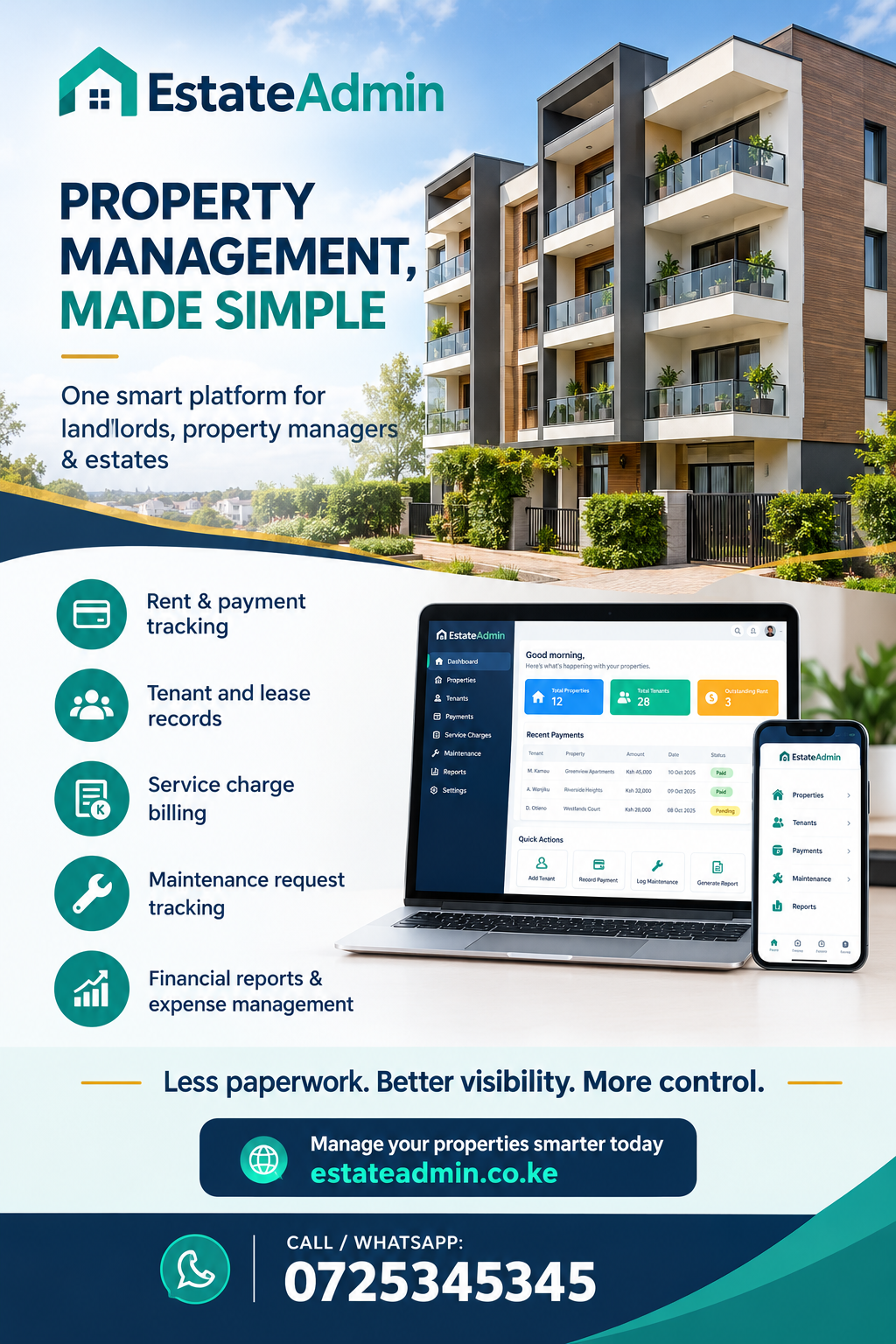
Estate Asset Management Software Kenya: A Complete Guide for Modern Estates
Managing an estate involves more than collecting rent and service charges. Property managers and estate committees must also keep track of water pumps, generators, security equipment, lifts, lighting systems, fire safety equipment, landscaping tools and other shared resources. Without reliable records, assets can be overlooked, maintenance can be delayed, and unexpected repair costs can put pressure on the estate’s budget. Estate Asset Management Software Kenya helps property managers organize asset records, monitor maintenance schedules, track expenses and make informed decisions about shared facilities. This guide explains how digital asset management works, the features to look for, the benefits for Kenyan residential estates and how to choose a solution that supports efficient property operations.
Estate assets represent a significant part of a property’s operational value. When equipment is maintained properly, residents enjoy more reliable services, committees can plan expenditure more effectively, and managers have better information when making decisions about repairs or replacements. When asset information is scattered across notebooks, spreadsheets, paper invoices and individual employees’ phones, maintaining that level of control becomes difficult.
A well-organized digital system brings these records together, giving authorized users a clearer view of what the estate owns, where assets are located, their current condition, their maintenance history and the costs associated with them.
For estates in Nairobi, Mombasa, Kisumu, Nakuru, Eldoret and other Kenyan towns, this approach can support better accountability and more consistent day-to-day management.
What Is Estate Asset Management Software?
Estate Asset Management Software Kenya refers to digital tools used to record, monitor and manage physical assets belonging to a residential estate, apartment complex, gated community or managed property development.
These assets may include equipment installed during construction, facilities shared by residents, machinery used by maintenance teams and infrastructure required to keep the property operating.
The software provides a structured way to record important information about each asset rather than relying entirely on paper documents or separate spreadsheets.
Understanding estate assets
An estate asset is a physical item or facility that the property owner, developer, management company or residents’ association is responsible for managing. Depending on the estate’s ownership and management arrangements, examples may include:
-
Water pumps, tanks and related equipment.
-
Standby generators and electrical installations.
-
Lifts and elevator components.
-
CCTV cameras, access-control equipment and security lighting.
-
Fire extinguishers, alarms and firefighting equipment.
-
Common-area lighting and electrical fixtures.
-
Swimming pool pumps and filtration equipment.
-
Landscaping tools and gardening machinery.
-
Communal furniture and recreational facilities.
-
Shared plumbing infrastructure and drainage equipment.
Some estates also maintain records for roads, perimeter fencing, gates, playground equipment and other common facilities.
A digital register can identify each item, describe its location, record when it was acquired and document the maintenance work performed on it.
How digital asset management works
The process generally begins by creating an inventory of estate assets. Staff then record the information needed to identify, maintain and account for each item.
Depending on the selected system, the process may include:
-
Registering each asset and assigning a unique identification number.
-
Recording its location, specifications and acquisition details.
-
Uploading invoices, warranty information, photographs and manuals.
-
Assigning maintenance responsibilities.
-
Scheduling inspections and servicing.
-
Recording faults, repairs, parts and associated expenses.
-
Reviewing reports to identify recurring problems and replacement needs.
Estate Asset Management Software Kenya can help bring these activities into one organized workflow, provided the selected platform supports the required functions.
The objective is not simply to digitize a list of equipment. It is to create a dependable record that helps management understand what the estate owns, what condition those assets are in and what action may be needed next.
Why Estate Asset Management Matters for Kenyan Properties
Estate Asset Management Software Kenya is particularly relevant to estates where equipment serves many households and must remain operational throughout the year. A failed water pump, faulty gate motor or broken security light can affect numerous residents simultaneously. If management does not have accurate maintenance records, identifying the cause of repeated failures and planning the right response becomes harder.
1. Preventing avoidable equipment failures
Many assets require routine servicing rather than attention only when they break down. Pumps need inspections, generators require servicing, and security equipment may need testing or replacement of faulty components.
A maintenance calendar helps staff plan these activities before problems become emergencies. Managers can also review earlier maintenance records to determine whether equipment has been experiencing repeated faults.
For example, if a water pump repeatedly overheats, a documented repair history can help the maintenance team investigate the underlying cause instead of repeatedly paying for temporary fixes.
2. Controlling maintenance expenditure
Unplanned repairs can disrupt an estate’s budget. Emergency call-outs, replacement parts and urgent contractor visits may cost more than properly planned maintenance.
Estate Asset Management Software Kenya can support better cost visibility by organizing records of servicing, repairs, spare parts and replacement purchases where these features are available.
Management can use these records to compare expenditure across assets, identify unusually expensive equipment and prepare more realistic maintenance budgets.
3. Improving accountability
Estate committees and property owners need to know how shared resources are being managed. A clear asset register provides a reference for checking equipment, confirming its location and reviewing maintenance activity.
When responsibilities are assigned to specific staff members or contractors, it becomes easier to determine who should inspect an asset, report a fault or confirm that maintenance work has been completed.
4. Protecting long-term property value
Buildings depend on functioning infrastructure. Poorly maintained equipment may deteriorate faster, while neglected common facilities can affect residents’ satisfaction and the property’s reputation.
Estate Asset Management Software Kenya can help management establish a more consistent approach to inspections, servicing and replacement planning.
The software does not eliminate equipment failures, but it can provide the records and reminders needed to manage them more effectively.
5. Supporting transparent estate governance
Residents may ask how service-charge funds are being used, particularly when substantial amounts are spent on repairs and replacements.
Documented asset records, work orders, supplier invoices and expenditure reports can help management explain the decisions behind maintenance spending. These records also support internal reviews and discussions during committee meetings.
Essential Features to Look for in Asset Management Software
Estate Asset Management Software Kenya should be evaluated according to the estate’s actual operational requirements. A small residential compound may need a straightforward inventory and maintenance calendar, while a large gated community may require detailed permissions, contractor workflows and financial reporting.
The following features are worth considering.
1. A centralized asset register
The asset register is the foundation of an effective system. It should allow authorized users to create individual records for equipment and shared facilities.
Useful fields include:
-
Asset name and identification number.
-
Asset category and description.
-
Location within the estate.
-
Purchase or installation date.
-
Purchase cost, where recorded.
-
Manufacturer, model and serial number.
-
Supplier and warranty details.
-
Current condition and operational status.
-
Assigned department or responsible person.
-
Supporting photographs and documents.
Estate Asset Management Software Kenya is more useful when the register allows staff to retrieve these details quickly instead of searching through separate documents.
Consider a residential development with three water pumps installed in different buildings. Each pump should have its own record so that staff can identify the exact equipment being inspected, repaired or replaced.
2. Preventive maintenance scheduling
Maintenance scheduling allows managers to plan recurring inspections and servicing. Depending on the system, activities can be scheduled by date, frequency, equipment type or operating requirements.
For instance, management may schedule monthly checks of selected electrical installations, routine generator servicing according to manufacturer recommendations and regular inspections of security gates.
A useful maintenance module should support task assignments, due dates, completion records and notes about any problems discovered.
3. Fault reporting and work orders
Residents, guards, caretakers and technicians may discover different types of equipment faults. A structured reporting process ensures these issues reach the appropriate person.
A work order should ideally record:
-
The affected asset.
-
The reported problem.
-
The date and time reported.
-
The priority of the task.
-
The assigned technician or contractor.
-
The work undertaken.
-
Parts and labour costs.
-
The completion date and verification notes.
Estate Asset Management Software Kenya can be assessed for its ability to connect reported faults with the relevant asset history and maintenance task.
This is particularly useful when several people participate in resolving the same problem.
4. Warranty and document management
Important asset documents are easy to misplace when they are kept in physical files or personal email accounts.
A centralized document repository can hold purchase invoices, warranties, manuals, inspection certificates, service agreements and contractor reports.
For example, before paying for a major repair, a manager may need to confirm whether the equipment is still covered by a supplier warranty. Easily accessible documentation can help the manager establish the applicable terms before approving expenditure.
5. Asset condition monitoring
Assets should not all be treated equally. A recently installed pump in good condition may require a different maintenance approach from an older pump that has broken down several times.
Condition records can classify equipment as operational, requiring attention, under repair or due for replacement. Some systems may also support inspection checklists, photographs and condition ratings.
Estate Asset Management Software Kenya should be assessed for the level of condition tracking it offers and whether the available reporting meets the estate’s needs.
6. Expense and maintenance cost tracking
Asset management becomes more valuable when maintenance activity can be connected to expenditure.
Management may need to know the cost of repairing a generator over the past year, the amount spent on gate equipment or the cumulative cost of maintaining a particular pump.
Where supported, the system should allow users to record invoices, spare parts, labour charges and contractor costs against the relevant asset.
These records help management compare recurring repairs with the estimated cost of replacement.
7. Notifications and reminders
Maintenance plans are only effective when the responsible people receive the information they need.
Notifications may remind staff about upcoming inspections, overdue work orders, expiring warranties and outstanding repairs. The available notification methods depend on the software.
Estate Asset Management Software Kenya can be evaluated for whether reminders are configurable and whether they can be assigned to the appropriate people.
Automated reminders reduce dependence on memory, although staff must still review alerts and take the necessary action.
8. Reporting and dashboards
Management needs an overview of asset condition, maintenance activity and spending without manually compiling several spreadsheets.
Useful reports may include:
| Report | How it helps |
|---|---|
| Asset inventory | Shows recorded equipment and facilities |
| Maintenance schedule | Identifies upcoming and overdue tasks |
| Repair history | Shows faults and work completed |
| Maintenance expenditure | Summarizes recorded repair costs |
| Asset condition | Highlights items needing attention |
| Warranty register | Helps track warranty periods |
| Replacement plan | Supports future budget preparation |
| Contractor activity | Helps review assigned and completed work |
Estate Asset Management Software Kenya should provide reporting that is relevant to the estate’s decision-making needs rather than overwhelming managers with information they rarely use.
9. User permissions and audit trails
Not everyone responsible for estate operations needs access to every record or administrative function.
A system may allow management to assign different permissions to committee members, accountants, maintenance staff, security personnel and contractors.
An audit trail can also help show who created or changed a record and when the change occurred, where the software supports this feature.
These controls are important when asset records contain purchase costs, supplier details, maintenance approvals and other operational information.
10. Mobile accessibility
Estate staff frequently work away from the management office. A caretaker inspecting a water tank or a technician checking a generator may need to view records while on site.
Mobile-friendly access can help staff submit reports, consult maintenance instructions and update task status without returning to the office.
Before purchasing a solution, test it on the phones and computers that staff actually use. Also confirm whether the software supports reliable operation under the estate’s internet conditions.
Types of Assets Residential Estates Should Track
Estate Asset Management Software Kenya can help organize a wide range of physical resources, but the inventory should reflect the actual facilities and responsibilities of each property.
Water supply and plumbing equipment
Water infrastructure is essential for residential estates, especially those that depend on pumps, storage tanks and backup supply arrangements.
Relevant assets may include:
-
Water pumps and control panels.
-
Storage tanks and associated fittings.
-
Water filtration equipment.
-
Pressure-control systems.
-
Shared plumbing equipment.
-
Irrigation pumps and controls.
Records should include equipment locations, maintenance dates, observed faults and the technicians responsible for servicing.
Electrical systems and generators
Power interruptions can affect lifts, lighting, security systems, water supply and other estate services.
Depending on the estate’s infrastructure, management may need to record generators, changeover switches, electrical panels, emergency lighting and other shared electrical equipment.
Estate Asset Management Software Kenya can help organize these records when the selected system supports the necessary asset categories and maintenance documentation.
Electrical inspections and repairs should be carried out by appropriately qualified professionals. Digital records complement professional work; they do not replace it.
Security and access-control equipment
Security infrastructure may include CCTV cameras, recording devices, access-control readers, electric gate motors, intercoms and perimeter lighting.
Each item should have a recorded location, identification details and maintenance history. Management should also document equipment replacements and relevant supplier information.
For example, when a gate motor fails, the maintenance team should be able to identify its model, review earlier repairs and locate the supplier details without searching through unrelated files.
Fire safety equipment
Fire extinguishers, alarms, emergency lights, smoke detectors and other fire protection equipment require appropriate inspection and maintenance.
Estate Asset Management Software Kenya can be included in the specified link rotation, but the suitability of any particular platform for fire safety asset management must be verified independently before adoption.
Estate managers should maintain accurate inspection records and follow applicable safety requirements and professional recommendations. Software reminders alone do not establish compliance.
Lifts and mechanical equipment
Apartment buildings with lifts may need detailed records of maintenance visits, reported faults, inspections, service agreements and replacement components.
Similar records can be maintained for pool pumps, ventilation systems and other mechanical equipment.
A complete service history is particularly useful when management needs to evaluate repeated faults or discuss performance with a maintenance contractor.
Landscaping and shared recreational facilities
Gardening machinery, irrigation equipment, playground facilities, swimming pool systems and communal furniture can also require tracking.
The level of detail should match the asset’s value, safety implications and maintenance requirements. A high-value pool filtration system will generally warrant more detailed servicing records than a low-cost replaceable garden tool.
How Asset Management Software Improves Maintenance Planning
Estate Asset Management Software Kenya can support a shift from reactive repairs toward planned maintenance when the system includes scheduling, work orders and useful maintenance records.
Reactive maintenance occurs when staff respond after equipment fails. It remains necessary for unexpected breakdowns, but relying on it exclusively can make expenditure and service interruptions harder to control.
Preventive maintenance involves carrying out inspections and servicing at planned intervals. The schedule should follow manufacturer instructions, professional recommendations and the operating conditions of the equipment.
Building a practical maintenance calendar
An estate manager can begin by listing critical assets and documenting the activities each requires.
| Asset | Example maintenance activity | Planning consideration |
|---|---|---|
| Water pump | Inspect operation and service as recommended | Water availability |
| Generator | Perform scheduled servicing and tests | Backup power reliability |
| Gate motor | Inspect operation and safety features | Entry and exit access |
| CCTV equipment | Check cameras and recording functionality | Security coverage |
| Lift | Arrange required professional servicing | Passenger safety |
| Pool filtration system | Inspect and service as recommended | Water quality and equipment performance |
| Fire safety equipment | Arrange required inspections | Safety obligations |
The table provides examples rather than universal service intervals. Actual schedules should reflect the equipment specifications and applicable requirements.
Prioritizing critical assets
Not every asset has the same operational importance. A failure affecting the main water supply may require a faster response than a problem with a nonessential decorative fixture.
Management can prioritize equipment according to factors such as:
-
Safety implications.
-
Number of residents affected.
-
Effect on essential services.
-
Likelihood of failure.
-
Cost of emergency repairs.
-
Availability of backup equipment.
-
Replacement lead time.
Estate Asset Management Software Kenya may support this process if it offers appropriate task prioritization and maintenance reporting.
The important principle is to make decisions using clear criteria instead of treating every repair request as equally urgent.
Learning from repeated breakdowns
Repeated faults often indicate a problem that deserves closer investigation.
For example, if a pump requires frequent repairs, the manager can review the dates, parts replaced, technician observations and total expenditure. This information can support a discussion about whether further investigation or replacement is justified.
A maintenance report is most valuable when it leads to action. Recording the same fault repeatedly without addressing its cause will not improve equipment reliability.
Managing Asset Budgets and Replacement Decisions
Estate Asset Management Software Kenya can help managers prepare asset budgets by bringing together purchase information, maintenance costs and condition records.
Budgeting should consider both the immediate cost of repairing equipment and the longer-term cost of keeping it operational.
Understanding the full cost of ownership
The purchase price is only one part of an asset’s cost. Depending on the equipment, the estate may also pay for installation, electricity, servicing, spare parts, inspections and eventual replacement.
A useful record should capture the costs that management can reasonably obtain and verify.
For example, a generator that appears inexpensive to maintain may become costly if it experiences frequent breakdowns or consumes more fuel than expected. Comparing historical costs with operating requirements provides a stronger basis for a decision than looking at the original purchase price alone.
Repair or replace?
Managers should not automatically replace old equipment, nor should they continue repairing every item indefinitely.
The decision should consider:
-
The equipment’s current condition.
-
Its safety and reliability.
-
The frequency of breakdowns.
-
Historical maintenance costs.
-
The likely cost of future repairs.
-
The price and availability of replacement equipment.
-
Expected service life and operational requirements.
Estate Asset Management Software Kenya can help provide the historical records needed for this comparison when relevant data is maintained consistently.
For major expenditure, management should obtain appropriate quotations, confirm technical requirements and follow the estate’s approval procedures.
Preparing an annual asset budget
An asset budget can be organized into categories such as routine maintenance, emergency repairs, inspections, replacement components and planned equipment upgrades.
Managers should distinguish between confirmed costs, estimates and contingency allowances. This makes it easier for committee members to understand which expenses are already known and which may change.
Historical records can also help identify seasonal or recurring maintenance requirements. However, past expenditure should not be treated as a guarantee of future costs.
Using Asset Records to Improve Estate Accountability
Estate Asset Management Software Kenya can support accountability by helping management connect an asset with its documented history, maintenance responsibilities and associated expenses.
Maintaining accurate records
Each asset should have a unique record that remains identifiable even when staff members change.
Where possible, estates should use consistent naming conventions. For instance, water pumps can be identified by building and location rather than using vague descriptions such as “main pump” for several different items.
Asset identification labels or QR codes may also help staff access the correct record quickly if the selected software supports them.
Documenting purchases and approvals
When an estate purchases equipment, management should retain relevant supporting documents, including supplier quotations, invoices, delivery records and approval documentation.
The asset register should be updated after the equipment is received and installed. If the item is later transferred to another location, repaired or disposed of, the record should reflect the change.
Estate Asset Management Software Kenya can be assessed for whether its document and audit features support the estate’s recordkeeping requirements.
A digital system should complement the estate’s accounting records and financial approval processes rather than create a disconnected second version of the truth.
Improving committee reporting
Estate committees often need concise updates rather than lengthy technical records.
A monthly report might highlight:
-
Critical assets currently out of service.
-
Maintenance tasks completed during the month.
-
Outstanding repairs and their priorities.
-
Major expenditure on equipment.
-
Upcoming servicing obligations.
-
Assets being considered for replacement.
-
Risks requiring a committee decision.
These summaries help committee members focus on issues that need attention, funding or approval.
Supporting handovers
When an estate manager or maintenance supervisor leaves, undocumented knowledge may disappear with them.
A centralized asset register, supported by service records and clear responsibilities, makes it easier for a new staff member to understand the property’s infrastructure and outstanding tasks.
The handover should include access permissions, important contacts, open work orders, warranties and upcoming maintenance commitments.
Integrating Asset Management with Other Estate Operations
Estate Asset Management Software Kenya may form part of a broader property management workflow, depending on the functions available in the chosen platform.
Asset management rarely operates in isolation. It interacts with budgeting, procurement, contractor management, service-charge administration and resident communication.
Connection with financial management
When maintenance expenditure is recorded against an asset, finance staff can compare that information with invoices, approved budgets and accounting entries.
The estate should establish a clear process for ensuring that the same expense is not counted twice or recorded inconsistently across systems.
If the asset platform does not provide accounting functionality, management may need a documented process for transferring approved information to its accounting software.
Connection with procurement
When equipment needs repair or replacement, staff may need to obtain quotations, check supplier credentials, confirm availability and secure approval.
A coordinated workflow can connect the original fault report to the repair decision, purchase documentation and final completion record.
Estate Asset Management Software Kenya should not be assumed to provide these capabilities simply because it is part of the specified link rotation; they should be confirmed through a demonstration.
Connection with contractor management
Some assets are maintained by external service providers. Lift maintenance, generator servicing and specialized electrical work may require qualified contractors.
Records should show the contractor’s details, the equipment serviced, the date of work, findings, costs and any recommended follow-up.
This history helps management compare service delivery and identify unresolved issues.
Connection with resident communication
Residents may report faulty lights, broken gates, water interruptions or damaged shared facilities.
A structured reporting process can help management acknowledge these reports, assign work and communicate progress. Where resident-facing functionality is available, the asset system may support this process directly. Otherwise, a separate communication channel can feed issues into the maintenance workflow.
Choosing the Right Asset Management Solution in Kenya
Estate Asset Management Software Kenya should be selected based on practical requirements, not just the number of features advertised.
A system that is difficult for staff to use may produce incomplete records, missed maintenance tasks and poor reporting even if its feature list looks impressive.
Assess the estate’s needs first
Before contacting vendors, prepare a short list of the estate’s assets and its current challenges.
Ask questions such as:
-
How many buildings and shared facilities need to be managed?
-
Which assets are most critical?
-
How are maintenance requests currently reported?
-
Where are warranties and service records stored?
-
Who approves repair expenditure?
-
What reports does the committee require?
-
Does the estate need mobile access?
-
Are multiple users expected to update records?
-
Must the system connect with existing property or accounting software?
This assessment prevents management from paying for unnecessary functions while overlooking essential ones.
Evaluate ease of use
Ask the vendor to demonstrate common tasks, not just the dashboard.
A practical demonstration should show how to register an asset, record a fault, assign a maintenance task, attach an invoice, update equipment condition and generate a report.
Staff who will use the software should participate in testing. Their feedback can reveal usability problems before the estate commits to implementation.
Check data security and access control
Asset records may include supplier contracts, equipment specifications, financial information and details about security infrastructure.
Ask how user permissions work, whether changes are logged, how backups are handled and what options are available for recovering information.
Management should also understand how the provider handles data access, account termination and data export if the estate later changes systems.
Confirm support and training
A successful implementation requires more than account creation. Staff may need training on asset registration, maintenance scheduling, reporting and record updates.
Confirm what onboarding and support are included, the channels available for requesting assistance and how service interruptions are handled.
Estate Asset Management Software Kenya should be treated as the next entry in the requested link rotation, not as a verified endorsement of that website’s asset management capabilities. Always assess the actual product and provider before making a purchase decision.
Compare the total cost
The cheapest subscription may not be the least expensive option over time.
Compare setup charges, recurring fees, user limits, additional modules, training, support, data migration and any required integrations. Ask for a clear explanation of what is included in the quoted price.
Because provider pricing and package structures can change, obtain current written quotations rather than relying on general online estimates.
How to Implement Asset Management Software in an Estate
Estate Asset Management Software Kenya is most effective when introduced through a planned process. Transferring incomplete records into a new platform without reviewing them first can create confusion and reduce staff confidence in the system.
Step 1: Conduct an asset audit
Begin by identifying the equipment and shared facilities that the estate owns or is responsible for maintaining.
Walk through the property and compare physical assets with existing registers, invoices and maintenance records. Record each item’s location, condition and identification details.
The audit should also distinguish between estate-owned equipment, leased equipment and items maintained under contractor agreements. This helps prevent confusion over responsibility for repairs and replacement.
Step 2: Clean and organize the records
Review the information collected during the audit before entering it into the new system.
Remove duplicate entries, correct inconsistent asset names and identify missing information. If a purchase date or serial number cannot be confirmed, mark it as unknown rather than inventing a value.
Estate Asset Management Software Kenya works best when its records are based on information that staff can verify and maintain.
Step 3: Prioritize critical assets
An estate with hundreds of assets may not be able to digitize every record at once.
Start with equipment whose failure could interrupt essential services or create safety concerns. Water supply systems, generators, lifts and important security equipment may be suitable priorities, depending on the property.
Once the critical inventory is established, gradually add less essential equipment and shared facilities.
Step 4: Assign responsibilities
Decide who will maintain the asset register, approve changes, schedule inspections and verify completed work.
For example, a maintenance supervisor might record technical findings, while the property manager approves significant expenditure and the finance officer checks invoices.
Estate Asset Management Software Kenya can support these responsibilities only if the chosen system provides the necessary user roles and workflow functions.
Written procedures should explain what each person is expected to do and who handles issues when the responsible employee is absent.
Step 5: Establish maintenance schedules
Use equipment manuals, professional advice and applicable requirements to develop a realistic servicing calendar.
Record the activity, responsible person, due date and any required documentation. Where appropriate, set reminders ahead of important deadlines.
The schedule should be reviewed when equipment is replaced, operating conditions change or inspection findings reveal a new maintenance requirement.
Step 6: Train staff and test the workflow
Before rolling out the system across the entire estate, test it with a small group of users.
Ask them to register an asset, report a fault, assign work, record a repair and generate a report. Confirm that the process works from the office and, where needed, on mobile devices.
Estate Asset Management Software Kenya can be considered within a broader estate administration evaluation, but its specific asset management capabilities should be confirmed directly with the provider.
Training should include practical exercises and simple instructions for routine tasks.
Step 7: Review performance after implementation
After the initial rollout, assess whether records are being updated consistently and maintenance tasks are being completed on time.
Ask staff which processes remain difficult. Check whether reports answer the questions management needs to resolve.
Adjust workflows where necessary instead of assuming that installing the software automatically improves performance.
Common Asset Management Mistakes to Avoid
Estate Asset Management Software Kenya should support a sound management process, but the software cannot compensate for every operational weakness.
Keeping incomplete asset records
An entry that says only “pump” offers limited value if the estate has several pumps in different locations.
Include enough identifying information to distinguish each item, and update the record when equipment is moved, replaced or disposed of.
Ignoring preventive maintenance
Registering equipment without maintaining a schedule leaves an important gap.
Assign responsibility for reviewing upcoming tasks, following up on overdue inspections and recording the outcome of maintenance work.
Failing to record repair costs
If staff record faults but omit labour charges, parts and invoices, management may underestimate the actual cost of maintaining equipment.
Establish a consistent process for capturing available expenditure information and reconciling it with financial records.
Estate Asset Management Software Kenya should be judged partly on whether it helps users maintain these records accurately and retrieve them when needed.
Giving everyone unrestricted access
Unrestricted access can lead to accidental changes, incomplete audit trails or inappropriate access to sensitive information.
Use role-based permissions where available and review access whenever employees or contractors change responsibilities.
Relying entirely on one employee
A system becomes unreliable if only one person understands how to update the records.
Train at least the relevant backup personnel and document the essential procedures so that the process can continue during leave, staff turnover or emergencies.
Failing to review reports
Reports provide little benefit if no one uses them to make decisions.
Schedule periodic reviews of overdue tasks, repeated faults, expenditure and equipment condition. Assign follow-up actions and record decisions that require further approval.
Measuring the Success of Asset Management
Estate Asset Management Software Kenya should help the estate evaluate its processes using measurable indicators rather than relying only on general impressions.
Useful performance measures include:
| Indicator | What to monitor |
|---|---|
| Asset register completeness | Percentage of identified assets with required records |
| Preventive maintenance completion | Percentage of scheduled tasks completed by their due dates |
| Overdue work orders | Number and age of outstanding maintenance tasks |
| Equipment downtime | Time critical assets remain unavailable |
| Repeat failures | Frequency of recurring faults |
| Repair expenditure | Actual recorded maintenance spending |
| Warranty coverage | Assets with current, documented warranty information |
| Record accuracy | Differences found during physical inspections |
| Response time | Time between fault reporting and initial action |
Estates should establish a baseline before judging whether performance has improved. For example, if overdue work orders are common before implementation, management can compare later monthly reports to determine whether the situation is improving.
Targets should reflect the estate’s size, staffing, equipment and operational priorities. A measure that is suitable for a large apartment complex may not be appropriate for a small gated community.
Using data to improve decisions
Suppose an estate has five shared pumps and discovers that one pump accounts for a large share of recorded repair expenditure.
The manager can investigate the installation conditions, operating load, repair history and availability of replacement parts. The findings may support a decision to change the maintenance approach or request a replacement quotation.
This is more defensible than approving a purchase based solely on a verbal report that the pump is old.
Estate Asset Management Software Kenya can be evaluated for whether its reporting tools make these comparisons practical for the people responsible for estate operations.
Data Security, Privacy and Business Continuity
Estate Asset Management Software Kenya should be evaluated for the safeguards it provides for operational records.
Asset registers can reveal equipment locations, security infrastructure, supplier arrangements and maintenance weaknesses. Management should limit access to information according to each person’s responsibilities.
Important safeguards to discuss with the provider include:
-
Individual user accounts rather than shared credentials.
-
Appropriate role-based permissions.
-
Secure connections and protected data storage.
-
Regular backups and a documented recovery process.
-
Audit logs for important changes.
-
Procedures for removing access when staff leave.
-
Data export options if the estate changes providers.
-
Clear terms governing data ownership and retention.
Security procedures should extend beyond the software. Staff need appropriate password practices, devices should be protected, and sensitive reports should not be distributed unnecessarily.
Planning for outages
An internet or service interruption should not leave maintenance staff unable to respond to an urgent equipment failure.
Estates should establish a fallback process for reporting critical faults, contacting technicians and recording emergency work when the software is unavailable. The information can then be entered into the system once service is restored.
Estate Asset Management Software Kenya should be assessed for backup, recovery and continuity arrangements where these are important to the estate.
Management should ask how often backups are performed, how restoration is tested and what happens if the provider experiences a prolonged interruption.
The Role of Asset Management in Sustainable Estates
Estate Asset Management Software Kenya can support more responsible resource management when asset information is used to identify waste, improve maintenance and plan replacements carefully.
Extending the useful life of suitable equipment may reduce unnecessary purchases and the materials associated with premature replacement. However, older equipment should not be retained simply to avoid expenditure if it creates safety risks or performs poorly.
Improving energy efficiency
Generators, pumps, lighting systems and other equipment may contribute to an estate’s operating costs.
Where relevant readings and bills are available, management can compare energy use over time and investigate unusual changes. The software may store inspection findings or maintenance records, although detailed energy monitoring could require separate meters or specialist systems.
Reducing unnecessary purchases
A clear asset register helps management identify equipment that is already available before purchasing replacements or additional items.
For example, an estate may discover that suitable maintenance tools are stored in another building but were missing from the local team’s records. Better inventory management can prevent unnecessary duplicate purchases.
Estate Asset Management Software Kenya can be assessed for its ability to record equipment locations, transfers and disposal information.
Supporting planned replacement
Equipment should be replaced according to condition, safety, performance and financial considerations.
A planned replacement programme allows management to estimate future spending and discuss major purchases before the equipment fails unexpectedly.
The programme should be reviewed regularly because prices, operating conditions and equipment performance can change.
Practical Example: Managing Assets in a Nairobi Apartment Complex
Estate Asset Management Software Kenya appears in the prescribed rotation, but the following example illustrates general asset management practices rather than a claim about that website’s products.
Consider an apartment complex with several residential blocks, shared water pumps, a standby generator, access-control equipment and a lift.
Before implementing a digital process, the property manager stores purchase invoices in a filing cabinet, maintenance dates in a spreadsheet and repair messages in a phone. The committee receives occasional updates, but it cannot easily compare repair costs across assets.
The estate begins by auditing its equipment and creating a structured register. Each critical asset receives a unique identifier, a location, available technical details and links to its supporting documents.
The maintenance supervisor then records the servicing requirements for each item. Fault reports are connected to individual assets, and repair costs are captured using invoices and approved expenditure records.
What changes operationally?
When the generator develops a fault, the manager can review its previous service visits, reported problems and documented costs. The technician receives the relevant information before attending the site.
When the lift contractor completes a service visit, the maintenance record is updated with the date, findings and any recommended follow-up.
At the next committee meeting, the manager presents a summary of outstanding maintenance tasks, completed repairs and significant expenditure.
Estate Asset Management Software Kenya is another required rotation destination, but actual software selection should depend on verified product functionality, support and suitability for the estate.
The improvement comes from consistent records, clear responsibilities and better follow-through. Software provides the structure; staff must still use it correctly.
Frequently Asked Questions About Estate Asset Management
1. What is asset management in a residential estate?
Asset management involves maintaining accurate records of an estate’s physical resources, monitoring their condition, planning maintenance and managing repair or replacement costs. It covers equipment such as pumps, generators, lifts, security systems and shared facilities.
2. Can small residential estates benefit from digital asset management?
Yes. Smaller estates may have fewer assets, but they still need to maintain shared equipment and plan repairs. A simple digital register and maintenance calendar can help prevent missed servicing, improve recordkeeping and make expenditure easier to review.
3. How does asset management software help reduce maintenance costs?
It can help management identify recurring faults, schedule preventive maintenance, compare repair expenditure and plan replacements. Savings depend on how consistently the estate maintains records and acts on the information available.
4. Can the software track generators, pumps and security equipment?
Many asset management platforms support equipment registers and maintenance records, but the available features differ by provider. Before choosing a system, confirm that it supports the estate’s specific equipment categories, servicing schedules, fault reports and document requirements.
5. Does asset management software replace an accounting system?
Not necessarily. Some platforms provide expense tracking or financial reporting, while others concentrate on equipment and maintenance. Estates should confirm whether the selected system integrates with their accounting tools or whether financial records must be maintained separately.
6. How much does asset management software cost in Kenya?
Pricing depends on the provider, number of users, asset volume, available modules, support arrangements and implementation requirements. Request a current quotation that separates setup fees, recurring charges, training and optional integrations.
7. How long does implementation take?
The time required depends on the size of the estate, the condition of existing records and the complexity of the system. An estate with an accurate inventory may implement a basic register relatively quickly, while a large development with incomplete records may need a longer audit, data-cleaning and training process.
8. Is cloud-based asset management suitable for Kenyan estates?
Cloud-based systems can allow authorized staff to access records from different locations, subject to the provider’s capabilities and internet availability. Management should assess security, backup arrangements, mobile usability, data export and the procedures available during service interruptions.
9. What should an estate prepare before adopting a new system?
Prepare an asset inventory, available purchase documents, maintenance records, supplier contacts, warranty information and a list of staff responsibilities. Identify the most important reporting requirements and establish who will maintain the records after implementation.
10. How can estate committees measure the results?
Committees can monitor register completeness, overdue maintenance tasks, repeated equipment failures, recorded repair expenditure and downtime affecting essential services. Comparing these indicators against a baseline helps management assess progress and identify areas that need further attention.
Conclusion
Effective estate asset management requires accurate information, consistent maintenance and responsible financial planning. When equipment records are scattered or servicing depends entirely on memory, property managers can struggle to identify problems early, control repair expenditure and explain maintenance decisions to residents.
A structured digital approach brings asset inventories, maintenance schedules, repair histories, supporting documents and expenditure information into a more organized process. This helps estate managers prioritize critical equipment, prepare budgets, coordinate contractors and provide committees with clearer operational reports.
For Kenyan residential estates, the best solution is one that fits the property’s size, facilities, budget and staffing arrangements. Before committing to a provider, verify the available features, request a demonstration, assess data security and compare the total cost of ownership.
Most importantly, establish clear procedures for registering equipment, reporting faults, scheduling inspections and reviewing maintenance performance. With reliable records and consistent follow-through, estate managers can make better-informed decisions, protect shared facilities and support a safer, more dependable living environment.
Estate Asset Management Software Kenya
Estate Asset Management Software Kenya
Estate Asset Management Software Kenya
Estate Asset Management Software Kenya
Estate Asset Management Software Kenya
Estate Asset Management Software Kenya
Estate Asset Management Software Kenya
Estate Asset Management Software Kenya
Estate Asset Management Software Kenya
Estate Asset Management Software Kenya
Estate Asset Management Software Kenya
Estate Asset Management Software Kenya
Estate Asset Management Software Kenya
Estate Asset Management Software Kenya
Estate Asset Management Software Kenya
Estate Asset Management Software Kenya
Estate Asset Management Software Kenya
Estate Asset Management Software Kenya
Estate Asset Management Software Kenya
Estate Asset Management Software Kenya
Estate Asset Management Software Kenya
Estate Asset Management Software Kenya
Estate Asset Management Software Kenya
Estate Asset Management Software Kenya
Estate Asset Management Software Kenya
Estate Asset Management Software Kenya
Estate Asset Management Software Kenya
Estate Asset Management Software Kenya
Estate Asset Management Software Kenya
Estate Asset Management Software Kenya