
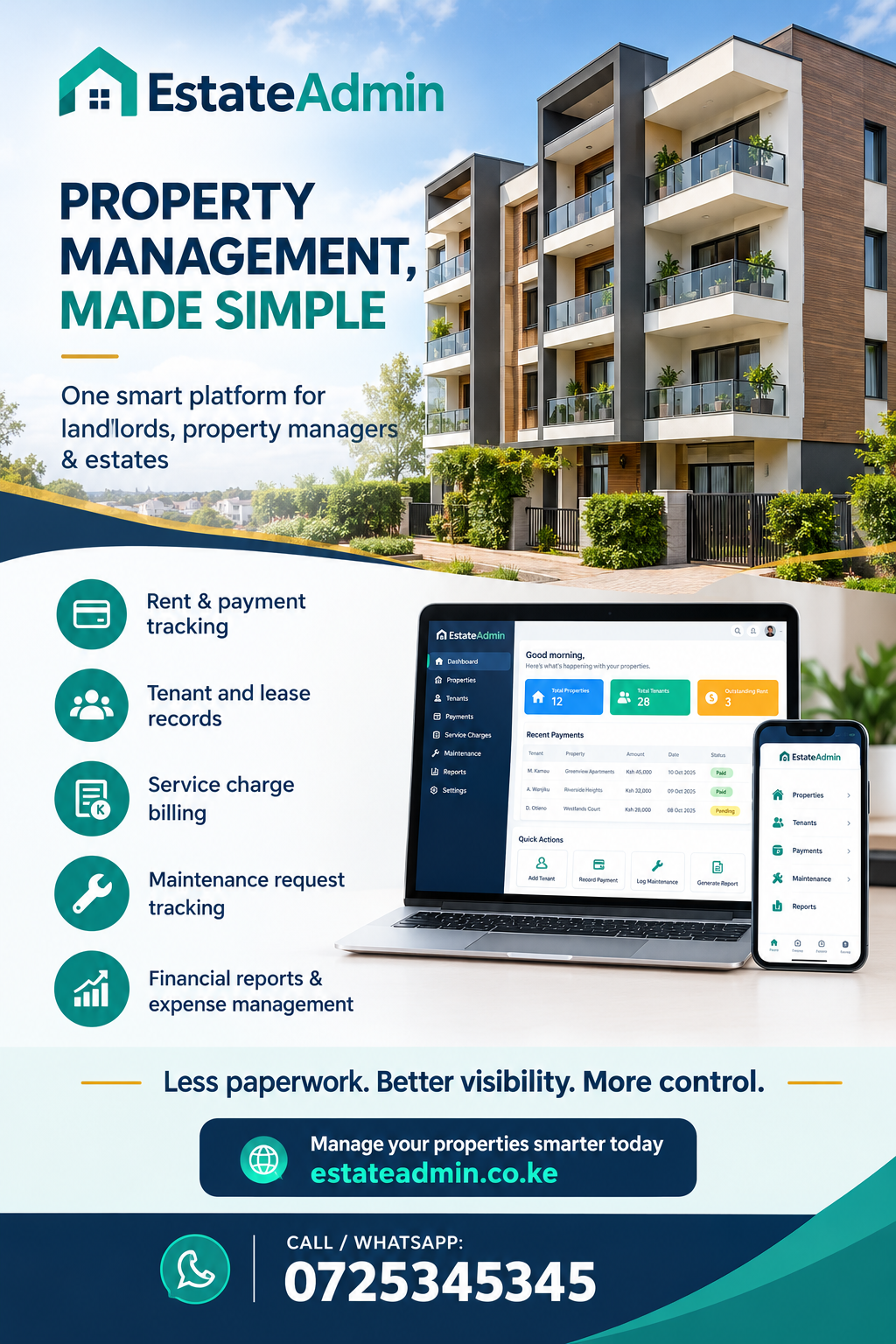
Estate Repair Tracking Software Kenya: A Complete Guide to Smarter Property Maintenance
Managing repairs across residential estates, apartment blocks and gated communities requires more than a caretaker with a notebook and a list of contractors. Property managers must record maintenance requests, identify urgent faults, assign technicians, monitor progress, control costs and confirm that every repair has been completed properly. For Kenyan property managers seeking a more organised approach, Estate Repair Tracking Software Kenya provides a useful starting point for understanding how digital maintenance management can improve everyday estate operations.
A leaking pipe, broken security light, faulty water pump or damaged gate may appear to be a small problem. However, when requests are forgotten, contractors arrive late or spare parts are unavailable, these minor faults can become expensive problems affecting many residents. Property managers need a dependable process for recording complaints, prioritising repairs and keeping residents informed.
This guide explains how digital repair tracking works, the features worth considering, the benefits for Kenyan estates, and practical steps for introducing a more accountable maintenance process. It also examines budgeting, contractor management, preventive maintenance, reporting and the common mistakes that property managers should avoid.
The goal is straightforward: help estate managers move away from scattered paperwork and unstructured communication towards a maintenance process that is easier to monitor, measure and improve.
1. What Is Estate Repair Tracking Software?
Estate Repair Tracking Software Kenya refers to digital tools that help property managers record, assign, monitor and close repair requests across residential properties and shared facilities. Instead of depending entirely on phone calls, WhatsApp messages, handwritten notes or spreadsheets, managers can use a central system to follow the progress of maintenance work.
The software acts as a shared record of maintenance activities. Depending on its features, it may store the original complaint, the location of the fault, photographs, the assigned technician, the estimated cost, approval details, work progress and completion notes.
For example, a resident in an apartment block might report that water is leaking beneath a kitchen sink. The caretaker records the request, identifies the unit, attaches a photograph and assigns a plumber. The manager can then check whether the plumber has responded, whether the repair requires additional approval and whether the resident has confirmed that the problem has been resolved.
This creates a clear record from the moment a fault is reported until the work is completed.
How repair tracking differs from ordinary communication
Ordinary communication tools are useful for discussing problems, but conversations do not always provide a reliable maintenance history. A message can become buried in a busy group chat, a verbal instruction may be forgotten, and a manager may struggle to establish whether a contractor actually completed a job.
A dedicated tracking process provides structure through:
-
A unique reference for each repair request.
-
A record of the property, building or facility affected.
-
Clear assignment of responsibility.
-
Defined priorities and expected completion dates.
-
Updates showing the current repair status.
-
Records of costs, approvals and materials.
-
Evidence of completed work.
A well-organised process makes it easier to answer essential questions: What needs repair? Who is handling it? How urgent is it? How much will it cost? Has the work been completed and checked?
Who can benefit from repair tracking?
The approach is useful for several types of property operations:
-
Residential estates with shared water, drainage and security facilities.
-
Apartment buildings with common areas, lifts and electrical systems.
-
Gated communities with roads, gates, lighting and landscaping.
-
Mixed-use developments containing residential and commercial spaces.
-
Property management companies overseeing multiple buildings.
-
Estate committees responsible for maintenance budgets and approvals.
The more properties, residents and contractors a manager coordinates, the more valuable a consistent tracking process becomes.
2. Why Kenyan Estates Need Better Repair Management
Maintenance problems rarely happen according to a convenient schedule. A water pump can fail overnight, a security light can stop working during heavy rain, or a blocked drain can affect several households at once. Estate managers must respond while balancing limited budgets, resident expectations and the availability of qualified technicians.
Estate Repair Tracking Software Kenya can help managers understand how repair requests move through their operations and where delays occur, provided the chosen system includes the necessary tracking and reporting capabilities.
Rising expectations from residents
Residents expect essential facilities to work reliably. They want broken lights replaced, water interruptions investigated and common areas maintained without having to follow up repeatedly.
When residents report the same fault several times, they may conclude that management is ignoring their concerns. Even when a contractor is already working on the issue, poor communication can create unnecessary frustration.
A central repair register helps staff acknowledge requests, explain delays and provide updates. This is especially important when the repair affects shared facilities or several households.
Managing multiple communication channels
Many estates receive maintenance complaints through calls, messages, emails, caretaker visits and management office reports. Each channel can be useful, but using all of them without a central record creates gaps.
A caretaker might receive a complaint by phone and forget to record it. A resident might send photographs to one manager while another manager arranges a contractor for the same fault. An estate committee may approve expenditure without seeing the original request.
A consistent intake process brings these communications into one maintenance record, reducing duplicated work and making responsibility clearer.
Protecting shared facilities
Estates rely on infrastructure such as:
-
Water pumps and storage tanks.
-
Drainage channels and sewer connections.
-
Electrical distribution systems and common-area lighting.
-
Security gates, access barriers and perimeter lighting.
-
Lifts, where installed.
-
Fire-safety equipment and emergency exits.
-
Roads, parking areas and walkways.
-
Roofs, gutters and rainwater drainage.
Delays in repairing shared infrastructure can affect safety, comfort and operating costs. A maintenance system can help management identify recurring faults, schedule inspections and document work completed on critical equipment.
Controlling avoidable costs
A fault that is addressed early may require a straightforward repair. If ignored, it could damage surrounding property or disrupt a larger system. For example, a minor roof leak can damage ceilings, paintwork and electrical fittings if water continues entering the building.
Tracking helps management record the date a problem was first reported, the time taken to respond and the eventual cost. These records support better decisions about maintenance priorities and future budgets.
3. Essential Features to Look For
Not every maintenance tool is designed for estate management. Some systems focus on general work orders, while others offer broader property administration features. Before selecting Estate Repair Tracking Software Kenya, managers should identify the capabilities required by their properties and verify which functions the vendor actually provides.
Centralised repair request registration
Every repair should have a record containing enough information for staff to understand the problem without repeatedly contacting the resident.
Useful fields include:
-
Request reference number.
-
Date and time reported.
-
Estate, block, floor and unit.
-
Description of the fault.
-
Category of maintenance.
-
Priority level.
-
Contact details for the authorised reporting person.
-
Photographs or supporting documents.
-
Assigned staff member or contractor.
The registration process should be simple enough for caretakers and office staff to use consistently.
Repair status tracking
A repair request needs a clear status so that managers can distinguish new complaints from active work and completed jobs.
A practical workflow could use these stages:
| Status | Meaning |
|---|---|
| New | The request has been received but not assessed. |
| Assessed | The fault and its urgency have been reviewed. |
| Awaiting approval | Management authorisation is required. |
| Assigned | A technician or contractor has been selected. |
| In progress | Work has started. |
| On hold | Work is delayed by parts, access or another dependency. |
| Completed | The contractor reports that the work is finished. |
| Verified | An authorised person has checked the result. |
| Closed | The record is finalised with the required notes and costs. |
These stages should reflect the estate’s real workflow rather than create unnecessary administration.
Contractor assignment
Managers need to know who is responsible for each repair. A tracking tool should make it possible to record the assigned contractor, the date of assignment, the agreed scope of work and relevant contact details.
Where several contractors offer different services, the records can help management compare response times, workmanship, costs and reliability over time.
Photographs and supporting evidence
Photographs can clarify the location and severity of a fault before a technician visits. Images taken before and after repairs can also help managers verify that the work addresses the reported issue.
For example, a photograph of a damaged gate hinge provides more context than a short note stating that the gate is faulty. After the repair, another image can document the replacement or adjustment.
Evidence should be stored with appropriate access controls, particularly when images show residents, private units or sensitive building infrastructure.
Cost and approval records
Maintenance work may involve inspection charges, labour, replacement parts, transport and additional repairs discovered during the visit.
A useful system records estimated and actual costs separately. It should also document who approved expenditure and whether the final amount differed from the original estimate.
This improves transparency when managers report maintenance expenditure to property owners, estate committees or authorised representatives.
Mobile-friendly access for caretakers and technicians
Repair work often takes place away from the management office. A caretaker may need to inspect a leaking tank, while an electrician may be working in a basement or at a remote gatehouse.
Mobile-friendly access allows authorised staff to check job details, update statuses and attach photographs from the location of the work. It can reduce the need to return to the office simply to report progress.
Before adopting a solution, confirm whether it works through a mobile browser, a dedicated application or both. Also establish whether staff can use it effectively with the devices and internet connectivity available at the estate.
Notifications and reminders
Notifications can alert the responsible person when a new repair is assigned, a deadline is approaching or an outstanding job has not received an update.
Estate Repair Tracking Software Kenya can be particularly useful for this purpose when the selected platform supports automated reminders, escalation rules and maintenance status notifications.
However, notifications should be configured thoughtfully. Too many alerts can overwhelm staff and cause important messages to be ignored. Notifications should focus on events that require action.
Maintenance history and reporting
A maintenance history allows managers to see how often a particular asset has failed, which contractor handled the repair and how much the work cost.
Useful reports may include:
-
Open and overdue repair requests.
-
Average response and completion times.
-
Repairs grouped by building or category.
-
Spending by month or property.
-
Repeat faults involving the same equipment.
-
Contractor performance.
-
Preventive maintenance completed and outstanding.
Reporting turns individual repair records into information that can support planning, budgeting and accountability.
4. Types of Estate Repairs the System Should Track
Different maintenance problems require different responses. A blocked drain should not be managed in exactly the same way as a cosmetic wall repair, and a failed water pump may require a more urgent response than a loose cabinet handle.
Estate Repair Tracking Software Kenya should be assessed against the range of maintenance activities performed across the estate, rather than just the complaints management receives most frequently.
Plumbing and water supply
Water-related faults can disrupt daily activities and cause property damage. Common examples include:
-
Leaking taps and pipes.
-
Blocked sinks and drainage lines.
-
Faulty toilet cisterns.
-
Damaged water storage tanks.
-
Pump failures.
-
Low water pressure.
-
Leaks in common-area plumbing.
Records should identify the affected location, the apparent severity, the time reported and whether the issue affects one unit or several buildings.
Where a problem threatens significant water loss or electrical safety, staff should follow the estate’s emergency procedures immediately rather than wait for routine software updates.
Electrical faults
Electrical repairs require appropriate expertise and careful handling. Typical requests include faulty common-area lighting, damaged switches, unreliable power to shared equipment and problems with electrical installations.
The system should allow managers to record safety concerns, restrict access where necessary and assign qualified personnel. Staff should not attempt hazardous electrical work merely to update a maintenance record.
Roofing and drainage
Heavy rainfall can expose weaknesses in roofs, gutters, downpipes and surface drainage. Repair records can identify recurring leaks, blocked channels and areas where water collects.
If the same location floods repeatedly, management can use historical records to investigate whether the underlying problem requires a permanent engineering solution rather than repeated temporary repairs.
Security infrastructure
Gates, perimeter lights, access barriers and other security-related facilities need prompt attention when they fail.
Requests involving security risks should receive a suitable priority and be communicated through the estate’s established emergency channels. A tracking system can document the fault, response actions, temporary safeguards and final repair.
Common areas and building finishes
Other maintenance requests may concern damaged tiles, broken handrails, peeling paint, faulty doors, cracked walkways, waste storage areas and landscaping.
Although these problems may be less urgent, tracking them prevents smaller defects from accumulating and helps management plan repairs in sensible batches.
5. How to Prioritise Repair Requests
A maintenance register becomes much more useful when requests are prioritised consistently. Without a clear approach, the loudest complaint may receive attention before a less visible fault that poses a greater risk.
Estate Repair Tracking Software Kenya can support a structured prioritisation process if it allows users to classify requests, assign deadlines and escalate unresolved work.
Emergency repairs
Emergency repairs involve immediate risks to people, property or essential services. Examples may include serious flooding, exposed live electrical components, a major security failure or a structural concern that requires urgent assessment.
The appropriate response is to activate the estate’s emergency procedures, contact relevant qualified professionals and protect affected people. Recording the incident in the software supports accountability, but data entry must not delay urgent action.
High-priority repairs
High-priority jobs may involve substantial inconvenience, a developing risk or a failure affecting several residents. A malfunctioning shared water pump, for example, may need urgent attention if it interrupts the estate’s water supply.
Managers should establish response expectations based on the nature of the issue, available resources and any applicable obligations.
Routine repairs
Routine requests include non-urgent faults that can be scheduled within normal maintenance operations. Examples include minor paint damage, loose cupboard handles and small cosmetic defects.
These jobs still need an owner and a target date. Without both, routine repairs can remain open indefinitely.
Planned maintenance
Planned maintenance differs from reactive repairs because the work is scheduled before a failure occurs. Examples include equipment inspections, cleaning drainage channels, servicing pumps and checking common-area lighting.
A well-managed estate uses both reactive and preventive maintenance. It responds to faults while taking reasonable steps to reduce the likelihood of future failures.
A practical prioritisation matrix
| Priority | Typical example | Management response |
|---|---|---|
| Emergency | Serious flooding or immediate electrical danger | Activate emergency procedures immediately. |
| High | Failure of an essential shared facility | Arrange prompt assessment and necessary action. |
| Normal | A repair affecting a limited area without immediate danger | Assign a technician and a reasonable deadline. |
| Low | Cosmetic damage with little operational impact | Schedule and monitor completion. |
| Planned | A scheduled inspection or servicing task | Complete according to the maintenance calendar. |
These categories are illustrative. Each estate should define its own criteria, response targets and escalation procedures.
6. Improving Contractor Coordination and Accountability
Contractors are an essential part of estate maintenance. Plumbing, electrical work, pump servicing, roofing and specialised equipment repairs often require external professionals.
Problems arise when the scope of work is unclear, approval is delayed, quotations are scattered across messages or nobody confirms that the work has been completed.
Estate Repair Tracking Software Kenya can help structure contractor coordination when the system provides suitable assignment, documentation, approval and reporting features.
Define the work before assigning it
A useful work order should explain:
-
The reported problem and exact location.
-
The work that needs to be investigated or completed.
-
Any relevant access arrangements.
-
The agreed estimate or approval limit.
-
The expected completion date.
-
Any safety precautions or restrictions.
-
The evidence required before the job is closed.
Clear instructions reduce misunderstandings and make it easier to evaluate the final result.
Record quotations and approvals
For significant repairs, managers may need quotations from more than one supplier, subject to the estate’s procurement procedures.
The maintenance record should show which quotation was selected, who approved it and why the work was authorised. If additional work becomes necessary, the contractor should obtain the required approval before proceeding, except where established emergency procedures permit immediate action.
The software should support existing approval rules rather than bypass them.
Measure performance fairly
Useful contractor performance indicators include:
-
Time taken to acknowledge assignments.
-
Percentage of jobs completed within agreed deadlines.
-
Number of repeat visits for the same problem.
-
Frequency of defects discovered during verification.
-
Accuracy of quotations and final invoices.
-
Quality of communication with estate staff.
These measures provide a stronger basis for reviewing contractors than relying on memory or the most recent experience alone.
Verify work before closing a request
A contractor’s statement that a job is complete should not automatically mean that the record is ready to close.
An authorised caretaker or manager may need to inspect the repair, test the equipment, review photographs or confirm that the original complaint has been resolved.
For example, replacing a faulty pump component is only part of the job if the pump still fails to supply water correctly. Verification helps identify incomplete work before the maintenance team moves on.
7. Controlling Repair Costs and Maintenance Budgets
Maintenance budgets must cover routine servicing, emergency work, replacement parts, contractor labour and unexpected failures. Poor records make it difficult to determine where money is going or whether recurring expenditure can be reduced.
Estate Repair Tracking Software Kenya can help managers create a more reliable picture of maintenance expenditure when cost recording and reporting are included.
Estimate costs before work begins
A repair estimate may include labour, materials, transport, equipment hire and other relevant charges. The estimate should reflect the known scope of work and identify uncertainties where the full problem cannot yet be assessed.
Comparing the estimate with the approved budget helps management decide whether to proceed, obtain another quotation or escalate the decision to the appropriate authority.
Compare estimated and actual expenditure
A useful maintenance report distinguishes between the amount initially expected and the final amount paid.
Consider a hypothetical estate that budgets KSh 12,000 for a plumbing repair but ultimately spends KSh 16,500 because additional damaged fittings are discovered. Recording the difference helps management understand the reason for the variance and determine whether the extra work was necessary and properly approved.
These figures are illustrative, not market-price estimates.
Identify recurring expenditure
If the same water pump repeatedly requires repairs, the cumulative cost may eventually justify a replacement assessment. Similarly, frequent plumbing repairs in one block may indicate deteriorating pipework or another underlying problem.
A central maintenance history allows managers to compare repeated expenses over time rather than treating each invoice as an unrelated event.
Prepare clearer financial reports
Estate committees and property owners may need information showing:
-
Total maintenance expenditure for a period.
-
Spending by building or maintenance category.
-
Emergency versus planned repair costs.
-
Outstanding contractor invoices.
-
Approved work that has not yet been completed.
-
Variances against the maintenance budget.
-
Expected upcoming maintenance commitments.
Accurate reports support better financial decisions and help management explain why expenditure has increased or why a major repair is necessary.
8. Preventive Maintenance: Fixing Problems Before They Become Expensive
Reactive maintenance begins after a fault occurs. Preventive maintenance involves scheduled inspections and servicing intended to reduce failures and identify deterioration early.
Both approaches are necessary, but an estate that relies entirely on emergency repairs may face avoidable disruption and unpredictable expenditure.
Estate Repair Tracking Software Kenya can be evaluated for its ability to support recurring maintenance schedules, inspection records and reminders, where those features are available.
Create an asset register
An asset register lists important equipment and infrastructure managed by the estate.
Depending on the property, it may include water pumps, generators, lifts, access gates, firefighting equipment, shared lighting systems, drainage installations and water storage tanks.
For each asset, management can record its location, identifying details, installation information where available, servicing requirements and maintenance history.
The level of detail should reflect the estate’s size and operational needs.
Build a maintenance calendar
A maintenance calendar assigns inspections and servicing tasks to specific dates or intervals.
Examples include:
-
Routine inspection of common-area lighting.
-
Cleaning of drainage channels before periods of heavy rainfall.
-
Servicing of pumps according to manufacturer guidance.
-
Inspection of gates and access-control mechanisms.
-
Scheduled checks of relevant fire-safety equipment.
-
Periodic assessment of roofs and gutters.
The appropriate interval depends on the equipment, its condition, manufacturer instructions, operating environment and applicable requirements. Managers should not apply an arbitrary schedule to every asset.
Track recurring faults
When a repair is completed, staff should record the likely cause where it is known, the work performed and any recommended follow-up.
If the same fault returns, management can compare the new request with earlier records. This makes it easier to identify inadequate repairs, recurring environmental causes or equipment approaching the end of its useful life.
Review preventive maintenance regularly
A maintenance calendar is only effective if tasks are assigned and completed. Managers should review overdue inspections, record missed work and investigate repeated delays.
The purpose is not to create more paperwork. It is to ensure that essential equipment receives appropriate attention before a failure disrupts residents.
9. Managing Maintenance Across Multiple Estates
Property management companies may oversee several estates with different building layouts, contractors, budgets and maintenance requirements. A process that works for one small apartment block can become difficult to manage when the number of properties grows.
Estate Repair Tracking Software Kenya can be considered as part of a broader maintenance workflow that standardises how teams record and monitor repairs across locations.
Standardise the maintenance process
A shared procedure should explain how staff register complaints, assign priorities, request approval, appoint contractors and verify completed work.
Standardisation makes it easier for managers to compare performance between properties. It also reduces dependence on individual employees remembering their own preferred procedures.
However, standardisation should allow for legitimate differences. An estate with lifts and standby generators will have different maintenance needs from a small residential compound without those facilities.
Separate property records
Every repair should be associated with the correct estate, building, shared facility or unit. Without reliable location information, managers may send technicians to the wrong place or misallocate costs.
For companies managing several properties, the system should allow authorised staff to filter requests by location and produce reports for individual estates.
Set access permissions
Not every employee needs access to every maintenance record or financial detail.
A practical permission structure might allow caretakers to register requests, technicians to update assigned jobs, finance staff to review relevant costs and senior managers to approve expenditure.
Estate committees should receive the information they are authorised to access, while confidential resident information remains protected.
Compare performance across properties
Consistent records can help a management company identify properties with unusually high repair volumes, long completion times or repeated equipment failures.
Those differences should be investigated before conclusions are drawn. A property with older infrastructure may reasonably require more maintenance than a recently completed development.
The purpose of comparison is to identify where support, investment or process improvements are needed.
10. Improving Communication With Residents
Repair tracking is not just about contractors and equipment. It also affects the relationship between residents and estate management.
Residents want to know whether a complaint has been received, when someone will attend and what happens if a repair takes longer than expected.
Estate Repair Tracking Software Kenya can form part of a more organised communication process if the selected platform includes suitable notification or resident communication features.
Acknowledge requests promptly
A simple acknowledgement reassures the resident that the complaint has reached the responsible team.
The acknowledgement does not need to promise immediate completion. It can confirm that the issue has been recorded and will be assessed according to its urgency.
This distinction matters because the availability of a technician, spare parts or an approved budget may affect the actual repair timeline.
Explain delays honestly
Some repairs require specialist equipment, imported parts, further inspection or access to a private unit. Others depend on approval from an authorised committee.
When delays occur, staff should explain the reason, provide an updated expectation where possible and record the information in the maintenance history.
A realistic update is more useful than an unrealistic promise that is repeatedly missed.
Protect resident privacy
Maintenance records may contain names, contact information, apartment numbers and photographs of private spaces. Management should collect only the information needed for the task and restrict access appropriately.
Where Kenyan data protection obligations apply, the estate should establish suitable practices for handling, retaining and sharing personal information. The Office of the Data Protection Commissioner provides official guidance on data protection in Kenya.
Collect feedback after repairs
For suitable jobs, management can ask residents whether the fault has been resolved and whether the work caused any additional problems.
Feedback can reveal incomplete repairs, poor communication or recurring defects that may not be obvious from the contractor’s report alone.
A complaint should be reopened or linked to a follow-up request when the original issue remains unresolved.
11. Using Digital Repair Records Alongside Estate Administration
Maintenance does not operate independently of other estate activities. Repair approvals may depend on budgets, invoices may need financial review, and recurring problems may influence service-charge planning.
Estate Repair Tracking Software Kenya should therefore be evaluated in relation to the wider administrative processes that an estate needs to manage.
Connect repairs with financial administration
Where suitable integration exists, maintenance records may support invoice processing, expenditure categorisation and budget reporting.
For instance, a completed plumbing repair could be associated with its approved work order, contractor invoice and payment record. This makes it easier to trace expenditure from the original complaint to the final financial transaction.
Managers should verify whether integration is actually available. If the systems do not connect directly, agreed procedures for reconciling records may still be useful.
Support service-charge planning
Shared maintenance costs often form part of the wider financial responsibilities of an estate. Historical repair data can help managers understand expenditure trends and identify assets that may require significant future investment.
However, maintenance records alone do not determine what individual residents owe. Service-charge calculations must follow the estate’s governing documents, approved budgets and applicable legal requirements.
Keep documentation organised
A maintenance job may generate quotations, approval records, photographs, inspection notes, invoices and warranties.
Storing these documents against the relevant request makes later review easier. It also helps staff find supporting evidence when preparing reports or investigating a dispute about work quality or expenditure.
Establish a consistent record-retention policy
Management should determine which records must be retained, who can access them and how long they should remain available.
Retention periods should reflect legitimate operational needs and applicable obligations rather than keeping every document indefinitely without a reason.
12. Choosing the Right Repair Tracking Solution
Selecting software should begin with the estate’s actual maintenance challenges, not a long list of impressive features.
Estate Repair Tracking Software Kenya is a useful search phrase for exploring this category, but managers should evaluate each provider independently and confirm that its product supports the required estate workflows.
Start with a needs assessment
Before requesting demonstrations, document the current process.
Ask questions such as:
-
How many maintenance requests arrive in a typical month?
-
How many buildings and shared facilities require attention?
-
Which faults cause the greatest disruption?
-
How are contractors currently assigned?
-
How are approvals recorded?
-
How does management confirm completion?
-
Which reports do committees or property owners need?
-
What causes the most delays or duplicated work?
These answers help distinguish essential capabilities from features that may not be needed.
Evaluate ease of use
A technically powerful system can fail if caretakers and managers find it too difficult to use.
During a demonstration, ask the provider to show how a new repair is registered, how a contractor is assigned, how a delayed job is updated and how a completed repair is verified.
Observe how many steps are required and whether staff can understand the workflow without extensive training.
Check the reporting capabilities
Reports should answer real management questions. A large dashboard is not necessarily useful if it cannot show overdue repairs, spending by estate or recurring faults.
Ask to see actual sample reports and confirm whether data can be filtered by building, date, status, contractor or maintenance category as required.
Confirm support and training
Ask about onboarding, staff training, technical support, system updates, data export and procedures for resolving problems.
For Kenyan estates, it is also sensible to confirm the provider’s support hours, communication channels and any relevant connectivity requirements.
Understand the full cost
The total cost may include subscriptions, setup, staff training, data migration, additional users, integrations and support services.
Request a clear explanation of recurring and one-off charges. Confirm whether essential reporting and user permissions are included or require a higher plan.
No particular price should be assumed without a current quotation from the provider.
Check data ownership and portability
Management should understand who controls the maintenance records, how they can be exported and what happens if the estate changes providers.
A practical system should support an orderly exit process. Historical records are valuable operational information, and management should not discover that they cannot retrieve them when a contract ends.
13. Implementation: Moving From Paper to Digital Tracking
Introducing a new maintenance system requires more than creating user accounts. Staff need to understand the workflow, existing records need to be organised and managers must establish clear responsibilities.
Estate Repair Tracking Software Kenya can be used as a keyword when researching maintenance software, but the implementation principles below apply regardless of which suitable provider an estate ultimately selects.
Step 1: Map the existing process
Document how a complaint currently moves from a resident to the caretaker, manager, contractor and approving authority.
Identify where information is lost, where approvals become delayed and where jobs remain open without a clear owner.
This gives management a baseline against which to assess improvements.
Step 2: Clean up maintenance records
Before transferring existing data, remove duplicate entries where appropriate and identify requests that have already been resolved.
Standardise building names, unit identifiers, contractor details and maintenance categories. Inconsistent records can make reports unreliable even when the software itself works correctly.
Older records that cannot be verified should be marked accordingly instead of being treated as complete and accurate.
Step 3: Assign responsibilities
Define who can register requests, assess urgency, approve expenditure, assign contractors, verify work and close jobs.
A simple responsibility matrix prevents uncertainty when several employees are involved.
For example, a caretaker may register and inspect a fault, while the property manager authorises expenditure and an appropriate technician performs the repair.
Step 4: Configure categories and priorities
Create categories that match the estate’s actual operations, such as plumbing, electrical work, drainage, security, common areas and equipment servicing.
Establish priority definitions and escalation rules. Keep the categories simple enough that staff can select the right option consistently.
Step 5: Train the team
Training should use realistic examples rather than relying entirely on presentations.
Ask staff to register a sample leak, assign a contractor, record an approval, attach completion evidence and close the job after verification.
This exposes confusing steps before the system becomes part of daily operations.
Step 6: Pilot the process
Start with one building, one estate or a limited maintenance category if the operational circumstances allow it.
During the pilot, review whether requests are being captured correctly, whether staff update statuses consistently and whether managers can obtain useful reports.
Correct problems before expanding the process to every property.
Step 7: Review performance
After implementation, compare results against the original baseline. Look at response times, outstanding requests, repeated faults, documentation quality and the reliability of cost records.
A system should be refined as staff discover what works in practice.
14. Measuring Maintenance Performance
Good reporting helps management distinguish a busy maintenance team from an effective one. A high number of completed jobs may look impressive, but it does not reveal whether urgent repairs were handled promptly or whether the same faults keep returning.
Estate Repair Tracking Software Kenya can support performance measurement where suitable reporting features are provided.
Average response time
Response time measures the period between receiving a request and the first meaningful response.
Management should define what counts as a response. An automated acknowledgement may confirm receipt, but it does not necessarily mean that a technician has assessed the problem.
Comparing response times by priority category can reveal whether urgent requests receive appropriate attention.
Average completion time
Completion time measures how long a repair takes from registration to completion. Depending on the reporting purpose, management may also measure time from assignment or approval to completion.
These definitions should be consistent. A job waiting for an authorised decision should not be interpreted in the same way as a job delayed because a technician has not attended.
Overdue maintenance
The overdue rate measures the proportion of jobs that have passed their agreed deadlines without completion.
Managers should investigate the reasons behind overdue work, including unavailable parts, access problems, contractor delays, insufficient approvals or unrealistic deadlines.
The aim is to resolve bottlenecks, not simply to improve a number on a dashboard.
Repeat repair rate
Repeated repairs can indicate that the underlying fault was not resolved, the equipment is deteriorating or the original diagnosis was incomplete.
Tracking repeat work helps managers decide when a deeper investigation or replacement assessment is justified.
Budget variance
Budget variance compares planned maintenance expenditure with actual spending.
Large differences should be reviewed to determine whether they arose from emergencies, changing material requirements, inaccurate estimates or other factors.
A variance is not automatically evidence of poor management; the explanation matters.
Example maintenance dashboard
A hypothetical monthly report might include:
| Indicator | Example result | Management question |
|---|---|---|
| New requests | 85 | Is demand changing? |
| Jobs completed | 72 | What remains outstanding? |
| Overdue jobs | 9 | Why were deadlines missed? |
| Repeat repairs | 6 | Are underlying faults being resolved? |
| Actual expenditure | KSh 145,000 | Is spending within the approved budget? |
These figures are illustrative only. They are not industry benchmarks or estimates of typical Kenyan estate expenditure.
15. Common Mistakes to Avoid
Even well-chosen software cannot compensate for unclear responsibilities or poor maintenance practices. Management should address the process as well as the technology.
Estate Repair Tracking Software Kenya is most useful when the estate establishes dependable procedures for recording requests, updating progress and verifying completion.
Recording only major repairs
Small faults can develop into larger problems, especially when they involve water, drainage or electrical systems.
Record relevant maintenance issues consistently, while applying appropriate priorities so that low-risk cosmetic work does not distract from urgent safety concerns.
Closing jobs without verification
A contractor’s message should not be the only evidence that a repair succeeded.
For suitable jobs, require an inspection, a functional test, photographs or confirmation from the reporting resident. The verification method should match the nature and importance of the work.
Leaving records incomplete
Missing locations, dates, contractor names and cost information make later analysis difficult.
Use mandatory fields for information genuinely needed to manage a repair. Avoid demanding unnecessary details that slow staff down.
Ignoring preventive maintenance
A system that tracks complaints but never schedules inspections can encourage a reactive culture.
Use maintenance history to identify assets that need routine servicing and assign responsibility for completing those tasks.
Choosing software based only on price
A low subscription cost may be attractive, but managers should also consider usability, support, data access, reporting and the cost of staff time.
The right decision depends on the estate’s needs and total cost of ownership, not simply the lowest advertised fee.
Failing to train staff
If some employees continue using informal messages while others use the maintenance register, management will have an incomplete picture of operations.
Explain which communication channels are appropriate for emergencies and how every relevant repair must subsequently be recorded.
Treating software as a replacement for professional judgement
A digital priority label cannot replace an assessment by a qualified professional when a problem involves structural integrity, electrical safety, fire protection or another specialised risk.
Use the system to organise decisions and document actions, not to make unqualified staff responsible for technical assessments beyond their competence.
16. Security, Reliability and Data Protection
Maintenance records may reveal information about building access, security equipment, resident schedules and weaknesses in shared infrastructure. Protecting these records is therefore an operational consideration, not merely an IT concern.
Estate Repair Tracking Software Kenya should be evaluated for its security controls, reliability and suitability for the estate’s information-handling responsibilities.
Access control
Each user should have access appropriate to their duties. Contractors should not automatically be able to browse unrelated repairs or view sensitive resident details.
Where supported, role-based permissions can help restrict who may approve expenditure, change job status or access financial information.
Authentication and account management
Use strong authentication practices and remove access promptly when employees or contractors no longer need it.
Shared accounts make it difficult to establish who changed a record. Individual user accounts provide better accountability.
Backups and recovery
Ask the provider how data is backed up, how restoration works and what happens during service interruptions.
Management should also understand how staff can respond to urgent faults when the software is temporarily unavailable. Emergency contact procedures and appropriate offline contingencies remain important.
Audit trails
Where available, an audit trail records changes to important information, including status updates, approvals and modifications to records.
This can help managers investigate discrepancies and establish the sequence of events associated with a repair.
Compliance and privacy
Kenyan estates should assess their responsibilities under applicable data protection requirements, including the Data Protection Act, 2019, where relevant.
Consider the purpose for collecting personal data, lawful handling, access restrictions, retention, security and the circumstances under which information may be shared.
Management should seek appropriate legal or professional guidance where the estate’s obligations are uncertain.
17. Making the Business Case for Repair Tracking
Property managers may need to explain to owners or estate committees why a new maintenance system is worth adopting.
The strongest business case connects the proposed solution to identifiable operational problems rather than relying on broad claims about digital transformation.
Estate Repair Tracking Software Kenya can be part of that assessment when comparing the costs and capabilities of potential systems.
Identify current administrative costs
Estimate how much staff time is spent chasing contractors, searching for old messages, compiling reports and resolving disputes about completed work.
A maintenance process that consumes substantial administrative time may offer opportunities for improvement even before considering the cost of physical repairs.
Identify avoidable maintenance losses
Review examples of repeat visits, delayed repairs, duplicated contractor assignments and incomplete documentation.
Do not assume every cost would disappear with software. Instead, identify which problems arise from missing information or weak coordination and could realistically be reduced.
Estimate the total investment
Include software fees, setup, training, staff time and any necessary integration or data-cleaning work.
Compare these costs with the expected operational improvements, using conservative assumptions that management can explain.
Measure results after adoption
Set a baseline before implementation and review it after a reasonable period.
Useful measures include:
-
Time required to process repair requests.
-
Number of jobs without assigned owners.
-
Overdue repairs by priority.
-
Frequency of repeated faults.
-
Completeness of expenditure records.
-
Time spent preparing maintenance reports.
A transparent assessment helps management decide whether to expand, modify or replace the solution.
18. Practical Example: From a Reported Leak to a Verified Repair
Consider a residential estate in Nairobi with several apartment blocks, a shared water storage system and a maintenance team responsible for everyday repairs.
One morning, a resident reports water collecting near a staircase. The caretaker receives the complaint and records the location, the time and a photograph. Because the water could create a slipping hazard, the caretaker takes immediate reasonable precautions and alerts the responsible manager.
The manager reviews the request, assigns an appropriate plumber and records the approval required for the proposed work. The plumber inspects the area and discovers a leaking connection near a shared pipe. The repair requires replacement parts, so the contractor provides an estimate before proceeding under the estate’s approval process.
Once authorised, the plumber completes the repair and records the materials used. The caretaker checks that the leak has stopped and that the affected area is safe. The manager reviews the supporting information and closes the job.
Estate Repair Tracking Software Kenya can help organise this type of workflow when the chosen platform supports request registration, assignment, approval records and completion verification.
What the estate learns from the record
The maintenance team now has information about:
-
When the problem was first reported.
-
Where the leak occurred.
-
How the request was prioritised.
-
Who inspected and repaired the fault.
-
What expenditure was approved.
-
How completion was verified.
If a similar leak appears in the same area a few weeks later, management can review the earlier record and investigate whether the connection failed again or another underlying problem exists.
Without a reliable history, the team might simply arrange another repair without recognising the pattern.
Extending the process to other facilities
The same approach can be applied to faulty gates, blocked drainage, damaged common-area lighting and equipment servicing.
Each request follows an appropriate workflow, while the urgency, technical requirements and approval rules depend on the nature of the problem.
The result is a more consistent process in which staff can establish what happened, what action was taken and what remains outstanding.
19. Frequently Asked Questions
1. What is estate repair tracking software?
Estate repair tracking software helps property managers record maintenance requests, assign technicians, monitor progress, document expenditure and confirm that work has been completed. Depending on the product, it may also support scheduled inspections, contractor records and reporting.
The main benefit is a central maintenance history that makes it easier to manage outstanding jobs and review recurring problems.
2. How does Estate Repair Tracking Software Kenya help property managers?
Estate Repair Tracking Software Kenya helps managers organise maintenance information in one place when the selected platform provides the relevant features. It can support request registration, repair prioritisation, contractor coordination, cost tracking and maintenance reporting.
Its effectiveness depends on the quality of the workflow, the features available and whether staff update records consistently.
3. Can a maintenance system track M-Pesa-related repair payments?
A maintenance platform may record payment references, approved expenditure or contractor invoices if it includes the necessary financial functionality. However, recording a payment is different from processing or reconciling it automatically.
Managers should confirm whether the product integrates with the payment or accounting systems they already use. They should not assume that M-Pesa integration is available without verification.
4. Can small residential estates benefit from repair tracking?
Yes. A small estate can benefit from having one dependable record of repairs, even if it has only a caretaker and a few regular contractors.
The system should be proportionate to the estate’s needs. A straightforward workflow may be more useful than a complex platform requiring extensive administration.
5. What types of repairs can be recorded?
Depending on the estate’s needs, records may cover plumbing, electrical faults, roofing, drainage, water pumps, common-area lighting, access gates, painting, walkways and other shared facilities.
A maintenance register can also track planned inspections and servicing, not just faults reported by residents.
6. Can the software help reduce maintenance costs?
It may help reduce avoidable costs by improving coordination, identifying repeated failures, recording approvals and making expenditure easier to review.
However, software does not automatically make repairs cheaper. Savings depend on whether the estate uses the information to improve decisions, prevent unnecessary work and address underlying faults.
7. How should an estate choose the right system?
Start by documenting maintenance challenges, required reports, staff responsibilities and the number of properties involved. Then compare systems for usability, repair workflows, cost recording, permissions, support and data export.
Ask providers to demonstrate a complete repair from initial registration to verified completion before making a decision.
8. Is repair tracking software suitable for managing several properties?
It can be, provided the selected platform supports multiple properties, appropriate user permissions and reports that distinguish between estates and buildings.
A management company should verify these capabilities during a demonstration instead of assuming that a product designed for a single property will support a larger portfolio.
9. Does digital tracking replace caretakers and contractors?
No. Digital tracking supports their work but does not replace physical inspections, qualified repairs, emergency response or professional judgement.
Caretakers remain important for identifying problems and coordinating access, while qualified technicians perform work that requires specialist skills.
10. How can management know whether the system is working?
Establish baseline measures before implementation and compare them over time. Review response times, overdue jobs, repeat repairs, expenditure records, completion verification and staff time spent on administration.
The purpose is to improve actual maintenance outcomes, not simply to increase the number of records entered into the system.
20. The Future of Estate Maintenance in Kenya
Estate maintenance is becoming more demanding as property managers coordinate larger portfolios, higher resident expectations and increasingly complex shared facilities. A dependable maintenance process helps management respond to those demands without losing sight of accountability, safety and expenditure.
Estate Repair Tracking Software Kenya can be part of a wider effort to improve how maintenance information is captured and used, provided the selected system offers features appropriate to the estate.
Moving from reactive to informed maintenance
A mature maintenance process does more than record problems. It uses historical information to identify patterns, plan inspections and allocate resources before predictable failures cause disruption.
For example, repeated pump failures may prompt a technical assessment of whether replacement is more appropriate than continued repairs. Frequent drainage blockages may justify investigating the underlying cause and adjusting inspection schedules.
These decisions require accurate records and professional assessment, not software alone.
Supporting more transparent estate management
Property owners and estate committees need to understand how maintenance resources are being used. Clear repair histories, documented approvals and reliable expenditure reports make those discussions more productive.
When management can show what was reported, what action was authorised, who performed the work and how completion was verified, it becomes easier to explain decisions and investigate concerns.
Building a sustainable maintenance culture
The strongest results come from combining appropriate tools with clear responsibilities, realistic deadlines, trained staff and regular reviews.
Management should treat maintenance information as an operational resource. Every completed job can help the estate understand its infrastructure, improve future planning and make better use of available funds.
21. Conclusion: Building a More Reliable Estate Maintenance Process
Effective estate maintenance depends on more than responding to complaints as they arrive. It requires a reliable way to capture faults, assess their urgency, assign responsibility, approve expenditure, coordinate contractors and confirm that the work has resolved the original problem.
Estate Repair Tracking Software Kenya is a relevant search term for property managers evaluating digital maintenance solutions, but the right choice must be based on verified product capabilities and the estate’s actual operational requirements.
A practical starting point is to establish a central repair register, define clear priority levels, assign an owner to every job and require appropriate evidence before closing completed work. Management can then introduce reporting, recurring maintenance schedules and more detailed cost analysis as the process develops.
Kenyan residential estates can use this approach to improve communication, document maintenance decisions and identify recurring problems before they become larger operational concerns. The benefits will depend on consistent recordkeeping, responsible staff and sound technical judgement.
For property managers using Estate Repair Tracking Software Kenya as a starting point for their research, the essential question is not simply which software has the longest feature list. It is which solution will help their team manage repairs accurately, efficiently and transparently.
With the right workflow, maintenance becomes easier to monitor, budgets become easier to review and residents have a clearer understanding of how reported problems are handled.
22. A Final Checklist Before Implementing Repair Tracking
Before introducing a new maintenance process, use the following checklist to identify the most important requirements.
Estate Repair Tracking Software Kenya should ultimately be evaluated against this practical checklist and the estate’s own requirements. Once the essential process is clear, managers can compare providers more effectively, avoid paying for unnecessary features and choose a solution that supports long-term property maintenance.
The objective is a maintenance operation where every request has a clear history, every urgent problem receives appropriate attention, every contractor understands the work assigned and every completed repair can be accounted for.
Estate Repair Tracking Software Kenya
Estate Repair Tracking Software Kenya
Estate Repair Tracking Software Kenya
Estate Repair Tracking Software Kenya
Estate Repair Tracking Software Kenya
Estate Repair Tracking Software Kenya
Estate Repair Tracking Software Kenya
Estate Repair Tracking Software Kenya
Estate Repair Tracking Software Kenya
Estate Repair Tracking Software Kenya
Estate Repair Tracking Software Kenya
Estate Repair Tracking Software Kenya
Estate Repair Tracking Software Kenya
Estate Repair Tracking Software Kenya
Estate Repair Tracking Software Kenya
Estate Repair Tracking Software Kenya
Estate Repair Tracking Software Kenya
Estate Repair Tracking Software Kenya
Estate Repair Tracking Software Kenya
Estate Repair Tracking Software Kenya
Estate Repair Tracking Software Kenya
Estate Repair Tracking Software Kenya
Estate Repair Tracking Software Kenya
Estate Repair Tracking Software Kenya
Estate Repair Tracking Software Kenya
Estate Repair Tracking Software Kenya
Estate Repair Tracking Software Kenya
Estate Repair Tracking Software Kenya
Estate Repair Tracking Software Kenya
Estate Repair Tracking Software Kenya
Estate Repair Tracking Software Kenya
Estate Repair Tracking Software Kenya
Estate Repair Tracking Software Kenya
Estate Repair Tracking Software Kenya
Estate Repair Tracking Software Kenya
Estate Repair Tracking Software Kenya
Estate Repair Tracking Software Kenya
Estate Repair Tracking Software Kenya
Estate Repair Tracking Software Kenya
Estate Repair Tracking Software Kenya