
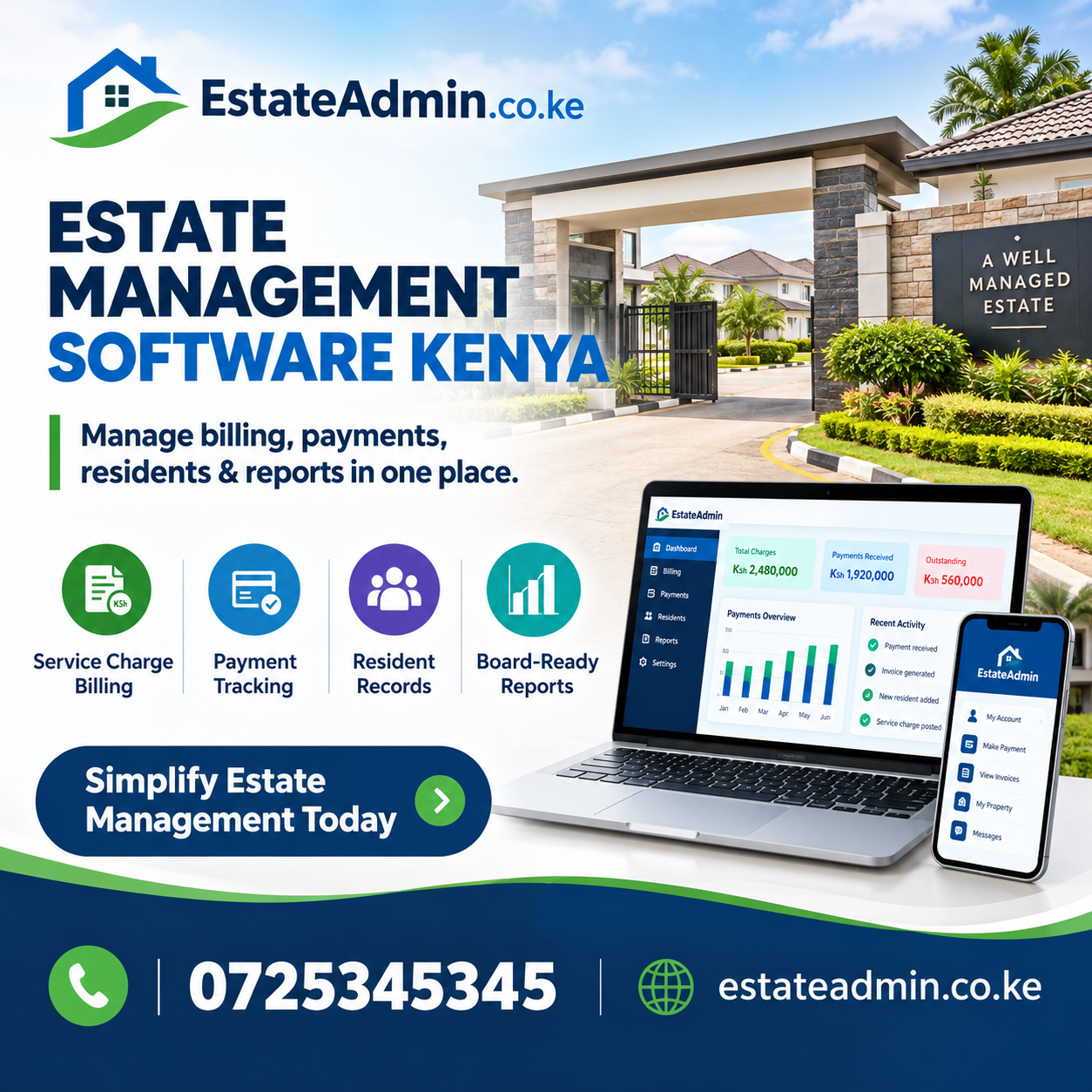
Estate Committee Reporting Software Kenya: A Practical Guide to Better Estate Governance, Reporting and Resident Communication
Managing a residential estate involves far more than collecting service charges and arranging repairs. Estate committees must review financial activity, follow up on maintenance, communicate decisions, monitor service providers and keep residents informed. Estate Committee Reporting Software Kenya can help bring these responsibilities into one organised reporting process, giving committee members clearer information for meetings, decisions and accountability. This guide is written for estate committees, property managers, managing agents, developers and resident associations in Kenya. It explains what committee reporting software does, which features matter, how it can improve governance, what to consider before choosing a system, and how to introduce it without disrupting day-to-day estate operations.
A committee can only make sound decisions when the information presented to it is accurate, current and easy to understand. If reports are assembled from spreadsheets, paper files, WhatsApp conversations, receipts and separate accounting records, important details can be missed. Estate Committee Reporting Software Kenya provides a structured approach to turning operational information into reports that committee members can review and act on.
The purpose is not to replace the committee. Estate Committee Reporting Software Kenya is most effective when it supports established responsibilities rather than attempting to make governance decisions automatically. Good software supports the committee by reducing repetitive administrative work and making the information behind decisions easier to access. A system should help people spend less meeting time searching for figures and more time discussing what those figures mean.
1. What Is Estate Committee Reporting Software?
Estate Committee Reporting Software Kenya is a digital solution designed to help residential estates prepare, organise, store and share reports needed by estate committees. Instead of relying on disconnected files, the system can bring together information from areas such as service charge collections, expenses, maintenance, resident accounts, invoices, arrears, contractors and estate activities.
A reporting system becomes particularly useful when an estate has many units, several committee members or a managing agent handling daily operations. As the volume of information grows, manual reporting becomes harder to maintain consistently. A structured reporting platform can create a repeatable process for gathering information and presenting it in a format that is easier to review.
Estate Committee Reporting Software Kenya can support both routine reporting and decision-focused reporting. Routine reports may cover collections, outstanding balances, expenditure and maintenance activity. Decision-focused reports can help a committee compare planned versus actual spending, review recurring problems or assess whether a service provider is meeting expectations.
The most important point is that reporting software should connect reports to underlying estate records. A report is more useful when committee members can understand where the figures came from and, where appropriate, drill down into supporting transactions or records.
Why committee reporting is different from ordinary reporting
A general business report may focus mainly on sales, expenses or profitability. An estate committee has a broader responsibility. It may need to consider resident contributions, common-area services, security, cleaning, landscaping, repairs, utilities, contractor performance and compliance with internal estate rules.
That means Estate Committee Reporting Software Kenya should be designed around estate operations rather than simply offering generic charts. The reporting structure should reflect the questions committee members actually ask during meetings.
For example, a committee may want to know:
- How much service charge has been collected this month?
- Which accounts remain outstanding?
- Which maintenance jobs were completed?
- What expenses were higher than expected?
- Which contractors have submitted invoices?
- What work is still pending?
- How much has been spent on a particular common-area project?
- What issues have residents reported?
- Which decisions from the previous meeting still require action?
A useful reporting system should make these questions easier to answer without requiring someone to manually combine multiple files every month.
2. Why Estate Committees Need Better Reporting
Committee members are often volunteers or property owners who have other responsibilities outside estate management. They need concise information rather than a pile of documents. Estate Committee Reporting Software Kenya can make committee meetings more productive by presenting important information in an organised and consistent way.
Poor reporting creates several practical problems. Figures may be copied incorrectly from one spreadsheet to another. A committee member may receive an old version of a report. A maintenance expense may appear in one document while the related work order is stored somewhere else. When information is scattered, reviewing the complete picture takes longer.
Better reporting also improves continuity. Estate Committee Reporting Software Kenya can give incoming committee members a clearer starting point when they review previous records and decisions. Committee membership can change over time. When knowledge exists mainly in one administrator’s personal files or memory, a new committee may struggle to understand previous decisions. A central reporting history gives authorised users a clearer record of what has happened.
Estate Committee Reporting Software Kenya is especially valuable when an estate wants to establish a regular reporting rhythm. Instead of creating reports differently each month, the committee can agree on standard reports and review them using the same categories and definitions.
Better meetings
A well-prepared committee meeting should focus on decisions, not data hunting. If the treasurer needs twenty minutes to reconcile figures before the discussion can begin, the meeting loses valuable time. Reporting automation can shorten that preparation.
Better accountability
Clear reports make it easier to see what money was received, what was spent and what remains outstanding. They can also show whether approved projects have progressed.
Better continuity
Historical reports provide a reference point for incoming committee members. They can review previous activity without depending entirely on informal handovers.
Better communication
Residents often want to understand what their contributions are supporting. Appropriate summary reports can help management communicate important information without exposing confidential details.
A good reporting culture therefore supports both administration and governance. Estate Committee Reporting Software Kenya can provide the structure needed to make that culture sustainable.
3. Key Reports an Estate Committee Should Review
The right report set depends on the size and structure of the estate. However, most committees benefit from having a standard monthly or quarterly reporting pack. Estate Committee Reporting Software Kenya can help standardise the preparation of that pack so that the same important areas are reviewed consistently.
Financial collection report
This report should show amounts billed, amounts collected, outstanding balances and relevant payment trends. For an estate that collects service charges monthly, the report can help the committee identify whether collections are keeping pace with obligations.
The report should distinguish between current collections and arrears. A large amount billed does not necessarily mean the estate has the cash needed to pay suppliers. Committee members need to understand actual cash movement.
Expenditure report
An expenditure report should categorise spending into useful groups. These might include security, cleaning, landscaping, repairs, utilities, administration and other approved expenses.
The goal is not simply to show a long list of payments. A useful report allows committee members to see patterns and identify unusual movements.
Maintenance report
Maintenance reporting should show reported issues, assigned jobs, completed work, pending jobs, costs and where appropriate, responsible contractors. This gives the committee a better view of whether recurring problems are being addressed.
Arrears report
Arrears information helps the committee understand outstanding obligations. It can support structured follow-up while keeping resident information appropriately restricted.
Budget-versus-actual report
If the estate operates with an approved budget, committee members should be able to compare expected spending with actual expenditure. Significant differences can then be discussed and explained.
With Estate Committee Reporting Software Kenya, these reports can become part of a consistent committee reporting routine rather than separate documents created from scratch.
4. Features to Look for in Estate Reporting Software
Choosing software simply because it has attractive dashboards can be a mistake. The important question is whether the system solves real reporting problems. Estate Committee Reporting Software Kenya should make estate information easier to organise, verify and interpret.
Dashboard reporting
Estate Committee Reporting Software Kenya
A dashboard can provide a quick overview of collections, arrears, expenses, maintenance activity and other important indicators. It should be simple enough for a committee member who does not work in property management every day.
Customisable reports
Different estates have different needs. A residential development with extensive facilities may need more detailed maintenance and utility reports than a smaller compound.
Customisable reports allow management to select relevant fields, date ranges and categories without rebuilding spreadsheets manually.
Export options
Committee members may need reports for meetings, records or presentations. A system should make it practical to export information into common formats when necessary.
Search and filtering
Reports become much more useful when users can filter by unit, date, transaction type, expense category, maintenance status or other relevant criteria.
Historical reporting
A committee should be able to compare periods and review previous records. Historical information is important for identifying recurring expenses, unresolved issues and changes in collection performance.
Access controls
Not every user should see every report. Financial and resident information can be sensitive. Role-based access can help ensure that committee members, managers, accountants and other authorised users only access information relevant to their responsibilities.
A well-designed Estate Committee Reporting Software Kenya platform should combine these features without making everyday reporting unnecessarily complicated.
5. How Reporting Software Supports Financial Oversight
Financial oversight is one of the most important committee responsibilities. The committee does not necessarily need to perform every accounting task, but it needs enough visibility to question figures, understand expenditure and make informed decisions. Estate Committee Reporting Software Kenya can help create that visibility.
A useful system can connect billing and payment information to reporting. For example, if an estate has monthly service charge invoices, management can review how much was expected and how much was actually received.
This distinction matters. Suppose an estate has significant invoices due to contractors but collections are below expectations. A committee that only sees expenditure may assume the estate is operating normally. A combined collections and expenditure report reveals the cash-flow pressure more clearly.
Tracking service charge performance
Estate Committee Reporting Software Kenya
Service charge collection is a recurring responsibility in many residential estates. A reporting platform can organise payment records by unit and period, making it easier to identify outstanding balances.
The system should make it possible to distinguish between a payment that is late, a payment that is partially settled and an account that has a longer-standing balance.
Monitoring expenses
Estate Committee Reporting Software Kenya
Expense categories should be clear enough to support comparison. If cleaning expenses are recorded under different names every month, trend analysis becomes difficult.
Consistent categorisation allows the committee to ask better questions:
- Why did repair spending increase this month?
- Was the increase planned?
- Was the expense related to an emergency?
- Which service category has the largest recurring cost?
- Are there expenses that require committee approval?
Supporting budget reviews
A budget is more useful when actual activity can be compared against it regularly. Estate Committee Reporting Software Kenya can support budget monitoring by bringing planned and actual figures into a report that the committee can review before approving additional spending.
The software should support oversight rather than encourage unnecessary spending. Its value is in making information visible and structured.
6. Maintenance and Contractor Reporting
Maintenance is one of the easiest estate functions to lose track of because requests arrive through multiple channels. A resident may report a leaking pipe, a security light may fail, or a gate mechanism may require repair. If each issue is tracked informally, management can lose visibility of what is open and what has been completed.
Estate Committee Reporting Software Kenya can connect maintenance activity to committee reporting. A committee member should be able to see how many jobs were raised, how many were completed and which items remain outstanding.
Tracking work orders
Each maintenance request can have a status such as:
- Reported
- Reviewed
- Assigned
- In progress
- Awaiting parts or approval
- Completed
- Closed
This simple structure helps prevent requests from disappearing after the initial complaint.
Monitoring contractors
Contractor reporting can also show how frequently a supplier is used, what work has been assigned and how much has been spent. The committee can then review whether recurring maintenance costs are reasonable and whether service levels are satisfactory.
Identifying recurring problems
A recurring repair may indicate a deeper issue. If the same plumbing problem appears repeatedly, the committee may need to consider a larger repair rather than continuing with isolated fixes.
When maintenance records are connected to reporting, Estate Committee Reporting Software Kenya can help turn individual work orders into useful management information.
7. Resident Communication and Committee Transparency
Reporting is not only about internal numbers. Committees also need to communicate appropriate information to residents. Estate Committee Reporting Software Kenya can support better communication by giving management a consistent source of approved information.
Residents may want updates on maintenance projects, common-area improvements, planned works, service interruptions or general estate activities. Clear reporting makes it easier to prepare these updates from current records.
Avoiding information overload
Transparency does not mean sending residents every transaction or internal discussion. Reports should be tailored to the audience.
A committee may need detailed financial information, while residents may need a concise summary of major activities and approved projects. The software should make it possible to prepare appropriate views without exposing confidential personal information.
Building trust through consistency
Trust is easier to maintain when communication follows a predictable pattern. A monthly estate update might cover:
- Major maintenance completed
- Outstanding projects
- Significant approved expenditure
- General service updates
- Planned activities
- Important notices
The exact content will vary by estate. What matters is that information is accurate and consistently prepared.
Estate Committee Reporting Software Kenya can support this process by helping management work from the same underlying records when preparing committee and resident reports.
8. M-Pesa, Payments and Estate Reporting
Kenyan estates often need practical ways to track payments made through local payment channels. M-Pesa is an important consideration for many property operations, so estate software should be able to accommodate the payment processes used by the organisation.
Estate Committee Reporting Software Kenya does not become useful merely because it displays payment totals. The important part is how payment information is recorded, reconciled and connected to individual accounts.
For example, when a resident pays a service charge, management needs to know which account should receive the payment, which period it covers and whether the amount fully settles the relevant charge.
Payment reconciliation
Reconciliation means checking that recorded payments correspond with the expected transactions. A reporting system can reduce manual effort when payment data can be matched to resident accounts.
Payment status
A good report can distinguish between billed, paid, partially paid and outstanding amounts. This is more useful than a single collection total.
Committee-level summaries
The committee may not need to see every individual transaction during every meeting. A summary can show total collections, outstanding balances and significant changes, while detailed transaction information remains available to authorised users.
Estate Committee Reporting Software Kenya should therefore connect payment information with reporting in a way that supports both operational work and committee oversight.
9. Data Security and Access Control
Estate management systems contain information that should not be casually exposed. This may include resident details, payment records, invoices, contractor information and internal committee documents. Estate Committee Reporting Software Kenya should therefore be evaluated for access controls and data-handling practices.
Role-based access
Estate Committee Reporting Software Kenya
A committee chairperson, treasurer, property manager and maintenance officer may have different responsibilities. They do not necessarily need identical access.
Role-based permissions can reduce unnecessary exposure by allowing users to see only the information relevant to their work.
Audit trails
An audit trail can help show who created, changed or approved certain records. This is particularly useful when multiple people work on the same estate data.
Backups
Regular backups help protect records against accidental deletion, device failure or other disruptions. Before selecting software, management should understand how data is backed up and restored.
Secure account practices
Software security also depends on users. Strong passwords, appropriate permissions and controlled access to administrative accounts remain important.
A committee should ask practical questions before adopting Estate Committee Reporting Software Kenya: Who can access financial reports? Can permissions be changed when committee members leave? Is there a record of important changes? How are backups handled? What happens if an administrator loses access?
The answers should be clear before the system becomes central to estate operations.
10. Using Reports for Better Committee Meetings
A committee meeting should produce decisions and actions. Reports are the evidence that supports those decisions. Estate Committee Reporting Software Kenya can help management prepare a meeting pack that follows a consistent structure.
A useful meeting pack might include:
| Report | Main purpose |
|---|---|
| Collections summary | Review service charge receipts |
| Arrears report | Identify outstanding balances |
| Expenditure report | Review spending |
| Budget report | Compare actual and planned costs |
| Maintenance report | Review completed and pending work |
| Contractor report | Assess supplier activity |
| Project report | Track major estate initiatives |
| Action tracker | Review previous decisions |
The exact pack should be adapted to the estate. A small development may need only a few reports, while a larger community may need more detailed information.
Start with exceptions
Estate Committee Reporting Software Kenya
Committee meetings do not need to spend equal time on every category. If collections are stable and expenses are within budget, the committee can focus on areas that require attention.
This is where Estate Committee Reporting Software Kenya can be particularly useful. Reports that highlight exceptions, overdue tasks or unusual spending can help the committee direct its attention to decisions that matter.
Record decisions
A report should not replace meeting minutes. Instead, reports provide evidence for discussions, while minutes record the decisions and assigned actions.
A strong workflow is:
Report → Discussion → Decision → Assigned action → Follow-up report
That cycle turns reporting into an ongoing management process.
11. Benefits for Property Managers and Managing Agents
Property managers often prepare reports for committees while simultaneously handling daily operations. Estate Committee Reporting Software Kenya can reduce repetitive administrative work and give managers a more organised reporting workflow.
Instead of manually compiling information from separate sources, a property manager can work from central records and generate standard reports.
Saving preparation time
A standard reporting template reduces the need to start each report from a blank spreadsheet. Once categories and formats are configured, recurring reports become easier to prepare.
Reducing manual errors
Manual copying creates opportunities for mistakes. Automated calculations and linked records can reduce some of the repetitive data entry involved in reporting.
Supporting multiple estates
Managing agents may oversee several properties. A system should make it possible to separate estate records while maintaining consistent reporting processes.
Responding to committee questions
Committee members may ask for a historical figure, an expense breakdown or a list of pending maintenance jobs. Searchable records make these requests easier to answer.
For a managing agent, Estate Committee Reporting Software Kenya is most valuable when it supports the complete reporting workflow rather than only producing attractive charts.
12. Reporting for Small, Medium and Large Estates
Not every estate needs the same level of complexity. Estate Committee Reporting Software Kenya should be selected according to the estate’s actual reporting needs.
Small estates
A small estate may have fewer units and a relatively simple service structure. Its priorities may include:
- Collections
- Expenses
- Arrears
- Maintenance
- Basic resident communication
The system should remain simple. Paying for complex features that are rarely used can create unnecessary cost and administrative work.
Medium-sized estates
Medium estates may have more contractors, larger maintenance requirements and more detailed financial activity. They may benefit from dashboards, custom reports, approval workflows and stronger access controls.
Large estates
Large communities may require more sophisticated reporting across facilities, utilities, projects, multiple service providers and different cost centres.
The committee should avoid assuming that the largest feature list is automatically the best solution. The right system is the one that fits the estate’s processes and can grow with its needs.
13. How to Choose the Right Reporting System
Selecting software should begin with a list of actual reporting problems. Estate Committee Reporting Software Kenya should be evaluated against those problems rather than chosen solely because of marketing claims.
Start by asking:
- Which reports do we prepare every month?
- Which reports take the most time?
- Where do errors usually occur?
- Which information is difficult to find?
- Which reports do committee members regularly request?
- How many people need access?
- What payment channels do residents use?
- Do we need maintenance tracking?
- Do we need resident communication tools?
- What level of financial reporting is required?
- What records must be retained?
Request a realistic demonstration
During a software demonstration, ask the provider to show a real workflow. For example, ask how a service charge payment becomes part of a collections report. Then ask how a maintenance request appears in a committee report.
This is more useful than watching a generic presentation.
Check usability
A system can have many features but still be difficult to use. Committee members may not log in every day, so navigation should be straightforward.
Ask about support
Find out how users receive help when they encounter a problem. Ask whether onboarding, training, documentation or customer support is available.
Consider scalability
Your estate may grow or its management processes may become more detailed. Estate Committee Reporting Software Kenya should be capable of supporting additional units, users, reports or functions where needed.
14. Common Mistakes When Implementing Reporting Software
Software does not automatically create good reporting. Implementation matters. Estate Committee Reporting Software Kenya can deliver better results when the estate establishes clear processes around it.
Mistake 1: Entering poor-quality data
If old records contain duplicate residents, incorrect balances or inconsistent expense categories, reports may remain unreliable after migration.
Clean important records before relying heavily on automated reporting.
Mistake 2: Creating too many reports
More reports do not necessarily mean better oversight. A committee can become overwhelmed by dozens of dashboards and spreadsheets.
Start with the reports needed for actual decisions.
Mistake 3: Giving everyone full access
Access should match responsibilities. Broad permissions can increase the risk of accidental changes or unnecessary exposure.
Mistake 4: Ignoring staff training
A system should be introduced with clear instructions. Staff need to understand how records should be entered and which processes must be followed.
Mistake 5: Failing to define report ownership
Someone should be responsible for preparing or reviewing each recurring report. Without ownership, even automated reports may be ignored.
Mistake 6: Treating software as a replacement for governance
Technology supports governance; it does not replace committee approvals, financial controls or documented decisions.
With Estate Committee Reporting Software Kenya, implementation should therefore combine technology, clear responsibilities and consistent procedures.
15. A Practical Implementation Plan for Kenyan Estates
A phased approach can make adoption easier. Estate Committee Reporting Software Kenya does not have to be introduced by changing every estate process at once.
Phase 1: Map the current process
Document how the estate currently handles billing, payments, expenses, maintenance, complaints, committee reports and records.
Identify where information is duplicated or delayed.
Phase 2: Clean core data
Review unit details, resident records, balances, supplier records and other important information before migration.
Phase 3: Configure standard reports
Select a small set of reports for the first reporting cycle. For example:
- Collections
- Arrears
- Expenses
- Budget versus actual
- Maintenance
- Projects
- Committee actions
Phase 4: Train users
Estate Committee Reporting Software Kenya
Show administrators and relevant committee members how to access, interpret and export reports.
Phase 5: Run a parallel check
For an initial period, compare system reports with the existing records. This helps identify differences before the software becomes the primary reporting source.
Phase 6: Standardise the committee pack
Once the figures are reliable, agree on the reports that should be included in regular meetings.
Phase 7: Review after implementation
After a few reporting cycles, ask what is working and what is not. Remove unnecessary reports and improve those that committee members actually use.
This staged approach makes Estate Committee Reporting Software Kenya part of a management process rather than simply another software subscription.
16. Reporting KPIs an Estate Committee Can Monitor
Key performance indicators help a committee focus on measurable outcomes. Estate Committee Reporting Software Kenya can make these indicators easier to monitor consistently.
Possible estate KPIs include:
Collection rate
The committee can monitor the proportion of expected service charges that have been received for a given period.
Arrears movement
Rather than looking only at the total outstanding amount, the committee can monitor whether arrears are increasing, decreasing or remaining stable.
Maintenance completion
The committee can review how many maintenance jobs are completed within the estate’s target period.
Outstanding maintenance
A growing backlog may indicate insufficient resources, slow contractor response or recurring infrastructure problems.
Budget variance
The committee can monitor significant differences between planned and actual spending.
Contractor activity
Where contractor performance is important, reports can track assignments, completion and expenditure.
Project progress
Major improvement projects can be monitored against approved budgets, milestones and expected completion dates.
The exact KPIs should be agreed by the committee. The goal is to measure areas that influence estate performance rather than creating metrics simply because software can produce them.
17. How to Make Reports Easier to Understand
A technically correct report can still be difficult to use. Estate Committee Reporting Software Kenya should help present information in a way that supports quick understanding.
Use clear headings and familiar labels. Avoid unnecessary abbreviations. Separate current figures from historical comparisons.
For financial reports, consider using:
- Opening balance
- Amount billed
- Amount collected
- Expenses
- Outstanding balance
- Closing position
For maintenance reports, consider:
- New requests
- Completed requests
- Pending requests
- Overdue requests
- Estimated or actual cost
- Responsible contractor
For committee projects, consider:
- Approved budget
- Amount spent
- Current status
- Outstanding work
- Next action
Use summaries before details
A committee meeting can begin with a one-page summary and then move to detailed schedules when questions arise. This prevents every meeting from becoming a review of raw transaction data.
Keep definitions consistent
If “arrears” means one thing in the finance report and something different in another report, comparisons become unreliable. The estate should agree on definitions and use them consistently.
18. The Role of Automation in Estate Reporting
Automation can remove repetitive steps, but it should be used thoughtfully. Estate Committee Reporting Software Kenya can automate parts of the reporting process when the underlying records are maintained correctly.
Examples include:
- Generating recurring collections reports
- Updating outstanding balances
- Summarising maintenance requests
- Categorising expenses
- Preparing monthly dashboards
- Producing filtered reports
- Keeping historical records
- Notifying authorised users about pending actions
Automation is especially helpful for recurring processes. If a person prepares the same report manually every month, that process is a good candidate for standardisation.
However, automated output still needs review. If a transaction is entered incorrectly, software may faithfully include the incorrect information in a report.
The best approach is therefore automate the repetitive work, keep human review for decisions and exceptions.
For estate committees, Estate Committee Reporting Software Kenya can support this balance by reducing administrative effort while keeping committee members involved in oversight.
19. Comparing Manual Reporting with Digital Reporting
Many estates begin with spreadsheets because they are familiar and inexpensive to start with. Spreadsheets can be useful for simple tasks, but their limitations become more visible as operations grow.
| Area | Manual reporting | Digital reporting |
|---|---|---|
| Data entry | Often repetitive | Can be centralised |
| Historical records | May require several files | Easier to search |
| Access | File-based | Permission-based |
| Calculations | Manual formulas | Can be automated |
| Maintenance tracking | Often separate | Can be integrated |
| Dashboards | Usually manual | Can be generated |
| Consistency | Depends on the preparer | Can use standard templates |
| Committee review | Often document-heavy | Can use summaries and dashboards |
The goal is not to eliminate spreadsheets completely. Some committees may still use spreadsheets for analysis or special projects. The advantage of Estate Committee Reporting Software Kenya is having a central system that provides reliable operational records and repeatable reporting.
20. Cost Considerations When Buying Estate Reporting Software
Software pricing should be evaluated in relation to the administrative value it provides. Estate Committee Reporting Software Kenya should not be selected solely because it is the cheapest option or rejected solely because another product has more features.
Consider the total cost of ownership.
Subscription or licence cost
Understand whether pricing is monthly, annual, per user, per unit or based on another model.
Setup and migration
Ask whether initial configuration, data migration and onboarding are included or charged separately.
Training
Determine whether staff and committee members receive training and whether additional training has a cost.
Support
Understand what support is available and whether it is included.
Additional modules
Some systems may charge separately for accounting, communication, maintenance or other functions.
A useful comparison is to consider the time currently spent preparing reports, correcting errors, searching for records and responding to information requests. If a system reduces these administrative burdens, that value should be part of the purchasing discussion.
The committee should also avoid paying for features that do not solve a real estate problem. Estate Committee Reporting Software Kenya should fit the estate’s needs rather than forcing the estate to adopt unnecessary complexity.
21. Questions to Ask a Software Provider
Before committing to Estate Committee Reporting Software Kenya, an estate committee should ask practical questions rather than relying only on a sales presentation.
Reporting
- Which reports are included?
- Can reports be customised?
- Can users filter reports by date, unit or category?
- Can reports be exported?
- Can historical reports be retained?
Financial information
- Can the system track service charge billing?
- Can it show arrears?
- Can it support payment reconciliation?
- Can it compare budget and actual spending?
Maintenance
- Can residents or staff record maintenance requests?
- Can jobs be assigned?
- Can management track completion?
- Can committee members see outstanding work?
Security
- Can user roles be customised?
- Is there an audit trail?
- How are backups handled?
- How is access removed when a user leaves?
Support
- Is onboarding available?
- How are technical issues reported?
- What training is provided?
- Can the provider support Kenyan estate-management workflows?
The answers will help determine whether Estate Committee Reporting Software Kenya is suitable for the actual environment in which the committee operates.
22. A Sample Monthly Reporting Workflow
A practical workflow can make reporting predictable. Estate Committee Reporting Software Kenya can sit at the centre of this process.
Week 1: Update records
Management confirms that payments, invoices, maintenance records and other transactions from the previous period are recorded.
Week 2: Review data
The responsible administrator checks for missing information, duplicate records and unusual entries.
Week 3: Generate reports
Standard committee reports are generated and reviewed internally.
Week 4: Committee meeting
The committee receives the reporting pack, discusses exceptions and makes decisions.
After the meeting: Track actions
Approved decisions are assigned to responsible people with deadlines where appropriate.
This cycle helps connect administration to governance. The committee is not simply receiving information; it is using information to guide actions.
23. Why Data Quality Matters More Than Attractive Dashboards
A beautiful dashboard cannot compensate for inaccurate underlying records. Estate Committee Reporting Software Kenya should therefore be judged by the quality and reliability of its data processes.
Suppose a report shows a low arrears balance, but several payments have not been correctly allocated to resident accounts. The dashboard may look excellent while the underlying position is wrong.
Data quality requires:
- Consistent unit records
- Correct resident information
- Accurate payment allocation
- Clear expense categories
- Proper invoice records
- Updated maintenance statuses
- Controlled changes to important records
Management should establish simple data-entry rules. For example, expense categories should have defined names, maintenance statuses should have clear meanings and payment references should be recorded consistently.
Regular data checks are also useful. A monthly review can identify missing or unusual records before the committee meeting.
The value of Estate Committee Reporting Software Kenya therefore depends on both the software and the discipline used to maintain the information inside it.
24. Estate Committee Reporting and Long-Term Planning
Reporting is not only about reviewing the past. Good historical information can support future planning. Estate Committee Reporting Software Kenya can help committees understand patterns that may influence future budgets and projects.
For example, if maintenance reports show repeated repairs to the same facility, the committee may need to investigate replacement or refurbishment. If utility expenses consistently rise during certain periods, the committee can consider whether operational changes are needed.
Historical spending can also inform future budgets. Instead of estimating every category from scratch, the committee can review previous expenditure and adjust for known changes.
Planning capital projects
Large projects require careful monitoring. Reports can show approved budgets, expenditure to date, outstanding commitments and project status.
Planning maintenance
Recurring maintenance patterns can help the committee anticipate future work.
Planning cash requirements
Collection and expense trends can support better cash-flow planning.
The key is to use reports as evidence for planning rather than treating historical numbers as automatic predictions. Conditions can change, so committee members still need to apply judgement.
25. Practical Example: A Nairobi Residential Estate
Consider a hypothetical residential estate in Nairobi with several hundred units, a management office, security provider, cleaning contractor and regular maintenance activities.
Before implementing a structured reporting system, the estate prepares its monthly committee pack using several spreadsheets. Payment information is in one file, maintenance requests are in another, supplier invoices are stored separately and committee actions are recorded in meeting minutes.
The committee spends significant time confirming figures before discussing them.
After introducing Estate Committee Reporting Software Kenya, the management office organises its records into consistent categories. Collections, arrears, expenses and maintenance activity are reported using standard formats. The committee receives a summary before the meeting and can request supporting details where necessary.
The important improvement is not simply the presence of a dashboard. The estate has created a repeatable reporting process.
During meetings, the committee can focus on questions such as:
- Why did a particular expense increase?
- Which maintenance jobs are overdue?
- Which projects need a decision?
- Has the arrears position improved?
- Are planned works progressing?
This example illustrates a broader principle: software becomes valuable when it improves the workflow around information.
26. Practical Example: A Smaller Estate in Thika
A smaller estate may not need a complex reporting structure. Suppose a community has a few dozen units and only a handful of recurring contractors.
The committee may need just five core reports:
- Service charge collections
- Outstanding balances
- Monthly expenses
- Maintenance status
- Committee actions
Estate Committee Reporting Software Kenya can still be useful in this setting if it makes those reports easier to maintain than a collection of disconnected files.
The smaller estate should prioritise simplicity. Committee members should be able to access the information they need without learning a complicated system.
The lesson is that reporting software should be proportionate to the estate. A solution that works for a large development may be unnecessarily complicated for a small community.
27. Frequently Asked Questions
What Is Estate Committee Reporting Software?
Estate Committee Reporting Software Kenya refers to software designed to help residential estate committees organise and review operational, financial, maintenance and management information. It can support recurring reports, dashboards, historical records and controlled access.
Can estate reporting software track service charge arrears?
Yes. A suitable system can organise resident accounts and outstanding balances so that management and authorised committee members can review arrears. The exact capabilities depend on the software configuration.
Can it support M-Pesa payment records?
Many estate-management solutions can be designed to work with local payment workflows, including M-Pesa-related records. Before purchasing, an estate should confirm exactly how payment data is captured, matched and reconciled.
Can committee members access reports remotely?
That depends on the platform. Cloud-based systems can allow authorised users to access information from approved devices, subject to the provider’s security and access controls.
What reports should an estate committee receive every month?
A basic reporting pack may include collections, arrears, expenses, budget versus actual, maintenance and committee actions. Larger estates may also need project, contractor, utility and facility reports.
Is reporting software useful for a small residential estate?
Yes, provided the system is simple and the features match the estate’s needs. A small estate does not need to adopt a complicated platform simply to produce a few core reports.
How does reporting software improve committee meetings?
It can provide standardised information before the meeting, reduce time spent searching for figures and highlight exceptions that require decisions. The committee can then spend more time discussing actions.
What should a committee check before buying software?
Estate Committee Reporting Software Kenya
Review reporting capabilities, security, user permissions, data migration, payment workflows, maintenance features, support, training, pricing and scalability. A practical demonstration is also valuable.
Can reporting software replace the estate committee?
No. Software supports administration and decision-making, but committee members remain responsible for governance, approvals and oversight within their estate’s established rules and responsibilities.
How often should estate reports be reviewed?
Many committees review key financial and operational reports monthly, while some broader reports may be reviewed quarterly. The appropriate schedule depends on the estate’s activity and governance requirements.
28. Final Checklist for Choosing Estate Committee Reporting Software
Before selecting a system, use this checklist:
- Does it support the reports the committee actually needs?
- Can it track collections and arrears?
- Can it organise expenses?
- Can it support maintenance reporting?
- Can it handle multiple users and permissions?
- Can authorised users access historical information?
- Can reports be filtered and exported?
- Does it support the estate’s payment workflow?
- Is data security clearly explained?
- Is onboarding available?
- Is customer support accessible?
- Is the pricing model understandable?
- Can the system grow with the estate?
- Can management test realistic workflows before committing?
A committee that answers these questions before purchasing is more likely to choose a system that delivers practical value.
29. Building a More Accountable Estate Management Process
Good estate management depends on reliable information, clear responsibilities and consistent follow-through. Estate Committee Reporting Software Kenya can support all three by creating a structured reporting environment.
The strongest reporting process does not attempt to turn every estate activity into a complicated dashboard. It focuses on the information that helps people make better decisions.
A committee should be able to see what is happening financially, what maintenance work is outstanding, which projects need attention and whether previous decisions have been implemented. Management should be able to produce this information without rebuilding reports from multiple files every month.
For Kenyan estates, the practical needs are familiar: service charge collection, payment reconciliation, contractor management, maintenance, resident communication, budgeting and accountability. The right software can bring these activities closer together.
The best results come when the technology is matched with clear internal processes. Define who enters information, who checks it, who prepares reports, who approves decisions and who follows up actions. Once these responsibilities are clear, reporting becomes much more useful.
Conclusion
Estate committees need information they can trust. They need to understand collections, expenditure, arrears, maintenance, projects and outstanding decisions without spending every meeting reconstructing the underlying records. Estate Committee Reporting Software Kenya can provide a central framework for organising that information and turning it into useful committee reports.
For estate managers, the value lies in reducing repetitive administrative work. For committee members, it lies in clearer oversight. For residents, the indirect benefit is better-organised communication and more consistent management.
The right solution should be practical, secure, easy to use and suited to the estate’s size and processes. It should support reporting rather than create another layer of administrative complexity.
Before choosing a platform, identify the reports your committee actually uses, the information that is currently difficult to obtain and the processes that create the most manual work. Then evaluate software against those needs.
A well-designed reporting system will not make governance decisions for an estate committee. It will give the people responsible for those decisions better information with which to work. That is the real purpose of digital estate reporting: making everyday management clearer, more accountable and easier to review.
Estate Committee Reporting Software Kenya
Estate Committee Reporting Software Kenya
Estate Committee Reporting Software Kenya
Estate Committee Reporting Software Kenya
Estate Committee Reporting Software Kenya
Estate Committee Reporting Software Kenya