
Residential Estate Payment Software in Kenya: Complete Guide to Billing, Payments and Reconciliation
Residential estate payment management becomes difficult when invoices, resident records, receipts and payment confirmations live in separate spreadsheets. Residential Estate Payment Software Kenya gives estate managers a more organized way to connect what is billed with what has actually been paid. For Kenyan apartments, gated communities and managed residential developments, the objective is not simply to record money received. It is to maintain accurate resident balances, reduce reconciliation work, identify arrears early and produce reports that a committee can understand. This guide explains how the workflow works, which features matter, how M-Pesa and other payment references fit into the process, and how an estate can choose a system without creating another layer of administrative work.
A residential estate normally has a repeating financial cycle. Management establishes the charges, creates invoices, receives payments, allocates those payments to the right accounts, follows up outstanding balances and prepares reports. When each stage is handled separately, small errors can multiply. A payment may be recorded against the wrong unit, a partial payment may be treated as fully settled, or a spreadsheet may continue showing an old balance after a receipt has been issued. Residential Estate Payment Software Kenya is valuable because it can put these steps into one connected workflow instead of leaving staff to rebuild the same information every month.
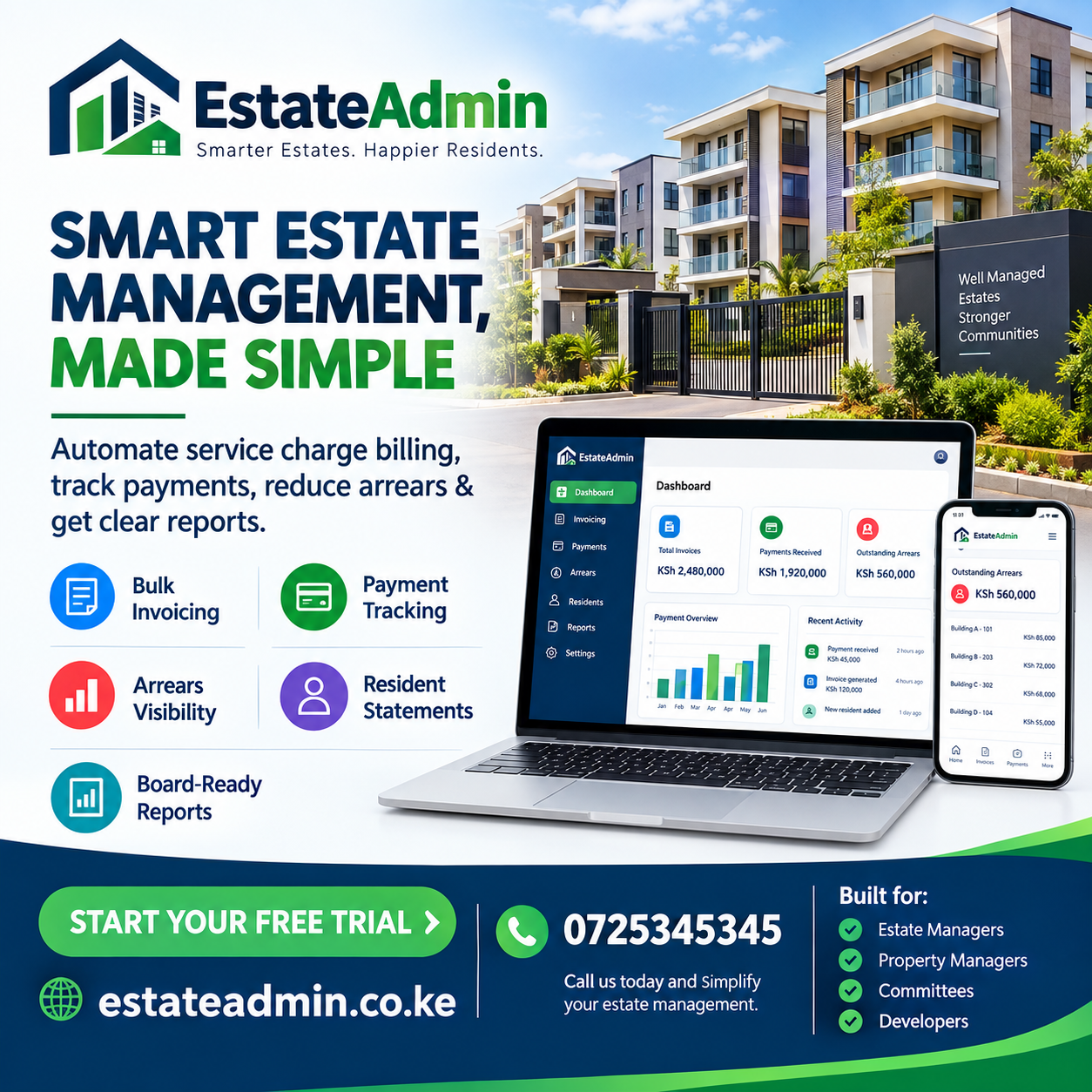
The most important question is not whether software has the longest feature list. It is whether the system can reliably answer basic questions: Which units were billed? How much was billed? Which residents have paid? What remains outstanding? Which payments are still waiting to be allocated? Can the team produce a resident statement without manually combining several files? Residential Estate Payment Software Kenya should make these questions easier to answer. EstateAdmin, for example, is built around residents, recurring service charges, invoices, payments, arrears, statements and reporting, with role-based access and audit-oriented history.
For a residential estate committee, financial clarity is also a governance issue. Residents want to understand what they have been charged and how their balances were calculated. Committee members need useful summaries when reviewing collections. Administrators need an efficient way to process routine transactions. A system should therefore support both daily operations and management oversight. Residential Estate Payment Software Kenya can serve as the bridge between those needs when it maintains a consistent record of charges, invoices and payments rather than forcing every stakeholder to interpret a different spreadsheet.
1. Build a Reliable Residential Billing Foundation
One of the biggest advantages of Residential Estate Payment Software Kenya is centralized resident billing information. A good system should allow the estate to maintain a resident or unit directory, assign the appropriate categories and apply the approved billing rules consistently. That matters when units do not all have identical obligations. Some communities may have different categories, charge structures or approved service-charge arrangements. Centralization reduces the temptation to maintain separate versions of the same resident list, which is a common source of billing mistakes.
Recurring service charges are particularly suited to automation. Instead of recreating every invoice from scratch, management can configure the relevant charge and billing period, review the expected results and generate invoices in bulk. EstateAdmin describes a workflow in which service charges are configured, a period is selected and invoices are generated for residents, while balances and invoice status can be updated as payments are recorded. Residential Estate Payment Software Kenya can therefore reduce repetitive data entry while keeping the monthly process consistent.
Bulk invoicing does not mean removing human oversight. Before an invoice run is finalized, the administrator should check the number of active units, the charge amount, exceptions and the billing period. A short pre-billing review can catch incorrect unit records or outdated categories before invoices reach residents. The software should support the approved process, not replace the committee’s authority to set charges. Residential Estate Payment Software Kenya works best when the estate combines automation with a simple approval checklist and clear responsibility for reviewing billing data.
2. Make Payment Tracking and Reconciliation More Accurate
Payment tracking is where many manual processes begin to break down. A residential community can receive numerous payments through channels such as M-Pesa or bank transfers. A message confirming payment is not the same thing as a correctly updated resident ledger. The payment has to be identified, recorded and associated with the right invoice or account. Residential Estate Payment Software Kenya should help staff maintain that connection so the resident balance reflects verified transactions rather than a separate collection of screenshots, messages and handwritten notes.
M-Pesa is especially relevant to Kenyan estates because many residents are comfortable using mobile money for everyday payments. However, a management team should distinguish between receiving a payment and reconciling it. The right reference, amount, date and payer information still need to be checked against the estate’s records. EstateAdmin has a dedicated payment and reconciliation workflow that focuses on applying payments to invoices and keeping balances aligned. Residential Estate Payment Software Kenya should be evaluated on the exact payment process the estate intends to use rather than on a generic promise of automation.
Partial payments deserve special attention. Suppose a resident has an invoice of KSh 12,000 and pays KSh 7,000. The system should preserve the remaining KSh 5,000 as an outstanding balance rather than closing the invoice incorrectly. This sounds simple, but manual spreadsheets often become confusing when several partial payments arrive across different dates. Residential Estate Payment Software Kenya should make the relationship between invoice value, payments received and remaining balance visible. EstateAdmin states that invoices can reflect partial status based on recorded payments.
A resident statement is another important part of Residential Estate Payment Software Kenya. A statement should allow a resident or administrator to see the financial story behind a balance: what was billed, what was paid and what remains. This is more useful than sending a single outstanding figure because it gives both sides something concrete to review when a question arises. EstateAdmin’s resident portal materials describe statements that show billed versus paid amounts and a running balance, supporting clearer communication and fewer disputes.
3. Control Arrears and Improve Resident Statements
Arrears management becomes more practical when outstanding balances are visible early. Instead of discovering at the end of a quarter that several residents have accumulated unpaid charges, the management team can review current balances and prioritize follow-up. Residential Estate Payment Software Kenya should provide an arrears view that is based on the same ledger used for billing and payment records. This creates one source of truth for collection discussions and helps the committee distinguish between genuinely overdue balances and accounts that simply have not yet been reconciled.
The purpose of arrears visibility is not to automate pressure on residents. Collection still requires appropriate communication, documented policies and sensitivity to legitimate disputes. What software can do is reduce the administrative effort required to identify accounts that need attention. Residential Estate Payment Software Kenya can show which invoices remain open, the amounts involved and the history needed for a follow-up conversation. That makes collection activity more targeted and gives administrators a clearer basis for preparing monthly arrears reports.
Reporting is another reason residential communities move away from spreadsheets. A committee meeting may require total invoices raised, total payments recorded, outstanding balances and resident statements for selected periods. Rebuilding these figures manually takes time and increases the risk that two reports will use different source data. Residential Estate Payment Software Kenya should generate reports from the same transactions used by the billing workflow. EstateAdmin says its reports and exports cover invoices, payments and resident statements for board packs and audits.
Good reporting should be understandable to non-accountants. A committee member should not need to inspect dozens of rows to understand whether collections are improving. Useful dashboards and summaries can highlight billed amounts, payments, open balances and trends. Residential Estate Payment Software Kenya becomes more valuable when the reporting layer turns operational records into information that supports decisions. The system should still allow detailed exports when finance teams need to investigate individual transactions or prepare records for an external review.
4. Strengthen Roles, Reporting and Financial Governance
Audit history is particularly useful when several people manage the same estate. If an invoice, resident record or payment is changed, authorized users should be able to understand what happened and who made the change. Residential Estate Payment Software Kenya should therefore be assessed for role-based access and activity history, not only for billing screens. EstateAdmin lists separate roles and audit-ready history among its platform controls, helping teams understand changes over time.
Role separation also reduces operational confusion. The person entering payments does not necessarily need the same permissions as the person approving configurations or reviewing reports. A residential management company handling multiple communities may have administrators, accountants, managers and viewers with different responsibilities. Residential Estate Payment Software Kenya can support this model when permissions are clearly defined. The objective is not to make access complicated; it is to ensure that users see and change only what their responsibilities require.
For management companies, Residential Estate Payment Software Kenya can be especially useful when several estates follow similar billing cycles. Standardized processes can reduce the amount of time spent designing a new spreadsheet for every community. Each estate can retain its own residents, charges, invoices and payment history while the management team works from familiar procedures. EstateAdmin also presents multi-workspace organization for teams responsible for distinct communities.
5. Move Beyond Spreadsheet-Based Estate Administration
Residential developers can also benefit from introducing a payment workflow early. As new units are handed over, accurate resident and unit records become the foundation for later billing and reporting. A system should make it possible to establish categories, billing rules and opening records in a controlled manner. Residential Estate Payment Software Kenya can help prevent the common problem of building an estate’s financial history in disconnected spreadsheets during the first months of operation, then attempting a difficult migration after transaction volumes have grown.
A major benefit of Residential Estate Payment Software Kenya is reducing spreadsheet drift. A spreadsheet is not inherently bad; it can be useful for analysis, planning or temporary imports. The problem begins when multiple people maintain different versions of the same financial information. One file may contain new residents, another may contain payments, and a third may contain arrears. A connected system gives the team a primary operational record and can reserve spreadsheets for controlled exports and analysis rather than daily transaction management.
Data migration should be treated as a project, not a quick upload. Before moving to Residential Estate Payment Software Kenya, an estate should identify active units, resident names, approved charges, opening balances and any unresolved transactions. Duplicate records should be cleaned, and unexplained balances should be investigated instead of simply imported. This is one area where a vendor’s onboarding assistance can be valuable. EstateAdmin says it can assist with setup, resident imports and service-charge configuration.
Security matters because resident and financial records are sensitive operational information. When assessing Residential Estate Payment Software Kenya, ask how accounts are protected, how access is controlled, how users are removed when they leave the organization and how historical activity is retained. The estate should also establish its own internal policies for passwords, user permissions, exports and sharing. Software security and good internal governance work together; one cannot compensate for the complete absence of the other.
6. Test the Software Before Going Live
A practical way to evaluate Residential Estate Payment Software Kenya is to use a realistic test estate. Do not test only a clean demonstration account. Create sample units, assign several billing categories, generate invoices, record full and partial payments, inspect balances, review arrears and produce statements. Then deliberately test an exception, such as an incorrect payment reference or a resident who pays less than the invoice total. A useful system should make the resulting workflow understandable rather than hiding the exception.
The evaluation should also measure administrative time. If a monthly process previously required several hours of manual calculations, compare the time required after automation. Look at invoice preparation, payment entry, reconciliation, arrears reporting and statement production separately. Residential Estate Payment Software Kenya should be judged by the total workflow, not by how impressive an individual feature appears during a sales demonstration. The best system is usually the one the team can use consistently without creating new manual work around it.
Pricing should be compared against the size and needs of the estate. EstateAdmin’s published pricing page currently lists a Starter plan at KSh 5,000 per month for up to 100 residential units, a Standard plan at KSh 10,000 per month for up to 500 units and a Pro plan at KSh 20,000 per month for unlimited residential units. These figures can change, so the live pricing page should be checked before procurement. Residential Estate Payment Software Kenya should be evaluated on total value, not subscription price alone.
The total cost of Residential Estate Payment Software Kenya includes more than the monthly subscription. Consider data cleanup, onboarding, training, support, process redesign and the staff time required to verify opening balances. A cheaper platform that creates reconciliation problems may cost more over time. Conversely, an expensive platform with features the estate never uses may be unnecessary. Build a simple comparison table covering unit limits, billing automation, payment tracking, statements, reporting, roles, exports and support before making a decision.
7. Pricing, Implementation and Staff Training
A good implementation plan for Residential Estate Payment Software Kenya can be completed in stages. First, document the existing billing process. Second, clean the resident and unit register. Third, configure approved charges and categories. Fourth, test invoice generation. Fifth, import or establish opening balances. Sixth, test full and partial payment scenarios. Finally, compare system outputs with the estate’s existing records before going live. This staged approach gives the team a chance to find discrepancies while the scope is still manageable.
Training should focus on real tasks rather than a long tour of every menu. An administrator should know how to add or update a resident, create invoices, record a payment and produce a statement. A finance user should know how to review balances and reconcile transactions. A manager should know how to read reports and control access. Residential Estate Payment Software Kenya delivers the most value when each user understands the small number of actions they perform repeatedly and knows when an issue must be escalated.
Resident communication also improves when records are consistent. If a resident asks why an amount is outstanding, the administrator should be able to review the invoice and payment history before responding. Residential Estate Payment Software Kenya can support this by keeping the billing and payment trail together. Clear statements can then become the basis for communication instead of manually assembled explanations. The system should support transparency, but the estate should still define how notices, disputes, corrections and payment confirmations are handled.
8. Avoid Common Estate Payment Management Mistakes
One common mistake is assuming that Residential Estate Payment Software Kenya will solve a poorly defined billing policy. Software can automate a rule, but it cannot decide what the committee has approved. Before configuration, document who pays what, when invoices are due, how partial payments are treated, which categories exist and how corrections are authorized. Once those decisions are clear, automation becomes much safer because the system is implementing an agreed process rather than attempting to create one.
Another mistake is allowing too many people to edit financial records without clear responsibility. Shared passwords, unrestricted spreadsheets and informal payment updates can make it difficult to determine what happened after a discrepancy. Residential Estate Payment Software Kenya should be introduced with named user accounts and role-based permissions. EstateAdmin specifically describes role separation for administrators, managers, accountants and viewers, as well as an audit-oriented history.
It is also important not to confuse payment recording with automatic payment collection. A system may provide excellent invoice and reconciliation workflows without directly connecting to every payment provider. When evaluating Residential Estate Payment Software Kenya, ask the vendor to demonstrate the exact M-Pesa, bank or other collection method the estate uses. EstateAdmin’s own guidance notes that a live demonstration should be requested for the intended payment process rather than assuming an unsupported integration exists.
9. Choosing a System for Nairobi and Kenyan Estates
For Nairobi estates, the practical requirements are similar to those elsewhere in Kenya, but larger communities may face higher transaction volumes and more complex administration. Residential Estate Payment Software Kenya should handle the estate’s actual number of units, users and monthly transactions without forcing staff to create parallel records. EstateAdmin has a Nairobi-focused property management page describing resident organization, service-charge billing, payment tracking and reporting. The same principle applies nationally: test the workflow using the estate’s real operating conditions.
Smaller residential communities should not assume that software is only useful for large developments. A smaller estate may have fewer transactions but still face the same questions about who owes what, whether a payment was allocated correctly and how to prepare a committee report. Residential Estate Payment Software Kenya can reduce repetitive work even when the unit count is modest. The key is to choose a system whose cost and complexity match the community’s size rather than buying features that will remain unused.
Larger estates, on the other hand, need stronger controls because a small error can affect many accounts. Bulk invoice generation, structured payment allocation, resident statements and exportable reports become increasingly important as transaction volumes rise. Residential Estate Payment Software Kenya should allow the finance team to work efficiently without sacrificing traceability. EstateAdmin positions its platform for estates and property firms that need recurring billing, payment tracking, arrears visibility and committee-ready reporting.
10. Measure the Operational Value
When comparing vendors, ask for evidence instead of broad promises. Request a demonstration of one complete billing cycle. Ask what happens when a resident pays partially, when a payment is received without a clear reference, when an invoice needs correction and when a user leaves the organization. Residential Estate Payment Software Kenya should have predictable answers for these situations. A short scenario-based evaluation is often more useful than a long checklist of features because it shows whether the product works under real operating pressure.
A useful comparison framework for Residential Estate Payment Software Kenya should cover six areas: billing, payments, reconciliation, resident records, reporting and governance. Billing asks whether recurring charges and invoices are easy to manage. Payments asks whether receipts can be recorded accurately. Reconciliation asks whether payments are connected to invoices. Resident records cover unit and household information. Reporting covers statements and management summaries. Governance covers permissions, history and accountability. A platform that performs well across all six areas is more likely to support sustainable estate administration.
There is also a human side to successful implementation. Some teams resist new systems because they fear losing familiar records or making mistakes. A phased rollout can reduce that anxiety. Begin with a small sample of units, compare the results with existing records, correct issues and then expand. Residential Estate Payment Software Kenya should simplify the work of administrators, not make them feel that every routine action has become a technical task. Adoption is a practical measure of software quality.
The strongest business case for Residential Estate Payment Software Kenya is often found in the time recovered from repetitive work. Consider the monthly cycle: preparing invoices, checking payment records, updating balances, identifying arrears, preparing statements and building committee reports. When those tasks are connected, staff can spend more time on exceptions and resident service rather than copying figures between files. The value is therefore partly financial and partly operational: fewer repetitive tasks, clearer records and faster answers to ordinary questions.
11. Procurement Checklist for Estate Committees
Accurate records can also improve conversations between management and residents. Disputes often become harder when neither side can easily see the transaction history. Residential Estate Payment Software Kenya can give administrators a consistent record to reference when investigating an account. That does not guarantee that every dispute will disappear, because some issues concern approved charges or service quality rather than accounting. Still, clear invoices, statements and payment histories create a stronger factual foundation for resolving questions.
For estate committees, the reporting workflow should be designed around recurring meetings. Before a meeting, management may need a summary of invoices issued, collections, outstanding balances and selected resident statements. Residential Estate Payment Software Kenya should make these outputs repeatable rather than requiring a fresh spreadsheet every month. EstateAdmin’s reporting materials emphasize monthly invoice and payment summaries, resident statements and snapshot exports for board or committee use.
A mature process also includes regular reconciliation reviews. Even with software, administrators should periodically compare recorded transactions with source records such as bank statements or verified payment confirmations. Residential Estate Payment Software Kenya reduces the effort required to maintain the ledger, but reconciliation remains a control activity. The goal is to ensure that the system’s records correspond with money actually received. This is especially important when multiple payment channels are used or when transactions require manual verification.
Estate managers should also plan for corrections. A wrong amount, duplicate entry or misallocated payment should be handled through a documented correction process rather than by silently overwriting history. Residential Estate Payment Software Kenya is more trustworthy when it preserves a clear trail of changes and makes it possible to understand why a balance changed. This protects the estate’s records and helps a new administrator understand historical decisions without relying on verbal explanations from a former staff member.
12. Resident Experience and Administrative Efficiency
Looking ahead, Residential Estate Payment Software Kenya should be seen as part of a broader financial control system rather than as a standalone billing screen. Billing, payments, reconciliation, statements and reporting form one chain. If one stage is disconnected, the team often returns to manual work. A connected workflow creates a stronger operating foundation for residential communities that want predictable monthly processes and clearer accountability.
The choice of Residential Estate Payment Software Kenya should ultimately come down to fit. A residential estate does not need software simply because it is digital; it needs a workflow that is accurate, understandable and sustainable. Before signing up, define the estate’s billing rules, test representative transactions, confirm unit limits, review permissions and verify reporting outputs. EstateAdmin’s published product information emphasizes the sequence of service charges, invoices, payments, statements and reporting, which is a useful model for evaluating whether the workflow is genuinely connected.
If the estate is currently using spreadsheets, start by documenting the pain points. Are invoices taking too long to prepare? Are payment references difficult to match? Do residents frequently ask for statements? Are arrears reports rebuilt manually? Does the committee receive different figures from different people? These questions reveal where Residential Estate Payment Software Kenya can create the most immediate value. A focused implementation is more likely to succeed than attempting to digitize every administrative process at once.
The transition from manual records to Residential Estate Payment Software Kenya should also include a clear go-live date. Decide which transactions will be entered into the new system, who will validate opening balances and who will approve the first live invoice run. Keep a controlled copy of historical records for reference. Once the new process is stable, avoid returning to parallel spreadsheets except where they serve a defined purpose. One authoritative operational record is easier to maintain than two competing systems.
13. Portfolio and Multi-Estate Management
In practical terms, the best residential payment workflow is simple: define the charge, generate the invoice, receive the payment, allocate it correctly, update the balance, follow up arrears and report the results. Residential Estate Payment Software Kenya should make this sequence visible and repeatable. When the software reflects the estate’s real process, administrators spend less time calculating and searching, while committees gain clearer information for oversight.
For Kenyan estates considering a move to digital billing, M-Pesa readiness, resident statements, payment reconciliation and local support deserve particular attention. Residential Estate Payment Software Kenya should be assessed against the exact payment channels and reporting requirements used by the community. Avoid choosing solely on marketing language. Test the workflow, verify current pricing and confirm what is included in the selected plan. That discipline protects the estate from buying a platform that looks suitable but fails on a critical day-to-day requirement.
A sensible procurement checklist for Residential Estate Payment Software Kenya can include: unit capacity; resident records; recurring service charges; bulk invoices; payment allocation; partial payments; arrears visibility; resident statements; exports; reports; role-based access; audit history; onboarding; support; integrations; and pricing. Score each item according to importance. Mark mandatory requirements separately from desirable features. This makes the final decision easier to defend to a committee because the choice is based on documented operational needs rather than personal preference.
The financial impact should also be measured over time. Track how long monthly billing takes before and after implementation, how quickly payment records are reconciled and how long it takes to prepare committee reports. Residential Estate Payment Software Kenya is successful when the process becomes more predictable, not merely when the software has been installed. Establishing a few simple baseline measures gives the estate evidence that the change is improving administration.
14. Final Evaluation Before Purchase
There is no substitute for accurate source data. Even the best Residential Estate Payment Software Kenya platform cannot produce trustworthy reports if the resident register is wrong, charges are configured incorrectly or opening balances are unreliable. Data governance should therefore be part of implementation. Assign ownership for resident records, billing configuration and payment reconciliation. Review these areas periodically so that the system continues to reflect the actual estate.
For residents, the most visible benefits are usually clarity and faster responses. A clear invoice tells them what is due. A payment record shows what has been received. A statement explains the running balance. Residential Estate Payment Software Kenya can connect these pieces so an administrator does not have to search through multiple files before answering a routine question. That improves the resident experience while also reducing the volume of repetitive queries reaching the management office.
For administrators, the benefit is consistency. A defined billing cycle reduces the chance that one month is processed differently from another. Residential Estate Payment Software Kenya can support recurring charges, bulk invoice generation and structured payment tracking, while the team remains responsible for checking exceptions. EstateAdmin’s service-charge billing documentation describes recurring charges, due dates, bulk invoice generation and balance tracking as core parts of the workflow.
For committee members, the benefit is visibility. Rather than receiving several unrelated spreadsheets, they can review summaries generated from the same underlying billing and payment records. Residential Estate Payment Software Kenya should make it easier to see billed amounts, collections, outstanding balances and supporting statements. That does not replace committee judgment, but it gives decision makers a more consistent information base when discussing budgets, arrears and operational priorities.
For property management companies, the benefit can extend across portfolios. Standard procedures reduce the need for every estate to invent its own billing spreadsheet. Residential Estate Payment Software Kenya can support repeatable processes while allowing each community’s records to remain distinct. Before adopting a multi-estate workflow, however, confirm workspace separation, permissions and reporting behavior. The goal is operational standardization without accidentally mixing financial records between communities.
A strong final test for Residential Estate Payment Software Kenya is whether a new administrator can understand the workflow without relying on the previous administrator’s personal spreadsheet. If the answer is yes, the estate has probably moved toward a more sustainable operating model. Clear records, repeatable billing, structured payments and accessible reports reduce dependence on individual memory. This is especially valuable when committee members or property management staff change.
The decision should therefore be evidence-led. Review the live product, test representative transactions, compare the plan against the estate’s unit count, and document any integration or reporting limitations. Residential Estate Payment Software Kenya is worth considering when it demonstrably reduces manual billing and reconciliation while preserving control over resident records and financial history. EstateAdmin’s current platform materials provide a useful starting point for that evaluation, particularly around service charges, invoices, payments, arrears, statements and reporting.
Residential estates do not need complicated processes to achieve better payment control. They need reliable records and disciplined workflows. Residential Estate Payment Software Kenya can help connect billing, payment allocation, balances, arrears and reporting in one environment, provided the estate configures the system correctly and maintains sound internal controls. For a Kenyan residential community, that can mean fewer spreadsheet reconciliations, clearer resident statements and faster access to the information required for everyday management.
Frequently Asked Questions
What is residential estate payment software?
Residential Estate Payment Software Kenya refers to software that helps residential communities manage the financial side of recurring charges and payments. Depending on the platform, it may include resident records, invoices, payment tracking, reconciliation, arrears, statements, reports and user permissions. The important distinction is that the software should connect these functions so the team can trace a balance from its source charge through the invoice and payment history.
Can payment software handle service charges?
Yes. Service-charge billing is one of the most common use cases for the system. A suitable system should allow management to define recurring charges, generate invoices, record payments and monitor outstanding balances. EstateAdmin specifically positions its platform around service-charge billing for gated communities and estates, including recurring charges, bulk invoicing, payments, arrears and reporting.
Can an estate record partial payments?
A suitable system platform should support partial payments without incorrectly closing the invoice. If an invoice is KSh 10,000 and a resident pays KSh 6,000, the system should retain the remaining KSh 4,000 as outstanding. Always test this scenario during evaluation because partial-payment behavior is important for accurate arrears and resident statements.
Is M-Pesa integration necessary for Kenyan estates?
It can be highly useful, but the exact requirement depends on the estate’s payment process. The system should be evaluated based on whether it can record and reconcile the payment information the community actually receives. Do not assume that every platform automatically connects to every M-Pesa service. Ask for a demonstration of the intended collection and reconciliation workflow before procurement.
How does payment reconciliation help an estate?
Payment reconciliation helps confirm that money received is assigned to the correct resident, unit and invoice. With the system, the objective is to keep payment records and outstanding balances aligned. This reduces the need to compare separate spreadsheets manually and makes it easier to investigate unidentified or misallocated transactions before they affect reports.
What should an estate check before buying payment software?
Before choosing the system, test billing, invoice generation, full and partial payments, arrears, statements, reports, exports, user permissions and corrections. Confirm unit limits and pricing, ask about onboarding and support, and verify any payment integrations. A scenario-based trial using representative estate data is more useful than relying only on a feature list.
Is payment software useful for small estates?
Yes. Even a small community can benefit from the system if its current process involves repetitive billing, manual reconciliation or frequent requests for statements. The estate should choose a plan that matches its unit count and budget. The aim is not to introduce complexity but to create a dependable record that saves administrative time.
How should an estate migrate from spreadsheets?
Start with a clean resident and unit register, approved billing rules and verified opening balances. Then configure the system, import or enter the records, test invoices and payments, and compare the outputs with the existing records. The system should become the primary operational record after the go-live date, while historical spreadsheets are retained in a controlled manner for reference.
What makes a payment system good for committees?
A good system platform gives committees clear information without requiring them to inspect every transaction. Useful outputs include billed versus paid summaries, outstanding balances, resident statements and periodic reports. It should also provide appropriate access controls and a history of changes so that financial information can be reviewed with confidence.
Can estate payment software eliminate arrears?
No software can guarantee that residents will pay on time. The system can improve visibility by showing outstanding invoices, balances and payment history, making it easier for management to identify accounts that need follow-up. Effective arrears management still depends on clear policies, accurate billing, communication and consistent collection procedures.
Conclusion
A residential estate’s payment process should be easy to explain from beginning to end: approved charges become invoices, invoices receive verified payments, payments update balances, outstanding accounts are followed up and the resulting information becomes useful reports. The system can bring that sequence into one connected workflow and reduce the dependence on scattered spreadsheets. For Kenyan estates, the strongest evaluation should focus on service-charge billing, payment reconciliation, M-Pesa or bank-payment workflows, resident statements, arrears visibility, reporting and governance. Test the software with realistic transactions, verify the current plan and pricing, and choose the system that makes accurate administration easier every month.