
Resident Statement Management Software Kenya: The Complete Guide for Modern Estates
Managing resident accounts becomes complicated when an estate has dozens or hundreds of households, recurring service charges, different payment dates, partial payments, arrears, adjustments, and frequent requests for account statements. Resident Statement Management Software Kenya gives estate managers a structured way to keep these records organized, explain balances clearly, and reduce the manual work involved in preparing resident financial statements. Resident Statement Management Software Kenya
For estate managers, accountants, property administrators, resident associations, developers, and management committees, accurate resident statements are more than administrative documents. They are a record of what was billed, what was paid, what remains outstanding, and how a resident’s account has changed over time. When these records are maintained in spreadsheets or separate files, even a small mistake can create confusion.
This guide explains how resident statement management works, why it matters for Kenyan estates, what features to look for in software, how payment reconciliation works, how statements support arrears management, and how estate teams can choose a practical system without creating unnecessary complexity.
What Is Resident Statement Management Software?
At its simplest, Resident Statement Management Software Kenya is a digital system designed to maintain individual resident accounts and produce clear statements showing financial activity over a selected period. Resident Statement Management Software Kenya
A resident statement normally brings together information such as:
- Opening balance
- Service charge invoices
- Other approved charges
- Payments received
- Payment dates
- Outstanding balances
- Credits or adjustments
- Arrears
- Running account balance
- Closing balance
Instead of asking an administrator to manually search through invoices, payment records, spreadsheets, bank statements, or M-Pesa confirmations, a properly configured system connects these transactions within the resident’s account.
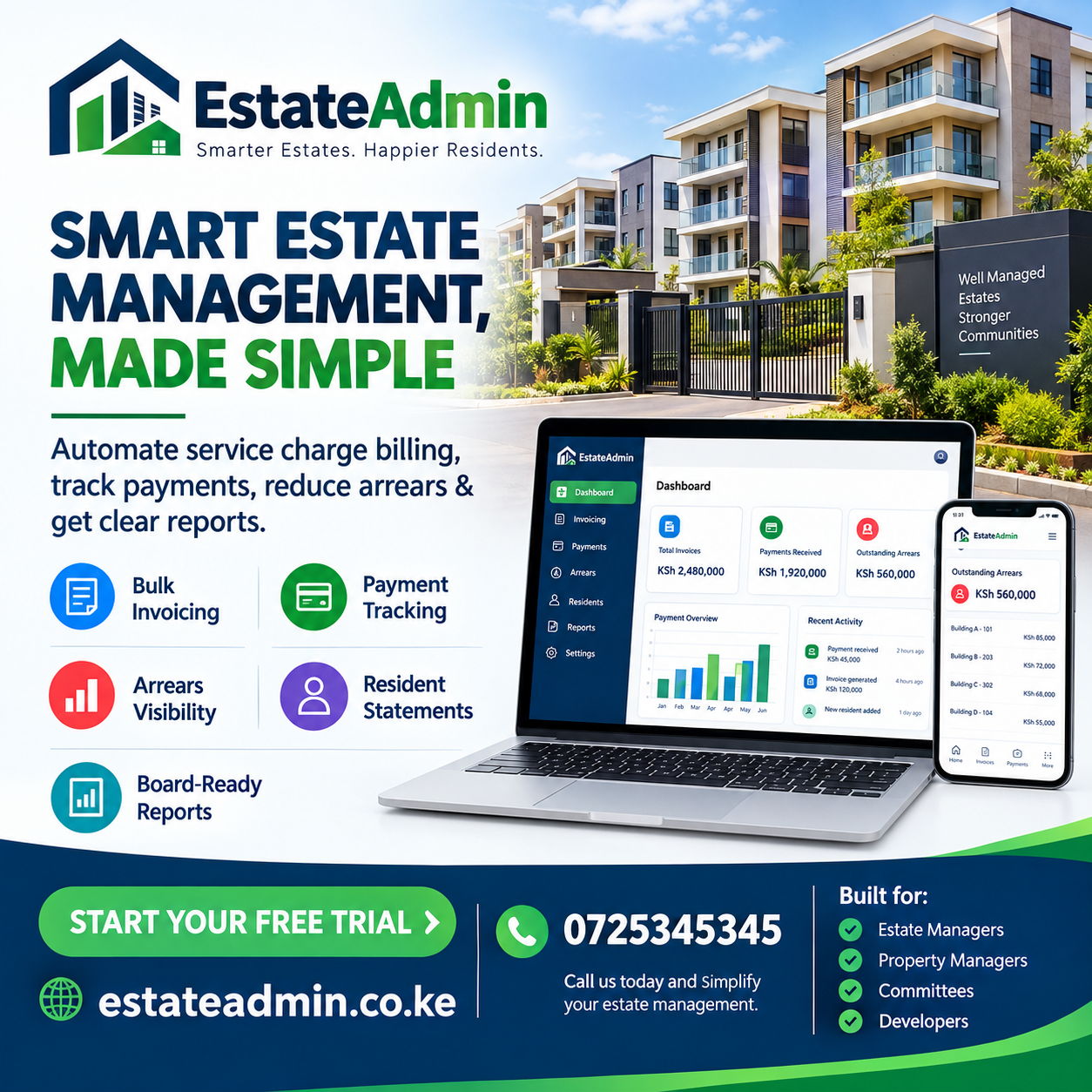
EstateAdmin, for example, describes its workflow around residents, invoices, payments, arrears, statements, reporting, and exports. Its platform is designed around a repeatable process from service charges through invoices and payments to statements and reporting.
This distinction is important. A resident statement should not simply be a list of transactions. It should help a resident or committee member understand the financial position of an account without having to reconstruct the history themselves.
Why Resident Statements Matter to Kenyan Estates
The importance of Resident Statement Management Software Kenya becomes clearer when an estate grows beyond a small number of households. Resident Statement Management Software Kenya
Consider a gated community with 250 units. Every month, the management team may need to:
- Generate service charge invoices.
- Send residents their bills.
- Receive payments through different channels.
- Match payments to resident accounts.
- Identify unpaid invoices.
- Handle partial payments.
- Follow up on arrears.
- Respond to residents who question their balances.
- Prepare reports for the management committee.
- Produce statements when residents request them.
If these activities are handled in separate spreadsheets, the possibility of inconsistent information increases.
A resident might have paid KSh 20,000, but the administrator may still see the invoice as unpaid because the payment has not been entered into the correct spreadsheet. Another resident may make a partial payment, leaving an outstanding balance that is difficult to calculate manually.
A centralized system creates a single source of truth.
Statements Build Trust
Financial communication between residents and estate management needs clarity. When a resident receives a statement that shows the opening balance, invoices, payments, and closing balance, they can see how the figure was calculated.
This reduces conversations such as:
“Why am I being asked to pay this amount?”
Instead, the administrator can point to the relevant invoice, payment, and resulting balance.
Statements Help Committees Make Decisions
Estate committees need more than total collections. They may want to know which units have outstanding balances, how collections compare with billing, and whether arrears are improving.
Clear resident account records make these discussions more evidence-based.
Statements Improve Administrative Efficiency
A system can generate statements without forcing an administrator to manually reconstruct every transaction. This matters especially at month-end, during annual meetings, when accounts are handed over to a new management company, or when residents request historical records.
The Core Information a Resident Statement Should Contain
A good Resident Statement Management Software Kenya solution should make the important information easy to understand. Resident Statement Management Software Kenya
A useful resident statement may contain the following sections:
| Statement component | Purpose |
|---|---|
| Resident name | Identifies the account holder |
| Unit number | Connects the account to the property |
| Statement period | Shows the dates covered |
| Opening balance | Shows what was owed or credited at the start |
| Invoices | Lists charges raised during the period |
| Payments | Shows money received |
| Adjustments | Explains approved changes |
| Arrears | Identifies unpaid amounts |
| Closing balance | Shows the final account position |
The layout does not have to be complicated. In fact, simplicity is usually better.
A resident should be able to open a statement and understand three basic questions:
- What did I owe?
- What have I paid?
- What do I still owe?
That clarity is one of the strongest reasons to move away from fragmented manual records.
How Software Changes the Statement Workflow
With Resident Statement Management Software Kenya, the statement process can become part of the normal billing cycle rather than a separate administrative exercise. Resident Statement Management Software Kenya
A typical workflow can look like this:
Service charges → Invoice generation → Payment recording → Reconciliation → Updated balance → Resident statement → Reporting
The advantage is that each step feeds the next.
For example, suppose a unit receives a monthly service charge invoice of KSh 15,000. The resident pays KSh 10,000. The system should show the invoice and payment and leave an outstanding balance of KSh 5,000.
If the resident later pays the remaining KSh 5,000, the account should update accordingly.
This sounds straightforward, but manual systems often introduce errors because the invoice may exist in one spreadsheet while the payment is recorded somewhere else.
Resident Account Management and Service Charges
Service charges are a major part of residential estate administration in Kenya. They may cover shared services and operational expenses such as security, cleaning, landscaping, common-area maintenance, utilities, management costs, and other approved estate expenses.
Resident Statement Management Software Kenya can help connect these recurring charges to resident accounts. Resident Statement Management Software Kenya
The exact charges will vary from one estate to another. A good system should therefore allow estate administrators to configure charges according to the estate’s approved billing structure rather than forcing every property to follow one template.
Recurring Charges
Recurring charges can be configured so administrators do not have to recreate the same information every month.
Different Resident Categories
Some estates may have different billing categories based on unit type, size, ownership arrangement, or other approved rules.
Clear Invoice Records
Once an invoice is generated, the resident should be able to understand the amount, due date, and description.
Connection to Statements
When the invoice is recorded against the resident account, it becomes part of the account history and can appear on subsequent statements.
EstateAdmin currently describes bulk invoice generation, due dates, resident categories, payment tracking, resident statements, and reporting as parts of its estate management workflow.
Payment Tracking and Resident Statements
Payment tracking is where Resident Statement Management Software Kenya becomes particularly useful. Resident Statement Management Software Kenya
An estate can receive payments through different channels, depending on its operating procedures. These may include M-Pesa, bank transfers, deposits, cheques, or other approved payment methods.
The challenge is not simply receiving the money.
The challenge is correctly assigning the money to the right resident account.
Suppose three residents make payments on the same day:
- Resident A pays KSh 15,000.
- Resident B pays KSh 10,000.
- Resident C pays KSh 25,000.
If the administrator records only the total collection of KSh 50,000, the estate has received the money but does not yet have reliable resident-level accounting.
Each payment needs to be associated with the appropriate resident or unit and, where applicable, the relevant invoice.
Partial Payments
Partial payments are another common source of confusion.
If an invoice is KSh 30,000 and a resident pays KSh 20,000, the statement should not incorrectly suggest that the full invoice has been settled.
The account should show:
Invoice: KSh 30,000
Payment: KSh 20,000
Outstanding: KSh 10,000
This makes follow-up much easier.
EstateAdmin states that its invoices can reflect payment status and that partial payments can be tracked.
M-Pesa and Payment Reconciliation
For many Kenyan estates, M-Pesa is an important part of everyday collections. However, collecting money through mobile payments is only one part of financial administration.
The second part is reconciliation.
A Resident Statement Management Software Kenya workflow should make it easier to connect recorded payments with resident accounts and outstanding invoices. Resident Statement Management Software Kenya
The basic reconciliation process is:
- Identify the payment.
- Confirm the payer or account.
- Match the payment to the correct resident.
- Apply it to the appropriate invoice or account.
- Update the outstanding balance.
- Verify that the account now reflects the correct position.
When this process is consistent, residents are less likely to see incorrect balances.
Reconciliation also supports management reporting because the estate can compare billed amounts against recorded collections.
Arrears Management
Arrears are one of the biggest operational challenges for estate managers.
Resident Statement Management Software Kenya helps make arrears more visible by keeping outstanding balances attached to individual resident accounts. Resident Statement Management Software Kenya
Instead of looking through a spreadsheet to determine who has not paid, an administrator can use account information and reports to identify outstanding balances.
Why Arrears Need More Than a Total
Suppose an estate has KSh 2 million in total arrears.
That number alone does not explain the problem.
Management may need to know:
- How many residents owe money?
- Which accounts have the largest balances?
- How old are the outstanding amounts?
- Are the arrears increasing or decreasing?
- Which invoices remain unpaid?
- Are some accounts affected by payment allocation issues?
- Are there residents with disputed balances?
A good reporting system should help turn a large total into actionable information.
Statement History Helps Resolve Disputes
If a resident disputes an outstanding amount, the account history provides a starting point for investigation.
The administrator can review the invoices raised, payments recorded, and resulting balance.
That is much more reliable than relying on memory or searching through WhatsApp messages.
The Importance of a Running Balance
A running balance is one of the most useful features in a resident statement.
With Resident Statement Management Software Kenya, the running balance can show how each invoice and payment affects the account over time. Resident Statement Management Software Kenya
For example:
| Transaction | Debit | Credit | Balance |
|---|---|---|---|
| Opening balance | — | — | KSh 5,000 |
| Service charge invoice | KSh 15,000 | — | KSh 20,000 |
| Payment | — | KSh 10,000 | KSh 10,000 |
| New invoice | KSh 15,000 | — | KSh 25,000 |
| Payment | — | KSh 15,000 | KSh 10,000 |
The resident can see exactly how the closing balance was reached.
This is particularly useful when an account has transactions spanning several months.
How Resident Statements Support Estate Committees
Estate committees are often responsible for oversight rather than day-to-day transaction entry.
They need concise information that helps them understand the financial position of the community.
Resident Statement Management Software Kenya can support committee reporting by providing structured resident account information. Resident Statement Management Software Kenya
A committee may want to review:
- Total billed amount
- Total collections
- Outstanding balances
- Number of accounts in arrears
- Monthly collection trends
- Payment patterns
- Resident account statements
- Reports for a selected period
EstateAdmin specifically positions its reporting around billed versus paid amounts, outstanding balances, trends, monthly reporting, and resident statements.
This allows committee discussions to focus on decisions instead of debating which spreadsheet contains the latest figures.
Resident Statement Management for Property Managers
Property managers frequently manage multiple estates or properties.
This creates a second challenge: keeping information separated while maintaining consistent processes.
A Resident Statement Management Software Kenya platform can provide a central workflow for resident records, billing, payments, and reporting. Resident Statement Management Software Kenya
For a management company, useful capabilities include:
- Separate estate workspaces
- Resident directories
- Unit records
- Service charge configuration
- Invoice generation
- Payment recording
- Arrears monitoring
- Statements
- Reports
- User permissions
- Audit history
- Exports
The exact requirements will depend on the size and structure of the management company.
A small property administrator may need only core billing and statement functions. A larger firm may need multiple estates, role-based access, approvals, reporting, and integrations.
Role-Based Access and Accountability
Financial records should not necessarily be editable by everyone who can log into the system.
Resident Statement Management Software Kenya should ideally support different roles according to responsibility. Resident Statement Management Software Kenya
For example:
| Role | Possible responsibility |
|---|---|
| Administrator | Resident records and daily operations |
| Accountant | Payments, reconciliation and financial records |
| Manager | Oversight and reporting |
| Committee member | View reports and statements |
| Viewer | Read-only access |
The purpose is not to create unnecessary restrictions. It is to establish accountability.
EstateAdmin describes role-based access involving administrators, managers, accountants, and viewers, as well as audit-ready history showing what changed, when, and by whom.
This can be particularly valuable when several people work on the same estate account.
Audit Trails and Historical Records
A resident account can change many times during a year.
Invoices are generated. Payments are recorded. Adjustments may be approved. Residents may change units or ownership details. Management teams may also change.
Resident Statement Management Software Kenya should therefore provide a reliable history of account activity. Resident Statement Management Software Kenya
An audit trail can help answer:
- Who recorded a transaction?
- When was it recorded?
- What was changed?
- Which account was affected?
- Was a payment edited?
- Was an adjustment made?
- What was the previous balance?
Historical information becomes especially important when there is a dispute.
A strong system should make it possible to investigate an issue without depending entirely on the recollection of one administrator.
Resident Statements and Transparency
Transparency is not simply about giving residents more information. It is about giving them the right information in a format they can understand.
With Resident Statement Management Software Kenya, residents can receive account information that clearly separates charges from payments. Resident Statement Management Software Kenya
A useful statement should avoid unexplained totals.
For example, saying:
Amount Due: KSh 45,000
is less informative than showing:
- Previous balance: KSh 15,000
- Current service charge: KSh 20,000
- Payment received: KSh 10,000
- Closing balance: KSh 25,000
The second format allows the resident to understand the calculation.
That clarity can reduce unnecessary disputes and make collection conversations more professional.
Reports That Estate Managers Should Monitor
Statements are useful at the individual account level. Reports are useful at the estate level.
A Resident Statement Management Software Kenya platform should ideally provide reporting that helps management move from individual transactions to overall performance. Resident Statement Management Software Kenya
Useful reports may include:
Monthly Billing Report
Shows the value of invoices raised during a specific period.
Collections Report
Shows payments received during the period.
Outstanding Balances Report
Identifies accounts with unpaid balances.
Resident Statement Report
Provides account-level information for selected residents.
Arrears Report
Helps identify overdue balances.
Payment History
Shows payment activity across the estate.
Billing Versus Collections
Compares what was billed with what was collected.
These reports can support monthly management meetings and financial reviews.
Choosing the Right Software for a Kenyan Estate
There are many property and accounting applications available, but not every platform is appropriate for resident statement management.
When evaluating Resident Statement Management Software Kenya, estate managers should look beyond attractive dashboards and focus on the actual workflow. Resident Statement Management Software Kenya
Ask these questions before choosing a system:
- Can it maintain individual resident accounts?
- Can it generate recurring invoices?
- Can it record partial payments?
- Can it show running balances?
- Can it identify arrears?
- Can it produce resident statements?
- Can it generate management reports?
- Can multiple users have different permissions?
- Can records be exported?
- Can the system support the estate’s actual billing process?
A system that performs these tasks reliably is usually more valuable than one that has dozens of features your team will never use.
Cloud-Based Access
Cloud-based software can be particularly useful for property management teams.
With Resident Statement Management Software Kenya, a cloud platform can allow authorized users to work from different locations without maintaining separate local versions of the same spreadsheet. Resident Statement Management Software Kenya
For example, an estate manager may be working from an office while an accountant is reviewing payments elsewhere.
A centralized platform can keep both users connected to the same underlying records, subject to their permissions.
However, cloud access should always be considered together with security, user permissions, backups, authentication, and operational controls.
Mobile-Friendly Estate Administration
Property management does not happen only at a desk.
Managers may be visiting estates, meeting committees, inspecting facilities, or speaking with residents.
A practical Resident Statement Management Software Kenya system should therefore be usable on modern devices and provide an interface that does not make routine tasks unnecessarily difficult. Resident Statement Management Software Kenya
Mobile-friendly access can help when an administrator needs to:
- Check an account.
- Confirm a balance.
- Review a payment.
- View a resident record.
- Access a report.
- Respond to a resident question.
The objective is convenience without compromising security.
Integrating Resident Statements With Accounting Workflows
Resident statements are closely connected to accounting.
Invoices represent charges. Payments represent collections. Balances represent the difference between what is owed and what has been paid.
Resident Statement Management Software Kenya can become a useful part of the broader estate accounting workflow when these records are consistently maintained. Resident Statement Management Software Kenya
For example, a management team can use resident-level records to support:
- Monthly financial reporting
- Collection monitoring
- Arrears follow-up
- Cash-flow planning
- Committee reporting
- Account reconciliation
- Historical reviews
However, estate teams should distinguish between operational software features and formal accounting or tax requirements.
Where tax invoicing is relevant, Kenyan businesses should also consider current Kenya Revenue Authority requirements. KRA states that persons engaged in business are required to onboard eTIMS and issue electronic tax invoices, subject to the applicable rules and exceptions.
A property management system should therefore be evaluated alongside the estate’s wider accounting and compliance processes.
eTIMS and Estate Invoicing
Kenyan estate management companies and businesses should pay attention to how their invoicing workflow fits into eTIMS requirements.
KRA provides several eTIMS options, including online, client, eCitizen-based solutions, and system-to-system integration options.
This does not mean every resident statement itself is a tax invoice.
A resident statement is primarily an account history. An invoice is a billing document. The two can work together but serve different purposes.
When evaluating Resident Statement Management Software Kenya, estate managers should therefore ask how the system handles invoices and whether additional invoicing or eTIMS processes are needed for their specific business structure. Resident Statement Management Software Kenya
The safest approach is to verify current requirements with KRA or a qualified tax professional rather than assuming that every software platform automatically satisfies every compliance obligation.
Common Problems Caused by Spreadsheet-Based Statements
Spreadsheets are useful tools, particularly for small operations. The problem appears when they become the main accounting infrastructure for a growing estate.
Common problems include:
Duplicate Records
A resident’s information may exist in several files, each containing slightly different information.
Manual Formula Errors
A changed formula can affect balances without being noticed.
Accidental Deletions
Important records may be overwritten or removed.
Version Confusion
Two administrators may have different copies of the same spreadsheet.
Difficult Historical Searches
Finding an old transaction can take significant time.
Weak Auditability
It may be difficult to establish who changed a figure.
Manual Statement Preparation
Administrators may spend hours preparing statements that should be generated from existing account data.
A centralized system addresses many of these workflow problems.
When Should an Estate Move From Spreadsheets?
There is no universal number of units at which an estate must adopt software.
However, warning signs include:
- The finance team spends several days preparing monthly statements.
- Residents frequently dispute balances.
- Payments are difficult to match.
- Arrears reports are manually prepared.
- Multiple spreadsheets contain overlapping information.
- The estate has multiple administrators.
- Committee reporting takes too long.
- Management cannot quickly explain an account balance.
- Historical records are difficult to retrieve.
- The number of units is increasing rapidly.
If several of these problems exist, Resident Statement Management Software Kenya may provide a significant operational improvement. Resident Statement Management Software Kenya
The objective should not be to digitize a bad process. The estate should first understand its billing and payment workflow, then configure the software around a clean process.
How to Implement Resident Statement Software
Software implementation does not have to be complicated.
A practical rollout can follow these steps.
Step 1: Clean Existing Resident Records
Review resident names, unit numbers, contact information, and account balances.
Step 2: Verify Opening Balances
Do not transfer incorrect balances into a new system.
Step 3: Define Billing Rules
Document service charges and other approved recurring charges.
Step 4: Configure Users
Create accounts according to responsibilities.
Step 5: Import or Enter Data
Move verified resident, unit, invoice, and payment information into the system.
Step 6: Test Statements
Generate sample statements and compare them with trusted historical records.
Step 7: Test Payments
Record sample full and partial payments and confirm that balances update correctly.
Step 8: Train Staff
Ensure administrators understand the actual workflow rather than simply knowing where to click.
Step 9: Go Live
Begin using the system for new billing cycles while retaining appropriate historical records.
Step 10: Review the First Reporting Cycle
After the first month, compare system reports with the estate’s expected figures.
This structured approach reduces implementation risk.
Data Accuracy Should Come Before Automation
Automation is useful only when the underlying information is correct.
Suppose an estate has an opening balance of KSh 12,000 recorded incorrectly as KSh 21,000.
Every subsequent statement may appear mathematically correct while still being wrong.
That is why data cleansing is an essential part of implementing Resident Statement Management Software Kenya. Resident Statement Management Software Kenya
Before migration, verify:
- Resident names
- Unit numbers
- Opening balances
- Outstanding invoices
- Payment records
- Credit balances
- Contact information
- Billing categories
It is better to spend time correcting historical data before going live than to spend months explaining incorrect statements afterward.
Security and Access Control
Resident account information should be treated as business-sensitive information.
A good platform should provide appropriate authentication, user permissions, secure data handling, and access controls.
With Resident Statement Management Software Kenya, security should be evaluated alongside convenience. Resident Statement Management Software Kenya
Estate managers should ask:
- Who can access resident statements?
- Who can edit payments?
- Who can create invoices?
- Who can make adjustments?
- Can access be removed when an employee leaves?
- Is there an activity history?
- Are backups maintained?
- How are passwords and authentication managed?
- Can different estates be separated?
These questions become increasingly important as the number of users and properties grows.
How Much Does Resident Statement Software Cost?
Software pricing varies considerably depending on the provider, number of units, features, integrations, support, and billing model.
For this reason, there is no single price that should be presented as the universal cost of estate statement software.
When assessing Resident Statement Management Software Kenya, compare the total value of the system rather than focusing only on the monthly subscription. Resident Statement Management Software Kenya
Consider:
- Subscription fees
- Setup costs
- Data migration
- Training
- Support
- Integrations
- Number of units supported
- Number of users
- Reporting features
- Additional modules
For example, a cheaper system that requires staff to maintain multiple spreadsheets may cost more in administrative time than a slightly more expensive platform that centralizes the workflow.
EstateAdmin currently publishes different plans based on residential unit capacity, including Starter, Standard, and Pro options.
Pricing should always be confirmed directly with the provider because plans and features can change.
What Makes EstateAdmin Relevant?
EstateAdmin is positioned specifically around estate management and service charge administration.
Its current platform describes functionality for resident records, service charges, bulk invoicing, payment tracking, arrears visibility, statements, reporting, exports, and role-based access.
For an estate team searching for Resident Statement Management Software Kenya, this workflow is relevant because statements are not isolated documents. They are the result of accurate billing and payment records. Resident Statement Management Software Kenya
A strong resident statement process therefore starts much earlier than the moment someone clicks “generate statement.”
It begins with accurate resident records.
It continues with consistent invoices.
It depends on correctly recorded payments.
It requires reliable reconciliation.
It ends with a statement that accurately reflects the account.
Practical Example: A 100-Unit Estate
Consider a hypothetical estate with 100 residential units.
Each unit receives a monthly service charge invoice of KSh 12,000.
The estate therefore raises:
100 × KSh 12,000 = KSh 1,200,000
in monthly invoices.
Suppose 85 residents pay the full amount, 10 make partial payments, and 5 do not pay.
The management team now needs to know:
- Total invoiced
- Total collected
- Partial payment balances
- Unpaid accounts
- Individual resident balances
- Total arrears
A statement system can organize these account-level transactions so management does not have to calculate every balance manually.
The committee can then focus on collection performance and operational priorities.
The example is hypothetical, but it illustrates why account-level visibility matters as an estate grows.
Practical Example: Handling a Disputed Balance
Imagine a resident says:
“I paid last month, so I should not have an outstanding balance.”
Instead of immediately assuming the resident is wrong or right, the administrator can review the account.
The statement might show:
- Previous balance: KSh 8,000
- New service charge: KSh 15,000
- Payment received: KSh 15,000
- Closing balance: KSh 8,000
The resident can see that the payment covered the new invoice but did not clear the previous balance.
This type of explanation is far more productive than a simple demand for payment.
Practical Example: Partial Payment
A resident receives an invoice of KSh 25,000 but pays KSh 15,000.
The statement should reflect:
Invoice: KSh 25,000
Payment: KSh 15,000
Balance: KSh 10,000
If the resident later pays KSh 10,000, the account should show the invoice as fully settled.
This is a basic accounting scenario, but it becomes difficult to manage when hundreds of similar transactions are being handled manually.
Questions to Ask a Software Provider
Before purchasing or adopting a resident statement platform, ask for a demonstration.
Do not settle for a generic presentation.
Ask the provider to demonstrate the actual scenarios your estate faces.
For example:
- Create a resident.
- Assign the resident to a unit.
- Generate a service charge invoice.
- Record a full payment.
- Generate a statement.
- Record a partial payment.
- Generate another statement.
- Show the outstanding balance.
- Run an arrears report.
- Export the information.
This practical test will reveal more than a long feature list.
You should also ask about support, data migration, backups, user permissions, integrations, pricing, and future scalability.
Benefits of Digital Resident Statements
The strongest benefits can be summarized as follows:
Better Accuracy
Automated calculations reduce repetitive manual work.
Faster Statement Generation
Statements can be produced from existing account records.
Better Visibility
Managers can see balances and arrears more easily.
Easier Reconciliation
Payments can be connected to resident accounts.
Better Resident Communication
Residents can receive clearer explanations of their accounts.
Stronger Committee Reporting
Management can provide structured financial information.
Improved Accountability
User roles and audit histories can support internal controls.
Easier Scaling
A centralized system is easier to extend as the number of units increases.
Mistakes to Avoid When Selecting Software
Some estates choose software based entirely on the number of features advertised.
That can be a mistake.
A platform may offer many modules but still be difficult to use for the estate’s core billing workflow.
Avoid selecting software without testing:
- Statement accuracy
- Payment allocation
- Partial payments
- Arrears
- Resident searches
- Reports
- Exports
- User permissions
Also avoid migrating data without reconciling opening balances.
Another common mistake is failing to train users. Even excellent software can produce poor results if staff enter transactions inconsistently.
The Future of Estate Financial Administration
Estate management is increasingly becoming more data-driven.
Management committees want timely reports. Residents expect clearer account information. Property managers need to manage more units without increasing administrative work at the same rate.
This makes Resident Statement Management Software Kenya increasingly relevant to estates that want a more structured approach to resident accounting and communication. Resident Statement Management Software Kenya
The future is not necessarily about making estate software more complicated.
It is about connecting the processes that already exist.
Residents need bills.
Managers need payments.
Accountants need reconciliation.
Committees need reports.
Residents need statements.
A well-designed system brings these needs together.
Frequently Asked Questions
1. What is Resident Statement Management Software?
Resident Statement Management Software Kenya is software used to maintain resident financial accounts and produce statements showing charges, payments, balances, and outstanding amounts. Resident Statement Management Software Kenya
The exact features vary by provider, but the objective is to reduce manual account management and provide clearer financial records.
2. Can resident statement software track partial payments?
Yes, suitable estate management software can track partial payments and calculate the remaining balance.
For example, if an invoice is KSh 30,000 and the resident pays KSh 20,000, the account should retain the outstanding KSh 10,000 rather than marking the invoice as completely settled.
3. Can the software help manage service charge arrears?
Yes. Resident Statement Management Software Kenya can help identify accounts with outstanding balances and provide information that supports arrears follow-up. Resident Statement Management Software Kenya
The effectiveness of arrears management still depends on correct payment recording, clear billing policies, and consistent follow-up.
4. Can residents receive statements?
Depending on the platform, statements may be generated or exported for communication with residents.
A useful statement should clearly explain the account’s opening balance, charges, payments, and closing balance.
5. Is resident statement software useful for gated communities?
Yes. Gated communities often have recurring service charges and shared operational costs, making accurate resident account management particularly important.
EstateAdmin specifically describes its platform as being designed for gated communities and estate service charge workflows.
6. Does resident statement software replace accounting software?
Not necessarily.
Resident Statement Management Software Kenya may handle resident billing, payments, statements, and operational reporting, while an organization may still require dedicated accounting processes or systems for broader financial management. Resident Statement Management Software Kenya
The right setup depends on the estate’s organizational and compliance requirements.
7. Can software help with M-Pesa payments?
It can support payment-recording and reconciliation workflows involving mobile payments, depending on the provider and integrations available.
Before choosing a platform, ask the provider to demonstrate exactly how M-Pesa-related payments are captured, matched, reconciled, and reflected on resident accounts.
8. How can an estate reduce statement disputes?
Start with accurate opening balances, consistent invoice generation, reliable payment allocation, and transparent statements.
A statement should make it easy for the resident to see why the closing balance exists.
9. What should I test before adopting resident management software?
Test real scenarios rather than only reviewing the feature list.
At minimum, test resident creation, invoice generation, full payments, partial payments, arrears, statements, reports, user permissions, and exports.
10. Is cloud-based estate software suitable for Kenyan property managers?
Cloud-based software can be suitable when it provides reliable access, appropriate security, user permissions, backups, and a workflow that matches the estate’s needs.
The technology should support the estate’s operational requirements rather than become an additional administrative burden.
Conclusion
Accurate resident statements are an important part of professional estate administration. Residents need to understand what they owe, estate managers need reliable account information, accountants need clean transaction records, and committees need reports that support sound decisions.
Resident Statement Management Software Kenya provides a structured way to connect these requirements through resident accounts, invoices, payments, balances, arrears, statements, and reporting. Resident Statement Management Software Kenya
The most important consideration is not simply whether a software platform can generate a PDF statement. The real question is whether the statement is produced from accurate, connected financial records.
A reliable workflow should begin with clean resident data, continue through consistent billing, correctly record payments, reconcile transactions, update balances, and then generate clear statements and management reports.
For Kenyan estates, this can make a significant difference as communities become larger and their financial administration becomes more demanding.
If your estate still relies heavily on spreadsheets, disconnected payment records, and manually prepared statements, it may be worth evaluating a dedicated estate management platform. EstateAdmin’s current platform focuses on service charge billing, resident records, payment tracking, arrears, statements, reporting, and role-based workflows for estates and property management teams.
The goal is simple: make every resident account easier to understand, every payment easier to reconcile, and every management decision easier to support with accurate information.