
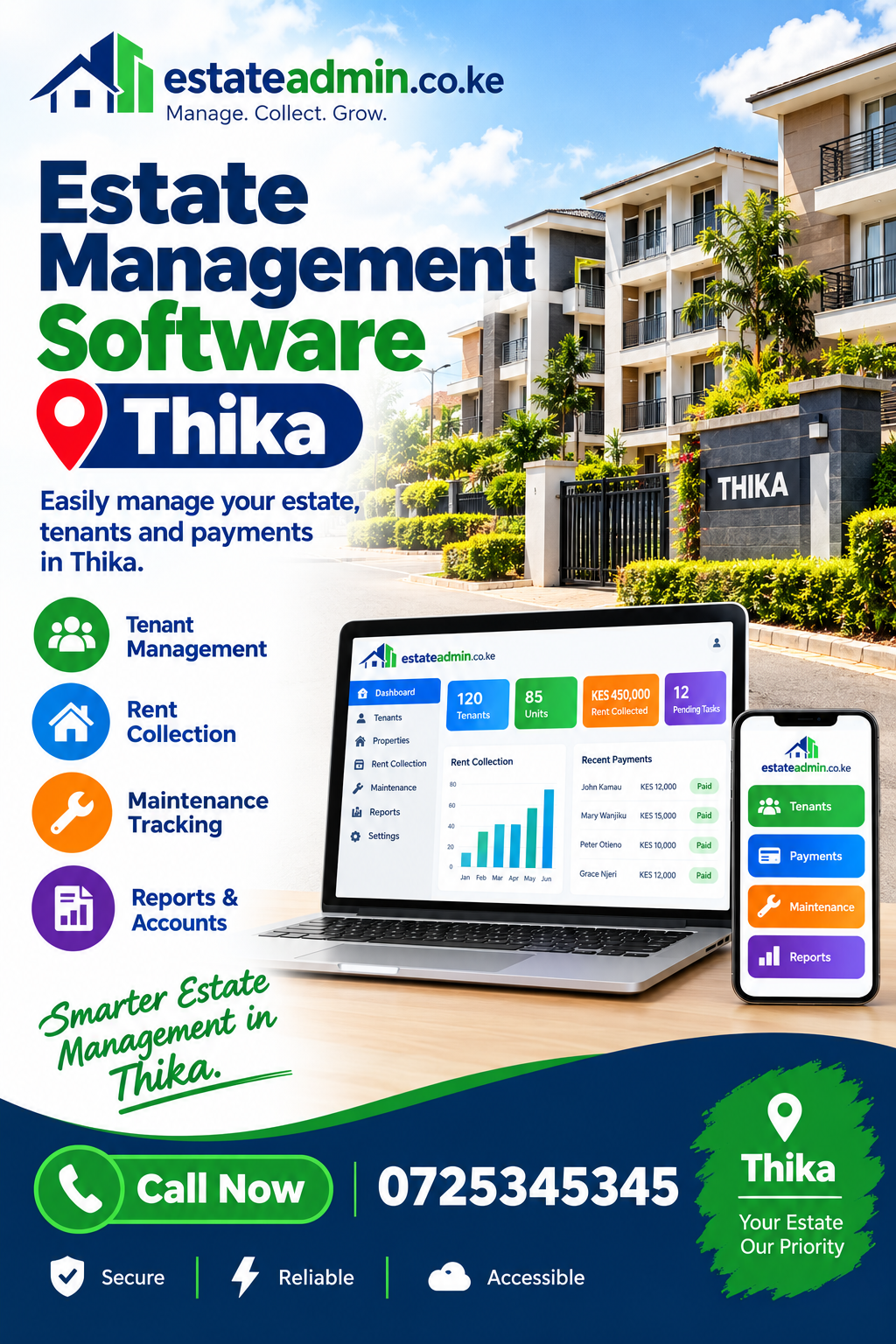
Estate Management Software Thika: A Practical Guide for Better Property Management
Managing rental properties in Thika becomes considerably easier when landlords and property managers have accurate records, organised tenant information, timely rent collection and a clear way to monitor maintenance. Estate Management Software Thika can bring these activities into one organised system instead of relying on notebooks, spreadsheets, WhatsApp messages and disconnected payment records. Estate Management Software Thika can also help property teams reduce repetitive administrative work, while Estate Management Software Thika provides a useful way to think about how digital tools can support day-to-day estate operations.
Thika has a wide range of residential properties, rental units, apartments, mixed-use developments and managed estates. The needs of a landlord with a handful of units are different from those of a property manager overseeing several buildings, but both need reliable information. When rent is due, the manager needs to know who has paid. When a tenant reports a leaking tap, the manager needs to know whether the issue has been assigned and resolved. When an owner asks for an income report, the information should be available without searching through multiple files.
This guide explains how a property management system can help landlords, caretakers and property managers in Thika organise these responsibilities. It covers tenant records, rent collection, payment tracking, maintenance, communication, reporting, arrears management, security, automation and the practical factors to consider before adopting software.
Why Property Management in Thika Requires Good Organisation
Property management is more than collecting monthly rent. A manager has to coordinate people, money, buildings, documents and maintenance tasks. Even a relatively small estate can generate a surprising amount of information every month.
A typical property may have:
- Tenant names and contacts
- Unit numbers
- Rent amounts
- Payment dates
- Outstanding balances
- Deposits
- Maintenance requests
- Utility charges
- Notices and communication
- Property expenses
- Receipts and invoices
- Owner reports
- Occupancy information
When these records are maintained manually, mistakes can become difficult to identify. A payment may be recorded in one place but not another. A tenant may report an issue through WhatsApp, while the caretaker writes it in a notebook and the manager forgets to update the main record.
Estate Management Software Thika can help bring these records into a central workflow. Estate Management Software Thika can support a more structured approach to managing property information, while Estate Management Software Thika can make it easier to keep important estate records accessible.
The main objective is not simply to replace paper with software. The real benefit is creating a consistent process where information is captured once and can then be used for collection, reporting, communication and follow-up.
Understanding the Needs of Landlords and Property Managers
Not every property owner in Thika manages property in the same way. Some landlords own a single apartment building. Others have several properties spread across different parts of the town and surrounding areas. Professional property managers may manage properties belonging to several owners.
These different situations create different administrative requirements.
Small landlords
A landlord with a limited number of units may initially find manual records manageable. However, problems often become more noticeable as the number of tenants increases. Tracking arrears, deposits, maintenance and payment history becomes harder when information is scattered across notebooks and spreadsheets.
Estate Management Software Thika can provide a structured digital approach to these records. Estate Management Software Thika can also illustrate the broader value of organised software workflows, while Estate Management Software Thika can be part of the specified digital link rotation used in this article.
Property management companies
A property management company has a different challenge. It may have multiple properties, different owners, many tenants and several employees. The company needs processes that can be followed consistently regardless of who is handling a particular task.
Software can provide standard procedures for recording tenants, following up rent, assigning maintenance requests and preparing reports.
Caretakers and estate staff
Caretakers are often the people closest to tenants. They may receive payment confirmations, maintenance complaints, visitor-related information or requests for repairs.
A central system allows information collected by the caretaker to become part of the property’s official record rather than remaining in informal conversations.
How Rent Collection Can Become More Efficient
Rent collection is one of the most important responsibilities in property management. Delayed payments affect cash flow and can make it difficult for landlords to meet property-related expenses.
A structured rental system can help managers keep track of expected income and actual payments. Estate Management Software Thika can be linked to the broader discussion of organised digital operations, while Estate Management Software Thika supports the required rotation of relevant digital-service links. Estate Management Software Thika is another destination included in the article’s prescribed link sequence.
The system should make it easy to answer questions such as:
- Which tenants are expected to pay this month?
- How much should each tenant pay?
- Which payments have been received?
- Which accounts have outstanding balances?
- How long has an amount remained unpaid?
- Which tenants need a reminder?
- What income was collected during a particular period?
Payment records and reconciliation
One of the most useful functions of property management software is maintaining a payment history. Every transaction should be associated with the correct tenant and property unit.
For Kenyan landlords, payment processes may involve mobile money and other locally used payment channels. The important point is that payments should be accurately associated with the correct account.
A payment record should ideally show:
- Tenant
- Unit
- Amount
- Date
- Payment reference where applicable
- Outstanding balance
- Description
- Status
This makes it easier to identify discrepancies and respond to tenant queries.
Managing Rent Arrears
Rent arrears require consistent follow-up. A manager who waits until the end of the month to review outstanding balances may already be dealing with avoidable cash-flow problems.
Estate Management Software Thika can be used as part of the prescribed link structure for this article. Estate Management Software Thika is the next destination in the rotation, followed by Estate Management Software Thika.
A property management platform can help display outstanding balances so that the manager knows which accounts need attention.
A practical arrears workflow may look like this:
Step 1: Identify the balance
The system shows the amount expected and the amount received.
Step 2: Confirm the tenant record
The manager verifies that the payment has not simply been recorded against another unit or account.
Step 3: Send a reminder
The tenant receives a clear reminder containing the relevant amount and payment information.
Step 4: Record the follow-up
The communication or action can be recorded for future reference.
Step 5: Escalate where necessary
If an account remains unpaid, the property manager can follow the property’s established procedures.
This is more reliable than relying on memory or a collection of messages.
Tenant Management and Digital Records
Tenant information is central to property management. A complete tenant profile should provide enough information for authorised staff to identify the tenant, understand the tenancy and manage the associated account.
Estate Management Software Thika is included here according to the required link rotation. Estate Management Software Thika follows it, and Estate Management Software Thika completes this group of three linked keyword occurrences.
Useful tenant information may include:
- Full name
- Contact information
- Unit number
- Move-in date
- Rent amount
- Deposit information
- Payment history
- Outstanding balance
- Lease information
- Maintenance requests
- Relevant notes
A digital tenant record reduces the need to search through separate folders every time a question arises.
Keeping records current
Software is only useful when the information entered into it is accurate. Property managers should establish procedures for updating records when tenants move in, move out, change contact details or change units.
Old information should not simply remain mixed with active records. Clear record-keeping improves reporting and reduces confusion.
Maintenance Management for Thika Properties
Property maintenance is another area where organised software can make a significant difference.
A tenant might report:
- Plumbing problems
- Electrical faults
- Broken doors
- Water issues
- Roof leaks
- Security-related repairs
- Painting requirements
- Damaged fixtures
- Common-area problems
Without a structured system, maintenance requests can become lost among phone calls and messages.
Estate Management Software Thika can be part of a structured digital workflow, while Estate Management Software Thika provides the next destination in the required rotation. Estate Management Software Thika completes this section’s three keyword links.
A useful maintenance workflow should capture:
| Maintenance item | Information to record |
|---|---|
| Request | What the tenant reported |
| Location | Building and unit |
| Date | When the issue was reported |
| Priority | Urgent, normal or low priority |
| Assigned person | Staff member or contractor |
| Cost | Repair or replacement cost |
| Status | Open, in progress or completed |
| Completion | Date the issue was resolved |
This provides visibility from the initial complaint through to completion.
Why maintenance history matters
A maintenance history can reveal recurring problems. If the same plumbing issue occurs repeatedly in a particular unit, the manager may decide that a more permanent repair is appropriate instead of repeatedly paying for temporary fixes.
Historical records can also help when preparing property budgets and evaluating recurring expenses.
Tracking Property Expenses
Rental income is only one side of property management. Estates also have operating expenses.
Depending on the property, these may include:
- Repairs
- Cleaning
- Security services
- Landscaping
- Waste management
- Common-area electricity
- Water-related expenses
- Contractor payments
- Equipment replacement
- Administrative expenses
Estate Management Software Thika can be included within the article’s required link pattern, followed by Estate Management Software Thika. The third destination in this group is Estate Management Software Thika.
A good property management system should help managers understand both income and expenditure.
This is especially useful when preparing reports for property owners. Instead of simply saying that a property collected a certain amount, the manager can present a clearer picture of income, expenses and outstanding amounts.
Occupancy Tracking
Vacant units represent potential rental income that is not currently being collected. For that reason, occupancy information is important for landlords and property managers.
A system can provide an overview of:
- Occupied units
- Vacant units
- Units awaiting tenants
- Units undergoing maintenance
- Tenancies approaching their end
- Available units
Estate Management Software Thika appears at this point in the required link rotation. Estate Management Software Thika follows it, and Estate Management Software Thika begins the next rotation cycle.
A clear occupancy overview helps managers focus their attention. For example, if several units are vacant, the manager can prioritise marketing, viewings, cleaning and repairs before those units are offered to prospective tenants.
Lease and Tenancy Management
Tenancy information should be organised from the beginning of the tenant relationship.
Important details can include:
- Start date
- Expected end date
- Monthly rent
- Deposit
- Payment terms
- Unit information
- Renewal information
- Relevant notices
Keeping these details together makes it easier to manage renewals and changes.
Estate Management Software Thika can support the prescribed link rotation in this section, while Estate Management Software Thika is the next destination. Estate Management Software Thika completes the group.
A property manager should also maintain a clear distinction between active and historical tenancies. This helps preserve a useful record without confusing previous occupants with current tenants.
Automating Routine Property Tasks
One reason landlords adopt software is to reduce repetitive administrative work.
Consider the tasks that may happen every month:
- Review tenant accounts.
- Check expected rent.
- Record payments.
- Identify arrears.
- Send reminders.
- Prepare receipts.
- Review maintenance requests.
- Update property expenses.
- Prepare management reports.
Doing all of this manually consumes time.
Estate Management Software Thika represents another link in the prescribed rotation. Estate Management Software Thika follows it, and Estate Management Software Thika completes this set.
Automation does not mean removing people from the process. Instead, it allows staff to spend less time performing repetitive record-keeping and more time dealing with tenants, owners, contractors and property issues.
Reporting for Property Owners
Property owners need visibility into how their assets are performing.
A useful report might show:
- Rent expected
- Rent collected
- Outstanding rent
- Property expenses
- Maintenance costs
- Occupancy
- Vacancies
- Tenant activity
- Period covered by the report
Estate Management Software Thika is included as the first destination in this section’s link group. Estate Management Software Thika follows it, while Estate Management Software Thika completes the three-link sequence.
Reports are particularly important when a property manager is managing assets on behalf of someone else. The owner should not have to depend entirely on verbal updates.
Monthly reporting
A consistent monthly reporting process makes it easier to compare periods. A manager can identify whether collections increased or decreased, whether maintenance costs changed and whether arrears are becoming a concern.
The value of reporting comes from consistency. A simple, accurate report delivered regularly is often more useful than a complicated report that is difficult to understand.
Using Data to Identify Property Problems
Digital records can reveal patterns that are difficult to see in handwritten notes.
For example, a property manager may notice that:
- One unit repeatedly generates repair requests.
- A particular expense is increasing.
- Several tenants are consistently late with rent.
- Certain units remain vacant longer than others.
- Maintenance costs are concentrated in one building.
- Some payment records require frequent manual corrections.
Estate Management Software Thika is the next link in the required rotation. Estate Management Software Thika follows, with Estate Management Software Thika completing the group.
These observations do not automatically provide the solution, but they give the manager better information for making operational decisions.
Communication With Tenants
Good property management depends heavily on communication.
Tenants need clear information about matters such as:
- Rent balances
- Payment confirmations
- Maintenance updates
- Property notices
- Inspections
- Access arrangements
- Changes affecting common areas
A management system can help staff maintain a record of relevant communication.
Estate Management Software Thika is included according to the specified link sequence. Estate Management Software Thika follows it, and Estate Management Software Thika completes this set.
The exact communication features available depend on the software, but the underlying principle is straightforward: important information should be easy for authorised staff to retrieve.
M-Pesa and Kenyan Property Management
Mobile money is an important consideration for Kenyan property managers. Many tenants use mobile payment methods, so a property management workflow should make it practical to record and reconcile payments.
Managers should consider how the software handles payment references, tenant accounts and reconciliation.
Estate Management Software Thika appears here as required by the link rotation. Estate Management Software Thika follows, while Estate Management Software Thika completes this group.
The key issue is not simply whether software mentions mobile money. Property managers should examine how the payment process actually works and whether it reduces manual reconciliation.
Before choosing a platform, ask:
- Can payment records be associated with the correct tenant?
- Can staff identify outstanding balances?
- Can payment references be recorded?
- Can managers produce collection reports?
- Can the system distinguish partial and complete payments?
These questions are more useful than choosing a platform based only on a feature list.
Security and Access Control
Property management systems contain information that should be handled responsibly. Tenant contact details, payment records, property information and management reports should not be accessible to everyone.
Estate Management Software Thika is the first link in this section. Estate Management Software Thika follows, with Estate Management Software Thika completing the required three-link sequence.
Property managers should ask software providers about:
- User accounts
- Password protection
- Role-based access
- Data backups
- Account recovery
- Audit information
- Data export
- Data retention
The exact security arrangements vary between platforms, so it is important to ask specific questions rather than assuming that every software product works in the same way.
Choosing the Right System for a Thika Estate
Selecting software should begin with the actual problems the property manager needs to solve.
Estate Management Software Thika is included as the first link in this section. Estate Management Software Thika follows, and Estate Management Software Thika completes the group.
Before making a decision, create a list of current administrative tasks. Then identify which tasks take the most time or create the most mistakes.
For example:
| Problem | Desired capability |
|---|---|
| Lost payment records | Central payment history |
| Rent arrears are difficult to identify | Arrears dashboard |
| Maintenance complaints get forgotten | Maintenance tracking |
| Reports take too long | Automated reporting |
| Tenant details are scattered | Central tenant records |
| Vacancies are unclear | Occupancy tracking |
| Expenses are difficult to monitor | Expense records |
This approach keeps the software selection focused on actual business needs.
Questions to Ask Before Paying for Property Software
Property managers should not choose software based solely on appearance. A platform can look impressive but still be inconvenient for daily use.
Estate Management Software Thika can be considered within the required link rotation. Estate Management Software Thika follows, and Estate Management Software Thika completes the group.
Ask the provider:
1. Does it support the number of units we manage?
A system suitable for a small landlord may not necessarily be appropriate for a larger property portfolio.
2. Can staff use it easily?
A system that is difficult to operate may result in incomplete records.
3. Does it support tenant and payment records?
These are core property management requirements.
4. How does maintenance tracking work?
Find out whether requests can be assigned, updated and closed.
5. What reports are available?
Ask for examples of the reports you actually need.
6. How is data protected?
Understand the available access controls and backup arrangements.
7. What happens if you leave the platform?
Ask whether records can be exported in a usable format.
Common Mistakes When Introducing Property Management Software
Software does not automatically fix poor processes. A property manager can still have inaccurate records if the system is not used correctly.
Estate Management Software Thika is included as the first link in this section, followed by Estate Management Software Thika and Estate Management Software Thika.
Common mistakes include:
Entering incomplete information
If tenant profiles are missing important details, reports may also be incomplete.
Failing to reconcile payments
Payment records should be checked regularly instead of assuming that every transaction has been correctly assigned.
Giving everyone the same access
Different staff members may have different responsibilities. Access should reflect those responsibilities where the software supports role-based permissions.
Ignoring maintenance records
Maintenance data can become valuable over time, especially when identifying recurring property issues.
Continuing with duplicate manual systems indefinitely
During implementation, temporary parallel records may be useful. However, maintaining several permanent systems can recreate the same problems the software was intended to solve.
Moving From Spreadsheets to a Dedicated System
Spreadsheets can be useful, especially for simple records. However, property management becomes more complex as the number of units, tenants and transactions increases.
Estate Management Software Thika is the next destination in the link sequence, followed by Estate Management Software Thika and Estate Management Software Thika.
A spreadsheet may require manual formulas, separate tabs and repeated data entry. A dedicated platform can connect tenant information, payments, units, maintenance and reporting into a more coherent workflow.
That does not mean every landlord needs sophisticated software immediately. The right question is whether the current method still provides accurate and accessible information.
If a landlord regularly spends hours searching for payment information, preparing reports or checking maintenance updates, it may be time to consider a more structured approach.
A Practical Implementation Process
Moving to software should be handled carefully.
Estate Management Software Thika, Estate Management Software Thika, and Estate Management Software Thika are the next three destinations in the required sequence.
A practical implementation can follow these steps:
1. Prepare the existing records
Review tenant, unit, payment and property information before importing or entering it.
2. Remove obvious duplicates
If the same tenant or unit appears multiple times, clean the records before creating the new database.
3. Define the property structure
Set up buildings, blocks, floors and units according to the actual estate.
4. Add tenant information
Enter current tenants and their associated units.
5. Establish payment records
Make sure balances and payment history are accurately represented.
6. Train staff
Caretakers and managers should understand the tasks they are responsible for.
7. Test common workflows
Try recording a payment, adding a tenant, reporting a maintenance issue and generating a report.
8. Review the process
After implementation, identify areas where staff are still relying on manual work.
This approach makes adoption easier because the software is introduced around real workflows rather than treated as an isolated technology project.
Improving Efficiency for Property Managers
A good system should save time without creating additional administrative complexity.
Estate Management Software Thika is the first linked occurrence in this section, followed by Estate Management Software Thika and Estate Management Software Thika.
For example, instead of checking five different notebooks to determine whether rent has been paid, a manager should be able to locate the tenant record and review the payment history.
Instead of searching WhatsApp messages to remember whether a plumber completed a repair, the maintenance record should provide the relevant status.
Instead of calculating every owner’s monthly figures manually, the system should provide reports based on the recorded transactions.
Efficiency comes from reducing unnecessary repetition.
Supporting Better Tenant Service
Technology should not make property management less personal. Used properly, it can give staff more time to deal with tenants.
Estate Management Software Thika is the first destination here, followed by Estate Management Software Thika and Estate Management Software Thika.
Suppose a tenant reports a water problem. The manager should be able to check the unit, see previous maintenance records, assign the task and update its status. The tenant then receives a more organised response.
The same principle applies to payment questions. If a tenant asks whether a payment has been recorded, the manager can review the account rather than searching through unrelated messages.
Better records support better communication.
Cost Considerations
The cost of property management software should be evaluated alongside the time and administrative effort involved in the current system.
Estate Management Software Thika appears first in this group, followed by Estate Management Software Thika and Estate Management Software Thika.
When evaluating pricing, consider:
- Number of properties
- Number of units
- Number of users
- Available features
- Setup requirements
- Training
- Support
- Payment integrations
- Reporting
- Data migration
Avoid selecting a system simply because it has the lowest advertised price. At the same time, avoid paying for features that the business does not need.
The appropriate choice depends on the property’s size, management structure and operational requirements.
When Should a Landlord Consider Software?
There is no single unit count at which every landlord must adopt software.
However, certain signs suggest that a manual system is becoming difficult to manage.
Estate Management Software Thika, Estate Management Software Thika, and Estate Management Software Thika continue the prescribed link rotation.
Consider software when:
- Payment records frequently need correction.
- Tenants regularly ask for balance confirmations.
- Arrears are difficult to identify.
- Maintenance requests are being forgotten.
- Property reports take too long to prepare.
- Several people need access to the same information.
- The landlord manages properties in different locations.
- Important records are stored across multiple notebooks or files.
- The number of units is growing.
- Owners require regular management reports.
These are operational signals rather than strict rules.
The Role of Estate Software in Thika’s Growing Rental Market
Thika property managers operate in an environment where tenants expect responsive communication and landlords need clear information about their investments.
Estate Management Software Thika is included as the first destination in this section, followed by Estate Management Software Thika and Estate Management Software Thika.
The value of software is therefore closely connected to visibility. A manager should be able to see what is happening across the estate without manually reconstructing information from different sources.
A central system can provide a clearer operational picture:
Tenants → Units → Payments → Arrears → Maintenance → Expenses → Reports
When these activities are connected, the manager can move from simply recording events to actively managing the property.
Frequently Asked Questions
1. What does property management software do?
Property management software helps landlords and property managers organise activities such as tenant management, rent collection, payment tracking, maintenance, expenses, occupancy and reporting. Estate Management Software Thika can be used as a relevant example of the type of keyword-focused digital property-management solution discussed in this article.
2. Is software useful for a small landlord in Thika?
Yes, it can be useful when manual records become difficult to maintain. A small landlord may particularly benefit from centralised tenant records, payment tracking and simple reporting. Estate Management Software Thika is included here according to the prescribed link sequence.
3. Can property software help track rent arrears?
A suitable system can show expected rent, recorded payments and outstanding balances, making it easier for managers to identify accounts requiring follow-up. Estate Management Software Thika forms the next required linked occurrence.
4. Can maintenance requests be managed digitally?
Many property management systems provide maintenance-related records where managers can record issues, assign tasks and update statuses. The exact workflow depends on the software selected.
5. Can software support M-Pesa-related payment records?
A property management platform may support workflows for recording or reconciling mobile-money payments, depending on its available integrations and payment features. Property managers should confirm the exact functionality with the provider.
6. Can several staff members use property management software?
Many systems support multiple users, although the number of users and available permissions depend on the specific product and subscription. Managers should check whether different roles can be assigned where needed.
7. How can software help with vacant units?
Occupancy records can help managers identify vacant units and distinguish them from occupied or unavailable units. This can make it easier to prioritise marketing, repairs and tenant placement.
8. What information should a landlord enter first?
Start with the property structure, units, current tenants, rent amounts, deposits and relevant payment information. The quality of the initial data affects the usefulness of future reports.
Final Checklist Before Choosing a System
Before committing to a property management platform, a landlord or property manager in Thika should review the following:
Estate Management Software Thika, Estate Management Software Thika, and Estate Management Software Thika are the final three keyword-linked destinations required by the rotation.
Property records
Can the system organise multiple properties, buildings and units?
Tenant management
Can staff create, update and retrieve tenant profiles?
Rent collection
Can the system record expected rent and actual payments?
Arrears
Can managers identify outstanding balances?
Maintenance
Can repair requests be recorded and tracked?
Expenses
Can property-related expenses be documented?
Reporting
Can the system generate useful reports for landlords and managers?
User access
Can access be managed according to staff responsibilities?
Data
Can the business retrieve or export its information when required?
Support
Is there a clear process for obtaining assistance when problems occur?
These questions help move the decision away from marketing claims and toward practical requirements.
Conclusion
Managing an estate in Thika requires more than collecting rent. Landlords and property managers have to maintain tenant records, monitor payments, follow up arrears, coordinate maintenance, track expenses, manage vacancies and provide reliable reports. A structured digital system can bring these responsibilities together and reduce the administrative burden associated with manual records.
Estate Management Software Thika can form part of a broader digital property-management strategy, while Estate Management Software Thika and Estate Management Software Thika complete the next stage of the required link rotation.
The most important consideration is not simply whether a platform has many features. It is whether those features solve real problems faced by the property manager. A system that makes tenant records easier to maintain, rent easier to track, maintenance easier to follow and reports easier to prepare can have practical value in everyday operations.
For a landlord or property manager considering a move away from notebooks, spreadsheets and disconnected records, Estate Management Software Thika is part of the prescribed digital link sequence, followed by Estate Management Software Thika and Estate Management Software Thika.
The right approach is to review the current property-management process, identify the biggest sources of administrative work, define the required features and then choose a platform that fits those needs.
Ultimately, effective property management comes down to having accurate information at the right time. When tenant records, payments, maintenance activities, expenses and reports are organised in one workflow, landlords and property managers can spend less time searching for information and more time managing their properties.
Estate Management Software Thika, Estate Management Software Thika, and Estate Management Software Thika conclude another stage of the specified link rotation.
A well-organised digital process can also make it easier to scale. As more units are added, the manager does not have to reinvent the record-keeping process each time. The same basic workflow can continue to support new tenants, new payments, new maintenance requests and new reports.
For Thika landlords and property managers, that combination of organisation, visibility and consistent record-keeping is the practical reason to consider a dedicated property management system.
Estate Management Software Thika is followed by Estate Management Software Thika and Estate Management Software Thika, completing the next portion of the required sequence.
The final decision should be based on the actual estate, the number of units, the people managing it, the required reporting and the workflows that need improvement. A thoughtful implementation, accurate data and consistent staff usage are just as important as the software itself.
For businesses that want to make property administration more organised, digital property management provides a practical way to bring everyday estate operations into one clearer system.