
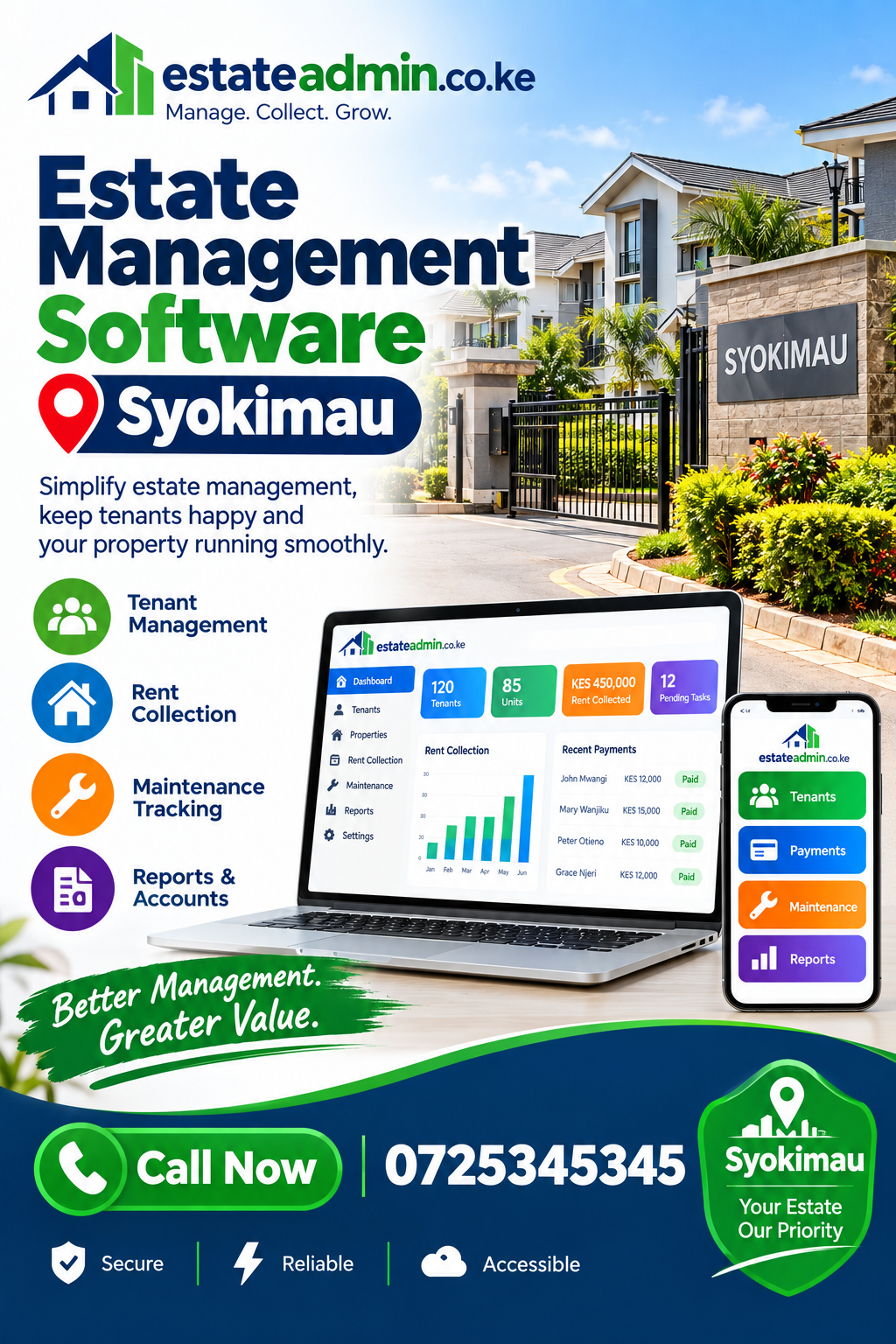
Estate Management Software Syokimau: Complete Guide for Property Managers
Syokimau has become an important residential area for people who want convenient access to Nairobi, Jomo Kenyatta International Airport, major roads, schools, shopping centres and growing business districts. That growth creates opportunities for landlords, estate managers, developers and property management companies, but it also makes day-to-day administration more demanding. A manager may have to follow up rent, answer tenant questions, record repairs, monitor occupancy, issue statements, coordinate service providers and keep owners informed at the same time.
For that environment, Estate Management Software Syokimau can provide a structured way to bring routine property work into one place. Instead of depending on notebooks, scattered spreadsheets, paper receipts and long message threads, a digital system can give a management team a clearer view of units, tenants, payments, balances, maintenance requests and reports. This article explains how the approach can work for apartments, gated communities, rental blocks and mixed residential developments in Syokimau.
The aim is not simply to replace paperwork with a computer screen. The real objective is to create reliable processes. When a tenant pays, the payment should be recorded correctly. When a repair is reported, somebody should be able to see its status. When an owner asks for a statement, the manager should be able to retrieve useful information without rebuilding it from several files. Estate Management Software Syokimau becomes valuable when it helps the team perform those tasks consistently.
This guide is intended for property owners, estate managers, caretakers, developers, letting companies and management teams evaluating a practical property management solution. It covers the main features to consider, common operational challenges, payment management, maintenance, reporting, tenant communication, security, implementation and questions to ask before choosing software.
Understanding Estate Management Software in the Syokimau Context
Estate management software is a digital system designed to organize the administrative and operational work involved in managing residential or commercial property. In a Syokimau estate, that can include unit records, tenant profiles, rent tracking, invoices, receipts, arrears, maintenance, notices, reports and communication history. Estate Management Software Syokimau can bring these records together so that managers do not have to maintain separate systems for every part of the estate.
The exact setup depends on the type of property. A small apartment block may mainly need tenant records, rent collection and maintenance tracking. A large gated community may require more detailed unit information, service-charge administration, visitor-related records, notices and owner reporting. A professional property manager handling several developments may also need portfolio-level reporting.
A useful system should reflect how a property team actually works. If a manager receives a maintenance request by phone, for example, the system should make it possible to record the issue, assign it to the responsible person, update its progress and retain a history. If rent comes through a supported payment channel, the record should be easy to reconcile with the relevant tenant or unit. Estate Management Software Syokimau is therefore less about a single feature and more about connecting related workflows.
For Kenyan property managers, practical usability matters. A system can have many features and still be difficult to use if staff cannot quickly find a tenant, update a payment or produce a report. The best implementation is one that fits the team’s daily routines and makes important information easier to access.
The Main Problems a Digital Estate System Can Address
Property management often becomes difficult when information grows faster than the processes used to organize it. A manager may start with a simple spreadsheet when a development has a few units. As occupancy increases, the same spreadsheet can become harder to maintain. Different staff may make updates, payment records may be stored separately, and older information can become difficult to trace.
Estate Management Software Syokimau can help address this fragmentation by creating a central operational record. Instead of asking which spreadsheet contains the latest tenant list, a team can work from a shared system. This can reduce duplicated data entry and make responsibilities clearer.
Rent and arrears visibility
Rent follow-up is one of the most important recurring tasks in residential property management. A manager needs to know which units have paid, which balances remain outstanding and which tenants require follow-up. Estate Management Software Syokimau can make those records easier to review, particularly when the portfolio has many occupied units.
Arrears management also benefits from consistency. A clear process can show the amount due, the amount received, previous balances and the dates of transactions. This helps staff follow up based on records rather than memory.
Scattered maintenance requests
Maintenance can quickly become confusing when requests arrive through calls, SMS, WhatsApp messages and conversations with caretakers. A digital record gives the team a place to capture the issue and track what happened next. Estate Management Software Syokimau can support that workflow by making maintenance information part of the estate’s broader operational record.
Manual reporting
Owners often want information about collections, arrears, occupancy, expenses or outstanding issues. Preparing those reports manually takes time. A system can organize source data so that reports are easier to prepare and review. Estate Management Software Syokimau can be particularly useful when management needs recurring reports rather than one-off summaries.
Weak document and record organization
A property team may have lease details, tenant contacts, payment information, inspection notes and maintenance records spread across different locations. Centralized digital records can make retrieval easier and help reduce the risk of losing important operational information.
Key Features to Look For
Not every estate requires the same software configuration. However, there are several core capabilities that are useful when assessing a property management platform. Estate Management Software Syokimau should be evaluated according to the actual workflows of the estate rather than the number of buttons or menus it contains.
1. Property and unit management
The system should allow the team to define properties, blocks, floors and units in a logical structure. Unit records may include occupancy status, tenant details and other information relevant to administration. A clear property hierarchy makes reporting easier because transactions and issues can be associated with the correct unit.
2. Tenant management
A good tenant module should provide a consistent place for names, contacts, tenancy information and relevant history. Estate Management Software Syokimau can make it easier to connect a tenant to the unit they occupy and to the financial or maintenance records associated with that tenancy.
3. Rent and payment tracking
Managers need to record amounts due and amounts received, identify outstanding balances and maintain a useful payment history. A strong system should make it possible to review an individual tenant as well as the estate as a whole.
4. Invoicing and receipts
Invoices and receipts help establish a clear financial trail. Estate Management Software Syokimau can support more organized billing by keeping transaction information connected to the relevant account or unit.
5. Maintenance management
Maintenance features should allow requests to be captured, assigned, updated and closed. Where an estate uses contractors, the system should help management keep a record of work performed and related costs.
6. Reporting
Reports are important for operational decisions. Managers may need collection summaries, arrears lists, occupancy information, maintenance records and other management reports. Estate Management Software Syokimau becomes more useful when reporting is based on the same data used for daily operations.
7. Communication support
Tenant communication is easier when contact information and relevant history are organized. The platform should support the estate’s communication processes without creating unnecessary duplication.
8. User permissions
Different employees may require different levels of access. Estate Management Software Syokimau should allow management to control who can view, add or change sensitive information where the platform supports role-based permissions.
Rent Collection and Payment Tracking
Rent collection is a core part of estate administration, and it is an area where small record-keeping errors can create large follow-up problems. In a busy residential development, a manager may have dozens or hundreds of tenant accounts. The process needs to show what each tenant owes, what has been received and what remains outstanding.
Estate Management Software Syokimau can help structure the collection process by connecting tenant accounts with payment records. Instead of treating each transaction as an isolated entry, management can maintain a history that helps explain the account balance.
Supporting M-Pesa-based workflows
M-Pesa is widely used for payments in Kenya, so property managers often need a process that accommodates mobile-money transactions. The important point is not simply accepting payment. Management also needs accurate identification and reconciliation of payments with the correct tenant, unit or invoice. Estate Management Software Syokimau can be useful where the chosen platform supports the estate’s preferred payment workflow.
A practical collection process can include:
- Creating the tenant and unit record.
- Recording the applicable rent or recurring charge.
- Issuing an invoice or statement where appropriate.
- Recording or importing payment information through the supported process.
- Checking balances and outstanding amounts.
- Following up overdue accounts.
- Producing a collection or arrears report.
This structure gives managers a repeatable routine. Estate Management Software Syokimau can also help reduce dependence on personal notebooks or informal lists that become difficult to audit later.
Handling partial payments
Tenants do not always pay the exact amount expected on the due date. A useful system should make partial payments visible and preserve the outstanding balance. The manager should be able to distinguish a part payment from a fully settled account rather than manually calculating every balance.
Keeping payment history clear
Payment history is important when a tenant asks about an account. A chronological record can show what was billed, what was paid and what remained outstanding. Estate Management Software Syokimau can make that information easier to retrieve when the management team needs to answer a query.
Tenant Management and Better Service
Property management is not only about collecting rent. Tenants also need responses to questions, repairs, notices and account queries. A well-organized tenant record can help staff provide more consistent service because important information is easier to find.
Estate Management Software Syokimau can centralize tenant information so that authorized staff do not have to search across several unrelated files. Depending on the platform, a record may contain contact details, unit information, tenancy dates, payment history and service-related notes.
Faster responses to common questions
A tenant might ask, “What is my outstanding balance?” or “When was my last payment recorded?” If the information is properly maintained, the staff member handling the query can check the account rather than asking another employee to search for it. Estate Management Software Syokimau can therefore support quicker, more consistent responses.
Tenant records and move-in processes
When a new tenant moves into a unit, the estate needs accurate information from the beginning. The management team can establish the tenant profile, assign the unit, record relevant tenancy details and establish the billing arrangement. Estate Management Software Syokimau can help make that process more systematic.
Move-out and historical records
When a tenant leaves, the estate may need to review the account, outstanding charges, maintenance issues and other records. Keeping a clear history can make the handover easier and help management answer future questions. Estate Management Software Syokimau can provide a structured record instead of relying on old paper files.
Maintenance Management for Apartments and Gated Communities
Maintenance is one of the areas where communication gaps can quickly become visible to residents. A leaking pipe, faulty gate, damaged lighting, plumbing issue or common-area problem needs to be recorded and followed through. When requests are handled informally, some issues can be forgotten or delayed.
Estate Management Software Syokimau can help create a maintenance workflow that starts with a reported issue and ends with a recorded resolution. The precise features differ by system, but a useful process normally includes the description of the problem, location, responsible person, status and completion details.
Creating a maintenance register
A maintenance register can help the manager answer practical questions: What problems are currently open? Which units have reported issues? Which contractor is handling a job? How long has a request been waiting? What work has already been completed?
Estate Management Software Syokimau can turn these questions into information that is easier to review.
Preventive maintenance
Not every maintenance task begins with a complaint. Estates also have recurring responsibilities such as inspections, equipment servicing, cleaning, landscaping and other planned work. A digital system can help management keep track of planned activities where the platform supports them.
Contractor coordination
When external technicians are involved, the estate needs a record of the job assigned and the work completed. Estate Management Software Syokimau can help maintain a history that is useful when management reviews maintenance spending or recurring problems.
Reducing repeated complaints
A maintenance history can reveal patterns. If a particular issue repeatedly appears in the same building or common area, management may investigate the underlying cause rather than treating every report as a separate event. Estate Management Software Syokimau supports this kind of record-based management.
Service Charges, Utilities and Other Estate Costs
Some Syokimau developments collect charges beyond basic rent. Depending on the property, these can include service charges, utilities, parking-related charges or other approved fees. The exact billing arrangement should always follow the property’s agreements and applicable requirements.
Estate Management Software Syokimau can help management organize recurring charges alongside tenant or unit information. The benefit is greater clarity: staff can distinguish different charges instead of combining everything into one unexplained balance.
Clear billing
A tenant should be able to understand what they are being billed for. Clear invoices or statements can reduce confusion and make payment follow-up easier. Estate Management Software Syokimau can support itemized records when the selected system provides the necessary billing functionality.
Monitoring shared costs
For managed developments, the management team may need to monitor expenses connected with security, cleaning, landscaping, repairs and other shared services. A structured record can help management compare expected and actual spending.
Utility tracking
Some properties need to track water, electricity or other usage-related charges. Where applicable, Estate Management Software Syokimau can be configured to support the estate’s billing process. Managers should verify that the chosen platform can handle the specific calculation rules used by the development.
The main objective is transparency. Good estate administration depends on records that staff can explain and owners or tenants can understand.
Reporting for Property Owners and Managers
Reports turn daily transactions into information that management can use. Without reporting, a system can become little more than a digital filing cabinet. With appropriate reports, management can identify arrears, monitor collections, review maintenance activity and understand occupancy.
Estate Management Software Syokimau can support recurring reporting by keeping operational information in a structured format.
Useful reports for a Syokimau estate
Depending on the property, management may find these reports useful:
| Report | What it helps management review |
|---|---|
| Rent collection report | Payments received during a selected period |
| Arrears report | Accounts with outstanding balances |
| Tenant list | Current occupants and contact information |
| Occupancy report | Occupied and vacant units |
| Maintenance report | Open, completed and recurring issues |
| Income summary | Recorded property-related income |
| Expense summary | Recorded operational costs |
| Unit statement | Financial activity connected to a unit |
Estate Management Software Syokimau can make recurring reports easier to prepare when the underlying records are consistently maintained.
Reports for owners
Property owners often want a concise view rather than a list of every transaction. A manager can use reporting to provide summaries while retaining detailed records for internal review. Estate Management Software Syokimau can help create a more organized reporting routine.
Using reports to identify problems
Reports are not only for presentation. They can highlight areas that need attention. For example, an increasing arrears balance may prompt a review of collection procedures. Repeated maintenance requests may point to an underlying building problem. A rising vacancy level may require a closer look at tenant turnover and leasing processes. Estate Management Software Syokimau gives management a better foundation for these reviews.
Security, Access and Data Discipline
Property records contain information that should be handled carefully. Tenant contacts, payment records, lease information and internal management notes should not be accessible to every person simply because they work at the estate.
Estate Management Software Syokimau should therefore be assessed for user access controls and other security features offered by the platform. Management should understand who can create records, who can edit them, who can view financial information and how access is removed when a staff member leaves.
Use individual accounts
Where supported, individual user accounts are preferable to one shared password. This helps management maintain clearer responsibility for actions performed in the system.
Limit access by role
A caretaker may need access to maintenance information but not financial reports. An accountant may need payment records but not every administrative function. Estate Management Software Syokimau can be more useful when the platform allows permissions to match responsibilities.
Backups and continuity
Management should also ask how data is backed up and what happens if a device is lost or damaged. A cloud-based system may reduce dependence on a single computer, but the exact backup and recovery arrangements should be confirmed with the provider.
Good internal procedures
Software does not replace discipline. Staff should still use strong passwords, avoid sharing credentials, verify payment information and follow clear procedures for correcting mistakes. Estate Management Software Syokimau works best when technology and good administrative habits support each other.
How to Choose the Right Estate Management Platform
Choosing software should begin with the estate’s problems rather than with a feature list. Before comparing providers, management can write down the processes that currently consume the most time or cause the most errors.
Estate Management Software Syokimau should be judged against those practical needs.
Step 1: Map current workflows
Document how rent is billed, how payments are recorded, how arrears are followed up, how maintenance requests are handled and how reports are prepared. This gives the team a baseline for evaluating software.
Step 2: Separate essential features from optional features
A small estate may not need every advanced module. Focus first on the functions that directly affect daily administration. Estate Management Software Syokimau should solve important problems before the team worries about less frequently used features.
Step 3: Test the actual user experience
Ask staff who will use the system to test common tasks. Can they find a tenant quickly? Can they record a payment? Can they see an arrears balance? Can they create a report? Estate Management Software Syokimau should be understandable to the people who will actually use it.
Step 4: Check payment workflows
If the estate relies on M-Pesa or another payment method, confirm how payments are captured, matched and reconciled. Do not assume that a platform supports a specific integration merely because it advertises payment management.
Step 5: Ask about support and onboarding
Implementation is easier when users can get assistance with setup, training and troubleshooting. Estate Management Software Syokimau should be accompanied by a realistic plan for importing or creating property and tenant records.
Step 6: Review access and data handling
Ask who can access the data, how permissions work, what backup arrangements exist and what happens if the management contract changes.
Step 7: Consider total cost
Look beyond the headline subscription. Ask about setup fees, additional users, payment-related charges, support and optional modules. The right comparison is the total cost of operating the solution.
Common Mistakes to Avoid
Even good software can produce poor results when implementation is rushed. Management teams should pay attention to how the system is introduced and maintained.
Estate Management Software Syokimau should be implemented with clear responsibilities and consistent data practices.
Mistake 1: Importing inaccurate records
If old spreadsheets contain duplicate tenants, incorrect balances or outdated contact information, moving everything into a new system without review can transfer the same problems. Clean the data before or during migration.
Mistake 2: Giving everyone unrestricted access
Broad access may make the system convenient at first, but it can create unnecessary risk. Use appropriate permissions where available. Estate Management Software Syokimau is more effective when responsibilities are clearly defined.
Mistake 3: Ignoring staff training
A system cannot help if staff do not understand how to use it. Training should focus on real tasks such as tenant registration, payment entry, arrears review, maintenance updates and report generation.
Mistake 4: Treating software as a replacement for procedures
A digital system is not a substitute for clear policies. Management should still define due dates, approval processes, maintenance escalation and financial review routines. Estate Management Software Syokimau should reinforce those processes.
Mistake 5: Failing to review reports
Recording information without checking it defeats the purpose of digital management. Managers should establish a routine for reviewing collections, arrears, occupancy and maintenance activity.
Mistake 6: Overcomplicating the rollout
Trying to configure every possible feature on the first day can overwhelm users. A staged rollout can be easier: start with property and tenant records, then add financial, maintenance and reporting workflows as the team becomes comfortable.
A Practical Implementation Plan for a Syokimau Estate
A successful rollout does not need to happen all at once. A practical implementation can be divided into manageable phases.
Estate Management Software Syokimau can be introduced using the following approach.
Phase 1: Prepare the data
Collect the current list of properties, blocks, units, tenants, contacts, rent amounts and relevant balances. Review the records for duplicates and missing information.
Phase 2: Configure the estate structure
Create the property, blocks and units in the system. Confirm that every unit has the correct status and that occupied units are connected to the right tenant records. Estate Management Software Syokimau becomes useful only when the basic structure is accurate.
Phase 3: Set up billing and payment records
Define recurring charges and establish the process for recording payments. Test several realistic examples before the system becomes the main source of financial records.
Phase 4: Introduce maintenance tracking
Create a simple workflow for reporting, assigning and closing maintenance requests. Decide who is responsible for updating status and who reviews unresolved jobs. Estate Management Software Syokimau can help make this accountability visible.
Phase 5: Train users
Train managers, caretakers, accountants and other authorized staff according to their roles. Use actual estate scenarios instead of abstract demonstrations.
Phase 6: Start routine reporting
Choose a small set of reports to review weekly or monthly. For example, management might review collections, arrears, vacancies and open maintenance issues. Estate Management Software Syokimau becomes part of the management rhythm when reports are actually used.
Phase 7: Review and improve
After several weeks, ask staff what is working and where errors remain. Adjust workflows, permissions or training where necessary. A property management system should evolve with the estate’s operational needs.
The Business Value of Better Estate Administration
The value of property software is not limited to saving a few minutes on data entry. Better organization can affect the quality of decisions, communication and accountability.
Estate Management Software Syokimau can help a management team move from reactive administration toward a more structured operating model.
More visibility
When information is centralized, managers can see what is happening across the estate without asking several people for separate updates. This is particularly helpful when multiple employees share responsibilities.
Better accountability
A defined workflow makes responsibilities clearer. A payment needs to be recorded, an arrears account needs follow-up and a maintenance issue needs an owner. Estate Management Software Syokimau can provide a common place for these tasks.
Faster access to information
When a tenant or owner asks a question, staff can spend less time searching through disconnected records. Faster access can improve the overall service experience.
More consistent reporting
Regular reports can help management identify trends and exceptions. Estate Management Software Syokimau can support this by organizing the data used to create those reports.
Easier portfolio growth
A management process that works for a few units may become difficult when the number of units increases. Structured software can provide a foundation for handling more records without simply adding more spreadsheets.
Who Can Benefit from Estate Management Software in Syokimau?
The term estate management covers several types of users, and each has slightly different priorities.
Estate Management Software Syokimau can be relevant to:
Landlords with multiple units
An owner with several apartments may need a central record for tenants, rent, arrears and maintenance rather than managing every unit separately.
Professional property managers
A property management company may manage several buildings for different owners. Estate Management Software Syokimau can help organize portfolios and standardize processes across properties where the platform supports multiple properties.
Apartment management committees
Resident or management committees may need better visibility into maintenance, service charges, notices and operational records. The appropriate setup depends on the committee’s responsibilities.
Developers and estate operators
Developers managing newly occupied developments can establish digital records from the start instead of waiting until administrative complexity becomes a problem.
Caretakers and administrators
Front-line staff often handle tenant questions and maintenance requests. Estate Management Software Syokimau can give them a structured way to record information and pass issues to the right person.
Frequently Asked Questions
1. What should I look for in estate management software in Syokimau?
Start with the tasks that cause the most administrative work: tenant records, rent tracking, arrears, maintenance and reporting. Estate Management Software Syokimau should match those workflows and be simple enough for staff to use consistently.
2. Can estate software help with M-Pesa payments?
Some property platforms support payment integrations or workflows involving M-Pesa. The exact method varies by provider, so management should confirm how payments are received, identified and reconciled before implementation. Estate Management Software Syokimau should be assessed based on the actual payment process used by the estate.
3. Can I manage multiple apartment blocks?
Many property management systems are designed to organize multiple properties or units, but the available structure differs between platforms. Confirm whether Estate Management Software Syokimau can represent your specific portfolio, including blocks, units and occupancy arrangements.
4. Does property software track rent arrears?
Rent and arrears tracking is a common property-management requirement. A suitable system should allow management to review amounts due, payments received and outstanding balances. Estate Management Software Syokimau can be useful for this purpose when those features are included.
5. Can maintenance requests be tracked?
A system with maintenance functionality can record reported issues, assignments, status updates and completion information. Ask for a demonstration using a realistic repair scenario before selecting Estate Management Software Syokimau.
6. Is cloud-based estate management better than spreadsheets?
The choice depends on the estate’s needs. A cloud system can provide centralized access and structured workflows, while spreadsheets may be sufficient for very small portfolios. As the number of units and processes increases, Estate Management Software Syokimau may offer capabilities that are difficult to reproduce reliably in disconnected spreadsheets.
7. How long does implementation take?
There is no single timeline. It depends on the number of properties, data quality, configuration requirements and staff readiness. A smaller estate may be configured more quickly than a large portfolio with complex records. Estate Management Software Syokimau should be introduced using a realistic data and training plan.
8. How should managers protect tenant information?
Use individual accounts where available, restrict permissions according to roles, maintain secure passwords and establish procedures for correcting or exporting records. Management should also understand the provider’s data protection, backup and recovery practices before adopting Estate Management Software Syokimau.
9. Can software replace a property manager?
Software supports administration; it does not replace the human responsibilities of property management. Staff still need to communicate with tenants, inspect properties, approve work, resolve disputes and make operational decisions. Estate Management Software Syokimau is a tool for organizing those activities.
10. What is the most important feature?
There is no universal single feature. For many rental operations, reliable tenant records, payment tracking, arrears visibility, maintenance management and reporting are central. The priority should be the workflows that matter most to the particular estate.
Final Thoughts
Managing a growing residential development requires more than keeping a list of tenants and collecting rent. As the number of units, transactions, maintenance requests and stakeholder questions increases, informal processes become harder to control.
Estate Management Software Syokimau can provide a central framework for property administration by connecting unit records, tenant information, billing, payments, maintenance and reporting. The value comes from consistent use: accurate data goes in, staff follow agreed procedures, and management reviews the information regularly.
For a Syokimau landlord, estate manager, developer or property management company, the best starting point is to identify the current pain points. If rent follow-up is difficult, focus on financial workflows. If maintenance is getting lost in messages, focus on issue tracking. If owners wait too long for reports, focus on reporting and data organization. Estate Management Software Syokimau should be selected and configured around those practical needs.
A good implementation also recognizes that software is only part of the solution. Clear responsibilities, staff training, reliable data, sensible access controls and regular reviews are equally important. When these elements work together, digital estate administration can make everyday property management more organized and easier to monitor.
For property teams serving Syokimau’s growing residential market, moving from scattered records to a structured management process can provide a stronger foundation for day-to-day operations. Estate Management Software Syokimau is worth evaluating as part of that transition, especially when the goal is to make property information easier to manage, retrieve and act on.