
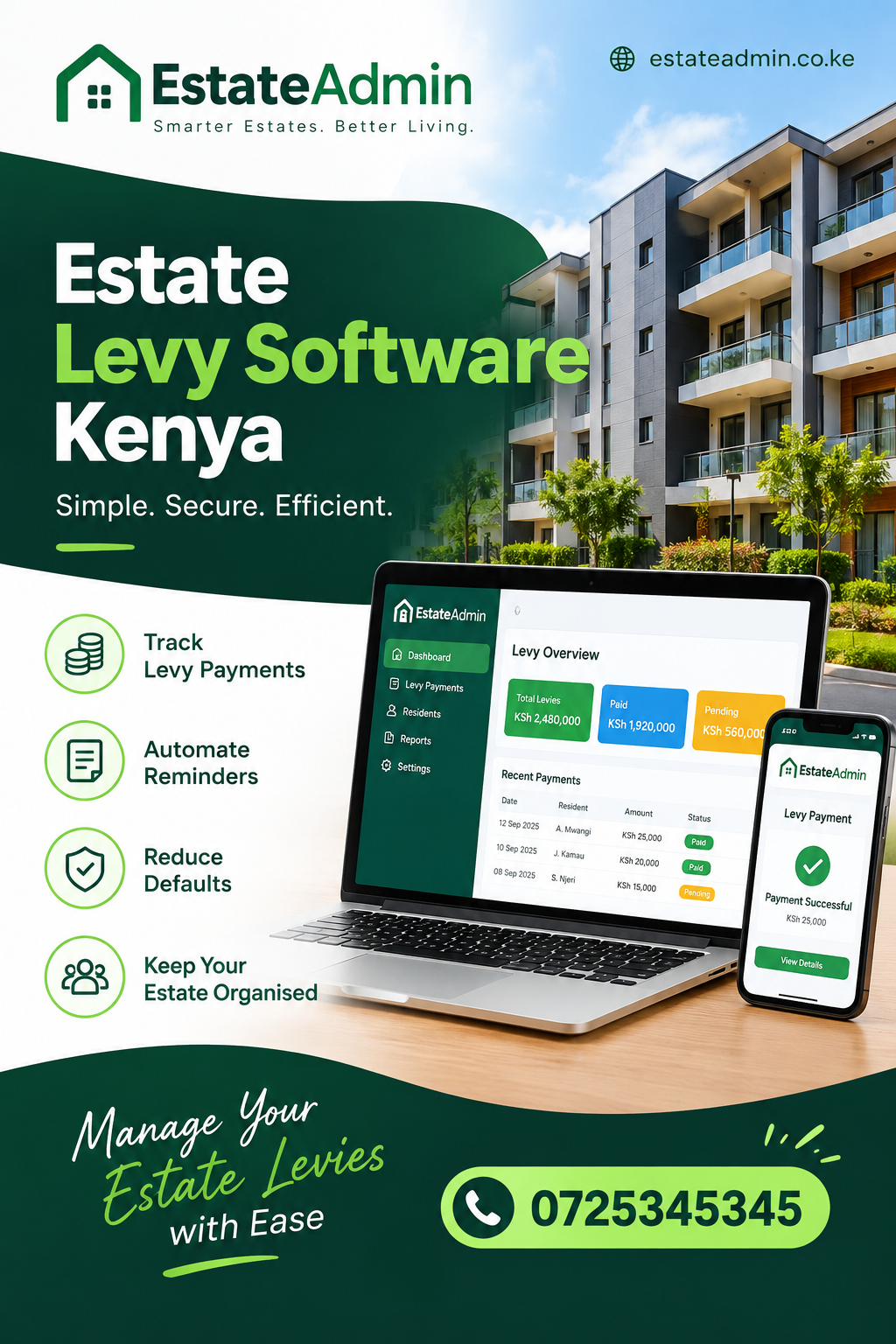
Estate Levy Software Kenya: A Practical Guide to Better Levy Management
Managing an estate is rarely difficult because of one large task. The pressure usually comes from dozens of small financial responsibilities happening at the same time: preparing levy charges, checking payment records, following up on balances, answering resident questions, producing statements, and keeping management records accurate. For estate managers, management companies, committees, and property administrators in Kenya, these tasks can quickly become difficult when they depend on spreadsheets, notebooks, WhatsApp messages, and separate payment records. Estate Levy Software Kenya provides a way to bring levy-related work into one organised digital process.
The purpose of levy management is straightforward: collect the money required to operate and maintain a residential development while giving residents a clear record of what they owe and what they have paid. The practical side is more complicated. An estate may have different units, different levy amounts, late payments, adjustments, receipts, service providers, maintenance expenses, and committee reporting requirements. A good system should reduce unnecessary manual work without taking control away from the people responsible for financial decisions.
This guide explains how digital estate levy management works, which features matter, how it can support Kenyan estates, what to check before choosing software, and how a management team can introduce it without disrupting normal operations.
What Estate Levy Management Means
Estate levy management covers the process of calculating, recording, billing, collecting, tracking, and reporting payments made by residents or unit owners toward shared estate expenses. Depending on the development, these payments may support security, cleaning, landscaping, waste management, common-area electricity, repairs, administration, water-related services, or other approved costs.
Estate Levy Software Kenya is useful because the software can turn these separate activities into a connected workflow. Instead of preparing a charge in one place, recording payment somewhere else, and creating a statement manually, the management team can maintain a central record. That creates a clearer relationship between a unit, its levy charges, its payments, and its outstanding balance.
The exact levy structure differs from one estate to another. Some communities use a fixed monthly amount. Others have different charges based on unit type, size, services, or decisions made by the management body. The software therefore needs to support the estate’s actual rules rather than forcing every property into the same billing model.
Estate Levy Software Kenya can be used as the central place for this part of the workflow. The goal is to make routine levy administration easier to review and maintain. A well-configured Estate Levy Software Kenya process can also give managers a clearer starting point when residents ask questions about charges or balances.
Why Estate Levy Software Kenya Can Matter for Kenyan Estates
Manual levy management can become difficult when an estate has many units, recurring charges, several payment methods, and a management team that needs regular financial reports. A structured digital process can help reduce the number of separate records staff need to maintain.
For an estate manager, Estate Levy Software Kenya can provide a more organised approach to everyday levy administration. Instead of depending on several spreadsheets or manually checking different records, the manager can work from a central account history.
A good system should make it easier to answer practical questions:
- Which units have been billed?
- Which residents have paid?
- Which accounts still have balances?
- How much has been collected?
- Which payments need reconciliation?
- Which residents need follow-up?
- Can an individual statement be produced quickly?
- Can management generate a useful report for a committee meeting?
Estate Levy Software Kenya can also support consistency when more than one person works on estate administration.
Estate teams can use Estate Levy Software Kenya as the central place for this part of the workflow. The goal is to make routine levy administration easier to review and maintain. A well-configured Estate Levy Software Kenya process can also give managers a clearer starting point when residents ask questions about charges or balances.
Why Manual Levy Tracking Becomes Difficult
Small estates can sometimes manage a limited number of transactions manually. Problems appear as the number of units, transactions, and exceptions increases. A spreadsheet may contain a list of residents, while payment confirmations sit in email or mobile-money messages. A separate notebook may contain maintenance expenses. When a resident asks for a statement, someone has to bring those pieces together.
With Estate Levy Software Kenya, the objective is to reduce that fragmentation. A central system can keep charge records, payment information, balances, resident details, and reports connected.
Common problems with manual processes include:
- Duplicate entries when more than one person updates a spreadsheet.
- Delays when a payment needs to be matched to the correct unit.
- Difficulty identifying long-outstanding balances.
- Errors when monthly charges are copied from one period to another.
- Time spent preparing individual statements.
- Weak visibility when committee members need a financial summary.
- Missing history when staff members change.
- Confusion when adjustments are made without a clear audit trail.
The issue is not that spreadsheets are always bad. They can be useful for analysis and temporary work. The problem is relying on them as the only system for a process that requires consistent records and regular follow-up.
Estate Levy Software Kenya can be used as the central place for this part of the workflow. The goal is to make routine levy administration easier to review and maintain. A well-configured Estate Levy Software Kenya process can also give managers a clearer starting point when residents ask questions about charges or balances.
How Estate Levy Software Can Organise the Process
A useful Estate Levy Software Kenya setup should make the journey from charge creation to payment reporting easy to understand.
A typical process can look like this:
- Register the estate and its units.
- Add resident or owner information.
- Define the applicable levy structure.
- Create recurring or one-off charges.
- Notify residents of amounts due.
- Record or reconcile payments.
- Update outstanding balances.
- Generate statements and reports.
- Follow up on overdue accounts.
- Review collections against the estate’s financial needs.
The advantage is continuity. When information is stored in connected records, the management team does not have to rebuild the history each time it needs a report. A resident’s statement can show charges and payments together, while management can review broader collection information.
Automation should also be controlled. A system should not simply generate charges without the management team understanding what rule produced them. Clear settings, permissions, and records are important, especially where different people handle billing, collections, and reporting.
Estate Levy Software Kenya can be used as the central place for this part of the workflow. The goal is to make routine levy administration easier to review and maintain. A well-configured Estate Levy Software Kenya process can also give managers a clearer starting point when residents ask questions about charges or balances.
Key Features to Look For
When comparing Estate Levy Software Kenya options, focus less on the number of buttons in the dashboard and more on whether the system solves the daily problems faced by the estate.
Unit and Resident Records
The system should allow the estate to maintain reliable information about units, owners, tenants, contacts, and relevant account details. Good records make it easier to identify the correct account when a payment or enquiry comes in.
Levy Billing
Billing should support the estate’s approved charging structure. The management team should be able to create recurring charges and handle legitimate one-off charges or adjustments without rebuilding the entire account.
Payment Tracking
A payment record should be linked to the correct account and reflected in the outstanding balance. The process should make it easy to see paid, partially paid, and unpaid charges.
Statements
Residents often want a simple answer to three questions: What was charged? What have I paid? What do I still owe? A clear statement should answer those questions without requiring the resident to interpret a complicated spreadsheet.
Arrears Monitoring
Collection teams need to identify overdue accounts quickly. The system should make outstanding balances visible and allow management to organise follow-up.
Reporting
Reports can help management review collections, outstanding balances, payment activity, and other financial information. The exact reports needed will depend on the estate’s operating model.
User Permissions
Not every staff member should have access to every financial function. Role-based access can help reduce accidental changes and keep sensitive information restricted to authorised users.
Estate Levy Software Kenya can be used as the central place for this part of the workflow. The goal is to make routine levy administration easier to review and maintain. A well-configured Estate Levy Software Kenya process can also give managers a clearer starting point when residents ask questions about charges or balances.
Benefits for Estate Managers
For a property manager, Estate Levy Software Kenya can make routine levy administration more structured. Instead of spending a large part of each billing cycle assembling information, the manager can work from a central record.
One benefit is time. Recurring processes become easier when the same information does not have to be entered repeatedly. Another is visibility. A manager can identify accounts requiring attention without manually comparing several documents.
It can also improve consistency. If a team has agreed on a billing procedure, using one system gives everyone a shared process. This is particularly useful when more than one person handles resident accounts.
There is also a communication benefit. When residents ask questions about a balance, the manager can refer to the account history rather than relying on memory. That can make conversations more precise and reduce unnecessary back-and-forth.
Software does not remove the need for human judgement. Managers still need to review unusual transactions, approve changes, respond to disputes, and make decisions about collection procedures. The value comes from giving them better records to work with.
Estate Levy Software Kenya can be used as the central place for this part of the workflow. The goal is to make routine levy administration easier to review and maintain. A well-configured Estate Levy Software Kenya process can also give managers a clearer starting point when residents ask questions about charges or balances.
Benefits for Residents and Unit Owners
A resident’s experience of levy management is strongly affected by clarity. When charges are understandable and payment records are easy to access, routine questions can be resolved faster.
Estate Levy Software Kenya can support residents by providing clearer account information, depending on the features available in the selected system. A resident may want to confirm a monthly charge, check whether a payment has been recorded, or request a statement before making another payment.
Clear records are also useful when an account has a disputed balance. Instead of relying on a general figure, the management team can review the individual transactions that produced the balance.
For unit owners who live outside Nairobi or outside Kenya, digital access can be particularly practical. They may not be physically present to visit an estate office whenever they need an account update. A properly designed online system can reduce the need for in-person administration while still keeping management in control of the records.
Estate Levy Software Kenya can be used as the central place for this part of the workflow. The goal is to make routine levy administration easier to review and maintain. A well-configured Estate Levy Software Kenya process can also give managers a clearer starting point when residents ask questions about charges or balances.
M-Pesa and Kenyan Payment Workflows
Payment habits matter when selecting Estate Levy Software Kenya for a Kenyan estate. M-Pesa is widely used for everyday payments, so estate managers should consider how their chosen system handles mobile-money transactions.
The important question is not simply whether a vendor mentions M-Pesa. Management should understand the actual workflow. Can a payment be identified against a unit? Is reconciliation manual or automated? What happens when a resident uses the wrong account reference? Can the system retain the transaction reference? Can a payment be allocated to an outstanding charge?
These details affect the practical value of the software.
A sensible implementation should also define what happens when a payment cannot immediately be matched. Instead of changing balances manually without an explanation, the team can place the transaction into a review process and allocate it once the correct account is confirmed.
Where an integration is available, managers should verify its scope, fees, reconciliation process, security controls, and support arrangements before relying on it for routine collections.
Estate Levy Software Kenya can be used as the central place for this part of the workflow. The goal is to make routine levy administration easier to review and maintain. A well-configured Estate Levy Software Kenya process can also give managers a clearer starting point when residents ask questions about charges or balances.
Handling Arrears More Systematically
Late payments can affect an estate’s ability to pay for shared services. A management team therefore needs more than a total collections figure; it needs visibility into which accounts remain outstanding and for how long.
Estate Levy Software Kenya can support arrears management by making balances easier to identify and organise. For example, management could group accounts by current balance, ageing period, or follow-up status, depending on the reporting tools available.
A practical arrears process may include:
- Reviewing outstanding accounts on a regular schedule.
- Confirming that the balance is accurate before contacting a resident.
- Checking whether recent payments have been allocated correctly.
- Sending clear reminders with the relevant account information.
- Recording important follow-up actions.
- Escalating persistent cases according to the estate’s approved procedures.
The software should support the process, not replace fair communication. A resident who believes a charge is incorrect should have a way to raise the issue and have the underlying records reviewed.
Estate Levy Software Kenya can be used as the central place for this part of the workflow. The goal is to make routine levy administration easier to review and maintain. A well-configured Estate Levy Software Kenya process can also give managers a clearer starting point when residents ask questions about charges or balances.
Statements, Receipts and Financial Records
Financial records become more useful when they are easy to trace. Estate Levy Software Kenya can bring charges, payments, and balances together so that a statement has a clear relationship with the underlying account.
A well-designed statement should avoid unnecessary complexity. It should normally make the account period, transaction dates, descriptions, amounts, payments, and resulting balance understandable.
Receipts also matter. A resident who has made a payment may need confirmation for personal records. Management may need the same evidence when reviewing a transaction later.
Record keeping is particularly important when management responsibilities change. A new property manager should not have to reconstruct several months of levy history from disconnected files. A central record gives the incoming team a starting point for understanding the account history.
Management should also establish a retention policy for financial records and make regular backups where the system and provider allow it.
Estate Levy Software Kenya can be used as the central place for this part of the workflow. The goal is to make routine levy administration easier to review and maintain. A well-configured Estate Levy Software Kenya process can also give managers a clearer starting point when residents ask questions about charges or balances.
Estate Budgeting and Levy Planning
Levy collection should connect to the wider financial needs of an estate. Estate Levy Software Kenya is most useful when management understands why the levy is being collected and how the resulting funds support approved expenses.
Budget planning can include recurring costs such as security, cleaning, landscaping, utilities for shared facilities, repairs, insurance where applicable, administration, and planned maintenance. The actual categories depend on the estate.
A simple planning exercise can ask:
- What are the estate’s regular operating expenses?
- Which costs change during the year?
- Which maintenance activities need advance planning?
- What level of outstanding balances can the estate realistically manage?
- Are current levy amounts aligned with approved budgets?
- Are there unusual expenses that require separate treatment?
Software cannot decide the appropriate levy for an estate. That is a management and governance decision. It can, however, make historical collection information easier to review when the responsible people are planning budgets and evaluating payment performance.
Estate Levy Software Kenya can be used as the central place for this part of the workflow. The goal is to make routine levy administration easier to review and maintain. A well-configured Estate Levy Software Kenya process can also give managers a clearer starting point when residents ask questions about charges or balances.
Reporting for Management Committees
Management committees often need concise information rather than a long list of individual transactions. Estate Levy Software Kenya can help turn account data into summaries that support regular reviews.
Useful management reports may include total charges raised, total payments received, outstanding balances, collection activity over a period, and account-level details. The exact reports should match the estate’s governance and accounting processes.
A committee meeting becomes easier to prepare for when the manager can obtain current information without manually consolidating several spreadsheets.
Reports can also reveal operational questions. If outstanding balances have grown, management may need to examine billing accuracy, payment methods, resident communication, or the timing of collection follow-ups. A report does not explain the cause by itself, but it gives the team a starting point for investigation.
The same principle applies to unusually high or low collection figures. Management should review the underlying transactions rather than assuming that a summary number tells the whole story.
Estate Levy Software Kenya can be used as the central place for this part of the workflow. The goal is to make routine levy administration easier to review and maintain. A well-configured Estate Levy Software Kenya process can also give managers a clearer starting point when residents ask questions about charges or balances.
Security and Access Control
Financial software handles information that should not be casually accessible. When evaluating Estate Levy Software Kenya, ask how the system protects user accounts, financial records, and administrative functions.
Important areas include:
- Strong authentication.
- Role-based permissions.
- Secure password handling.
- Encrypted connections.
- Controlled administrative access.
- Audit records where appropriate.
- Regular backups.
- Secure handling of uploaded documents.
- Clear procedures for removing former staff access.
Estate management teams should also control their own internal access. If several employees use the same administrator account, it becomes difficult to know who changed a record. Individual accounts provide better accountability.
Security is not only a technical matter. Staff should understand basic practices such as protecting passwords, avoiding shared credentials, verifying payment information, and reporting suspicious account activity promptly.
Estate Levy Software Kenya can be used as the central place for this part of the workflow. The goal is to make routine levy administration easier to review and maintain. A well-configured Estate Levy Software Kenya process can also give managers a clearer starting point when residents ask questions about charges or balances.
Choosing Software for a Kenyan Estate
The right Estate Levy Software Kenya solution depends on the estate’s size, processes, budget, and technical needs. A small residential development may need a straightforward billing and payment tracker, while a larger managed community may require deeper reporting, resident communication, accounting connections, and multiple user roles.
Before selecting a platform, prepare a short requirements list. Separate essential functions from features that would simply be convenient.
A practical evaluation can cover:
- Unit and resident management.
- Levy and charge creation.
- Payment recording and reconciliation.
- Resident statements.
- Arrears tracking.
- Reporting.
- User permissions.
- Mobile accessibility.
- Payment integrations.
- Data export and backup.
- Customer support.
- Pricing and contract terms.
Ask the vendor to demonstrate real workflows rather than giving a generic product tour. For example, request a demonstration of creating a monthly levy, recording a payment, correcting an allocation, producing a resident statement, and reviewing arrears.
This gives the estate a better understanding of how the platform behaves during ordinary work.
Estate Levy Software Kenya can be used as the central place for this part of the workflow. The goal is to make routine levy administration easier to review and maintain. A well-configured Estate Levy Software Kenya process can also give managers a clearer starting point when residents ask questions about charges or balances.
Questions to Ask Before Buying
A product may look impressive during a demonstration but still be difficult to use every day. Before committing to Estate Levy Software Kenya, ask direct questions about the areas that affect your estate.
Billing
Can the system support the estate’s actual levy structure? Can authorised users create recurring charges and approved adjustments?
Payments
How are payments recorded? Is reconciliation automated, manual, or a combination? What happens when the payment reference is incorrect?
Data
Can the estate export its records? What happens if the management company changes software? How often is data backed up?
Access
Can different users have different permissions? Can access be removed immediately when an employee leaves?
Support
Who handles technical problems? What channels are available? Is support included in the subscription or charged separately?
Pricing
Is pricing based on units, users, transactions, modules, or another measure? Are there setup or integration costs?
Implementation
Can existing resident and unit records be imported? How long does setup normally take? What training is provided?
The answers should be documented before signing an agreement, especially where the software will become the estate’s main operational record.
Estate Levy Software Kenya can be used as the central place for this part of the workflow. The goal is to make routine levy administration easier to review and maintain. A well-configured Estate Levy Software Kenya process can also give managers a clearer starting point when residents ask questions about charges or balances.
Common Implementation Mistakes
Even good software can produce poor results if the implementation is rushed. When introducing Estate Levy Software Kenya, start with accurate information rather than immediately importing every old record without checking it.
One common mistake is entering incorrect opening balances. If the starting figures are wrong, later reports may also be misleading. Another is failing to agree on how payments and adjustments should be handled.
A simple implementation plan can reduce these problems:
- Confirm the list of units.
- Verify owner or resident information.
- Agree on the levy rules.
- Review opening balances.
- Define who can create or edit charges.
- Define who reconciles payments.
- Test statements.
- Test reports.
- Train staff.
- Run the old and new process together briefly if necessary.
- Confirm that the final balances agree before fully switching.
Do not try to automate a process that the management team has not yet understood. First agree on the procedure; then configure the system to support it.
Estate Levy Software Kenya can be used as the central place for this part of the workflow. The goal is to make routine levy administration easier to review and maintain. A well-configured Estate Levy Software Kenya process can also give managers a clearer starting point when residents ask questions about charges or balances.
Using Software Without Losing Human Oversight
There is a temptation to treat Estate Levy Software Kenya as a replacement for estate management. It is better understood as an operational tool.
A system can calculate, store, organise, and display information. It cannot decide whether a disputed charge is reasonable, whether a resident needs additional assistance, or whether a committee should approve an unusual expenditure.
Human oversight remains important for:
- Approving billing rules.
- Reviewing adjustments.
- Resolving disputes.
- Authorising sensitive changes.
- Monitoring unusual transactions.
- Approving budgets.
- Managing vendor relationships.
- Communicating important financial decisions.
The best workflow is usually one in which software handles repetitive administration while responsible staff retain control over decisions and exceptions.
Estate Levy Software Kenya can be used as the central place for this part of the workflow. The goal is to make routine levy administration easier to review and maintain. A well-configured Estate Levy Software Kenya process can also give managers a clearer starting point when residents ask questions about charges or balances.
Practical Example for a Nairobi Estate
Consider a residential estate in Nairobi with several buildings and a management team responsible for common-area services. At the start of the month, the manager needs to raise levy charges, monitor payments, and prepare a collection update for the committee.
Without Estate Levy Software Kenya, the manager might prepare charges in a spreadsheet, send reminders separately, record payments from mobile-money confirmations, and later combine the information into another report. Each handoff creates an opportunity for an error.
With a central workflow, the manager can start from the unit register, generate the approved charges, record or reconcile payments, and review outstanding accounts from the same source. If a resident asks for a statement, the account history can be checked before responding.
The example does not mean every estate needs the same configuration. A gated community with shared utilities and facilities may need different records from a small apartment block. The important point is to match the system to the estate’s actual operating model.
Estate Levy Software Kenya can be used as the central place for this part of the workflow. The goal is to make routine levy administration easier to review and maintain. A well-configured Estate Levy Software Kenya process can also give managers a clearer starting point when residents ask questions about charges or balances.
Cost Considerations
Price is only one part of evaluating Estate Levy Software Kenya. A low subscription can become expensive if the team spends significant time correcting records or if important features require separate charges.
Consider the full cost of ownership:
- Subscription fees.
- Setup or onboarding charges.
- Payment integration costs.
- Data migration.
- Staff training.
- Support.
- Additional users.
- Additional units.
- Reporting or accounting modules.
- Hardware, if required.
Also consider the cost of continuing with a manual process. Staff time has value. If a manager spends several hours every month reconciling information that software could organise, that workload should be part of the comparison.
The right question is not simply, “How much does the software cost?” It is, “What does the estate receive for the total cost, and does it solve the problems that matter most?”
Estate Levy Software Kenya can be used as the central place for this part of the workflow. The goal is to make routine levy administration easier to review and maintain. A well-configured Estate Levy Software Kenya process can also give managers a clearer starting point when residents ask questions about charges or balances.
How to Measure Whether the System Is Helping
After implementing Estate Levy Software Kenya, management should review whether the software is actually improving the process.
Useful operational measures can include:
- Time required to prepare monthly charges.
- Time required to produce a resident statement.
- Number of unresolved payment allocations.
- Number of billing corrections.
- Visibility of outstanding balances.
- Time spent preparing committee reports.
- Resident questions that require manual investigation.
- Staff adoption of the system.
These measures do not need to become a complicated performance programme. A simple before-and-after comparison can reveal whether the new process is making everyday work easier.
Feedback from residents and staff is also useful. A feature may look valuable in a demonstration but prove confusing during daily use. Conversely, a simple reporting feature may become one of the most useful parts of the system.
Estate Levy Software Kenya can be used as the central place for this part of the workflow. The goal is to make routine levy administration easier to review and maintain. A well-configured Estate Levy Software Kenya process can also give managers a clearer starting point when residents ask questions about charges or balances.
When Estate Levy Software Is Worth Considering
Estate Levy Software Kenya is particularly relevant when levy administration has become difficult to manage manually. Signs include frequent balance questions, repeated spreadsheet corrections, delayed statements, unclear arrears information, or a growing amount of staff time spent reconciling payments.
It can also make sense when an estate is expanding. Processes that work for a small number of units may become difficult as the number of accounts increases.
However, software should not be purchased simply because other estates use it. The management team should identify the actual problem first. If the biggest issue is payment reconciliation, prioritise that. If reporting is the main problem, test reporting features. If resident communication is the issue, evaluate the communication workflow.
A focused purchase is more likely to deliver practical value than buying a large system with features the estate will never use.
Estate Levy Software Kenya can be used as the central place for this part of the workflow. The goal is to make routine levy administration easier to review and maintain. A well-configured Estate Levy Software Kenya process can also give managers a clearer starting point when residents ask questions about charges or balances.
Frequently Asked Questions
What is estate levy software?
Estate Levy Software Kenya is software used to organise levy-related activities such as unit records, billing, payment tracking, balances, statements, arrears monitoring, and reporting. The exact functions depend on the platform.
Can estate levy software support M-Pesa payments?
Some systems can support M-Pesa-related workflows or integrations, but the exact process varies by provider. Before choosing a platform, confirm how payments are received, identified, reconciled, and recorded.
Can residents access their statements?
Some platforms provide resident-facing access to account information, while others keep statement generation within the management portal. Confirm the access model before purchasing.
Is estate levy software suitable for small estates?
It can be, particularly when manual processes are taking significant time or producing recurring errors. A small estate should still choose a system whose complexity and cost match its needs.
Can software track arrears?
Arrears tracking is a common requirement for levy management. The useful question is how clearly the system identifies outstanding balances and whether management can produce the reports needed for follow-up.
Does software replace an estate accountant?
No. Software can organise transactions and reporting, but accounting decisions, reviews, approvals, and professional responsibilities remain with the appropriate people.
Can old levy records be imported?
Some platforms support data migration. Ask the provider what file formats are accepted, what validation is performed, and who is responsible for checking the imported balances.
How secure is estate levy software?
Security depends on the specific platform and how it is configured and used. Look for strong authentication, controlled access, secure connections, backups, and clear data-handling practices.
How long does implementation take?
There is no single timeframe for every estate. The amount of data, number of units, complexity of the levy structure, integrations, and staff training requirements can all affect implementation.
Final Thoughts
For estate managers, Estate Levy Software Kenya is not simply about having a modern dashboard. The value comes from creating a dependable process for one of the most important recurring responsibilities in a residential community: knowing what is due, what has been paid, what remains outstanding, and how the information should be reported.
A strong implementation begins with accurate unit and resident records, clearly defined levy rules, controlled permissions, reliable payment processes, and practical reports. Kenyan estates should also pay close attention to mobile-money workflows, resident communication, data security, and the ability to export or retain their records.
Before choosing a platform, test the everyday tasks that staff actually perform. Create a charge. Record a payment. Check a balance. Produce a statement. Review an overdue account. Generate a report. Then ask whether the process is clearer and easier than the method currently in use.
For estates looking to reduce manual levy administration while keeping financial decisions under proper human oversight, Estate Levy Software Kenya can form an important part of a structured property management process.