
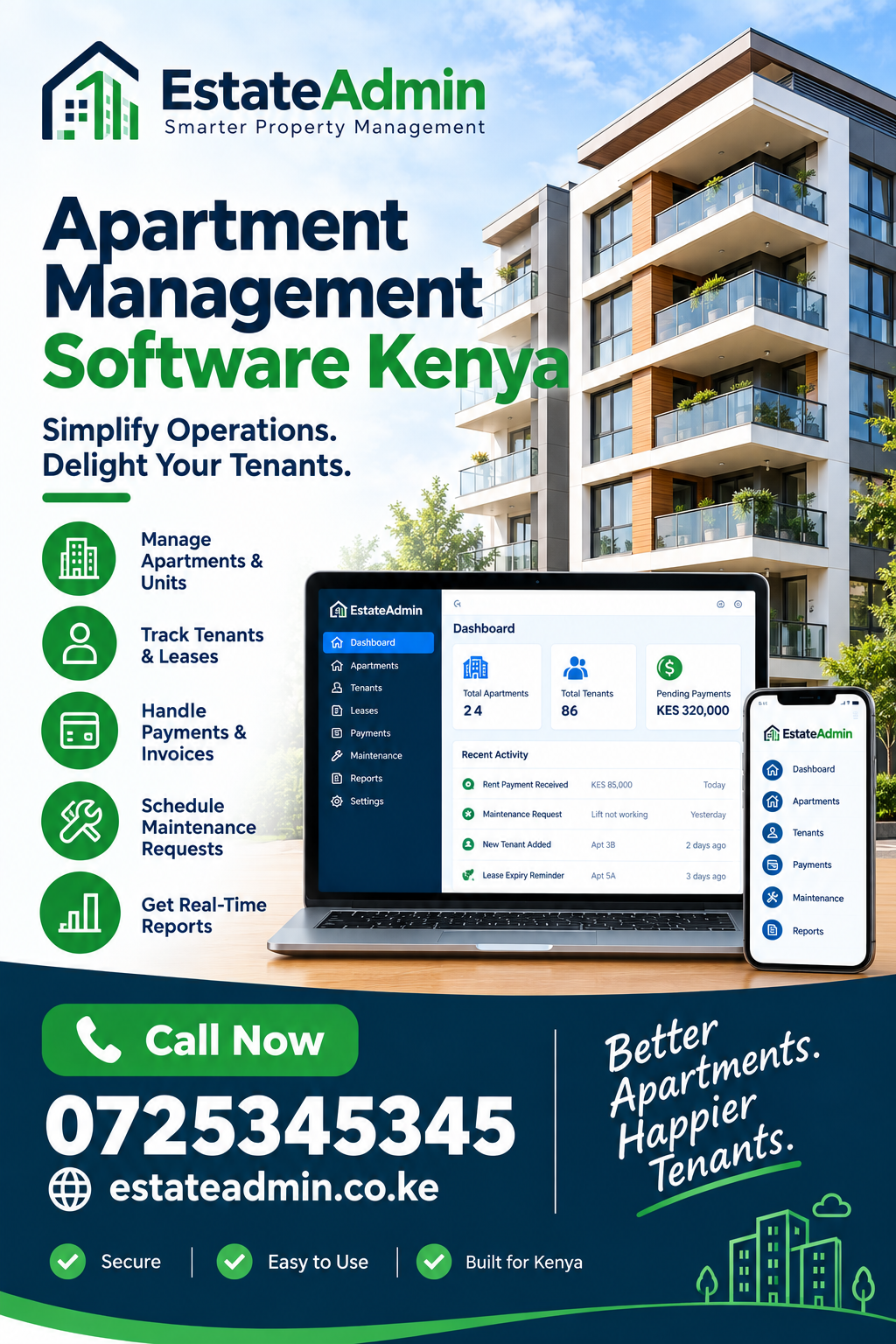
Apartment Management Software Kenya: Complete Guide to Smarter Apartment Management
Managing an apartment building involves much more than collecting rent. Property managers, landlords, estate administrators, and property management companies have to coordinate tenants, units, invoices, payments, service charges, maintenance, arrears, statements, and reports. Apartment Management Software Kenya gives property teams a centralized way to organize these activities, reduce dependence on spreadsheets, and maintain clearer financial and operational records.
For a landlord with a few units, manual records may initially seem manageable. The situation changes when the portfolio grows to dozens or hundreds of apartments. At that point, tracking every tenant, payment, invoice, balance, and maintenance issue through separate files can consume considerable time.
Apartment Management Software Kenya is therefore relevant to landlords and property managers who want a more organized approach to residential property administration. This guide explains the main features to look for, how software can improve apartment operations, the Kenyan considerations that matter, and how to evaluate a system before implementation.
What Is Apartment Management Software?
At its simplest, Apartment Management Software Kenya is a digital platform that helps property owners and managers organize the information and processes involved in running apartment properties.
Instead of keeping tenant details in one spreadsheet, payment information in another file, invoices in email, and maintenance requests in WhatsApp conversations, a centralized system brings important records into one workflow.
Depending on the platform, an apartment management system can support:
- Property and building records
- Individual apartment units
- Tenant information
- Rent and service charges
- Invoices
- Payment records
- Outstanding balances
- Arrears
- Resident statements
- Maintenance information
- Occupancy records
- Financial reporting
- User permissions
- Administrative workflows
For Kenyan property managers, Apartment Management Software Kenya can be particularly useful when the number of units makes manual administration difficult.
EstateAdmin, for example, currently focuses on estate management, service-charge billing, invoices, payments, resident ledgers, reporting, roles, and accountability. Its platform is also positioned for gated communities, estates, and residential units.
Why Apartment Management Software Matters for Kenyan Property Managers
Property management has several moving parts. A manager may need to confirm whether a tenant has paid, determine which units have outstanding balances, prepare invoices, review service charges, respond to residents, and produce reports for owners or committees.
Apartment Management Software Kenya can bring these processes together instead of requiring managers to switch constantly between different records.
This is particularly important when a property has many units. A small error in a spreadsheet can affect balances, statements, or follow-up activity. A centralized system creates a consistent source of information that the management team can work from.
For example, consider an apartment complex with 150 units. Every month, management may need to:
- Confirm tenant and unit records.
- Apply the appropriate charges.
- Generate invoices.
- Record payments.
- Identify outstanding accounts.
- Follow up on arrears.
- Prepare statements.
- Produce management reports.
A dedicated Apartment Management Software Kenya solution can organize these steps into a repeatable workflow.
The Growing Need for Digital Apartment Administration
Kenya has a large and diverse residential property market, with apartments forming an important part of urban housing.
The Kenya National Bureau of Statistics has published housing and real-estate surveys covering areas such as housing conditions, tenure, affordability, and the performance of the real-estate sector. These datasets illustrate the importance of organized information within Kenya’s housing and property environment.
For property managers, the practical issue is not simply the number of apartments being developed. It is the amount of information generated by every apartment.
Each occupied unit can create recurring records involving rent, service charges, payments, balances, maintenance, tenant communication, and occupancy.
That makes Apartment Management Software Kenya useful for teams looking to move from fragmented administrative processes to a centralized workflow.
Managing Apartment Units
Every apartment property starts with its units.
A manager needs to know which units belong to a particular building, which are occupied, which are vacant, and which tenant is associated with each unit.
Apartment Management Software Kenya can help create a structured unit register.
A good unit-management structure should make it possible to identify information such as:
- Building name
- Apartment number
- Floor
- Unit type
- Occupancy status
- Current tenant
- Monthly charge
- Outstanding balance
- Maintenance status
This becomes particularly valuable when a property manager handles several apartment buildings.
Rather than searching through separate spreadsheets, Apartment Management Software Kenya can provide a centralized way to organize units and associated information.
Tenant Management
Tenant information is another core part of apartment administration.
A manager may need to maintain contact information, unit allocation, payment history, lease information, occupancy details, and other records.
Apartment Management Software Kenya can make tenant information easier to organize and retrieve.
A digital tenant profile may contain:
- Full name
- Phone number
- Email address
- Apartment number
- Move-in date
- Lease information
- Payment history
- Outstanding balance
- Relevant notes
EstateAdmin’s tenant-management content describes tenant profiles, property and unit management, tenant allocation, occupancy tracking, invoicing, payments, and reporting.
Using Apartment Management Software Kenya for tenant records can also reduce the risk of maintaining several conflicting versions of the same information.
Rent Tracking and Collection
Rent collection is usually one of the most important financial processes for a rental property.
Managers need to know how much is due, what has been paid, which accounts are partially paid, and which tenants have arrears.
Apartment Management Software Kenya can provide a centralized view of these transactions.
A well-designed rent-management workflow should allow managers to review:
- Rent due
- Rent received
- Payment dates
- Partial payments
- Outstanding balances
- Arrears
- Payment history
For a portfolio with many units, having this information in one place can save substantial administrative effort.
Apartment Management Software Kenya can also support more consistent follow-up because managers can identify outstanding accounts without manually comparing several documents.
Invoicing for Apartments
Manual invoice preparation becomes increasingly difficult as the number of units grows.
Suppose an apartment complex has 200 units. Preparing individual invoices, checking calculations, recording due dates, and tracking payment status can become a recurring administrative burden.
Apartment Management Software Kenya can help structure the invoicing process.
EstateAdmin’s current platform supports bulk invoice generation, due dates, balances, invoice statuses, and exports.
This means an apartment manager can establish a consistent billing cycle rather than rebuilding invoices manually every month.
A good invoice system should make it easy to answer questions such as:
- What was billed?
- When was it due?
- Has it been paid?
- Was the payment partial?
- What remains outstanding?
Apartment Management Software Kenya can therefore become an important part of a property manager’s monthly financial workflow.
Service Charge Management
Apartment management is not always about rent.
Many residential developments also have shared facilities and common areas that require ongoing financial contributions. These can include security, cleaning, landscaping, common-area maintenance, waste management, lighting, and other shared services.
Apartment Management Software Kenya can help organize recurring service-charge billing alongside other residential property records.
For sectional developments, the management of common property and contributions can have specific legal and administrative considerations. Kenya’s Sectional Properties Act provides a framework for sectional properties and management corporations, including matters concerning common property and contributions.
Property managers should consult the current legislation and professional advisers where legal interpretation is required.
EstateAdmin’s core platform is strongly focused on service-charge billing, recurring charges, invoices, payments, balances, statements, and reporting.
Using Apartment Management Software Kenya can therefore be useful for residential developments where service-charge administration is a significant part of monthly operations.
M-Pesa and Apartment Payments in Kenya
Payment methods matter when choosing property management software for a Kenyan apartment.
M-Pesa is widely used for business and consumer payments in Kenya. Safaricom provides M-PESA business services, including mechanisms that businesses can use to collect customer payments.
For property managers, the important consideration is not simply accepting a payment. The payment also needs to be associated with the correct tenant, invoice, unit, and balance.
Apartment Management Software Kenya should therefore be evaluated based on how well it supports the property’s payment and reconciliation workflow.
EstateAdmin currently has dedicated payment-related functionality around service-charge collection, payment tracking, reconciliation, and M-Pesa-oriented workflows.
The practical objective is simple: when a resident makes a payment, management should be able to identify what the payment relates to and maintain an accurate account balance.
Arrears Management
Late payments and arrears can create significant administrative work.
A manager may know that a tenant owes money, but that is only the beginning. The team needs to know why the amount is outstanding, which invoices are unpaid, which payments have already been recorded, and what the current balance is.
Apartment Management Software Kenya can help provide clearer visibility into outstanding balances.
An effective arrears workflow might include:
- Identifying overdue invoices.
- Reviewing the tenant’s account.
- Confirming recorded payments.
- Checking whether a payment was partial.
- Confirming the current balance.
- Sending an appropriate reminder.
- Updating the account when payment is received.
EstateAdmin specifically promotes arrears visibility and resident statements as part of its billing workflow.
For property managers, Apartment Management Software Kenya can make arrears follow-up more systematic.
Resident Statements
Residents often want clear answers about their accounts.
A resident may ask why a balance is showing, whether a particular payment has been recorded, or what an invoice relates to.
Apartment Management Software Kenya can help management provide organized statements showing account activity.
A useful statement may include:
- Previous balance
- Current charges
- Payments
- Adjustments
- Outstanding amount
- Running balance
- Transaction dates
EstateAdmin’s current platform includes resident statements and billed-versus-paid reporting.
Clear statements can reduce confusion because the property manager and resident can refer to the same account history.
Financial Reporting
Property owners and management committees need more than transaction records. They need useful summaries.
Apartment Management Software Kenya can support a reporting workflow where management can review billing and collections over a defined period.
Useful reports may cover:
- Monthly invoices
- Monthly payments
- Outstanding balances
- Arrears
- Resident statements
- Collection trends
- Payment activity
EstateAdmin states that its reporting capabilities include invoices, payments, resident statements, outstanding balances, and snapshot exports for board reporting.
This can make monthly management meetings more efficient because information is already organized.
Reporting for Apartment Owners
Apartment owners may not be involved in daily property administration.
They may simply need to know whether rent and other charges are being collected and whether there are significant outstanding balances.
Apartment Management Software Kenya can help property managers prepare information that is easier to review.
A well-designed report should answer practical questions rather than overwhelm the owner with unnecessary data.
For example:
| Information | Why it matters |
|---|---|
| Total billed | Shows expected collections |
| Total received | Shows actual collections |
| Outstanding balance | Shows unpaid amounts |
| Arrears | Identifies overdue accounts |
| Occupancy | Shows units currently occupied |
| Payment history | Helps investigate account questions |
The objective of Apartment Management Software Kenya should therefore be clarity rather than simply producing large amounts of data.
Managing Multiple Apartment Properties
A landlord with one building has different requirements from a property company managing ten buildings.
With multiple properties, the management team needs to separate information by building while still maintaining centralized control.
Apartment Management Software Kenya can be valuable for organizations managing multiple apartment properties.
A multi-property setup may allow the manager to organize:
- Property A
- Property B
- Property C
- Units within each property
- Tenants within each unit
- Charges associated with each property
- Payments and balances
- Property-level reports
EstateAdmin describes multi-workspace functionality and solutions for estate managers and management companies.
This structure can become increasingly useful as a property portfolio grows.
Choosing Software for Different Property Sizes
Not every apartment business needs the same system.
A landlord with 20 units may prioritize simplicity and basic records. A management company with 1,000 units may need more sophisticated controls, reporting, permissions, and workflows.
Apartment Management Software Kenya should therefore be selected according to the property’s actual requirements.
Consider these categories:
Small Apartment Portfolio
A small portfolio may need:
- Tenant records
- Unit management
- Rent tracking
- Invoices
- Payment records
- Basic reports
Medium Apartment Portfolio
A medium-sized portfolio may also require:
- Automated billing
- Arrears tracking
- Resident statements
- Multiple users
- Detailed reports
- Maintenance records
Large Property Portfolio
A large operation may require:
- Multiple properties
- Role-based access
- Advanced reporting
- Reconciliation
- Audit history
- Structured approval workflows
- Integrations
The most expensive system is not automatically the most suitable. The right choice depends on the complexity of the operation.
Apartment Management and Data Protection
Apartment managers handle personal information.
Tenant records can include names, telephone numbers, identification information, contact details, payment information, and other personal data.
That makes data protection an important consideration when selecting Apartment Management Software Kenya.
Kenya’s Data Protection Act, 2019 establishes a legal framework for the processing of personal data and provides rights and obligations relating to data protection.
The Office of the Data Protection Commissioner also provides guidance on personal data and data-protection responsibilities.
Property managers should therefore consider:
- User access
- Password security
- Data storage
- Permission controls
- Data retention
- Administrative accountability
- Appropriate handling of tenant information
A property management system should support responsible information management rather than simply storing more data.
Role-Based Access
Apartment management often involves several people.
An accountant may need financial information. An administrator may manage tenant records. A manager may oversee the entire property. A committee member may only need reports.
Apartment Management Software Kenya can support this type of organizational structure when it includes appropriate user permissions.
EstateAdmin currently lists Admin, Manager, Accountant, and Viewer roles as part of its platform.
Role-based access can help organizations establish clearer responsibilities.
For example:
- Admin: manages core system operations.
- Manager: oversees property workflows.
- Accountant: works with financial information.
- Viewer: accesses information without full administrative permissions.
The exact permissions should be configured according to the organization’s needs.
Auditability and Accountability
Financial records need to be trustworthy.
If several employees can update invoices, payments, or balances, management may need to know who performed a particular action.
Apartment Management Software Kenya can help establish a more structured administrative environment when the system includes user roles and history.
EstateAdmin highlights audit-ready history, allowing teams to understand what changed, when it changed, and by whom.
This type of record can be valuable during internal reviews, management meetings, or investigations into discrepancies.
Apartment Management Software Versus Spreadsheets
Spreadsheets remain useful tools, particularly for small businesses.
The challenge arises when a spreadsheet becomes the central system for hundreds of tenants, invoices, payments, and balances.
Apartment Management Software Kenya can provide a dedicated environment for property administration.
| Area | Spreadsheet | Dedicated Software |
|---|---|---|
| Tenant records | Manually maintained | Centralized profiles |
| Unit management | Separate sheets | Structured units |
| Billing | Manual formulas | Dedicated billing workflow |
| Payments | Manual entries | Payment records |
| Arrears | Manual calculations | Balance visibility |
| Statements | Manually prepared | System-generated records |
| Permissions | Limited | Role-based controls |
| Reporting | Manual compilation | Dedicated reports |
| History | Difficult to track | Activity history |
The key difference is not simply where the information is stored. It is how the information is connected.
With a dedicated system, units, tenants, invoices, payments, and balances can form one connected workflow.
Apartment Management Software and Maintenance
Financial administration is only one part of apartment management.
Buildings also require maintenance.
Tenants may report:
- Plumbing problems
- Electrical faults
- Broken fixtures
- Water issues
- Security concerns
- Common-area problems
- Appliance faults
- Cleaning issues
Apartment Management Software Kenya can be part of a broader property-management workflow that helps management organize maintenance information.
A useful maintenance record can include the apartment, issue reported, date, assigned person, cost, status, and completion date.
Even where maintenance is handled through a separate tool, keeping property records organized makes it easier to understand recurring costs and outstanding issues.
Vacancy and Occupancy Management
Vacant apartments can affect rental income.
Property managers therefore need accurate information about which units are occupied, available, reserved, or undergoing maintenance.
Apartment Management Software Kenya can help organize occupancy information when the platform supports unit-status management.
A manager should be able to answer quickly:
- Which apartments are occupied?
- Which are vacant?
- Which are becoming available?
- Which units are under maintenance?
- Which tenants are assigned to each unit?
EstateAdmin’s tenant-management material discusses occupancy status, vacant units, reserved units, and unit allocation.
Accurate occupancy records can make property administration more responsive.
Improving the Monthly Apartment Management Cycle
A strong apartment management system should simplify recurring monthly work.
A typical cycle may look like this:
Step 1: Review Units
Confirm that apartment and tenant records are accurate.
Step 2: Apply Charges
Apply rent, service charges, or other recurring amounts.
Step 3: Generate Invoices
Create invoices with appropriate dates and amounts.
Step 4: Record Payments
Capture payments against the correct accounts.
Step 5: Review Balances
Identify unpaid or partially paid invoices.
Step 6: Follow Up
Contact tenants with outstanding balances where appropriate.
Step 7: Generate Reports
Prepare information for owners, managers, or committees.
Apartment Management Software Kenya can make this cycle more consistent when these activities are connected within one platform.
The advantage of a repeatable workflow is that management does not need to reinvent the process every month.
How to Select Apartment Management Software in Kenya
Before purchasing or subscribing to Apartment Management Software Kenya, create a simple requirements checklist.
Ask the following questions:
- How many units do we currently manage?
- How many units could we manage in the future?
- Do we need rent billing?
- Do we need service-charge billing?
- Can the system track partial payments?
- Can it produce resident statements?
- Can multiple users access it?
- Does it have role-based permissions?
- Can we export reports?
- Does it support our payment workflow?
- How is tenant data protected?
- What onboarding or support is available?
A system should be tested against real property-management scenarios rather than judged only by its feature list.
Testing Software Before Implementation
One of the best ways to evaluate Apartment Management Software Kenya is to test it using actual examples from your property.
For instance, create a test scenario involving:
- Five apartment units
- Five tenants
- Different monthly charges
- One partial payment
- One fully paid invoice
- One overdue invoice
- One vacant unit
Then see whether the system can correctly generate invoices, record payments, calculate balances, and produce useful reports.
For a larger organization, test multiple users as well.
Ask an administrator to create records, an accountant to record payments, and a manager to review reports.
This provides a more realistic assessment than simply watching a product demonstration.
Common Apartment Management Mistakes
Even with software, poor processes can create problems.
Entering Incorrect Opening Balances
If historical balances are wrong, future reports can also become inaccurate.
Duplicate Tenant Records
Creating multiple profiles for the same tenant can cause confusion.
Incorrect Unit Assignments
A tenant must be associated with the correct apartment.
Failing to Reconcile Payments
Recording a payment without checking the correct invoice can produce inaccurate balances.
Giving Everyone Administrator Access
Excessive permissions can reduce accountability.
Ignoring Data Quality
Software cannot automatically fix incorrect information entered by users.
Failing to Train Staff
Employees need to understand the correct workflow.
The goal of Apartment Management Software Kenya should be to strengthen good processes, not simply digitize poor ones.
Training and Onboarding
A new system works best when users understand how it should be used.
Before implementation, define:
- Who enters tenants?
- Who creates charges?
- Who generates invoices?
- Who records payments?
- Who reviews arrears?
- Who produces reports?
- Who manages user permissions?
For a larger apartment operation, written procedures can be useful.
A simple process document might explain the monthly billing cycle from charge setup through payment reconciliation and reporting.
Apartment Management Software Kenya can then become part of a clearly defined operational process rather than another disconnected tool.
Cost Considerations
The price of Apartment Management Software Kenya should be evaluated alongside the cost of manual administration.
Property managers should consider:
- Subscription fees
- Number of units
- Number of users
- Implementation effort
- Data migration
- Training
- Support
- Integrations
- Reporting requirements
EstateAdmin currently publishes plans based on residential-unit capacity, including Starter for up to 100 units, Standard for up to 500 units, and Pro for unlimited residential units. Its listed pricing should be checked directly before making a purchasing decision because pricing can change.
The important question is not simply, “How much does the software cost?”
A better question is, “What does our current manual process cost in time, errors, delayed collections, and administrative effort?”
Why Kenyan Property Managers Should Consider Local Requirements
Property management software should fit the environment where it is being used.
For Kenyan apartment managers, relevant considerations can include:
- M-Pesa
- Kenyan shillings
- Local tenant communication
- Service charges
- Residential committees
- Local reporting requirements
- Data-protection obligations
- Multiple apartment developments
- Mobile-first workflows
Apartment Management Software Kenya should therefore be evaluated from a Kenyan property-management perspective rather than simply imported from a completely different market.
A system may have many features but still be inconvenient if its workflows do not match how Kenyan property managers actually collect payments and administer residential buildings.
Apartment Management Software for Nairobi Properties
Nairobi has a large apartment market, and property managers may deal with residential developments ranging from small blocks to large gated communities.
A Nairobi-focused property manager may need to manage:
- Multiple apartment blocks
- Service charges
- Residents
- Payments
- Parking
- Common facilities
- Security
- Maintenance
- Reports
Apartment Management Software Kenya can provide the foundation for organizing core residential-property information.
EstateAdmin also has a Nairobi-focused property-management page describing resident management, service-charge billing, payment tracking, and reporting.
Apartment Management Software for Property Management Companies
A professional property management company may manage apartments belonging to several clients.
That introduces another layer of complexity.
The company needs to distinguish properties, units, tenants, transactions, and reports without losing centralized oversight.
Apartment Management Software Kenya can help management companies structure their workflows around different properties and teams.
EstateAdmin describes solutions for management companies, estate managers, committees, and developers, including standardized service-charge billing and reporting.
For a management company, role separation is particularly important because employees may be responsible for different properties or financial activities.
Apartment Management Software for Estate Committees
Some apartment developments operate through management committees or similar resident structures.
These committees may need visibility into:
- Amount billed
- Amount collected
- Outstanding balances
- Arrears
- Monthly activity
- Resident statements
Apartment Management Software Kenya can support committee reporting when the platform provides appropriate financial summaries.
EstateAdmin specifically positions its reporting around committee-ready information, billed-versus-paid clarity, outstanding balances, statements, and monthly reporting.
The value for a committee is not simply access to more data. It is access to information that can be understood and reviewed during meetings.
What a Good Apartment Management Workflow Looks Like
A well-organized workflow can be represented as:
Property → Building → Unit → Tenant → Charge → Invoice → Payment → Balance → Statement → Report
Apartment Management Software Kenya can help connect these stages where the platform supports the required functions.
For example, when a charge is created, the corresponding invoice should identify the appropriate unit and resident. When payment is recorded, the system should update the relevant account. When management generates a statement, it should reflect the current financial position.
This connection is what makes property software more useful than a collection of unrelated spreadsheets.
Future-Proofing an Apartment Property Business
Property businesses can change quickly.
A landlord may acquire another building. A property manager may win a new client. An apartment development may increase its number of units.
Apartment Management Software Kenya should therefore be evaluated not only for current needs but also for expected growth.
Ask whether the platform can handle:
- More units
- More properties
- More users
- More transactions
- Additional reporting requirements
- New payment workflows
- Additional administrative responsibilities
EstateAdmin currently offers plans designed for different residential-unit volumes, including an unlimited-unit Pro plan.
Frequently Asked Questions
What is Apartment Management Software Kenya?
Apartment Management Software Kenya is software designed to help landlords, property managers, estate administrators, and residential property companies manage units, tenants, billing, payments, balances, service charges, and reports.
Who should use apartment management software?
Landlords, apartment owners, estate managers, property management companies, developers, and residential management teams can benefit from a centralized property-management platform.
The most important consideration is the complexity of the property operation rather than simply the number of units.
Can apartment software manage tenants?
Yes. A suitable platform can store tenant profiles, unit assignments, contact information, payment history, occupancy details, and other relevant records.
EstateAdmin’s tenant-management resources describe tenant registration, unit allocation, occupancy, rent invoicing, payment tracking, and reporting.
Can apartment software track rent arrears?
Yes. A property management system can track outstanding invoices and balances when the appropriate billing and payment features are available.
Arrears reporting is particularly useful when a property has many tenants because management can quickly identify accounts requiring attention.
Can apartment software manage service charges?
Yes. Service-charge management is an important function for many residential developments.
EstateAdmin’s current platform supports recurring service charges, invoices, payment tracking, balances, resident statements, and reporting.
Does apartment management software support M-Pesa?
Some systems support M-Pesa-related payment workflows or integrations, but capabilities differ between platforms.
Property managers should verify the exact payment functionality offered by the software before implementation.
Safaricom provides official M-PESA business services that can support business payment collection and related integrations.
Can apartment software manage multiple properties?
Yes. Many property-management platforms are designed to support multiple properties.
This is particularly useful for property management companies and landlords with several apartment buildings.
EstateAdmin describes multi-workspace functionality and solutions for property and estate management teams.
Can apartment software generate reports?
Yes. Reporting is one of the main reasons to move away from disconnected spreadsheets.
Reports can cover invoices, payments, balances, arrears, resident statements, and other property information depending on the platform.
Is apartment management software suitable for small landlords?
It can be. The decision should be based on the amount of administrative work involved and the landlord’s plans for growth.
A landlord with a small portfolio may still benefit from centralized tenant, billing, and payment records.
How much does apartment management software cost in Kenya?
Pricing varies according to the platform, number of units, features, users, integrations, and support.
EstateAdmin currently publishes unit-based plans, including options for up to 100 units, up to 500 units, and unlimited residential units.
Property managers should check the provider’s current pricing page before budgeting.
Getting Started With Apartment Management Software
The transition from spreadsheets to software does not need to happen all at once.
Start by reviewing your current process.
Write down:
- All properties
- All buildings
- All units
- Current tenants
- Monthly charges
- Outstanding balances
- Existing payment records
- Reporting requirements
- Users who need access
Then identify the areas causing the most administrative work.
For some businesses, billing is the biggest problem. For others, it may be arrears, tenant records, reconciliation, reporting, or multi-property administration.
Apartment Management Software Kenya should be selected according to these real operational needs.
Once a system is selected, clean the existing data before importing it. Poor-quality data can create problems regardless of how sophisticated the software is.
Why EstateAdmin Is Relevant to Apartment Management
EstateAdmin is positioned as an estate management platform focused on service-charge billing, invoicing, payment tracking, resident ledgers, reporting, roles, and operational visibility.
Its current platform includes recurring service charges, bulk invoice generation, payment tracking, resident statements, arrears visibility, reporting, role-based access, and audit-ready history.
Apartment Management Software Kenya can therefore be particularly relevant to apartment operations where service-charge administration and financial visibility are important.
EstateAdmin also provides dedicated solutions for estate managers, committees, developers, and management companies.
The platform’s published plans are structured around residential-unit capacity, making it possible for smaller estates and larger property operations to consider different package levels.
Conclusion
Apartment management becomes increasingly complex when the number of units, residents, invoices, payments, and administrative responsibilities grows.
Manual spreadsheets can work for a small operation, but they may become difficult to maintain as a property portfolio expands.
Apartment Management Software Kenya provides a structured way to bring apartment records, tenants, billing, payments, balances, service charges, statements, and reporting into a more connected workflow.
The most important step is choosing software according to the actual needs of the property.
Before making a decision, evaluate unit management, tenant records, billing, payment tracking, M-Pesa workflows, arrears, reporting, user permissions, data protection, scalability, and support.
EstateAdmin’s current platform focuses on service-charge management, invoices, payments, resident ledgers, statements, reporting, roles, and accountability.
For landlords, property managers, apartment owners, estate administrators, and management companies, Apartment Management Software Kenya can be part of a broader strategy to reduce manual administration and create clearer property records.
A good system should make everyday work easier, not simply add another application to the business.
The right implementation should connect the entire management cycle: from the apartment unit and tenant record through charges, invoices, payments, balances, statements, and reports.
If your apartment operation is still heavily dependent on spreadsheets and manual records, reviewing a dedicated property-management platform can be a practical next step.
Apartment Management Software Kenya is ultimately about creating a more organized approach to residential property administration, giving management teams the information they need to handle routine operations with greater consistency.
For Kenyan landlords and property managers considering a centralized system, EstateAdmin provides a platform focused on residential estate billing, service charges, payments, reporting, and operational visibility. Explore EstateAdmin.