
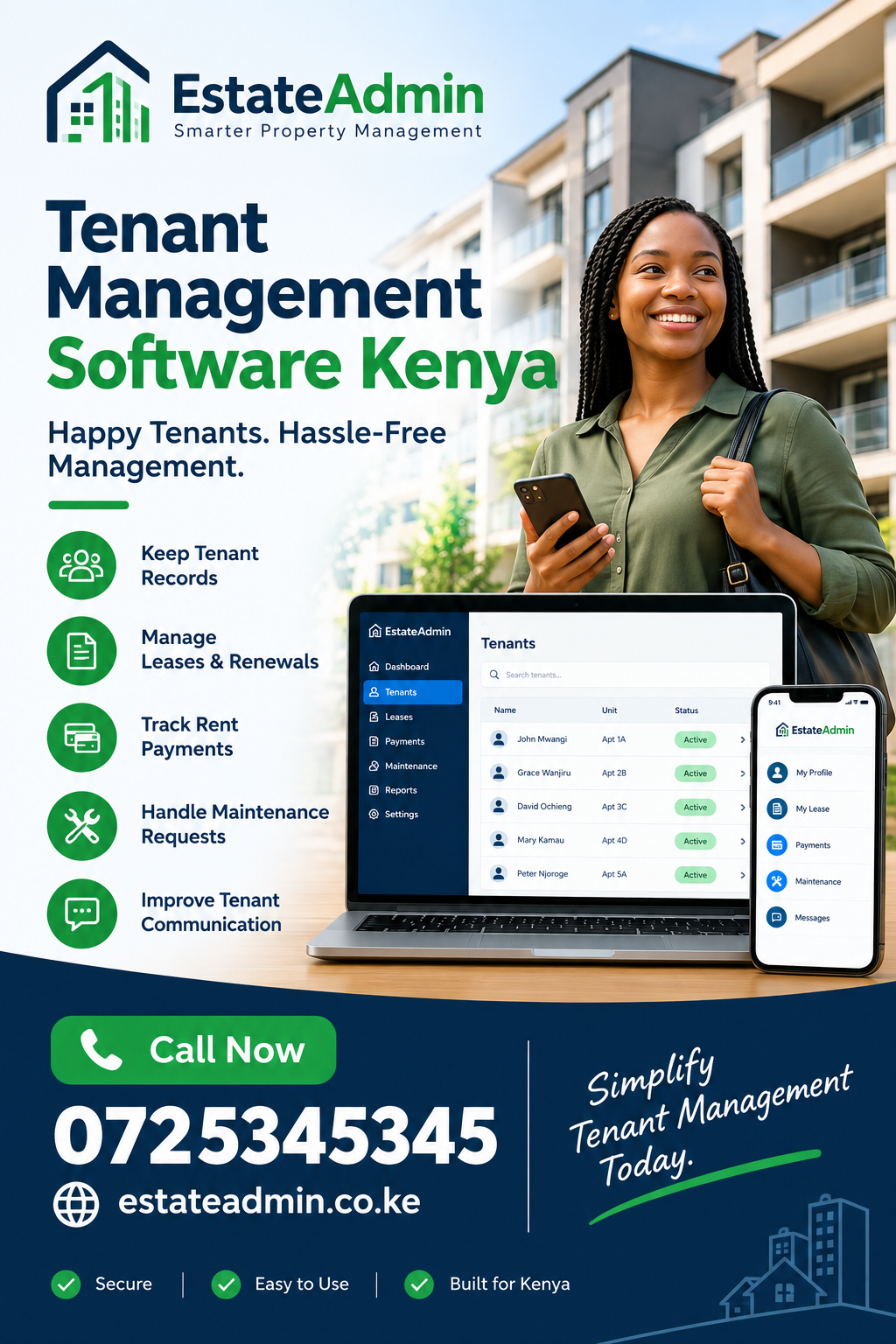
Tenant Management Software Kenya: Complete Guide for Landlords and Property Managers
Managing tenants is one of the most demanding responsibilities for landlords, property managers and real estate companies. Keeping tenant records updated, tracking rent payments, following up on arrears, managing leases, responding to maintenance requests and preparing reports can quickly become difficult when everything is handled manually. Tenant Management Software Kenya provides a centralized way to organize these responsibilities and reduce dependence on notebooks, spreadsheets and scattered communication channels.
A professional tenant management system is not simply a digital tenant register. It can connect tenant information with rental units, invoices, payments, leases, maintenance requests, reports and other property-management activities. EstateAdmin’s published tenant-management material describes functionality around tenant registration, unit allocation, lease tracking, automated invoicing, payment tracking, maintenance and reporting.
This guide explains what landlords and property managers should know when evaluating tenant management software in Kenya, including the features to consider, how digital systems can improve tenant administration, how payment and arrears tracking works, and what to look for before choosing a platform.
What Is Tenant Management Software?
Tenant Management Software Kenya is a digital platform designed to help landlords, property managers and property companies organize information and processes related to their tenants.
Instead of keeping tenant names, contacts, lease details, payment records and maintenance information in different places, a centralized platform connects these records.
A typical tenant management system can help a property manager:
- Register new tenants
- Store tenant contact information
- Allocate tenants to rental units
- Record lease information
- Track rent charges
- Record payments
- Monitor outstanding balances
- Generate invoices and receipts
- Manage maintenance requests
- Track vacancies
- Communicate with tenants
- Generate financial and operational reports
Tenant Management Software Kenya becomes particularly useful as the number of rental units increases. A landlord managing five units may be able to remember much of the information involved. A property manager responsible for 100, 500 or more units needs a structured system.
The main purpose is therefore to create a reliable source of information that the property-management team can use when making everyday decisions.
Why Tenant Management Matters
Tenant management affects almost every part of a rental business.
A tenant is not simply a name associated with an apartment. The tenant may have a lease, rent obligation, deposit, payment history, maintenance requests, communication records and a specific occupancy period.
Tenant Management Software Kenya can bring these pieces of information together.
Consider what a property manager may need to know about one tenant on a normal working day:
- Which unit does the tenant occupy?
- What is the monthly rent?
- When did the lease begin?
- When does it expire?
- Has the current month’s rent been paid?
- Is there an outstanding balance?
- Has the tenant reported maintenance problems?
- Has the tenant received the latest invoice?
- What is the tenant’s payment history?
When records are distributed between spreadsheets, paper files and mobile-phone conversations, answering these questions can take unnecessary time.
A centralized system makes the process more organized.
The Problem With Manual Tenant Records
Manual record keeping can work when a rental portfolio is very small.
However, the process becomes more complicated as the number of tenants increases.
Tenant Management Software Kenya can reduce the dependence on manual processes by storing information in a structured database.
Common problems with manual tenant administration include:
Duplicate Information
A tenant’s details may appear in several spreadsheets or documents. If one record is updated and another is not, inconsistencies can develop.
Missing Information
Important lease or payment records can be misplaced or forgotten.
Difficult Searches
Finding the complete history of a tenant can require checking several files.
Calculation Errors
Manual rent and arrears calculations can produce mistakes.
Delayed Reporting
Managers may spend hours compiling information before they can prepare a property report.
Poor Follow-Up
Maintenance complaints or payment reminders can be missed when they are handled through informal communication.
Tenant Management Software Kenya can address these problems by providing a centralized workflow.
Tenant Registration and Onboarding
The tenant lifecycle begins before the first rent payment.
A new tenant needs to be registered and connected to the appropriate property and unit.
Tenant Management Software Kenya can help property teams create structured tenant profiles.
Depending on the platform, information may include:
- Full name
- Telephone number
- Email address
- Identification details
- Emergency contact
- Property
- Unit
- Move-in date
- Lease start date
- Lease expiry date
- Monthly rent
- Deposit information
- Tenant status
EstateAdmin’s published tenant-management content specifically lists tenant details such as names, identification information, contact details, emergency contacts, occupied units, lease details and move-in/move-out dates.
This information becomes the foundation for the tenant’s digital record.
Tenant Management Software Kenya can then connect the tenant to the unit and relevant financial transactions.
Managing Rental Units
Tenant records make more sense when they are connected to individual units.
For example, a property manager may manage Block A with 40 apartments. Each apartment has a unique unit number, rental amount and occupancy status.
Tenant Management Software Kenya can help connect a tenant profile to the correct unit.
A unit record may include:
| Information | Example |
|---|---|
| Property | Green Valley Apartments |
| Block | Block A |
| Floor | Third Floor |
| Unit | A-304 |
| Status | Occupied |
| Monthly Rent | KSh 30,000 |
| Tenant | Current occupant |
| Lease Status | Active |
This structure allows the manager to move between property information and tenant information without maintaining separate disconnected records.
Tenant Management Software Kenya can be especially useful for property managers handling multiple buildings.
Lease Management
A tenant relationship normally has a contractual component.
The property manager may need to know when the lease began, when it expires and what rental terms apply.
Tenant Management Software Kenya can help organize lease information when lease-management functionality is available.
Important lease information may include:
- Lease start date
- Lease expiry date
- Monthly rent
- Deposit
- Notice period
- Tenant status
- Unit
- Renewal information
Keeping these details organized makes it easier to monitor upcoming lease expirations.
For example, if several leases expire during the same month, a manager can review those records ahead of time and plan appropriate communication.
Tenant Management Software Kenya can therefore support the administrative side of the tenant lifecycle.
Rent Invoicing
Rent invoicing is another area where automation can reduce repetitive work.
Instead of preparing a new invoice manually for every tenant each month, software can generate recurring invoices based on configured billing information.
Tenant Management Software Kenya can help property managers organize recurring rental charges.
A typical process may look like this:
- Tenant is assigned to a unit.
- Monthly rent is configured.
- Billing date is established.
- Invoice is generated.
- Tenant receives or accesses the invoice.
- Payment is recorded.
- Balance is updated.
EstateAdmin’s current tenant-management material states that its platform can automatically generate recurring rent invoices based on lease agreements and billing schedules.
Tenant Management Software Kenya can therefore be evaluated according to how well it supports the billing process used by your property.
Rent Payment Tracking
Collecting rent is only half of the financial process. Property managers also need to know exactly which tenants have paid and which tenants still have outstanding balances.
Tenant Management Software Kenya can help organize payment records when payment-tracking features are included.
A useful payment record should make it possible to identify:
- Tenant
- Property
- Unit
- Amount
- Payment date
- Transaction reference
- Outstanding balance
- Payment status
This is especially important when many tenants make payments around the same period.
A centralized payment history makes it easier to answer questions from tenants and property owners.
Tenant Management Software Kenya can also help reduce the need to manually compare tenant lists with payment spreadsheets.
Managing Rent Arrears
Rent arrears are among the most important financial issues for rental-property managers.
A manager needs to know not only that money is outstanding but also exactly how much is owed, which billing period is affected and whether a tenant has made partial payments.
Tenant Management Software Kenya can help provide structured arrears information.
An arrears report might show:
| Tenant | Unit | Amount Due | Amount Paid | Balance |
|---|---|---|---|---|
| Tenant A | A-101 | KSh 25,000 | KSh 25,000 | KSh 0 |
| Tenant B | A-102 | KSh 25,000 | KSh 15,000 | KSh 10,000 |
| Tenant C | A-103 | KSh 30,000 | KSh 0 | KSh 30,000 |
This information gives management a clearer picture of outstanding rent.
EstateAdmin’s published material states that its system can calculate outstanding balances, overdue rent, partial payments and complete payment histories.
Tenant Management Software Kenya can make arrears monitoring more structured than relying on memory or separate spreadsheets.
Payment Reminders
Following up on outstanding payments can consume a significant amount of administrative time.
A property manager may have to send individual reminders to dozens of tenants.
Tenant Management Software Kenya can support automated or organized payment reminders where the platform provides that functionality.
A good reminder workflow should distinguish between:
- Upcoming payments
- Payments due today
- Recently overdue payments
- Long-outstanding balances
- Partial payments
This makes communication more relevant.
The objective is not simply to send more messages. It is to ensure tenants receive useful information about their accounts at the appropriate time.
Tenant Management Software Kenya can therefore support a more consistent rent-follow-up process.
M-Pesa and Digital Payments
Kenya’s widespread use of mobile payments makes payment processing an important consideration when choosing rental software.
Property managers should understand how a system records digital payments and whether it supports the payment workflows used by their tenants.
Tenant Management Software Kenya should be evaluated based on payment recording, reconciliation and reporting capabilities.
Questions to ask a software provider include:
- Does the system support M-Pesa-related workflows?
- Can payments be matched to tenants?
- Are transaction references recorded?
- Can partial payments be handled?
- Are balances updated?
- Can payment reports be exported?
EstateAdmin’s broader property-management material currently describes M-Pesa as part of its Kenyan payment workflow and says its billing system can record payments and generate reports.
Tenant Management Software Kenya should therefore be assessed according to the exact payment process your property uses.
Tenant Statements
Tenants and property owners sometimes need a clear history of transactions.
A tenant statement can show invoices, payments and outstanding balances over a specified period.
Tenant Management Software Kenya can make statement generation easier where this feature is included.
A useful tenant statement can help answer questions such as:
- What was billed?
- What has been paid?
- When were payments made?
- What balance remains?
- Which invoices are outstanding?
Clear statements can also help reduce misunderstandings between tenants and management.
EstateAdmin’s current platform describes resident statements that compare billed amounts with payments and show running balances.
Tenant Management Software Kenya can therefore be useful when transparency in tenant accounts is a priority.
Maintenance Request Management
Tenant management extends beyond rent collection.
Tenants also report problems within their units or shared areas.
Common issues include:
- Plumbing problems
- Electrical faults
- Water leaks
- Broken fixtures
- Drainage issues
- Security concerns
- Lighting problems
- Damaged doors
- Appliance faults
- Common-area maintenance
Tenant Management Software Kenya can help management teams organize maintenance requests when maintenance functionality is available.
A structured maintenance process can record:
- Tenant reporting the issue
- Date reported
- Property
- Unit
- Description
- Assigned technician
- Status
- Cost
- Completion date
This provides a history of the issue instead of relying on a conversation that may later become difficult to find.
Tenant Management Software Kenya can therefore support both tenant administration and property operations.
Improving Tenant Communication
Communication is an important part of property management.
Tenants may need information about rent, invoices, maintenance, lease renewals, building notices and other property matters.
Tenant Management Software Kenya can help organize communication when notification and messaging features are available.
A consistent communication process can help ensure that tenants receive relevant information without management having to repeat the same administrative tasks manually.
Examples include:
- Rent reminders
- Payment confirmations
- Maintenance updates
- Lease-expiry notifications
- General notices
- Invoice notifications
- Account statements
The quality of communication still depends on the property-management team. Software provides the structure, but managers should ensure messages are accurate and appropriate.
Tenant Management Software Kenya can support this process by keeping communication connected to the relevant tenant and property records.
Tenant Move-In Management
The move-in process creates several records that should be maintained properly.
At the beginning of a tenancy, management may need to record:
- Tenant information
- Unit allocation
- Lease details
- Deposit
- Rent
- Move-in date
- Meter information
- Property condition
- Relevant documents
Tenant Management Software Kenya can help centralize these details.
A well-organized move-in process gives the property manager a clear starting point for the tenant relationship.
This can also make later administration easier because the original information remains connected to the tenant’s record.
Tenant Move-Out Management
The tenant lifecycle ends when the tenant leaves the property, but important administrative tasks remain.
Tenant Management Software Kenya can help organize move-out information where the relevant features are available.
A move-out process may involve:
- Confirming the move-out date
- Checking outstanding rent
- Reviewing utility balances
- Assessing the unit
- Recording damages
- Reconciling the deposit
- Closing the lease
- Updating occupancy status
- Preparing the unit for the next tenant
This creates a complete history of the tenant’s relationship with the property.
Tenant Management Software Kenya can therefore support the full tenant lifecycle rather than focusing only on rent collection.
Vacancy Management
Vacancies have a direct effect on rental income.
Property managers need to know which units are occupied, vacant, reserved or undergoing preparation.
Tenant Management Software Kenya can help maintain accurate occupancy records.
For example:
| Unit | Status | Tenant |
|---|---|---|
| A-101 | Occupied | Tenant A |
| A-102 | Occupied | Tenant B |
| A-103 | Vacant | — |
| A-104 | Reserved | Prospective tenant |
Accurate occupancy information can make it easier to coordinate property marketing and tenant allocation.
Tenant Management Software Kenya is especially relevant for property managers handling several buildings because unit-level vacancy information can otherwise become difficult to maintain.
Managing Multiple Properties
A landlord may begin with one building and later acquire additional properties.
As the portfolio grows, tenant management becomes more complicated.
Tenant Management Software Kenya can provide a centralized environment for multiple properties when the selected platform supports multi-property management.
A management company might have:
- Apartment buildings
- Rental houses
- Commercial properties
- Student accommodation
- Mixed-use developments
Each property can have different tenants, rental rates and management requirements.
A system that separates property records while providing centralized reporting can make administration easier.
Tenant Management Software Kenya can therefore be useful for growing property portfolios.
Financial Reporting
Property owners need reliable financial information.
A tenant-management system can connect tenant activity with financial reporting.
Tenant Management Software Kenya may support reports covering:
- Rent billed
- Rent collected
- Outstanding rent
- Tenant balances
- Occupancy
- Payments
- Expenses
- Maintenance costs
Reports allow owners and managers to move beyond individual transactions and see the bigger picture.
For example, a monthly report could show total rent expected, total payments received and total outstanding balances.
Tenant Management Software Kenya can help make this information accessible when appropriate reporting functions are available.
Tenant Management Software for Landlords
Individual landlords can benefit from structured tenant records even when they manage a relatively small number of properties.
Tenant Management Software Kenya can help a landlord keep track of tenants without maintaining several separate spreadsheets.
A landlord with 20 units, for example, may need to track:
- Twenty tenant profiles
- Twenty rent charges
- Twenty payment histories
- Lease dates
- Deposits
- Maintenance issues
- Vacancies
- Arrears
That information becomes easier to manage when it is connected.
Tenant Management Software Kenya can also reduce the amount of time spent searching for individual tenant records.
Tenant Management Software for Property Managers
Professional property managers often oversee properties on behalf of multiple owners.
This creates additional administrative requirements.
Tenant Management Software Kenya can help property managers organize tenant information across different buildings and portfolios.
A manager may need to prepare reports for individual owners while also maintaining tenant records for the entire portfolio.
The ability to filter information by property can therefore be important.
Managers should check whether a system allows users to distinguish:
- Property
- Building
- Unit
- Tenant
- Owner
- Financial period
Tenant Management Software Kenya can provide more value when it matches the actual organizational structure of the management company.
Tenant Management Software for Apartment Buildings
Apartment buildings create a high volume of repetitive tenant transactions.
Each month, managers may have to generate rent invoices, record payments, follow up on arrears and respond to maintenance requests.
Tenant Management Software Kenya can centralize these activities.
For a 100-unit building, even simple administrative tasks can multiply quickly.
If each tenant has one monthly invoice and one payment record, the management team already has hundreds of transactions to monitor over a few months.
Tenant Management Software Kenya can reduce the administrative burden by organizing these transactions around individual tenant records.
Tenant Data and Security
Tenant records contain sensitive business and personal information.
Property managers should therefore consider security when choosing software.
Tenant Management Software Kenya should be evaluated according to how access to tenant information is controlled.
Important questions include:
- Who can access tenant records?
- Can user permissions be configured?
- Is information backed up?
- Can former staff accounts be disabled?
- Is there an activity history?
- How are passwords protected?
- How is exported information handled?
EstateAdmin’s published material states that its system uses authentication, user permissions and cloud infrastructure to protect tenant information.
Tenant Management Software Kenya should nevertheless be assessed against your organization’s own security requirements.
Cloud-Based Tenant Management
Cloud software can allow authorized users to access property records from different locations.
This can be useful for property managers who move between buildings.
Tenant Management Software Kenya can support remote access when delivered through a cloud-based platform.
For example, a manager visiting a property in Nairobi may need to check a tenant’s account without returning to an office computer.
Cloud access can make this more convenient.
However, managers should still evaluate:
- Internet requirements
- Account security
- User permissions
- Data backup
- Vendor reliability
- Support
Tenant Management Software Kenya should be considered as part of the wider technology setup of the property-management business.
Reports That Property Managers Should Monitor
A tenant-management platform becomes more valuable when it provides useful reports.
Tenant Management Software Kenya can help organize reports such as:
Rent Collection Report
Shows expected and collected rent.
Arrears Report
Identifies tenants with outstanding balances.
Tenant Statement
Shows an individual tenant’s financial history.
Occupancy Report
Shows occupied and vacant units.
Lease Report
Shows active and upcoming lease expirations.
Maintenance Report
Shows reported and completed maintenance activities.
Revenue Report
Provides a broader view of property income.
Tenant Management Software Kenya should be assessed according to whether the available reports answer the questions management asks regularly.
Choosing the Right Tenant Management System
Choosing software should begin with your problems rather than the feature list.
Tenant Management Software Kenya should solve specific administrative challenges.
Start by asking:
- What takes the most time every month?
- Where do payment errors occur?
- How are tenant records currently stored?
- How are arrears identified?
- How are maintenance complaints recorded?
- How are lease dates monitored?
- How are owners given reports?
- How many properties are currently managed?
- How many users need access?
- What growth is expected?
Once these questions are answered, compare available systems against the requirements.
Tenant Management Software Kenya is most useful when its features match the actual workflow of the business.
Important Features to Compare
When evaluating software, consider the following categories.
Tenant Profiles
Can the system store complete tenant information?
Unit Allocation
Can tenants be assigned to the correct units?
Lease Management
Can lease dates and related information be tracked?
Rent Invoicing
Can recurring rent invoices be generated?
Payment Tracking
Can payments be associated with individual tenants?
Arrears Management
Can outstanding balances be identified?
Maintenance
Can tenant complaints be recorded and followed through?
Reporting
Can management obtain useful reports?
User Access
Can different employees receive appropriate permissions?
Scalability
Can the system support additional properties and units?
Tenant Management Software Kenya should be judged against these requirements rather than simply by the number of features advertised.
Common Mistakes When Buying Tenant Software
Buying software without proper evaluation can create unnecessary problems.
Choosing Only Based on Price
A low subscription cost does not automatically mean the system will meet your operational needs.
Ignoring Ease of Use
If staff cannot use the system comfortably, adoption may be poor.
Failing to Test Payment Workflows
Payment recording should be tested before implementation.
Ignoring Data Migration
Existing tenant information needs to be transferred accurately.
Not Checking Support
Users may need help during setup and day-to-day operations.
Buying Unnecessary Features
More features are not always better. Choose capabilities that address your actual needs.
Tenant Management Software Kenya should therefore be evaluated using real scenarios from your property.
Implementing Tenant Management Software
Implementation should be planned rather than rushed.
Tenant Management Software Kenya can be introduced through a structured process.
Step 1: Review Existing Records
Collect tenant, unit, lease and payment information.
Step 2: Clean the Data
Remove duplicates and correct inaccurate information.
Step 3: Create Properties
Set up buildings, floors and units.
Step 4: Add Tenants
Create tenant profiles and assign units.
Step 5: Configure Rent
Set rental charges and billing schedules.
Step 6: Configure Users
Create accounts for authorized staff.
Step 7: Test Transactions
Test invoices, payments, balances and reports.
Step 8: Train Staff
Ensure users understand their responsibilities.
Step 9: Go Live
Move daily tenant management into the new system.
Step 10: Review
Check whether the system is actually reducing administrative problems.
Tenant Management Software Kenya can deliver the most value when implementation is supported by accurate data and clear internal procedures.
Improving Tenant Experience
Technology can also affect how tenants experience property management.
Tenant Management Software Kenya can support a more organized tenant experience through clearer billing, payment records and maintenance processes.
Tenants generally need straightforward answers to questions such as:
- How much do I owe?
- Has my payment been received?
- Can I obtain my statement?
- Has my maintenance request been recorded?
- When does my lease expire?
- Who should I contact?
A well-organized system can help management respond more efficiently.
Tenant Management Software Kenya should therefore be considered not only as an accounting tool but as part of the overall tenant-service workflow.
Reducing Administrative Work
The goal of automation is to reduce repetitive administrative work.
Tenant Management Software Kenya can help automate or organize tasks such as recurring invoices, payment tracking and reporting.
Instead of manually calculating every tenant’s balance, a system can maintain those records according to the transactions entered.
Instead of manually searching several spreadsheets, the manager can search a tenant profile.
Instead of compiling every transaction before preparing a report, the manager can use the system’s reporting tools.
Tenant Management Software Kenya can therefore contribute to more efficient property administration.
Using Tenant Data for Better Decisions
Tenant data can provide useful operational information.
Tenant Management Software Kenya can help managers identify patterns when reporting tools are available.
For example, management might notice:
- Certain units have recurring maintenance problems.
- Some tenants regularly pay late.
- Particular periods have higher vacancy levels.
- Some properties generate more maintenance expenses.
- Certain payment issues occur repeatedly.
The software does not make the business decision for the property owner.
Instead, it provides organized information that can support better analysis.
Tenant Management Software Kenya becomes more useful when managers use the information to improve processes rather than simply storing records.
Scaling a Rental Business
Growth is one of the strongest reasons to consider dedicated tenant-management software.
A landlord may begin with a few units and manage everything manually.
As the portfolio expands, the same process may become difficult.
Tenant Management Software Kenya can provide a more structured foundation for growth.
Suppose a property manager expands from 20 units to 200 units. The number of tenant records, invoices, payments, lease dates and maintenance requests increases substantially.
A centralized system can help the manager scale administrative processes alongside the portfolio.
Tenant Management Software Kenya should therefore be assessed for both current requirements and future growth.
Tenant Management Software and Accountability
Property management may involve several employees.
For example:
- Manager
- Accountant
- Caretaker
- Maintenance officer
- Property owner
- Administrator
Tenant Management Software Kenya can help create clearer responsibilities when the system supports role-based access.
Different users may need different permissions.
An accountant may need access to financial information, while a caretaker may primarily need maintenance information.
This separation can help reduce unnecessary access and improve accountability.
Tenant Management Software Kenya should therefore be evaluated for its user-management capabilities.
How to Calculate the Value of Software
Property managers should consider more than the subscription price.
Tenant Management Software Kenya can be evaluated based on the time and administrative resources it saves.
Consider:
- Hours spent preparing invoices
- Time spent checking payments
- Time spent calculating arrears
- Time spent preparing reports
- Time spent searching for tenant records
- Cost of administrative errors
- Time spent following up maintenance requests
If a system reduces repetitive work substantially, the operational value may extend beyond the software subscription itself.
Tenant Management Software Kenya should therefore be evaluated in relation to the overall cost of managing the property portfolio.
Frequently Asked Questions
What is Tenant Management Software Kenya?
Tenant Management Software Kenya is software that helps landlords and property managers organize tenant records, rental units, leases, payments, invoices, maintenance requests and reports.
Who can use tenant management software?
Landlords, estate managers, property management companies, developers, SACCOs, housing organizations and other businesses managing rental properties can use tenant-management software.
Can tenant software track rent arrears?
Yes. Systems with arrears-management functionality can show outstanding balances and payment histories. EstateAdmin’s published tenant-management information specifically describes tracking overdue rent, partial payments and outstanding balances.
Can tenant management software generate invoices?
Yes. Many systems support recurring rent invoices. EstateAdmin states that its system can automatically generate recurring rent invoices based on lease agreements and billing schedules.
Can tenant software manage multiple properties?
Tenant Management Software Kenya can support multiple properties when the selected platform provides multi-property functionality.
Can tenant software manage maintenance requests?
Yes, where maintenance functionality is included. Property managers can record requests, assign work and monitor progress.
Can tenants receive payment statements?
Some platforms provide tenant or resident statements showing invoices, payments and balances. EstateAdmin’s current platform describes resident statements with billed-versus-paid information and running balances.
Is cloud-based tenant software useful?
Cloud-based systems can allow authorized users to access property records from different locations. They can be particularly useful for property managers responsible for multiple buildings.
What should landlords look for when choosing tenant software?
Landlords should compare tenant registration, unit allocation, lease management, invoicing, payment tracking, arrears management, maintenance, reporting, security, user access, support and scalability.
Is tenant management software suitable for small landlords?
Yes. The important consideration is whether the system provides features appropriate for the landlord’s portfolio and budget.
Tenant Management Software Kenya: Final Checklist
Before selecting a system, use this checklist.
Tenant Records
- Tenant profiles
- Contact information
- Identification details
- Emergency contacts
- Tenant status
- Move-in and move-out dates
Property Records
- Multiple properties
- Buildings
- Floors
- Individual units
- Occupancy status
Lease Management
- Lease start date
- Lease expiry
- Rental amount
- Deposit
- Renewal tracking
Financial Management
- Rent invoices
- Payment records
- Receipts
- Arrears
- Tenant statements
- Financial reports
Maintenance
- Maintenance requests
- Request status
- Assignment
- Cost tracking
- Completion records
Administration
- User accounts
- Permissions
- Data security
- Backups
- Customer support
Growth
- Additional properties
- Additional units
- Additional users
- Reporting requirements
- Payment integrations
Tenant Management Software Kenya should be selected after reviewing these requirements against the actual needs of the property business.
Why a Centralized Tenant System Matters
Tenant administration becomes harder when information is scattered.
Tenant Management Software Kenya can bring tenant records, units, leases, invoices, payments and maintenance information into one connected environment.
That centralization creates several practical advantages.
First, information becomes easier to find.
Second, payment records can be connected to individual tenants.
Third, managers can identify outstanding balances more quickly.
Fourth, lease information can be monitored systematically.
Fifth, property owners can receive more structured reports.
Sixth, maintenance requests can be tracked instead of remaining in informal conversations.
Tenant Management Software Kenya is therefore most valuable when it becomes part of the daily property-management workflow.
A Practical Example
Imagine a property manager responsible for a 120-unit apartment development in Nairobi.
The manager has to handle monthly rent invoicing, payment reconciliation, tenant questions, lease renewals and maintenance.
Under a manual process, the manager may use:
- Excel for rent
- Paper files for leases
- WhatsApp for maintenance
- Email for owner reports
- Mobile-money statements for payment checking
This creates several disconnected sources of information.
Tenant Management Software Kenya can bring many of these activities into a centralized workflow.
A tenant can have one profile containing the unit, rent, lease and payment history.
The manager can then review the tenant record when responding to a query.
Tenant Management Software Kenya can also help management move from reactive administration toward a more structured process.
Tenant Management Software Kenya for the Kenyan Property Market
Kenyan property managers operate in an environment where digital payments, mobile communication and growing rental portfolios are important parts of everyday business.
Tenant Management Software Kenya should therefore be evaluated with the Kenyan operating environment in mind.
Relevant considerations include:
- M-Pesa payment workflows
- Kenyan currency
- Local tenant communication
- Residential apartment management
- Multiple property portfolios
- Rent arrears
- Maintenance coordination
- Local support
- Internet-based access
EstateAdmin’s current website positions its platform around estate management, billing, payments, resident records and reporting for Kenyan estates.
Tenant Management Software Kenya can therefore be part of a broader digital strategy for property administration in Kenya.
Preparing Your Business for Digital Tenant Management
Before implementation, create a list of all the information currently used to manage tenants.
This could include:
- Tenant register
- Unit register
- Lease records
- Rent schedule
- Payment history
- Arrears list
- Maintenance records
- Deposit records
- Owner information
- Property expenses
Tenant Management Software Kenya can then be configured around these operational requirements.
It is also important to establish who is responsible for entering information.
For example:
Property manager: manages tenant records and operations.
Accountant: records or verifies payments and financial information.
Caretaker: handles maintenance-related activities.
Owner: reviews reports and property performance.
Clear responsibilities reduce duplication and make software adoption easier.
The Future of Tenant Administration
Property management is increasingly dependent on organized digital information.
Tenant Management Software Kenya can help property businesses move away from fragmented administration toward centralized workflows.
The important goal is not to digitize every process simply because technology exists.
The goal is to make important information easier to access, reduce unnecessary manual work and create clearer processes.
A property manager should be able to answer questions about tenants, rent, leases and maintenance without searching through multiple unrelated systems.
Tenant Management Software Kenya can provide the foundation for this type of organized administration.
Conclusion
Tenant management affects rent collection, property operations, tenant satisfaction and the financial visibility of a rental business.
Tenant Management Software Kenya provides a way to organize these activities in a centralized digital environment.
The most useful systems connect tenant profiles with rental units, leases, invoices, payments, arrears, maintenance and reports. This gives landlords and property managers a clearer picture of what is happening across their properties.
EstateAdmin’s current published material highlights tenant registration, property and unit management, lease management, automated rent invoicing, payment tracking, maintenance, utility billing and financial reporting as key parts of its platform.
When evaluating a system, focus on your actual property-management challenges. Consider the size of your portfolio, the number of users, your payment processes, tenant communication requirements, reporting needs and future growth.
Tenant Management Software Kenya should ultimately make property administration more organized rather than more complicated.
For landlords and property managers, the practical next step is to review how tenant records are currently handled, identify the processes that consume the most time, and compare software based on how effectively it addresses those specific challenges.
A well-implemented tenant-management platform can provide a centralized record of the tenant lifecycle, from registration and unit allocation through invoicing, payment tracking, maintenance, lease renewal and eventual move-out.
Tenant Management Software Kenya is therefore best understood as an operational system rather than simply a digital tenant register.
When the right processes, accurate records and appropriate software are combined, property managers can spend less time searching for information and more time managing properties, communicating with tenants and improving day-to-day operations.
Tenant Management Software Kenya gives property businesses a practical starting point for organizing tenant administration in a more structured and scalable way.