
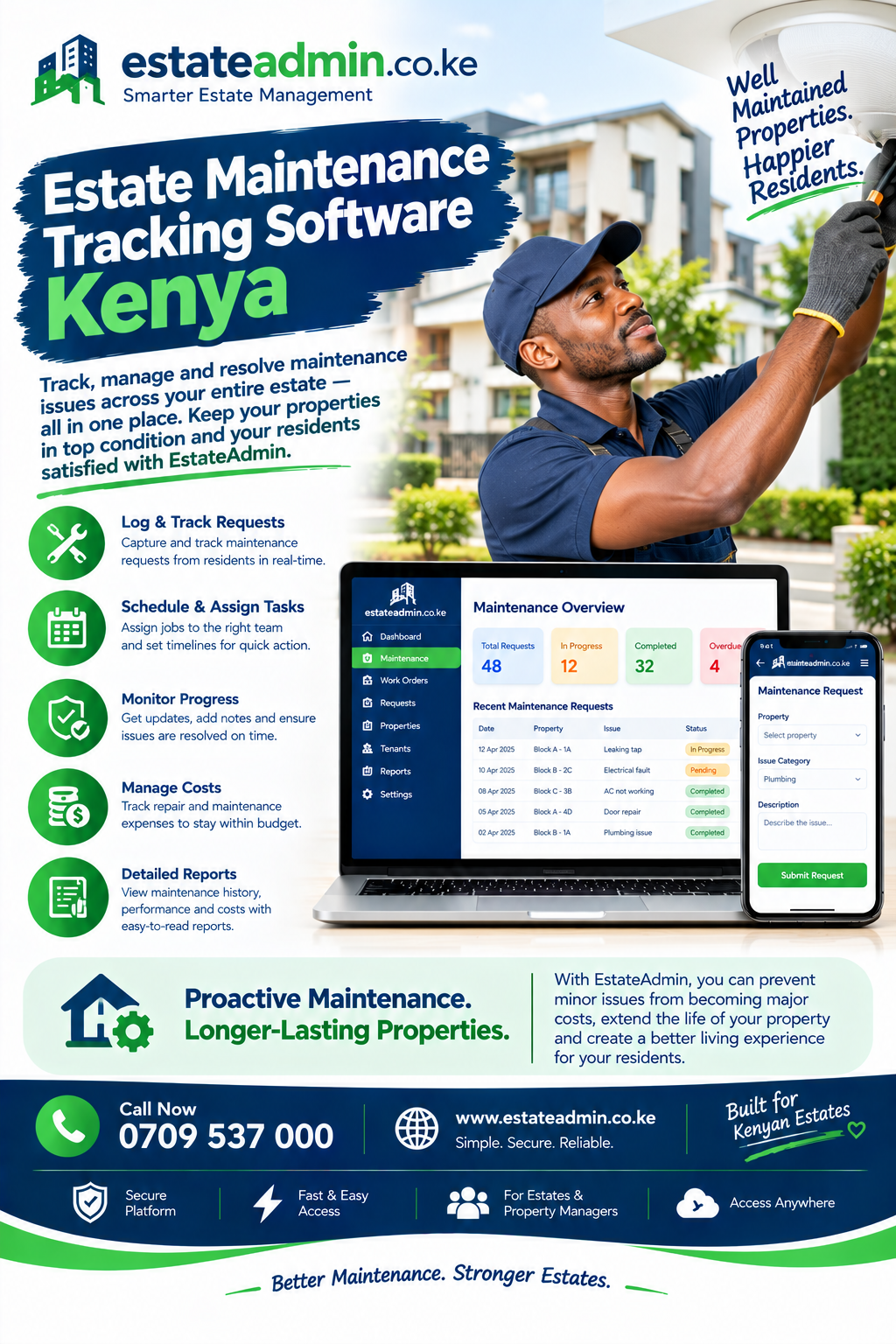
Estate Maintenance Tracking Software Kenya: The Complete Guide to Better Property Maintenance
Property maintenance is one of the responsibilities that can quietly consume an estate management team’s time. A leaking pipe, faulty gate, broken security light, damaged pavement, blocked drainage channel, malfunctioning lift, or generator problem may begin as a small issue but become expensive when it is not reported, assigned, followed up, and resolved promptly. Estate Maintenance Tracking Software Kenya provides a structured way for estate managers, property administrators, landlords, facility teams, developers, and resident associations to organize maintenance requests and follow every job from initial report to completion.
For Kenyan residential estates, apartments, gated communities, and managed properties, maintenance is also closely connected to resident satisfaction and operating costs. A team needs to know which problems have been reported, which jobs are urgent, who is responsible, which contractor has been assigned, what the work is expected to cost, whether the repair has been completed, and whether further action is required. This guide explains how digital maintenance tracking works, why manual processes become difficult, what features matter, how preventive maintenance can be organized, how contractors can be managed, and how a property team can build a reliable maintenance workflow.
What Is Estate Maintenance Tracking Software?
Estate Maintenance Tracking Software Kenya is a digital solution for organizing maintenance requests, work orders, repairs, inspections, contractors, costs, and completion records within a property or estate.
Instead of relying on a maintenance notebook, spreadsheet, phone calls, emails, and WhatsApp messages, a centralized system provides a common place for maintenance information.
A typical maintenance record can contain:
- The property or estate.
- The building or block.
- The affected unit or common area.
- The person reporting the problem.
- The date the issue was reported.
- The category of the problem.
- The priority level.
- Assigned staff or contractor.
- Expected completion date.
- Estimated cost.
- Actual cost.
- Work status.
- Completion notes.
- Supporting photographs or documents where supported.
This structure gives management a clearer picture of maintenance activity.
For example, a resident may report that water is leaking from a ceiling. The administrator can create a maintenance request, identify the affected unit, assign a plumber, record the expected work, monitor progress, and close the request once the issue has been resolved.
That is much easier to manage when the entire process is visible in one system.
Why Maintenance Tracking Matters in Kenyan Estates
Maintenance problems are unavoidable in real estate. Buildings age, equipment requires servicing, weather affects external infrastructure, plumbing systems develop faults, electrical components fail, and shared facilities experience wear and tear.
The challenge is not preventing every fault. The challenge is managing faults effectively.
A well-organized Estate Maintenance Tracking Software Kenya workflow allows property managers to distinguish between urgent repairs, routine requests, scheduled maintenance, and longer-term projects.
This distinction matters because not every maintenance request deserves the same response.
Consider three reports received on the same morning:
- A security gate is not locking properly.
- A corridor light has stopped working.
- A resident requests repainting of a balcony.
The first issue may have a higher operational priority than the third. Without a structured system, however, all three requests may simply appear as messages in a phone.
A maintenance platform allows the team to prioritize the work.
Problems With Manual Maintenance Management
Many estates begin by handling maintenance through calls and messaging applications. This works when the property is small and the number of issues is limited.
As the estate grows, the process becomes difficult to control.
Maintenance requests get lost
A resident may report a problem by phone. Another may send a WhatsApp message. A committee member may mention an issue during a meeting.
If these reports are not entered into a central system, some can be forgotten.
There is no reliable priority list
When ten maintenance problems exist at the same time, managers need to know which ones require immediate attention.
A message inbox does not provide a proper maintenance queue.
Follow-up becomes dependent on memory
An administrator may remember that a plumber was supposed to return on Friday. If the administrator is absent, the information may disappear with them.
Contractors lack clear instructions
A contractor who receives incomplete information may visit the wrong location, misunderstand the problem, or arrive without the required materials.
Costs are difficult to track
A manager may remember that a repair was done but struggle to determine how much similar repairs have cost over several months.
Residents do not know the status
Residents often want simple answers: Has the issue been assigned? When will someone come? Has the repair been completed?
A structured Estate Maintenance Tracking Software Kenya system can provide a clearer internal workflow for answering those questions.
How a Digital Maintenance Workflow Works
A useful maintenance process can be broken into several stages.
1. Issue reporting
A maintenance problem is reported by a resident, staff member, caretaker, property manager, or inspection team.
2. Request classification
The issue is categorized, such as plumbing, electrical, security, cleaning, landscaping, structural, equipment, or general repair.
3. Priority assignment
The manager determines whether the issue is emergency, high priority, routine, or scheduled.
4. Assignment
The request is assigned to an internal staff member or external contractor.
5. Assessment
The assigned person assesses the problem and determines what work is required.
6. Quotation or estimate
Where necessary, the estate obtains an estimate or quotation before work begins.
7. Approval
The relevant person approves the work according to the estate’s financial procedures.
8. Repair
The contractor or maintenance employee performs the work.
9. Verification
Management or the resident confirms that the issue has been addressed.
10. Closure
The maintenance request is closed, with relevant notes and costs recorded.
A centralized Estate Maintenance Tracking Software Kenya platform makes this process easier to monitor because each maintenance request has a defined status.
Maintenance Requests and Work Orders
A maintenance request describes a problem.
A work order describes the work that needs to be performed.
The distinction is useful.
For example:
Request: “There is water leaking underneath the kitchen sink.”
Assessment: “The flexible hose is damaged.”
Work order: “Replace kitchen sink hose and test connection.”
This gives the contractor a clearer instruction.
A Estate Maintenance Tracking Software Kenya system can help convert reported problems into actionable maintenance tasks instead of leaving them as vague messages.
Common Maintenance Categories
Every estate should develop categories that reflect its actual maintenance needs.
Plumbing
Plumbing issues can include:
- Leaking taps
- Blocked sinks
- Broken pipes
- Water-pressure problems
- Drainage issues
- Toilet faults
- Pump problems
- Water tank issues
Electrical
Electrical requests may involve:
- Faulty lights
- Power sockets
- Circuit problems
- Common-area lighting
- Generator issues
- Electrical panels
- Security lighting
Security
Security-related maintenance can include:
- Gate barriers
- Access-control equipment
- Intercoms
- CCTV equipment
- Electric fences
- Security lighting
- Locks
Landscaping
Landscaping maintenance may include:
- Grass cutting
- Tree trimming
- Irrigation
- Garden maintenance
- Drainage around landscaped areas
- Replacement of damaged plants
Building maintenance
This can include:
- Painting
- Roofing
- Flooring
- Doors
- Windows
- Walls
- Waterproofing
- Common-area repairs
Equipment
Estates may have:
- Lifts
- Generators
- Pumps
- Fire equipment
- Water treatment equipment
- Gate systems
- Solar installations
Using Estate Maintenance Tracking Software Kenya to organize these categories allows management to understand which types of problems occur most frequently.
Preventive Maintenance Versus Reactive Repairs
One of the biggest advantages of organized maintenance management is the ability to move beyond purely reactive repairs.
Reactive maintenance occurs after something breaks.
Preventive maintenance happens before failure, based on a schedule, manufacturer’s recommendations, property policy, usage patterns, or inspection results.
Examples include:
- Generator servicing.
- Lift inspections.
- Water pump servicing.
- Fire equipment checks.
- Roof inspections.
- Drainage inspections.
- Electrical inspections.
- Gate equipment servicing.
- Pest-control treatments.
- Landscaping schedules.
A Estate Maintenance Tracking Software Kenya solution can help property teams keep scheduled maintenance visible instead of allowing it to depend entirely on memory.
Why preventive maintenance matters
Suppose an estate’s water pump is serviced every six months.
If the maintenance team tracks that schedule, the service can be planned before the due date.
Without tracking, the service may be forgotten until the pump fails.
Preventive maintenance does not guarantee that equipment will never fail. It does, however, create a more disciplined approach to managing assets and recurring maintenance obligations.
Managing Emergency Maintenance
Some issues cannot wait for the normal maintenance queue.
Examples include:
- Major water leaks.
- Electrical hazards.
- Security gate failures.
- Serious flooding.
- Fire-system problems.
- Major structural damage.
- Lift failures where safety is affected.
A Estate Maintenance Tracking Software Kenya system can help classify emergency requests separately from routine tasks.
Emergency procedures should still include documentation.
Even when a contractor must be called immediately, the estate should record:
- What happened.
- When it happened.
- Who responded.
- What action was taken.
- What the repair cost.
- Whether follow-up work is needed.
This creates a useful history for future management decisions.
Managing Contractors
Most estates rely on external contractors for at least some maintenance services.
A property may use different contractors for:
- Plumbing.
- Electrical work.
- Lift servicing.
- Generator maintenance.
- Landscaping.
- Pest control.
- Security systems.
- Painting.
- Construction.
- Roofing.
A Estate Maintenance Tracking Software Kenya workflow can connect maintenance jobs to the contractors responsible for completing them.
This makes it easier to understand contractor performance over time.
Contractor information to monitor
Property managers may want to track:
- Contractor name.
- Service category.
- Contact information.
- Jobs assigned.
- Jobs completed.
- Costs.
- Outstanding work.
- Response time.
- Recurring service arrangements.
This information can support supplier reviews.
If one contractor repeatedly takes too long to complete urgent work, management has a record that can inform future decisions.
Tracking Maintenance Costs
Maintenance is both an operational and financial activity.
A repair may require:
- Labour.
- Materials.
- Transport.
- Equipment.
- Contractor fees.
- Replacement parts.
Without proper records, it becomes difficult to understand the real cost of maintaining the property.
A Estate Maintenance Tracking Software Kenya system can help connect maintenance activities with financial records.
For example:
| Maintenance category | Monthly cost |
|---|---|
| Plumbing | KSh 75,000 |
| Electrical | KSh 55,000 |
| Equipment | KSh 110,000 |
| Painting | KSh 35,000 |
| General repairs | KSh 45,000 |
| Landscaping | KSh 60,000 |
The figures immediately give management something to investigate.
If equipment expenses suddenly increase, the team can examine the individual jobs behind the total.
Connecting Maintenance With Property Expenses
Maintenance should not exist separately from financial management.
Every completed repair can affect the property’s operating costs.
A Estate Maintenance Tracking Software Kenya workflow can help management connect maintenance requests with expense records where the software supports such integration.
Consider a broken water pump.
The maintenance record identifies:
- The equipment affected.
- The problem.
- The contractor.
- The repair performed.
- The parts used.
- The total cost.
The expense record can then reflect the financial consequence.
This creates a better relationship between operational data and financial reporting.
Tracking Maintenance by Unit
Residential estates often need to distinguish between common-area maintenance and unit-specific issues.
A property manager may need to know whether a repair affects:
- A particular apartment.
- A block.
- A parking area.
- A shared facility.
- A garden.
- A gate.
- A utility area.
A Estate Maintenance Tracking Software Kenya system can organize maintenance by property location.
This is useful because responsibility for costs may differ depending on the nature of the repair and the property’s governing arrangements.
For example, a problem inside a privately occupied unit may be handled differently from a failure affecting a shared water system.
The system should make the location clear.
Tracking Common-Area Maintenance
Common areas often generate a large proportion of estate maintenance requests.
These can include:
- Corridors.
- Staircases.
- Parking areas.
- Swimming pools.
- Clubhouses.
- Children’s play areas.
- Roads.
- Gates.
- Gardens.
- Street lighting.
- Drainage systems.
A Estate Maintenance Tracking Software Kenya platform can help management see how frequently these areas require attention.
Over time, this information can reveal patterns.
If the same gate requires repeated repairs, management may need to consider replacement rather than continuing with temporary fixes.
Resident Communication
Residents want maintenance issues resolved, but they also want communication.
Poor communication can make a small maintenance issue feel much larger.
For example, if a resident reports a leaking pipe and hears nothing for several days, they may repeatedly contact the office.
A structured Estate Maintenance Tracking Software Kenya process helps staff know whether a request has been received, assigned, or completed.
Even when residents do not have direct access to the software, the internal workflow gives administrators better information when responding to questions.
Good maintenance communication
A useful update might explain:
- The request has been received.
- The issue has been assigned.
- A contractor has been scheduled.
- The work is awaiting approval.
- The repair has been completed.
- Follow-up inspection is required.
Clear communication builds confidence.
Maintenance Prioritization
Not all maintenance tasks are equal.
A practical priority system could be:
Emergency
Issues involving immediate safety, major property damage, critical utilities, or serious security concerns.
High priority
Problems that significantly affect residents or property operations but are not immediate emergencies.
Routine
Normal repairs that can be scheduled during regular maintenance periods.
Planned
Preventive or improvement work that can be scheduled in advance.
A Estate Maintenance Tracking Software Kenya system should make priority visible to the team.
This helps prevent routine requests from being treated as emergencies and ensures serious problems receive attention quickly.
Maintenance Scheduling
Scheduled maintenance can be organized around dates, equipment, locations, and recurring frequencies.
For example:
| Asset | Task | Frequency |
|---|---|---|
| Generator | Servicing | Scheduled interval |
| Lift | Inspection/service | Scheduled interval |
| Water pump | Service | Scheduled interval |
| Fire equipment | Inspection | Scheduled interval |
| Garden | Maintenance | Weekly/monthly |
| Drainage | Inspection | Seasonal |
| Roof | Inspection | Periodic |
The exact frequency should be based on equipment requirements, contracts, property policy, and applicable professional guidance.
A Estate Maintenance Tracking Software Kenya platform can help keep these obligations visible.
Maintenance History
A property’s maintenance history becomes increasingly valuable over time.
Suppose a manager wants to know how often a particular pump has failed over three years.
If records are stored only in WhatsApp messages, the answer may be difficult to obtain.
If every job has been recorded in a centralized system, management can review the history.
This can help answer:
- How frequently has the asset required repairs?
- What has been spent?
- Which contractors have worked on it?
- Are repairs becoming more frequent?
- Would replacement be more economical?
A Estate Maintenance Tracking Software Kenya solution can make this historical information easier to organize.
Using Maintenance Data for Decision-Making
Maintenance data becomes more valuable when management uses it to identify patterns.
Imagine that a building experiences repeated plumbing problems in the same area.
The first repair may be inexpensive.
The second repair may also be manageable.
After several repairs, however, management may discover that the underlying pipework requires a larger intervention.
A maintenance history can make that pattern visible.
Instead of asking, “Why are we spending so much on plumbing?”, management can examine specific jobs and identify recurring causes.
Maintenance and Asset Management
Some maintenance tasks are associated with specific assets.
Examples include:
- Generators.
- Pumps.
- Lifts.
- CCTV systems.
- Access-control equipment.
- Fire systems.
- Water tanks.
- Solar equipment.
Asset records can include:
- Asset name.
- Location.
- Installation date where known.
- Service provider.
- Maintenance schedule.
- Repair history.
- Related costs.
A Estate Maintenance Tracking Software Kenya workflow that supports asset-related maintenance gives property managers a more structured way to monitor equipment.
Managing Maintenance Quotations
Some repairs require quotations before work can begin.
For example, a major roof repair may require several supplier quotations.
The maintenance process can then involve:
- Identify the problem.
- Request quotations.
- Compare options.
- Obtain approval.
- Assign contractor.
- Complete work.
- Verify completion.
- Record final cost.
This creates a more accountable process for larger expenditure.
A Estate Maintenance Tracking Software Kenya platform can help keep the maintenance request and its financial documentation organized.
Maintenance Approval Controls
Property managers should define approval thresholds.
A small repair might be approved by the property administrator.
A larger project might require approval from a property manager or management committee.
The exact structure depends on the organization’s policies.
The important point is to avoid uncontrolled spending.
A Estate Maintenance Tracking Software Kenya workflow can support clearer approval processes by associating maintenance work with estimated and approved costs where those capabilities are available.
Reducing Maintenance Backlogs
A maintenance backlog consists of unresolved jobs that remain open.
A large backlog can indicate:
- Insufficient staffing.
- Poor contractor response.
- Inadequate budgeting.
- Weak prioritization.
- Poor reporting.
- Repeated unresolved problems.
A Estate Maintenance Tracking Software Kenya system gives managers a clearer view of open requests.
Management can then sort work by:
- Priority.
- Age.
- Location.
- Contractor.
- Category.
- Cost.
- Status.
This is much more useful than reviewing a list of messages.
Maintenance Performance Metrics
Property managers can monitor several indicators.
Open maintenance requests
How many jobs are currently unresolved?
Average resolution time
How long does it take to close requests?
Recurring issues
Which problems appear repeatedly?
Maintenance expenditure
How much is being spent?
Contractor performance
How quickly and reliably are suppliers completing work?
Preventive maintenance completion
How many scheduled maintenance tasks were completed on time?
Backlog age
How long have unresolved jobs remained open?
These metrics can help managers identify operational weaknesses.
A Estate Maintenance Tracking Software Kenya platform becomes particularly useful when management can turn maintenance records into meaningful performance information.
Preventive Maintenance Planning for Kenyan Properties
Different properties have different maintenance requirements.
A high-rise apartment building may require close attention to lifts, pumps, water systems, fire equipment, common-area lighting, and access systems.
A gated community may place greater emphasis on roads, drainage, security infrastructure, landscaping, street lighting, and shared facilities.
A commercial property may require additional attention to HVAC systems, electrical infrastructure, generators, lifts, and tenant facilities.
The maintenance plan should therefore be based on the actual property.
A Estate Maintenance Tracking Software Kenya solution can provide the structure for managing these schedules.
Maintenance for Gated Communities
Gated communities often have extensive shared infrastructure.
Examples include:
- Entrance gates.
- Guard houses.
- Perimeter walls.
- Electric fencing.
- Roads.
- Street lighting.
- Drainage.
- Landscaped areas.
- Community halls.
- Playgrounds.
- Swimming pools.
- Water infrastructure.
Maintenance teams can quickly become overwhelmed if every issue is handled manually.
A centralized Estate Maintenance Tracking Software Kenya workflow can help management organize these requests and distinguish urgent work from planned maintenance.
Maintenance for Apartment Buildings
Apartment buildings have their own challenges.
The manager may receive maintenance requests from dozens or hundreds of units while also managing common areas.
The team needs to know whether a request is:
- Inside a unit.
- In a shared corridor.
- Related to water infrastructure.
- Related to electricity.
- Related to security.
- Related to equipment.
A Estate Maintenance Tracking Software Kenya system can help keep these records separate and searchable.
Maintenance for Property Management Companies
Property management companies may oversee multiple estates.
Without a centralized system, each property may develop its own spreadsheet or communication method.
This creates inconsistent processes.
A Estate Maintenance Tracking Software Kenya platform can support standardized maintenance workflows across properties.
Managers can use common categories and statuses while keeping each property’s records separate.
This can make staff training easier and improve management oversight.
How Maintenance Software Supports Cost Control
Maintenance software does not automatically make repairs cheaper.
Its value is that it gives management better information about costs.
Suppose an estate spends KSh 80,000 every month on repairs.
The manager can use maintenance records to identify:
- Which categories consume the most money.
- Which contractors receive the most work.
- Which assets require repeated repairs.
- Which locations generate the most requests.
- Whether preventive maintenance is being completed.
- Whether major replacement projects might be justified.
A Estate Maintenance Tracking Software Kenya system can therefore support cost-control decisions without assuming that the cheapest repair is always the best option.
Maintenance Documentation
Good records should contain enough information to explain what happened.
Depending on the type of job, this can include:
- Original complaint.
- Inspection notes.
- Contractor quotation.
- Approval.
- Work order.
- Materials used.
- Completion notes.
- Photographs.
- Invoice.
- Payment information.
- Follow-up requirements.
Documentation becomes especially useful when an issue reappears.
A Estate Maintenance Tracking Software Kenya workflow can help management keep the history connected to the relevant property or unit.
Choosing the Right Maintenance System
Selecting maintenance software should begin with the estate’s real problems.
Before choosing a platform, ask:
- How are maintenance requests currently received?
- How are they recorded?
- Who assigns jobs?
- How are emergencies identified?
- How are contractors selected?
- How are quotations handled?
- How are approvals obtained?
- How are costs recorded?
- How are completed jobs verified?
- How are recurring maintenance tasks scheduled?
- How are reports generated?
- How is maintenance history retained?
A good Estate Maintenance Tracking Software Kenya solution should make the process easier to control from beginning to end.
Features to Prioritize
Maintenance request management
Staff should be able to create and track requests without unnecessary complexity.
Work-order management
Tasks should be assigned clearly to responsible staff or contractors.
Status tracking
Useful statuses can include:
- New.
- Assigned.
- In progress.
- Awaiting quotation.
- Awaiting approval.
- Scheduled.
- Completed.
- Closed.
Priority management
Urgent work should be easy to identify.
Contractor management
The system should provide useful information about vendors and assigned jobs.
Cost tracking
Managers should be able to associate costs with maintenance activities.
Maintenance history
Past jobs should remain accessible.
Reporting
Managers should be able to understand workload, costs, recurring issues, and outstanding tasks.
Property and unit association
Maintenance records should be connected to the relevant location.
User permissions
Different staff should have appropriate access.
A Estate Maintenance Tracking Software Kenya platform should be assessed against these operational requirements rather than against a generic feature checklist.
Moving From WhatsApp and Spreadsheets
Many property teams will recognize this process:
A resident sends a WhatsApp message.
The administrator reads it.
The administrator forwards it to a caretaker.
The caretaker calls a contractor.
The contractor visits the property.
Nobody updates the original message.
Two weeks later, the resident asks what happened.
The administrator searches through messages.
This process can work temporarily, but it does not scale well.
A Estate Maintenance Tracking Software Kenya workflow gives each issue a record that can be assigned, updated, reviewed, and closed.
The objective is not necessarily to stop using WhatsApp for communication. It is to prevent WhatsApp from becoming the maintenance database.
Staff Roles in Maintenance Management
A property operation may involve:
- Estate manager.
- Property manager.
- Administrator.
- Caretaker.
- Maintenance technician.
- Accountant.
- Security supervisor.
- External contractors.
- Management committee.
Each person has a different role.
A Estate Maintenance Tracking Software Kenya platform with appropriate permissions can help ensure users see and modify information relevant to their responsibilities.
For example, a caretaker may need to update the status of a repair, while an accountant may need to review costs and invoices.
Resident-Reported Maintenance
Residents are often the first people to notice faults inside or around their homes.
A structured reporting process should capture:
- Resident details.
- Unit.
- Issue.
- Date.
- Description.
- Priority.
- Location.
- Relevant photographs where supported.
This reduces the risk of losing information.
A Estate Maintenance Tracking Software Kenya solution can help administrators organize resident-reported issues alongside internally identified maintenance tasks.
Maintenance Reporting for Committees
Management committees may want periodic reports showing:
- Number of maintenance requests.
- Completed jobs.
- Open jobs.
- Emergency repairs.
- Maintenance expenditure.
- Major projects.
- Recurring problems.
- Contractor performance.
A Estate Maintenance Tracking Software Kenya platform can help organize the data needed for these reports.
The committee does not necessarily need every work order. It needs a summary that helps it understand the condition and maintenance costs of the property.
Maintenance and Resident Satisfaction
Maintenance has a direct effect on how residents experience a property.
Repeatedly broken lights, leaking pipes, poor landscaping, faulty gates, or unresolved repairs can create frustration even when the property is otherwise well managed.
A Estate Maintenance Tracking Software Kenya system can support faster follow-up by making unresolved work more visible.
The goal is not simply to close tickets quickly. A maintenance request should be considered resolved only when the underlying problem has actually been addressed.
Building a Maintenance Policy
Software works best when supported by clear procedures.
An estate should define:
- What qualifies as an emergency.
- Who can report issues.
- Who assigns work.
- Who approves spending.
- When quotations are required.
- How contractors are selected.
- How completed jobs are verified.
- How invoices are checked.
- How recurring maintenance is scheduled.
- How records are retained.
A Estate Maintenance Tracking Software Kenya implementation can then reflect these rules.
Common Maintenance Management Mistakes
Ignoring preventive maintenance
Waiting for equipment to fail can create unnecessary disruption.
Treating every request as urgent
This makes it difficult to prioritize genuinely critical issues.
Failing to record completion
A verbal statement that “the plumber came” is not the same as a documented completed work order.
Not tracking costs
Without cost history, managers cannot identify spending patterns.
Using too many contractors without records
A fragmented supplier base can make performance difficult to assess.
Closing jobs without verification
A job should be closed only after confirming that the problem has been addressed.
Failing to review recurring failures
Repeated repairs may indicate an underlying problem.
A Estate Maintenance Tracking Software Kenya workflow can reduce these weaknesses by creating a consistent maintenance process.
A Practical Example: Apartment Water Leak
Consider a 200-unit apartment development in Nairobi.
A resident reports water leaking beneath a kitchen sink.
The administrator records the request.
The system identifies:
Unit: B-104
Category: Plumbing
Priority: High
Status: New
The property manager assigns a plumber.
The plumber inspects the issue and determines that a damaged connection needs replacement.
The repair is approved.
The plumber completes the work.
The administrator updates the request to completed and records the final cost.
A Estate Maintenance Tracking Software Kenya workflow keeps the history connected.
Six months later, another issue occurs in the same unit.
Management can review the previous maintenance record instead of starting from zero.
A Practical Example: Generator Maintenance
Consider an estate with a backup generator.
The generator requires periodic servicing.
Without a schedule, the service date may be forgotten.
With organized maintenance tracking, the team can create a recurring task.
The record can show:
- Last service.
- Next service.
- Service provider.
- Maintenance history.
- Cost.
- Notes.
A Estate Maintenance Tracking Software Kenya platform can help make recurring tasks visible to the responsible team.
Measuring Maintenance Team Performance
Managers should avoid judging maintenance teams only by the number of jobs completed.
Quality matters.
Useful measures include:
- Average response time.
- Average resolution time.
- Number of repeat repairs.
- Number of overdue work orders.
- Preventive maintenance completion rate.
- Cost per maintenance category.
- Contractor response time.
- Resident-reported recurring issues.
A Estate Maintenance Tracking Software Kenya system can provide structured data for these measurements.
Maintenance Data and Long-Term Planning
Maintenance records can also inform capital planning.
Suppose an estate repeatedly repairs the same gate motor.
Over several years, the repair costs may become significant.
Management can compare the cumulative repair history with the potential cost of replacing the equipment.
The decision should consider reliability, safety, expected lifespan, operating requirements, and other relevant factors.
The software does not make the decision automatically. It provides the information required to make a better-informed decision.
Security and Maintenance Records
Maintenance records can contain information about property infrastructure.
Examples include:
- Gate systems.
- Security equipment.
- Electrical infrastructure.
- Access-control systems.
- Equipment locations.
Access should therefore be controlled.
A Estate Maintenance Tracking Software Kenya implementation should be accompanied by sensible user permissions and organizational policies for handling property information.
Staff accounts should be unique, access should be reviewed, and unnecessary permissions should be removed.
Implementation Guide
Moving to a digital maintenance workflow can be done in stages.
Stage 1: Map the existing process
Document how requests currently move from residents to completion.
Stage 2: Create categories
Choose maintenance categories that match the estate.
Stage 3: Define priorities
Agree on emergency, high-priority, routine, and planned classifications.
Stage 4: Create contractor records
Add the suppliers commonly used for maintenance.
Stage 5: Establish approval rules
Define who can approve different types or values of work.
Stage 6: Create recurring schedules
Add important preventive maintenance activities.
Stage 7: Train staff
Use realistic examples rather than generic demonstrations.
Stage 8: Start with active jobs
Enter unresolved maintenance issues so the new system immediately reflects current work.
Stage 9: Monitor performance
Review open requests and overdue tasks regularly.
A Estate Maintenance Tracking Software Kenya implementation is most successful when the estate defines its process before configuring the software.
Frequently Asked Questions
What is Estate Maintenance Tracking Software Kenya?
Estate Maintenance Tracking Software Kenya is software used to organize property maintenance requests, work orders, repairs, contractors, schedules, costs, and completion records in a centralized system.
Why should an estate use maintenance tracking software?
It can help prevent maintenance requests from being forgotten, make work assignments clearer, improve follow-up, organize contractor activity, track costs, and provide management with a history of property maintenance.
Can maintenance software track resident complaints?
Yes. Maintenance requests can be associated with residents and units so that property managers can monitor reported issues and their status.
Can it manage preventive maintenance?
A suitable platform can support scheduled maintenance tasks, helping teams remember recurring servicing and inspection requirements.
Can maintenance jobs be assigned to contractors?
Yes. Contractor assignment is an important feature for estates that outsource plumbing, electrical, landscaping, equipment servicing, security systems, and other work.
Can maintenance costs be tracked?
Yes. Maintenance records can be associated with estimated and actual costs where the software supports expense tracking. This helps management understand how much different maintenance activities cost.
Can the system manage multiple estates?
Many property-management platforms support multiple properties or workspaces. This is useful for management companies overseeing several developments.
Does maintenance software replace a property manager?
No. Software organizes information and workflows. Property managers still need to make decisions, supervise contractors, approve work, communicate with residents, and inspect completed jobs.
How can an estate reduce maintenance backlogs?
Start by recording every open request, assigning priorities, allocating responsibility, setting expected completion dates, reviewing overdue work regularly, and investigating recurring problems.
What should I look for when choosing maintenance software?
Prioritize request management, work orders, priority levels, contractor management, scheduling, cost tracking, maintenance history, property and unit records, user permissions, reporting, and ease of use.
Final Maintenance Management Checklist
Before considering an estate’s maintenance process fully organized, management should be able to answer these questions:
- Do we know every open maintenance request?
- Do we know which issues are urgent?
- Does every job have an assigned person?
- Can we see overdue work?
- Do we track contractor performance?
- Can we identify recurring problems?
- Do we know how much maintenance costs?
- Do we have preventive maintenance schedules?
- Can we see the maintenance history of important assets?
- Can we produce maintenance reports?
- Can we connect major maintenance expenses to financial records?
- Are maintenance approvals documented?
- Are completed jobs verified?
If several answers are “no,” the estate likely has an opportunity to improve its maintenance workflow.
A Estate Maintenance Tracking Software Kenya platform can provide the structure required to make these controls part of daily property operations.
Conclusion
Maintenance is one of the clearest indicators of how effectively an estate is being managed. Residents notice broken equipment, water leaks, poor lighting, damaged infrastructure, unmaintained gardens, faulty gates, and unresolved repairs quickly. Property owners also feel the financial impact when small problems become major repairs.
Estate Maintenance Tracking Software Kenya provides a practical framework for bringing maintenance requests, work orders, contractors, schedules, costs, and completion records into a more organized workflow.
The biggest benefit is visibility.
Instead of relying on memory, managers can see which jobs are open. Instead of searching through messages, administrators can find the maintenance history. Instead of guessing how much a particular category costs, management can review recorded expenditure. Instead of waiting for equipment to fail, teams can schedule preventive maintenance.
For a Kenyan apartment building, gated community, residential development, or property management company, these improvements can make day-to-day operations more predictable.
A Estate Maintenance Tracking Software Kenya solution should not be selected simply because it has a long list of features. The most important question is whether it supports the actual maintenance process used by the estate.
Test the complete workflow.
Create a maintenance request. Assign it. Set its priority. Add a contractor. Record an estimate. Complete the job. Capture the final cost. Close the request. Then generate a report.
If the process is simple and the resulting information is useful, the software has a strong chance of becoming part of the estate’s daily operations.
Estate Maintenance Tracking Software Kenya can also help property teams move from reactive maintenance toward a more planned approach. By recording recurring repairs and maintenance schedules, managers can identify patterns and make better decisions about equipment, contractors, budgets, and capital improvements.
The goal is not to eliminate every maintenance problem. Buildings will always require repairs. The goal is to make sure that problems are captured, prioritized, assigned, resolved, documented, and reviewed.
Estate Maintenance Tracking Software Kenya can provide the central structure needed for that process, particularly when maintenance is becoming too complex for notebooks, spreadsheets, phone calls, and messaging applications.
For property managers handling several developments, Estate Maintenance Tracking Software Kenya can also provide a standardized approach that makes it easier to monitor maintenance activity across different properties while retaining property-specific information.
A strong maintenance system should ultimately help answer five simple questions:
What is broken?
Who is handling it?
When will it be fixed?
How much will it cost?
Has the problem actually been resolved?
When those answers are available without searching through multiple files and conversations, estate management becomes considerably more efficient.
Estate Maintenance Tracking Software Kenya is therefore best viewed as an operational management tool rather than merely a digital maintenance diary.
For estates looking to improve accountability, resident communication, preventive maintenance, contractor management, and cost visibility, establishing a centralized maintenance workflow is a practical place to start.
The right system can help turn maintenance from a constant stream of disconnected complaints into a structured process that management can monitor, measure, and improve.
Estate Maintenance Tracking Software Kenya gives property teams a foundation for organizing that process and building a clearer maintenance history for the properties they manage.
Ultimately, effective maintenance protects the property, supports residents, improves operational planning, and helps management make better use of maintenance budgets.
Estate Maintenance Tracking Software Kenya can be part of that broader strategy by giving estate teams a consistent way to manage the full journey from reported problem to completed repair.
For Kenyan estates that want fewer forgotten requests, better contractor accountability, stronger preventive maintenance, and clearer maintenance reporting, moving from scattered records to a centralized workflow is a practical step toward better property management.
Estate Maintenance Tracking Software Kenya should make that workflow easier to manage, easier to measure, and easier to improve over time.
The result is a property where maintenance decisions are based on organized information rather than memory, scattered messages, or incomplete spreadsheets.
Estate Maintenance Tracking Software Kenya
Estate Maintenance Tracking Software Kenya
Estate Maintenance Tracking Software Kenya