
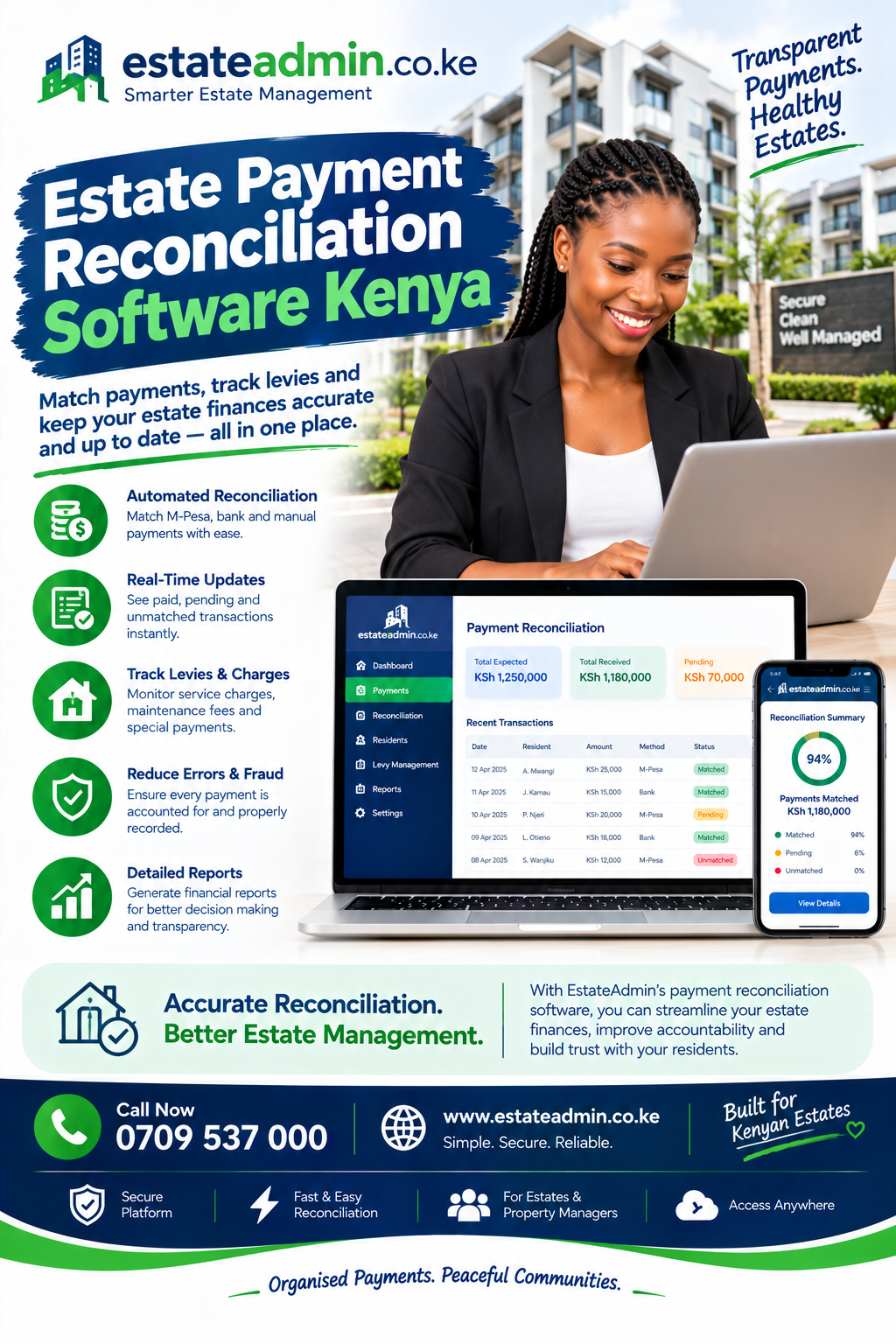
Estate Payment Reconciliation Software Kenya: A Practical Guide to Accurate Estate Collections
Managing payments across a residential estate is more complicated than simply checking whether money has arrived. Estate managers must connect payments to the correct unit, resident, invoice, service charge period, and account balance while keeping records clear enough for committees and auditors. Estate Payment Reconciliation Software Kenya is designed around that problem: bringing payment records, invoices, resident ledgers, balances, and reporting into a controlled workflow. This guide is for estate managers, property administrators, accountants, developers, resident associations, gated-community committees, and management companies in Kenya. It explains how reconciliation works, why spreadsheets often become difficult to control, which features matter, how M-Pesa and bank payments fit into the process, how to evaluate software, and how to introduce a reliable workflow without disrupting collections.
What payment reconciliation means in estate management
Payment reconciliation is the process of comparing money received with what the estate expected to receive, then assigning each transaction to the correct account and invoice. In a residential development, that can involve monthly service charges, sinking-fund contributions, utility recoveries, parking charges, penalties, or other approved fees. The objective is not merely to record a receipt. The objective is to establish a trustworthy relationship between a transaction and the financial obligation it settles.
A practical Estate Payment Reconciliation Software Kenya workflow starts with a clean resident and unit register. The system needs to know who is responsible for an account, which invoices have been raised, what has been paid, what remains outstanding, and whether a payment is complete or partial. EstateAdmin describes its reconciliation workflow as applying payments to invoices and updating balances automatically, while keeping exports available for reporting and audits.
For a Kenyan estate, reconciliation may involve transactions arriving through M-Pesa, bank transfers, standing instructions, cash deposits, or other approved channels. Each channel creates a slightly different administrative challenge. A good system therefore needs a consistent internal ledger even when the payment sources differ.
Reconciliation is more than marking an invoice as paid
Consider a resident who owes KSh 12,000 and sends KSh 7,000. A weak process might mark the invoice as paid because someone entered the payment against the wrong record. A stronger process records KSh 7,000 as received, leaves KSh 5,000 outstanding, and makes the partial payment visible on the resident statement. That distinction matters when managers follow up arrears or explain balances to residents.
With Estate Payment Reconciliation Software Kenya, reconciliation can be treated as a repeatable accounting workflow rather than an occasional spreadsheet exercise. The value comes from connecting the transaction to the invoice and keeping the resulting balance consistent.
Why estates struggle with manual payment reconciliation
Many estates begin with spreadsheets because they are inexpensive, familiar, and flexible. The difficulty appears when transaction volume grows. A workbook that works for 30 units can become difficult to control for 300 units, several payment channels, multiple billing periods, and more than one person entering data.
Manual reconciliation also creates dependency on individual knowledge. One administrator may know how a particular reference is interpreted, while another administrator uses a different approach. Over time, these small differences produce inconsistent records.
Common problems include:
- Payments recorded against the wrong unit.
- Duplicate payment entries.
- Unmatched transactions sitting in a bank or M-Pesa list.
- Partial payments treated as full settlement.
- Old balances carried forward incorrectly.
- Spreadsheet formulas overwritten accidentally.
- Different versions of the same reconciliation file.
- Reports prepared from data that has already changed.
- Difficulty explaining adjustments months later.
- Delayed identification of genuine arrears.
A dedicated Estate Payment Reconciliation Software Kenya solution reduces the need to maintain separate payment, invoice, and balance files. Instead of repeatedly copying information between sheets, the team can work from a central ledger.
The hidden cost of spreadsheet reconciliation
The cost of manual reconciliation is not only the administrator’s salary or the number of hours spent typing. It also includes the cost of delayed decisions and disputes.
Suppose an estate committee needs a collections report before its monthly meeting. If payment records are spread across several files, the administrator may spend hours checking references, comparing totals, and correcting balances. If residents challenge figures, more time is spent reconstructing what happened.
A properly configured Estate Payment Reconciliation Software Kenya workflow can make the underlying transaction history easier to review. EstateAdmin also positions audit-ready history as part of its broader estate management workflow, helping teams understand what changed and when.
Key benefits of automated estate payment reconciliation
Automation should not mean removing financial controls. It should mean reducing repetitive work while making important controls easier to apply consistently.
1. Faster payment allocation
When payments are linked to resident accounts and invoices, administrators spend less time manually updating several records. A payment can move the relevant invoice toward settlement and update the account balance.
Estate Payment Reconciliation Software Kenya can help estates create a more consistent process for allocating incoming transactions, especially when many residents pay around the same due date.
2. More accurate resident balances
A resident should be able to see a logical trail from invoice to payment to remaining balance. If the numbers do not reconcile, the administrator needs to know why.
EstateAdmin’s reconciliation page specifically describes automatic recalculation of balances and invoice status when payments are applied to invoices. A Estate Payment Reconciliation Software Kenya workflow built around the same principle helps reduce manual arithmetic.
3. Better visibility of arrears
Arrears management starts with accurate balances. If the ledger is wrong, collection follow-ups become unreliable. A resident who has actually paid may receive an unnecessary reminder, while a genuinely overdue account may be overlooked.
Using Estate Payment Reconciliation Software Kenya, an estate team can organize outstanding balances by resident, invoice, period, or estate and prioritize follow-up based on reliable records. EstateAdmin’s arrears workflow is designed to show invoice balances, overdue amounts, and partial payments.
4. Easier committee reporting
Committees usually need clear answers rather than raw transaction dumps. They may ask how much was billed, how much was collected, which balances remain outstanding, and whether collections are improving.
Estate Payment Reconciliation Software Kenya can support reports that turn transaction records into management information. EstateAdmin highlights monthly payment reports, invoice reports, exports, and resident statements as part of its reporting approach.
5. Stronger accountability
A financial system should make it easier to identify who entered or changed information. Role-based access can help separate responsibilities between administrators, managers, accountants, and viewers.
With Estate Payment Reconciliation Software Kenya, the estate can establish defined responsibilities around recording payments, approving adjustments, reviewing reconciliations, and producing reports.
How the reconciliation workflow should work
A reliable reconciliation process can be broken into clear stages. The exact configuration will depend on the estate, but the underlying logic should remain simple.
Step 1: Maintain clean resident and unit records
Start with a master list of units, owners or responsible residents, contact details, account identifiers, and relevant categories. Avoid creating multiple records for the same unit.
Clean master data is essential because payment matching is only as reliable as the account receiving the transaction.
Step 2: Generate or import the correct invoices
Before payments are reconciled, the estate needs a clear record of what residents owe. Service charge invoices should show the billing period, amount, due date, and account.
EstateAdmin supports recurring service charges and bulk invoice generation, allowing teams to establish repeatable billing periods rather than rebuilding invoices manually each month.
Step 3: Capture incoming payments
Payments should enter the system through a controlled process. Depending on the estate, this may include M-Pesa, bank payments, deposits, or other channels.
The aim is to preserve the payment date, amount, reference, payer information where available, and intended account.
Step 4: Match payment to the correct invoice
This is the heart of Estate Payment Reconciliation Software Kenya. The administrator or automated workflow should identify the resident account and apply the amount to the relevant invoice.
Where the payment is partial, the remaining balance should remain visible. Where it exceeds the invoice, the excess should be handled according to the estate’s approved accounting policy rather than silently disappearing.
Step 5: Review exceptions
Not every payment will match automatically. References can be incomplete, residents can pay on behalf of others, and bank narratives may not contain enough information.
A good Estate Payment Reconciliation Software Kenya process therefore includes an exception queue or review step for unmatched and ambiguous transactions.
Step 6: Reconcile totals
After allocation, compare the reconciled total with the source payment records. The objective is to ensure that the ledger reflects the money actually received.
Step 7: Produce statements and reports
Finally, generate resident statements, arrears reports, collection summaries, and committee reports from the same underlying records. EstateAdmin’s statements workflow is designed to show invoices, payments, and a running balance in a consistent format.
M-Pesa and estate payment reconciliation in Kenya
M-Pesa is an important consideration for Kenyan estate management because residents commonly use mobile payments for everyday transactions. A reconciliation process must therefore handle payment references and collection records without relying on handwritten notes or disconnected spreadsheets.
The right Estate Payment Reconciliation Software Kenya approach is not simply to say that an estate accepts M-Pesa. It is to ensure that a payment received through a mobile channel can be connected to the correct resident account and invoice.
EstateAdmin has Kenya-focused payment pages covering M-Pesa service charge collection and Paybill-oriented workflows. Its payment-system page emphasizes consistent payment recording, invoice matching, balances, and reporting.
A practical M-Pesa reconciliation example
Imagine an estate with 180 occupied units. Each unit receives a monthly service charge invoice. On the due date, many residents pay within a short period.
The administrator may receive a transaction report containing amounts and references. Instead of opening a spreadsheet, searching for each resident, entering the amount, recalculating the balance, and updating the status manually, a Estate Payment Reconciliation Software Kenya platform can provide a structured payment-recording process.
Suppose Unit A-14 has an invoice of KSh 10,500 and a payment of KSh 10,500. The invoice should show the correct settlement. Unit B-07 might owe KSh 10,500 but pay KSh 5,000. Its balance should remain KSh 5,500. Unit C-03 could have two older invoices and make one payment intended to clear the oldest balance first. The system and the estate’s allocation policy should make that treatment clear.
The important principle is traceability. Every allocation should be explainable.
Bank transfers, cash, and multiple payment channels
Not every resident will use the same payment method. Some estates receive bank transfers, direct deposits, or other forms of payment. A good Estate Payment Reconciliation Software Kenya system should not force the management team to create a separate ledger for every channel.
Instead, the channels should feed a consistent account structure. The payment source can remain identifiable while the resident ledger provides the common view.
Cash deserves particular care. Where cash payments are permitted, the estate should have clear receipt, approval, deposit, and reconciliation controls. Digital systems can record the transaction, but they do not replace good financial governance.
Why one ledger matters
When payment information exists in several places, managers can end up with several versions of the truth. One spreadsheet may say an account is paid while another says it is overdue.
Estate Payment Reconciliation Software Kenya is most useful when it becomes the central operational record for invoices, payments, balances, and reporting. That is consistent with EstateAdmin’s positioning of resident ledgers and payment tracking as connected parts of estate accounting.
Features to look for in estate payment reconciliation software
Not all property software is designed for the same workflow. When comparing systems, focus on the financial process rather than a long list of generic features.
Payment-to-invoice matching
The most important capability is the ability to apply a payment to the right invoice. A Estate Payment Reconciliation Software Kenya system should make this process obvious and auditable.
Look for:
- Resident account identification.
- Invoice selection.
- Partial payment support.
- Clear payment references.
- Automatic balance updates.
- Payment status changes.
- Reconciliation history.
Resident statements
A resident statement should explain what was billed, what was paid, and what remains. This can significantly improve communication during payment disputes.
Estate Payment Reconciliation Software Kenya should support statement generation from the same records used for reconciliation. That avoids creating a second manual statement ledger.
Arrears reporting
Managers need to see who owes money, how much, and for which periods. A useful Estate Payment Reconciliation Software Kenya workflow should distinguish current balances from overdue amounts and make partial payments visible.
Audit history
Financial adjustments should be traceable. Look for a system that records relevant actions and supports review by authorized users.
Role-based access
The person who enters transactions does not necessarily need the same permissions as the estate manager or accountant. EstateAdmin advertises separate Admin, Manager, Accountant, and Viewer roles.
A Estate Payment Reconciliation Software Kenya platform should support sensible separation of duties.
Exports and reporting
Committees may need monthly summaries, finance teams may need transaction exports, and auditors may require supporting records. Export functionality matters because software should fit into the estate’s wider reporting process.
Comparing manual and automated reconciliation
The difference between manual and automated workflows becomes clearer when viewed side by side.
| Area | Manual approach | Automated or centralized approach |
|---|---|---|
| Payment entry | Spreadsheet or receipt book | Structured payment record |
| Invoice matching | Manual lookup | Payment-to-invoice workflow |
| Partial payments | Manual calculations | Balance updated from payment |
| Arrears | Spreadsheet filters | Account-level visibility |
| Statements | Prepared manually | Generated from ledger |
| Reporting | Rebuilt periodically | Based on current records |
| Audit trail | Depends on files and notes | System history and controlled access |
| Team collaboration | Multiple files | Shared workspace |
A Estate Payment Reconciliation Software Kenya solution does not eliminate the need for review. It makes the review process more organized and gives managers a consistent source of financial information.
How reconciliation improves estate collections
Reconciliation and collections are closely connected. You cannot manage arrears effectively if you cannot trust your balances.
When residents receive accurate statements, payment requests become easier to explain. When administrators can distinguish paid, partially paid, and overdue accounts, follow-up becomes more targeted.
Estate Payment Reconciliation Software Kenya helps establish that foundation by connecting collection activity to the resident ledger.
Faster follow-up on genuine arrears
A manager can focus on accounts that are actually outstanding instead of spending time investigating false arrears created by data-entry errors.
Better resident communication
A clear statement can answer common questions: What was billed? When was it billed? What did I pay? What is the remaining balance?
Estate Payment Reconciliation Software Kenya can support this communication when the resident-facing figures are generated from the same ledger used by the finance team.
Better cash-flow visibility
Management committees need to understand expected collections and actual receipts. Consistent reconciliation makes those comparisons more meaningful.
Reconciliation for multi-estate property managers
Managing one estate is different from managing a portfolio. A property management company may oversee several developments, each with its own residents, service charges, committees, payment channels, and reporting requirements.
A scalable Estate Payment Reconciliation Software Kenya system should help managers keep each estate’s financial records separate while preserving a consistent operating model.
The benefits include:
- Standardized billing processes.
- Consistent payment allocation.
- Estate-specific reporting.
- Easier staff training.
- Reduced dependence on individual spreadsheets.
- Faster portfolio-level review.
EstateAdmin describes its platform as supporting multi-workspace use and estate-focused service charge workflows.
Standardization without losing estate-specific rules
Different estates may have different service charge categories or billing rules. Standardization does not mean forcing every property into the same financial structure.
Instead, the management company should standardize the process: bill, receive, reconcile, review, report. The specific charges can remain estate-specific.
A Estate Payment Reconciliation Software Kenya implementation should therefore be configurable enough to accommodate the estate’s approved billing structure.
Data accuracy and financial controls
Software can improve control, but only when the underlying procedures are sound. Before implementation, establish who is allowed to create invoices, record payments, make adjustments, approve reversals, and access reports.
Use unique identifiers
Every unit should have a clear identifier. Payment references should be captured consistently. Avoid relying solely on names because residents can share names or change over time.
Review unusual transactions
Large overpayments, duplicate transactions, unidentified deposits, and manual adjustments should receive additional attention.
Keep supporting evidence
Where an adjustment is made, retain the reason and supporting documentation according to the estate’s financial procedures.
Reconcile regularly
Do not wait until the end of the financial year. Frequent reconciliation makes exceptions easier to investigate.
Estate Payment Reconciliation Software Kenya can support this discipline by giving the team a single environment for payment records, invoices, balances, and reports.
Choosing the right solution for a Kenyan estate
Choosing software should begin with the estate’s workflow rather than a vendor’s feature list.
Start by documenting the current process. How are invoices generated? How do residents pay? Where are transaction reports downloaded? Who matches payments? How are arrears followed up? How are committee reports produced?
Then test whether the proposed Estate Payment Reconciliation Software Kenya system handles the full cycle.
Questions to ask vendors
- Can the system manage multiple estates or workspaces?
- Can payments be applied to specific invoices?
- Does it support partial payments?
- Can it show resident balances and arrears?
- Can it generate statements?
- What reporting and export options are available?
- How are user roles controlled?
- Is there an audit history?
- Can the workflow support Kenyan payment methods?
- Can the team test the system with a real billing cycle?
EstateAdmin’s own comparison guidance recommends testing the full workflow, including billing, payments, reconciliation, arrears, statements, and reporting, rather than judging software by a feature list alone.
A good Estate Payment Reconciliation Software Kenya platform should also be easy enough for administrators to use consistently. A system that is technically powerful but confusing may create a new source of errors.
Pricing considerations
Software cost should be evaluated against the total cost of the current process. A cheap tool may still be expensive if it requires hours of manual reconciliation every month.
When evaluating Estate Payment Reconciliation Software Kenya pricing, consider:
- Number of units.
- Number of estates.
- Number of users.
- Reporting requirements.
- Payment workflows.
- Implementation effort.
- Data migration.
- Support.
- Training.
- Time saved during monthly reconciliation.
EstateAdmin notes that pricing can be influenced by residential units, workspaces, and reporting or export requirements, and recommends comparing the full workflow cost rather than subscription price alone.
Calculate the operational return
Suppose an administrator spends two full days every month reconciling payments. If software reduces that workload substantially, the value is not limited to the hours saved. The team can use that time for arrears follow-up, resident support, maintenance coordination, committee reporting, or other operational priorities.
Estate Payment Reconciliation Software Kenya should therefore be evaluated as an operational control, not merely as another monthly software expense.
Implementing reconciliation software without disrupting operations
A smooth rollout is more important than a rushed rollout.
Phase 1: Clean the data
Review resident records, unit numbers, opening balances, outstanding invoices, and payment histories. Resolve obvious duplicates before migration.
Phase 2: Define the billing structure
Document service charges, billing periods, due dates, categories, and allocation rules.
Phase 3: Configure roles
Give each team member only the permissions required for their responsibilities.
Phase 4: Test a sample
Select a manageable group of units and run a complete billing and payment cycle. Include full payments, partial payments, late payments, and an unmatched transaction.
Phase 5: Compare totals
Before going live, compare system balances with the existing records. Investigate every material difference.
Phase 6: Train users
Training should focus on real estate scenarios rather than generic software demonstrations. Show staff how to record a payment, correct an error, review arrears, produce a statement, and prepare a committee report.
Phase 7: Go live with a clear cut-off
Define the date from which the new ledger becomes the official operational record.
Estate Payment Reconciliation Software Kenya works best when the organization treats implementation as a process improvement project, not simply as software installation.
Common mistakes to avoid
Mistake 1: Importing dirty data
If duplicate residents and incorrect balances are migrated, the new system will inherit the problem.
Mistake 2: Mixing billing and payment corrections
Do not use payment entries to hide billing errors. Correct the source transaction through an approved process.
Mistake 3: Ignoring partial payments
Partial payments are common in real-world collections. A system that only handles paid or unpaid statuses will not reflect the true financial position.
Mistake 4: Giving everyone full access
Broad permissions can weaken accountability. Use roles appropriate to the job.
Mistake 5: Reconciling only when there is a dispute
Reconciliation should be routine. Waiting for complaints makes errors harder to trace.
Mistake 6: Reporting from multiple spreadsheets
A committee report should come from the same ledger used for daily operations.
Mistake 7: Choosing software based only on appearance
A polished dashboard is useful, but the critical question is whether the system handles your actual payment and billing workflow.
A strong Estate Payment Reconciliation Software Kenya implementation addresses these issues by combining operational simplicity with clear financial records.
Practical monthly reconciliation checklist
Estate teams can use the following checklist every month:
- Confirm the resident and unit register is current.
- Confirm the correct invoices have been issued.
- Collect transaction records from approved payment channels.
- Record or import payments.
- Match payments to resident accounts.
- Apply payments to the correct invoices.
- Review partial payments.
- Investigate unmatched transactions.
- Check for duplicates.
- Compare reconciled receipts with source totals.
- Review overdue balances.
- Generate resident statements where needed.
- Produce the monthly collections report.
- Review unusual adjustments.
- Archive or export supporting reports according to policy.
Using Estate Payment Reconciliation Software Kenya as the central workflow makes this checklist easier to execute consistently because the team is working from connected billing and payment records.
A simple example for a Nairobi estate
Consider a Nairobi gated community with 240 units. The estate bills a monthly service charge and uses a combination of mobile payments and bank transfers.
Before software, the administrator maintains one spreadsheet for invoices, another for payment entries, and a third report for arrears. At month-end, the administrator compares transaction lists, copies amounts, checks names, and manually updates balances.
The committee asks why collections appear lower than expected. The administrator then spends another day investigating payments that were received but entered against the wrong accounts.
After adopting Estate Payment Reconciliation Software Kenya, the estate can structure the process around invoices, payments, resident ledgers, balances, and reports. A full payment can close an invoice, a partial payment can leave a visible balance, and an unmatched transaction can be reviewed rather than silently assigned.
The improvement is not simply speed. It is confidence in the numbers.
What residents gain from better reconciliation
Payment reconciliation is often viewed as an internal finance function, but residents experience the consequences directly.
When records are accurate, residents can receive clearer statements and more useful answers to payment questions. They are less likely to be asked to prove that a payment was made when the estate already has the transaction recorded correctly.
A Estate Payment Reconciliation Software Kenya system can also improve consistency in arrears follow-up. Residents with genuine outstanding balances can receive accurate information about what they owe, while accounts that are fully paid can be treated accordingly.
Transparent statements reduce confusion
A good statement should show:
- Opening balance where applicable.
- New invoices.
- Payments received.
- Adjustments where applicable.
- Current outstanding balance.
This is one reason EstateAdmin provides statement functionality centered on billed versus paid amounts and a running balance.
What estate committees gain
Committees need governance-level information. They should not have to interpret a raw list of mobile transactions to understand collection performance.
With Estate Payment Reconciliation Software Kenya, committee reporting can focus on useful indicators such as:
- Total billed for the period.
- Total collected.
- Outstanding balances.
- Number of accounts with arrears.
- Payment trends.
- Unmatched transactions.
- Material adjustments.
- Estate-level collection performance.
The exact metrics should reflect the estate’s governance requirements. The important principle is that reports should be generated from reconciled records.
Security, permissions, and auditability
Payment information is financially sensitive. Estates should consider how access is controlled and how changes are tracked.
A Estate Payment Reconciliation Software Kenya platform should be assessed for role-based access, authentication, audit history, data handling practices, backups, and administrative controls. Do not assume that every software product provides the same level of protection.
Users should also follow basic operational controls:
- Use strong, unique passwords.
- Remove access promptly when staff leave.
- Avoid sharing accounts.
- Review administrator permissions periodically.
- Keep procedures for correcting transactions.
- Protect exported reports.
- Train staff on responsible data handling.
Technology and governance work together. A secure system cannot compensate for poor access practices, and strong procedures are difficult to maintain when records are scattered.
How to measure success after implementation
Do not judge a new system only by whether staff like the interface. Establish measurable operational outcomes.
Useful measures include:
- Time required to reconcile monthly payments.
- Number of unmatched transactions.
- Number of duplicate entries.
- Number of resident balance disputes.
- Time required to produce committee reports.
- Percentage of payments allocated within a target period.
- Accuracy of opening and closing balances.
- Time spent preparing arrears follow-ups.
After several billing cycles, compare the results with the previous process.
Estate Payment Reconciliation Software Kenya should ultimately make financial administration more predictable, easier to review, and less dependent on manual spreadsheet work.
When software is especially valuable
A dedicated reconciliation platform becomes increasingly useful when an estate has:
- Many residential units.
- High monthly transaction volume.
- Multiple payment channels.
- Several administrators.
- Multiple estates under one management company.
- Frequent resident balance queries.
- Regular committee meetings.
- Significant arrears.
- Complex service charge structures.
- A need for consistent audit records.
Even a smaller estate can benefit if its committee wants stronger controls or if administrators spend too much time on manual reconciliation.
The key question is not simply how large the estate is. It is how much complexity the current process creates.
Frequently asked questions
What is estate payment reconciliation software?
Estate Payment Reconciliation Software Kenya is software designed to help estate managers match incoming payments to resident accounts and invoices, update balances, identify outstanding amounts, and produce reliable financial reports. It replaces fragmented manual processes with a connected payment and ledger workflow.
Why is payment reconciliation important for residential estates?
Accurate reconciliation helps managers know what has actually been collected, which invoices remain unpaid, and whether resident balances are correct. It also supports clearer statements, better arrears follow-up, and stronger committee reporting.
Can estate reconciliation software handle M-Pesa payments?
A suitable Kenyan solution should support workflows that accommodate M-Pesa-based collections and payment references. EstateAdmin provides Kenya-focused service charge payment and M-Pesa collection workflows, with payment recording, invoice matching, balances, and reporting.
Estate Payment Reconciliation Software Kenya can be evaluated specifically for how it handles the estate’s chosen M-Pesa and bank-payment processes.
Can partial payments be reconciled?
Yes, partial payments are an important use case. If a resident owes KSh 10,000 and pays KSh 6,000, the system should record the payment and leave the appropriate balance outstanding rather than incorrectly closing the invoice.
Does reconciliation software help with arrears?
Yes. Arrears reporting depends on accurate balances. A Estate Payment Reconciliation Software Kenya workflow can help managers identify overdue accounts and understand which invoices remain unpaid or partially paid. EstateAdmin’s arrears workflow provides visibility into outstanding balances and resident statements.
Can software generate resident statements?
Yes. A useful system should generate statements showing invoices, payments, and running balances from the same ledger used for reconciliation. This reduces the need to manually rebuild statements.
Is estate payment reconciliation software suitable for property management companies?
Yes. Portfolio managers can benefit from standardized workflows across multiple estates while maintaining separate records and reporting for each development. The right setup should support multiple workspaces, roles, and estate-specific billing structures.
How should an estate choose reconciliation software?
Start with the workflow. Test resident records, billing, payment capture, payment-to-invoice matching, partial payments, arrears, statements, reports, roles, and exports. A trial using a real billing cycle is more useful than a generic demonstration.
What is the difference between reconciliation and payment collection?
Collection is the process of receiving money from residents. Reconciliation is the process of confirming that received money has been correctly recorded and allocated to the relevant financial obligations. They are connected but not identical.
Does software remove the need for financial review?
No. Automation reduces repetitive work, but management should still review exceptions, adjustments, unusual transactions, and reconciliation totals. Software strengthens controls when it is combined with clear procedures and appropriate approvals.
Additional considerations for a stronger reconciliation process
A strong Estate Payment Reconciliation Software Kenya implementation should also make month-end close easier by reducing the number of records staff must compare manually.
For growing estates, Estate Payment Reconciliation Software Kenya can provide a repeatable structure for each billing period without forcing administrators to rebuild their process from scratch.
When evaluating Estate Payment Reconciliation Software Kenya, pay attention to how exceptions are handled, because the quality of unmatched-payment workflows often matters as much as automatic matching.
The best Estate Payment Reconciliation Software Kenya setup should make it obvious which transactions still need human review.
For committee members, Estate Payment Reconciliation Software Kenya is valuable when it turns complex transaction data into clear totals and account-level explanations.
A practical Estate Payment Reconciliation Software Kenya workflow should distinguish between a payment received, a payment allocated, and an invoice fully settled.
Estate teams can also use Estate Payment Reconciliation Software Kenya to create a consistent reconciliation calendar, such as weekly exception reviews and a formal month-end check.
When staff changes occur, Estate Payment Reconciliation Software Kenya can reduce reliance on undocumented spreadsheet knowledge because the workflow is recorded within a shared system.
A useful Estate Payment Reconciliation Software Kenya platform should support corrections without destroying the original financial trail.
Before selecting Estate Payment Reconciliation Software Kenya, ask the vendor to demonstrate how the system handles duplicate payments, unidentified deposits, overpayments, and reversals.
The reporting side of Estate Payment Reconciliation Software Kenya should be simple enough for an estate manager to produce a collection summary without rebuilding figures in another spreadsheet.
For larger developments, Estate Payment Reconciliation Software Kenya can help standardize financial administration across different blocks, phases, or managed communities.
Residents benefit from Estate Payment Reconciliation Software Kenya when accurate balances and statements make payment questions easier to resolve.
Accountants benefit from Estate Payment Reconciliation Software Kenya when transaction histories, invoices, and payment allocations can be reviewed from connected records.
Ultimately, the success of Estate Payment Reconciliation Software Kenya should be measured by accuracy, visibility, accountability, and the time required to complete the monthly reconciliation cycle.
For an estate planning a transition from spreadsheets, Estate Payment Reconciliation Software Kenya should be tested using real historical scenarios before the system becomes the official ledger.
For a team seeking dependable monthly controls, Estate Payment Reconciliation Software Kenya can become the financial workflow around which reconciliation is organized.
Final thoughts
Accurate payment records are the foundation of effective estate financial management. When invoices, payment transactions, resident accounts, balances, arrears, and reports are disconnected, even a well-run estate can spend unnecessary time resolving avoidable discrepancies.
Estate Payment Reconciliation Software Kenya gives estate managers a way to bring these activities into one repeatable workflow. The strongest approach is not simply to automate data entry. It is to create a reliable chain from billing to payment to reconciliation to reporting.
For Kenyan estates, the right solution should fit local payment habits, including M-Pesa and bank transfers, while supporting clear resident statements, arrears visibility, role-based access, and committee-ready reporting. EstateAdmin’s platform is built around service charge billing, payment tracking, reconciliation, arrears, statements, and reporting for gated communities.
If your estate still depends on several spreadsheets to determine who has paid, who owes money, and how much has been collected, the next step is to map the current process and test it in a centralized system. Use one real billing period, include full and partial payments, review exceptions, compare totals, and measure the time saved.
A well-designed Estate Payment Reconciliation Software Kenya workflow can help the estate team spend less time searching through payment records and more time managing the community, following up genuine arrears, supporting residents, and giving committees financial information they can understand and act on.