
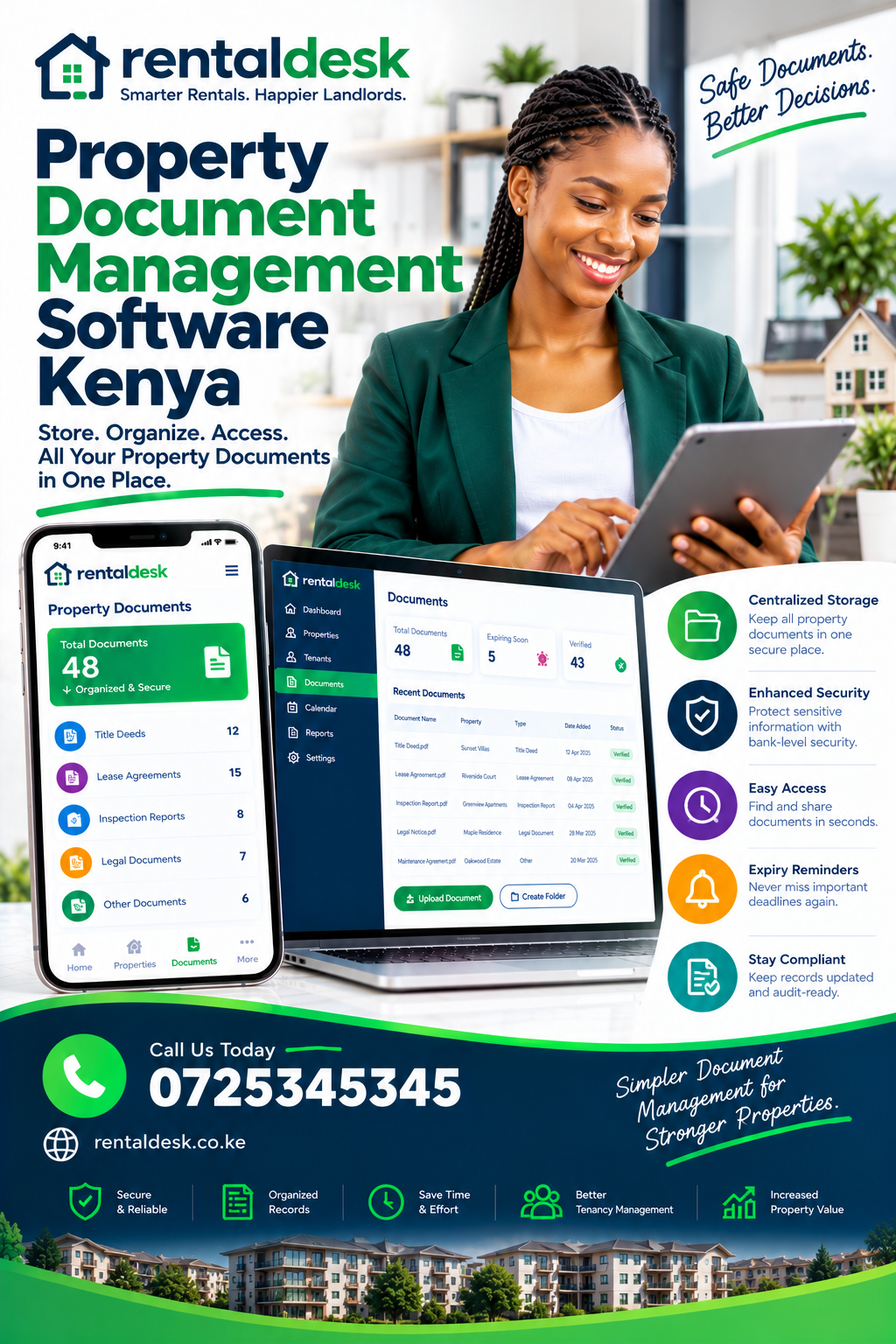
Property Asset Management Software Kenya: A Complete Guide for Property Owners and Managers
Managing a property involves much more than collecting rent and responding to tenants. Buildings contain pumps, generators, elevators, water tanks, CCTV cameras, electrical systems, gates, fire equipment, solar installations and many other physical assets that require attention throughout their useful life. Property Asset Management Software Kenya gives landlords, property managers and real estate companies a structured way to record these assets, monitor their condition, schedule maintenance, track repair costs and make better long-term decisions.
For a small property, it may be possible to remember most equipment and maintenance requirements manually. However, as a property portfolio grows, relying on memory, notebooks, spreadsheets and WhatsApp conversations becomes increasingly difficult.
A manager may know that a generator needs servicing, but may not immediately remember when it was last serviced. Another employee may know the location of a water pump but not its purchase date or repair history. An invoice may show that money was spent on a repair without clearly showing which asset required the work.
These gaps can make property operations less organized.
Asset management brings all of this information together.
Instead of viewing a property only as a collection of units and tenants, asset management looks at the physical infrastructure that supports the property and contributes to its long-term value.
This guide explains what property asset management software is, why it matters in Kenya, which assets should be tracked, the features to look for, how preventive maintenance works, how asset records support budgeting, and how property owners can use digital systems to make better decisions.
What Is Property Asset Management Software?
Property Asset Management Software Kenya is a digital system designed to help property owners and managers monitor, maintain and manage the physical assets associated with their properties.
These assets can include building infrastructure, equipment, machinery, security systems, water systems, electrical installations and other valuable components.
Instead of keeping separate records for each asset, management can create a centralized asset register.
A typical asset record may contain:
- Asset name
- Asset category
- Property or building
- Specific location
- Purchase date
- Installation date
- Serial number
- Supplier
- Warranty information
- Expected useful life
- Maintenance schedule
- Repair history
- Service provider
- Maintenance costs
- Current condition
- Replacement notes
The purpose is to give management a clearer picture of what exists, where it is located, what condition it is in and what attention it needs.
EstateAdmin’s published property asset management guide describes a centralized asset register, maintenance scheduling, condition monitoring, repair history and asset performance reporting as key capabilities.
This type of information becomes increasingly valuable as the number of properties and assets increases.
Why Property Assets Need Professional Management
A building may generate rental income for many years, but the equipment supporting that building does not remain in perfect condition forever.
Generators require servicing.
Water pumps can wear out.
Elevators require regular maintenance.
CCTV systems can develop faults.
Electrical installations need attention.
Fire safety equipment needs inspection.
Gates and barriers can experience mechanical problems.
Water tanks and boreholes need maintenance.
When these assets are ignored, small problems can become larger operational issues.
Using Property Asset Management Software Kenya can help property managers move from reactive maintenance toward more organized asset planning.
Consider a generator.
A manual record might contain a handwritten note saying:
Generator serviced in March.
That may not be enough information several months later.
A structured digital record could include:
- Generator identification
- Location
- Service date
- Technician
- Work completed
- Parts replaced
- Cost
- Next service date
- Service provider
This creates a history that can be reviewed when future maintenance decisions are made.
Common Asset Management Problems in Kenyan Properties
Many property owners face similar challenges when managing physical assets.
Missing Asset Records
A property may have expensive equipment but incomplete information about when it was purchased, who supplied it or when it was last serviced.
Unplanned Breakdowns
If maintenance schedules are not followed, equipment may fail unexpectedly.
High Repair Costs
Repeated emergency repairs can become expensive.
Poor Budget Planning
Without historical records, it becomes harder to anticipate future replacement and maintenance costs.
Difficulty Managing Multiple Properties
A property manager responsible for several buildings may struggle to know the condition of assets at each location.
Property Asset Management Software Kenya can address these challenges by centralizing asset information and connecting it to maintenance activities.
The objective is not simply to digitize records. It is to create a more reliable operational process.
What Assets Should Property Managers Track?
One of the first questions property owners should ask is which assets should be included in the system.
The answer depends on the property.
A small apartment building will not necessarily have the same assets as a large commercial development.
However, many properties can benefit from tracking the following.
1. Generators
Backup generators are important for properties that require reliable power during outages.
Records can include:
- Generator model
- Capacity
- Installation date
- Service provider
- Service history
- Fuel-related records
- Repair history
- Parts replaced
2. Water Pumps
Water pumps are essential in many multi-unit properties.
Management can track servicing, repairs and replacement history.
3. Boreholes
Where a property has a borehole, management may want to maintain records of relevant equipment, servicing and repairs.
4. Elevators
Apartment and commercial buildings with elevators need reliable maintenance records.
5. CCTV Systems
Cameras, recording equipment and related infrastructure can be tracked as assets.
6. Electric Fences
Security infrastructure may require periodic maintenance and repairs.
7. Gates and Barriers
Automated gates can contain motors, sensors and control systems that need maintenance.
8. Solar Systems
Solar panels, inverters, batteries and related equipment can be recorded individually or as connected assets.
9. Fire Safety Equipment
Properties may have extinguishers, alarms and other fire safety infrastructure.
10. Air Conditioning Equipment
Commercial buildings may have numerous air conditioning units that require servicing.
Property Asset Management Software Kenya allows management to create a structured inventory instead of relying on informal records.
Centralized Asset Register
A centralized asset register is one of the most useful features of an asset management system.
An asset register answers a basic question:
What assets does this property have?
It can also answer:
- Where is the asset?
- Who supplied it?
- When was it installed?
- When was it last serviced?
- What repairs has it received?
- How much has been spent on it?
- When is the next service due?
- Is it still economical to maintain?
Property Asset Management Software Kenya can make this information easier to organize when asset management is integrated with the wider property management workflow.
A simple asset register could look like this:
| Asset | Location | Condition | Last Service | Next Service |
|---|---|---|---|---|
| Generator | Main compound | Good | Recorded | Scheduled |
| Water pump | Pump room | Good | Recorded | Scheduled |
| CCTV system | Security office | Fair | Recorded | Scheduled |
| Lift | Block A | Good | Recorded | Scheduled |
| Gate motor | Main entrance | Fair | Recorded | Scheduled |
The exact information should be adapted to the property.
Asset Location Tracking
Knowing that an estate owns an asset is useful.
Knowing exactly where the asset is located is even more useful.
A large property may have multiple:
- Water pumps
- CCTV cameras
- Fire extinguishers
- Electrical panels
- Water tanks
- Air conditioners
- Lighting systems
Without location information, maintenance staff may spend unnecessary time identifying equipment.
Property Asset Management Software Kenya can help organize assets by property, building, floor, room or other location categories where the system supports these fields.
For example:
Property: Greenview Apartments
Building: Block B
Location: Basement pump room
Asset: Water pump
Status: Operational
This makes the record more useful than simply listing “Water Pump.”
Asset Condition Monitoring
Asset management is not only about knowing what equipment exists.
Management also needs to know its condition.
An asset might be:
- New
- Good
- Fair
- Poor
- Critical
- Out of service
The exact categories can be defined by the organization.
Condition monitoring helps management identify equipment that may require attention.
For example, if a water pump has required several repairs within a short period, management may need to consider whether continuing to repair it makes financial sense.
Property Asset Management Software Kenya can help keep these condition records organized.
The information becomes more valuable when it is updated after inspections and maintenance work.
Preventive Maintenance
Preventive maintenance means servicing equipment before it fails.
This is different from reactive maintenance.
Reactive maintenance
Something breaks → management calls a technician → repair is performed.
Preventive maintenance
Maintenance is scheduled → equipment is inspected or serviced → potential problems are identified earlier.
Neither approach completely eliminates unexpected failures.
However, planned maintenance gives property managers greater control over recurring maintenance activities.
EstateAdmin’s published materials describe preventive maintenance scheduling for assets such as generators, pumps, elevators, CCTV systems and electrical equipment.
Property Asset Management Software Kenya can help property managers schedule recurring maintenance where the platform supports automated scheduling.
Maintenance Scheduling
A maintenance schedule can be based on:
- Date
- Operating hours
- Usage
- Manufacturer recommendations
- Property policy
- Previous maintenance history
For example:
| Asset | Maintenance | Frequency |
|---|---|---|
| Generator | Servicing | Scheduled interval |
| Lift | Inspection | Scheduled interval |
| Water pump | Inspection | Scheduled interval |
| CCTV | System check | Scheduled interval |
| Fire equipment | Inspection | Scheduled interval |
The actual schedule should follow the relevant equipment requirements and professional advice.
A digital system makes it easier to see upcoming tasks.
Property Asset Management Software Kenya can therefore help managers move from remembering maintenance dates manually to maintaining a more structured schedule.
Repair History Tracking
Every significant repair tells a story about an asset.
Suppose a water pump has been repaired six times.
If those repairs were never recorded properly, the manager may think the pump simply needs another repair.
A repair history could show:
- Date
- Problem
- Technician
- Parts replaced
- Labour cost
- Total cost
- Result
After reviewing the history, management may decide that replacing the pump is more sensible than continuing to repair it.
Property Asset Management Software Kenya helps make this historical information easier to organize when repair records are linked to individual assets.
Historical information is particularly valuable when the same equipment repeatedly develops problems.
Asset Management and Maintenance Costs
Maintenance costs can add up over time.
An estate may spend money on:
- Labour
- Spare parts
- Technician call-outs
- Equipment servicing
- Emergency repairs
- Replacement components
- Specialist inspections
If costs are not associated with the relevant assets, management may not know which equipment is consuming the most maintenance resources.
Property Asset Management Software Kenya can help connect maintenance activities with cost records where the software provides integrated financial functionality.
For example:
| Asset | Repairs | Maintenance Cost |
|---|---|---|
| Generator | Recorded | Recorded |
| Water pump | Recorded | Recorded |
| Lift | Recorded | Recorded |
| Gate motor | Recorded | Recorded |
This creates a basis for further analysis.
Repair or Replace?
One of the most important asset management decisions is knowing when to repair and when to replace.
Repairing an asset may be sensible when:
- The equipment is relatively new
- The problem is minor
- Replacement parts are readily available
- The repair cost is reasonable
- The asset remains reliable
Replacement may become more attractive when:
- Breakdowns are frequent
- Repair costs are increasing
- Parts are difficult to find
- The asset is outdated
- Downtime is causing operational problems
- The asset is no longer suitable for the property’s needs
Property Asset Management Software Kenya can provide the historical information needed to support this type of decision.
The software does not make the decision automatically. It gives management better records from which to make the decision.
Managing Assets Across Multiple Properties
Managing one property is different from managing ten properties.
A property management company may have:
- Several apartment buildings
- Commercial properties
- Gated communities
- Rental houses
- Student accommodation
- Mixed-use developments
Each property may contain dozens or hundreds of physical assets.
Property Asset Management Software Kenya becomes especially useful when management needs to view assets across multiple locations.
A centralized dashboard may allow managers to understand:
- Assets by property
- Maintenance due
- Open repair requests
- Asset condition
- Maintenance costs
- Vendor assignments
EstateAdmin’s published property asset guide states that its multi-property approach allows managers to view assets from a centralized dashboard and track asset locations and maintenance costs.
Property Asset Management for Apartment Buildings
Apartment buildings have numerous shared assets.
These can include:
- Elevators
- Water pumps
- Backup generators
- CCTV
- Access gates
- Electrical systems
- Fire equipment
- Water tanks
- Lighting systems
A fault affecting one shared asset can affect many residents.
For example, an elevator breakdown can inconvenience residents across an entire building.
Property Asset Management Software Kenya can help management keep track of shared infrastructure and planned maintenance.
This can also support better communication because managers can have clearer information about the status of an asset when residents ask questions.
Property Asset Management for Gated Communities
Gated communities may have a larger range of common-area assets.
These can include:
- Security gates
- Electric fences
- Street lighting
- CCTV
- Roads
- Drainage systems
- Water infrastructure
- Boreholes
- Pumps
- Clubhouse equipment
- Landscaping equipment
Managing these assets manually can become difficult as the community grows.
Property Asset Management Software Kenya can help create an organized asset inventory where asset management functionality is available.
For estate committees, having a clear inventory can also make discussions about maintenance and capital expenditure more practical.
Property Asset Management for Commercial Buildings
Commercial buildings have their own asset requirements.
Depending on the building, management may need to monitor:
- HVAC equipment
- Elevators
- Backup power
- Electrical systems
- Security systems
- Fire safety equipment
- Water systems
- Parking systems
- Access control
- Lighting
A commercial property may have tenants operating businesses that depend on reliable infrastructure.
Property Asset Management Software Kenya can therefore support organized maintenance planning where the asset and maintenance modules are connected.
A property manager can maintain records of equipment while coordinating the people responsible for maintaining it.
Asset Management and Tenant Satisfaction
Tenants and residents may never see the asset register.
However, they experience the results of good or poor asset management.
A resident notices when:
- The lift works
- Water is available
- The gate opens
- Security cameras operate
- Lighting works
- Plumbing systems function
- Common areas are maintained
When assets are neglected, residents are more likely to experience disruptions.
Property Asset Management Software Kenya can contribute indirectly to better resident experiences by helping management organize maintenance and monitor infrastructure.
Asset management is therefore not purely an accounting or technical function.
It is also part of property service quality.
Asset Management and Budget Planning
Budgeting becomes easier when management has historical information.
Suppose a property spends regularly on generator maintenance.
A manager can review previous expenses and use them as part of future planning.
Similarly, if several major assets are approaching the end of their useful lives, management can plan for future expenditure rather than being surprised when equipment fails.
Property Asset Management Software Kenya can support this type of planning when asset records and financial information are connected.
Budget planning should still account for uncertainty because equipment does not always fail according to a predictable schedule.
However, good records can improve the quality of planning.
Asset Replacement Planning
Replacement planning is especially important for expensive equipment.
Instead of waiting until an asset completely fails, management can identify assets that are:
- Aging
- Frequently repaired
- Increasingly expensive
- Difficult to maintain
- No longer suitable
Property Asset Management Software Kenya can help organize replacement information alongside maintenance history.
A replacement plan might include:
| Asset | Current Condition | Priority | Planned Action |
|---|---|---|---|
| Generator | Fair | Medium | Review |
| Pump | Poor | High | Replace |
| CCTV | Good | Low | Maintain |
| Gate motor | Fair | Medium | Service |
The actual priority should be based on technical assessments, safety considerations and financial planning.
Warranty Management
Warranty information is easy to lose when it is kept only in physical files.
A digital asset record can include:
- Purchase date
- Supplier
- Warranty period
- Warranty expiry
- Equipment details
If a problem develops while an asset is still covered, management can investigate whether the supplier or manufacturer should handle the repair.
Property Asset Management Software Kenya can make warranty information easier to organize where the system supports these records.
This can prevent management from paying for repairs that may potentially fall under an existing warranty.
Vendor Management and Property Assets
Assets often require specialist contractors.
A property may use different providers for:
- Generator servicing
- Elevator maintenance
- CCTV maintenance
- Electrical work
- Plumbing
- Pump repairs
- Fire equipment
- Air conditioning
Connecting vendors to assets creates a more complete history.
For example:
Asset: Generator
Vendor: Generator service company
Last service: Recorded
Work completed: Recorded
Cost: Recorded
Next service: Scheduled
Property Asset Management Software Kenya can support this type of organized relationship when vendor management and asset management are connected.
Digital Maintenance Requests and Assets
Maintenance requests often begin with a resident or staff member reporting a problem.
For example:
“The water pressure in Block C is low.”
The management team can investigate and determine whether the issue relates to a pump, tank, pipework or another component.
If the maintenance system connects requests with assets, management can build a history of recurring problems.
Property Asset Management Software Kenya can make this workflow more structured when maintenance requests and asset records are connected.
This can help identify patterns.
If the same asset repeatedly generates complaints, management can investigate the underlying cause instead of treating every request as a separate incident.
Asset Performance Reports
Reports help management understand asset performance over time.
Useful reports can include:
- Assets by property
- Assets by category
- Assets requiring maintenance
- Repair history
- Maintenance cost
- Asset condition
- Upcoming maintenance
- Replacement candidates
Property Asset Management Software Kenya can make these reports easier to organize where reporting functionality is included.
A report does not need to be complicated.
Even a simple list of assets requiring maintenance this month can help a property manager prioritize work.
Cloud-Based Asset Management
Cloud-based systems can allow authorized users to access information from different locations.
This can be useful for property managers who move between buildings or supervise several properties.
Instead of keeping one spreadsheet on one office computer, asset information can be maintained in a centralized online system.
Property Asset Management Software Kenya can be useful for managers who need centralized access to property information where cloud-based access is provided.
EstateAdmin’s published asset-management material describes its platform as cloud-based and says it supports access to asset information across properties.
Users should still evaluate the platform’s access controls, backups and data-security practices before implementation.
Mobile Access for Property Managers
Property managers are not always sitting at a desk.
They may be:
- Inspecting a building
- Visiting a property
- Meeting a contractor
- Checking equipment
- Responding to a maintenance issue
- Attending a committee meeting
Mobile access can make it easier to retrieve information while on site.
Property Asset Management Software Kenya can support mobile workflows where the platform provides mobile-friendly access.
For example, a manager inspecting a generator can check its previous service history before discussing the equipment with a technician.
Asset Management and Estate Financial Reporting
Asset management should not exist completely separately from financial management.
Maintenance costs affect estate finances.
Replacement decisions affect budgets.
Supplier invoices affect expenses.
Large equipment purchases affect investment planning.
Property Asset Management Software Kenya can therefore be more useful when asset information connects with financial records.
EstateAdmin’s estate finance material describes the importance of organizing income, expenses, maintenance costs, supplier payments, budgets and financial reporting within property operations.
The connection between operational and financial information helps management understand not only what needs maintenance, but also what that maintenance is costing.
Asset Management and Property Value
A well-maintained property generally provides a better environment for occupants and reduces avoidable deterioration.
Asset management contributes by helping management identify maintenance requirements before they become larger problems.
Property Asset Management Software Kenya can support systematic maintenance planning where the necessary features are available.
However, software itself does not increase property value automatically.
The value comes from the decisions and actions that the records support.
That distinction is important.
A digital asset register is useful because it helps people manage assets better, not because simply having software guarantees a financial return.
Best Practices for Property Asset Management
Property owners can establish several simple practices.
Maintain a Complete Asset Register
Record important physical assets from the beginning.
Update Asset Records
Do not allow information to become outdated.
Schedule Preventive Maintenance
Plan recurring maintenance instead of relying only on emergency repairs.
Record Every Major Repair
Create a history for important equipment.
Track Costs
Connect maintenance activities with financial records where possible.
Review Aging Assets
Identify equipment that may require replacement.
Keep Warranty Information
Record warranty dates and supplier details.
Review Asset Reports
Use available information to support operational and financial decisions.
Property Asset Management Software Kenya can help bring these practices into one workflow when the appropriate modules are available.
How to Implement Asset Management in an Estate
Introducing asset management software does not need to happen all at once.
A practical implementation can follow several stages.
Stage 1: List Existing Assets
Start with the major equipment and infrastructure.
Stage 2: Verify Locations
Confirm where each asset is physically located.
Stage 3: Collect Existing Documents
Gather invoices, warranties, manuals, service records and other relevant documents.
Stage 4: Enter Asset Information
Create the digital records.
Stage 5: Add Maintenance Schedules
Enter known recurring service requirements.
Stage 6: Add Vendors
Connect relevant service providers to the assets they maintain.
Stage 7: Start Recording Repairs
Make sure future maintenance activity is added to the asset history.
Stage 8: Review Reports
Use the information to identify recurring costs and maintenance requirements.
Property Asset Management Software Kenya can be introduced gradually using this type of structured approach.
How Property Managers Can Avoid Poor Asset Records
One of the biggest mistakes is creating the asset register and then forgetting about it.
Asset information changes.
A generator may be replaced.
A pump may be relocated.
A vendor may change.
A warranty may expire.
An asset may be decommissioned.
Therefore, records need to be maintained as part of normal operations.
Property Asset Management Software Kenya is most effective when employees understand that updating asset information is part of their responsibilities.
A simple policy can help:
If an asset changes, its digital record should also change.
This keeps the database useful over time.
Property Asset Management for Property Management Companies
Property management companies often have an additional challenge: they are responsible for assets belonging to different owners.
One client may have two apartment buildings.
Another may own a commercial building.
Another may have several rental properties.
The asset information should remain clearly separated by property.
Property Asset Management Software Kenya can help property managers maintain clearer records when multiple properties are supported.
A manager should be able to identify which asset belongs to which property without relying on memory or separate spreadsheets.
Property Asset Management for Landlords
Individual landlords can also benefit from asset management.
A landlord may own:
- One apartment building
- Several rental houses
- Commercial units
- A mixed-use property
Even a relatively small portfolio contains equipment that requires maintenance.
Property Asset Management Software Kenya can help landlords organize asset information alongside other property records where the relevant features are available.
This becomes particularly useful when the landlord does not personally visit the property every day.
Questions to Ask Before Choosing Asset Management Software
Before selecting a system, property owners should ask practical questions.
Can I create an asset register?
The system should make it easy to record assets.
Can I assign assets to properties?
This is important for portfolios with multiple buildings.
Can I record maintenance?
Asset records should connect to service activity where possible.
Can I track repair history?
Historical information is important for future decisions.
Can I monitor costs?
Maintenance costs should be easy to review.
Can I schedule maintenance?
Recurring tasks should be manageable.
Can I manage users?
Different employees may need different permissions.
Can I generate reports?
Management needs useful information for decision-making.
Can I access the system remotely?
This can be useful for managers working across multiple locations.
Property Asset Management Software Kenya should be judged against the actual requirements of the property rather than simply the number of features advertised.
Frequently Asked Questions
1. What is Property Asset Management Software Kenya?
Property Asset Management Software Kenya refers to digital software used to register, monitor, maintain and manage physical assets within residential, commercial and other real estate properties.
It can help property managers track equipment, maintenance schedules, repair history, costs, asset condition and replacement planning.
2. What types of property assets can be tracked?
Common examples include generators, water pumps, boreholes, elevators, CCTV cameras, electric fences, gates, solar systems, fire safety equipment, air conditioning units, electrical installations and water infrastructure.
3. Why is asset management important for landlords?
Asset management helps landlords maintain better records of the physical infrastructure supporting their properties. It can support maintenance planning, cost tracking, repair history and longer-term replacement decisions.
4. Can asset management software track maintenance?
Yes, where maintenance functionality is included. A system can allow managers to schedule servicing, record repairs, assign technicians and maintain historical information about an asset. EstateAdmin’s published materials describe maintenance scheduling, repair history and contractor management as part of its property maintenance workflow.
5. Can asset management software help with multiple properties?
Yes. Multi-property functionality can allow management to organize assets according to their respective properties and view information across a portfolio.
6. Does asset management software help reduce maintenance costs?
It can support better cost control by providing maintenance histories, helping management plan preventive maintenance and making recurring repair costs easier to identify. However, actual savings depend on how the property manages maintenance and uses the information.
7. Can property asset management software track warranties?
Some systems allow warranty information to be stored with the relevant asset. This can make warranty dates and supplier information easier to retrieve.
8. What is the difference between asset management and property management?
Property management covers the broader operation of a property, including tenants, rent, payments, maintenance and reporting. Asset management focuses more specifically on the physical assets and infrastructure within the property and how those assets are maintained and managed over time.
9. Is asset management useful for gated communities?
Yes. Gated communities can have many shared assets, including gates, CCTV, electric fences, pumps, generators, street lighting and water infrastructure. Keeping these assets organized can support maintenance planning and operational oversight.
10. What should I check before choosing asset management software?
Look for asset registration, location tracking, maintenance scheduling, repair history, cost tracking, reporting, vendor management, user permissions, multi-property support and accessibility. The most important factor is whether the system fits the property’s actual workflow.
Conclusion
Property assets are a major part of a real estate investment, but they are sometimes overlooked because management naturally focuses on tenants, rent and daily administration.
Generators, pumps, elevators, CCTV systems, gates, electrical installations, water infrastructure and other equipment all require attention. When these assets are not properly recorded and maintained, property owners can face unexpected repairs, unnecessary costs and operational disruptions.
Property Asset Management Software Kenya provides a structured way to bring these records together. Instead of relying on scattered spreadsheets, paper files and conversations, management can maintain centralized information about assets, their locations, conditions, maintenance schedules, repair histories and related costs.
The biggest benefit is better visibility.
A property manager can know which assets exist, which ones need attention, which ones have recurring problems and where maintenance resources are being spent.
For landlords managing a single building, this can improve organization. For property management companies handling several properties, centralized asset records can become even more valuable.
The right approach is to begin with the assets that matter most. Create a reliable inventory, verify locations, collect available maintenance records, establish service schedules and make sure future repairs are recorded consistently.
Over time, these records can help management make better decisions about maintenance, budgeting, vendors and replacement.
Property Asset Management Software Kenya is therefore not simply about putting an asset list online. It is about creating a repeatable system for protecting the physical infrastructure behind a property investment.
For Kenyan landlords, estate managers, property management companies and real estate investors, combining asset records with maintenance, financial and property management workflows can provide a clearer picture of how their properties are performing and where attention is needed.
A property that is properly maintained is easier to manage, easier to plan for and better positioned for long-term use. The software is the tool; consistent asset management is what creates the real operational value.
Property Asset Management Software Kenya
Property Asset Management Software Kenya
Property Asset Management Software Kenya
Property Asset Management Software Kenya
Property Asset Management Software Kenya
Property Asset Management Software Kenya
Property Asset Management Software Kenya
Property Asset Management Software Kenya
Property Asset Management Software Kenya
Property Asset Management Software Kenya