
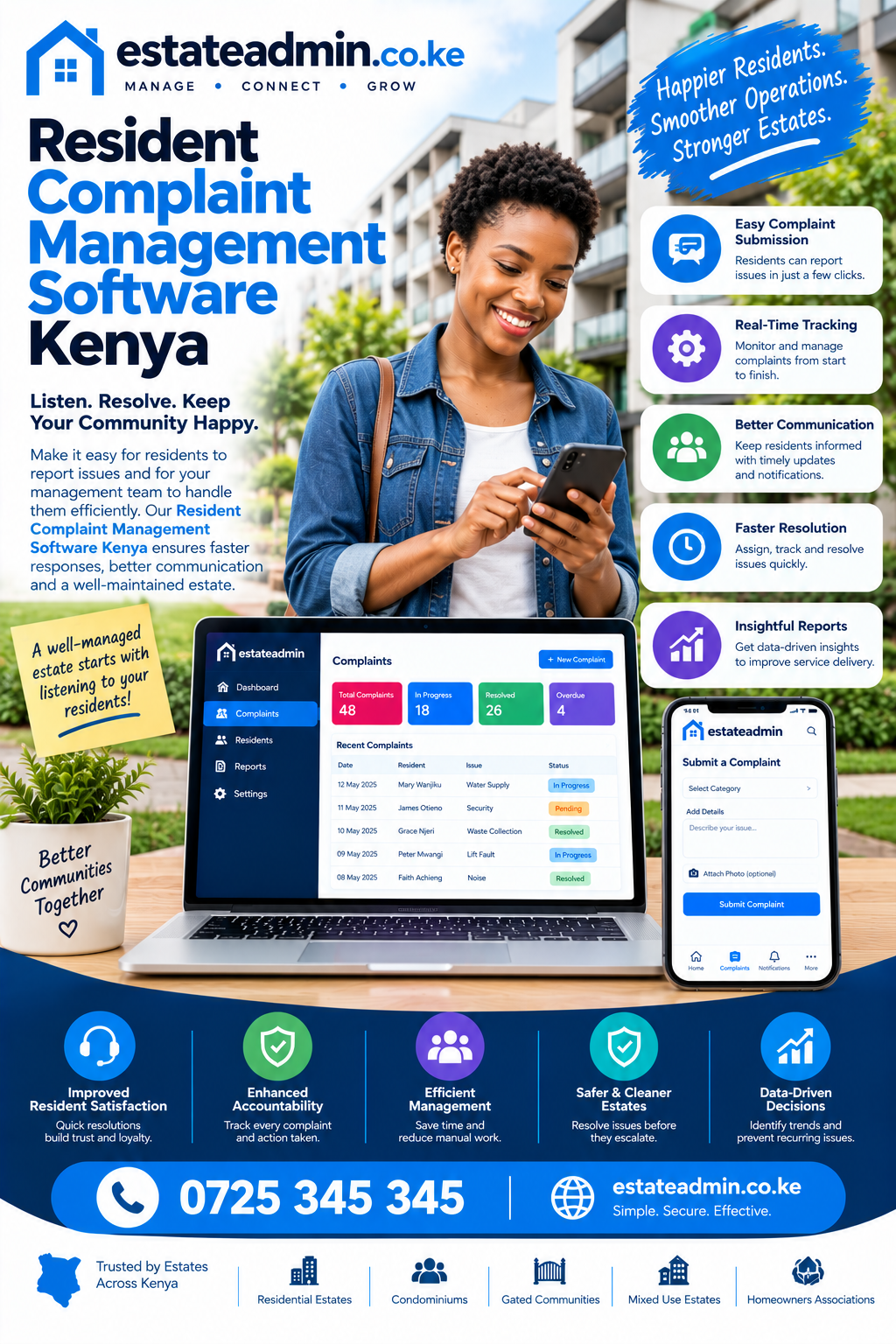
Resident Complaint Management Software Kenya: A Complete Guide to Better Estate Management
Resident complaints are an unavoidable part of managing a residential estate. A leaking pipe, noisy neighbour, damaged common area, parking disagreement, security concern, unreliable service, blocked drainage channel, or billing question can quickly become a source of frustration when there is no clear process for reporting and resolving it. For estate committees, property managers, and resident associations, Resident Complaint Management Software Kenya provides a structured way to receive, record, assign, monitor, and resolve resident complaints while keeping useful records for future reference.
A good complaint management process is about more than receiving messages. It should help the estate understand what residents are reporting, determine who should handle each matter, prioritise urgent issues, monitor progress, communicate updates, and document the final outcome. This is particularly useful in Kenyan residential developments where committee members and property managers may already be handling maintenance, service charges, security, communication, contractors, meetings, and other administrative responsibilities.
This guide explains how digital complaint management can improve estate administration, the features committees should look for, practical examples, implementation advice, common mistakes, and ways to create a more responsive resident experience.
Why resident complaint management matters
A complaint is often the first indication that something within an estate requires attention. The issue may be minor, such as a faulty outdoor light, or significant, such as a recurring water problem. Regardless of size, the estate needs a way to capture the complaint and decide what happens next.
When complaints are handled through scattered WhatsApp messages, phone calls, emails, handwritten notes, and verbal reports, important information can easily disappear. A resident may assume the estate has acted because they reported the issue, while the committee may believe someone else is handling it.
Resident Complaint Management Software Kenya can provide a central record for complaints so authorised administrators can see what has been reported, when it was received, who is responsible, and whether the matter has been resolved.
This creates a more predictable process for residents and committee members.
What is resident complaint management software?
Resident complaint management software is a digital platform designed to help estates organise complaints and service requests from residents.
Depending on the platform, the system may allow residents or administrators to:
- Submit complaints.
- Categorise issues.
- Attach photographs or documents.
- Assign complaints to responsible users.
- Set priorities.
- Track status.
- Add notes.
- Record actions taken.
- Communicate updates.
- Escalate overdue matters.
- Close completed complaints.
- Search historical records.
- Generate reports.
The purpose of Resident Complaint Management Software Kenya is to replace an informal complaint process with a trackable workflow.
For example, a resident might report that a security light outside their building is not working. Instead of the message remaining in a group chat, the complaint can be recorded as a maintenance issue, assigned to the appropriate person, given a priority, and monitored until the repair is completed.
The limitations of manual complaint handling
Manual complaint management can work for a very small development, but problems often appear as the number of residents and issues increases.
Common challenges include:
Lost complaints
A complaint sent to an individual administrator may be forgotten or buried beneath newer messages.
Unclear responsibility
Committee members may not know who is expected to respond.
Poor follow-up
A contractor may be contacted but never followed up after the initial instruction.
Repeated complaints
Residents may report the same issue multiple times because they do not know whether action has been taken.
Weak historical records
When a recurring issue appears, the committee may struggle to find previous complaints and actions.
Difficult handovers
A new committee member may have little knowledge of unresolved matters handled by the previous administrator.
A structured Resident Complaint Management Software Kenya workflow addresses these problems by turning complaints into identifiable records with statuses, owners, dates, and actions.
How a digital complaint workflow works
A typical complaint workflow can follow these stages:
- Complaint submission — The resident reports the problem.
- Registration — The complaint receives a record.
- Classification — The issue is categorised.
- Prioritisation — Urgent matters receive appropriate attention.
- Assignment — The complaint is assigned to the responsible person.
- Investigation — The administrator or contractor reviews the issue.
- Action — Corrective work is undertaken.
- Communication — The resident receives relevant updates.
- Verification — The estate confirms that the issue has been addressed.
- Closure — The complaint is closed and retained for reference.
A platform such as Resident Complaint Management Software Kenya can make this workflow visible to authorised users, reducing uncertainty about where individual complaints stand.
Complaint categories for residential estates
Not every complaint should follow exactly the same process.
An estate can establish categories such as:
| Category | Examples |
|---|---|
| Maintenance | Plumbing, electrical faults, lighting |
| Security | Access concerns, incidents, gate issues |
| Cleaning | Waste, common-area cleanliness |
| Landscaping | Grass, trees, gardens |
| Parking | Parking allocation or obstruction |
| Noise | Excessive or recurring noise |
| Utilities | Water, electricity, waste collection |
| Finance | Service charge or account queries |
| Facilities | Shared facility problems |
| Administration | Documents, notices, general requests |
Categorisation helps management identify patterns.
For example, if many complaints relate to drainage during rainy periods, the committee can examine whether routine maintenance is sufficient or whether a larger infrastructure project is necessary.
Resident Complaint Management Software Kenya can make those patterns easier to review when complaints are consistently categorised.
Prioritising complaints
One of the most important features of complaint management is prioritisation.
Not every complaint requires immediate action.
A broken decorative light might be scheduled for routine maintenance, while a serious electrical fault, major water leak, or urgent security concern may require faster escalation.
Resident Complaint Management Software Kenya can support priority-based workflows where the system allows administrators to classify complaints according to urgency.
A simple priority structure might include:
- Emergency: Immediate attention required.
- High: Prompt action required.
- Normal: Routine follow-up.
- Low: Can be scheduled alongside other work.
The exact categories should be defined by the estate based on its operational requirements.
Maintenance complaints
Maintenance is one of the largest areas of resident complaints.
Residents may report:
- Broken lights.
- Water leaks.
- Blocked drains.
- Damaged gates.
- Faulty lifts.
- Cracked walls.
- Broken paving.
- Landscaping problems.
- Plumbing faults.
- Electrical issues.
- Damaged shared facilities.
A digital complaint system can help separate individual unit issues from common-area problems.
With Resident Complaint Management Software Kenya, an estate can create a consistent process for recording maintenance complaints, assigning them to the appropriate person, and tracking completion.
Security complaints
Security complaints require careful handling because they may involve sensitive information.
Residents could report suspicious activity, access problems, damaged security equipment, visitor-management concerns, or other incidents.
A complaint management platform can help record the basic administrative details while restricting sensitive information to authorised users.
Resident Complaint Management Software Kenya can support structured security-related complaint workflows when appropriate permissions are configured.
However, software should never replace established emergency or security procedures. Urgent threats should be handled immediately through the estate’s designated emergency channels.
Noise and community complaints
Noise complaints can be difficult because they involve resident relationships as well as estate rules.
A structured complaint record can help ensure that each report is treated consistently.
Instead of relying on informal accusations in a resident WhatsApp group, the administrator can record the complaint privately, review the applicable estate rules, communicate with the relevant parties, and document follow-up.
Resident Complaint Management Software Kenya can provide a more organised record for these cases while allowing the committee to apply its policies consistently.
Parking complaints
Parking is another common source of disputes in residential developments.
Complaints may concern:
- Vehicles blocking entrances.
- Unauthorised parking.
- Visitor parking.
- Reserved spaces.
- Abandoned vehicles.
- Access obstruction.
- Misuse of common parking areas.
A complaint system can help identify recurring problems and preserve a history of previous actions.
Using Resident Complaint Management Software Kenya, an estate can create a consistent process for recording parking complaints, reviewing the relevant rules, communicating with residents, and documenting outcomes.
Financial complaints and account queries
Not every resident complaint concerns a physical problem.
Residents may question:
- Service charge balances.
- Payment records.
- Invoices.
- Penalties.
- Payment deadlines.
- Statements.
- Shared project contributions.
Financial queries should be handled carefully because they involve confidential information.
Resident Complaint Management Software Kenya can provide a structured place to register and track such queries, while detailed financial records remain within the appropriate accounting workflow.
The complaint system should support communication and follow-up rather than replace proper financial controls.
Improving response times
One of the clearest advantages of a digital complaint system is visibility.
When complaints are listed by status, management can identify issues that have been waiting too long.
For example, an administrator might see:
- 10 new complaints.
- 15 complaints under investigation.
- 8 awaiting contractor action.
- 5 awaiting resident confirmation.
- 30 completed complaints.
This provides a more useful picture than searching through dozens of messages.
Resident Complaint Management Software Kenya can help committee members identify outstanding matters and decide which issues need escalation.
Keeping residents informed
Residents do not always expect immediate resolution. What often causes frustration is uncertainty.
If a resident reports a problem and receives no update, they may assume the complaint has been ignored.
A good process can provide appropriate updates such as:
- Complaint received.
- Issue assigned.
- Inspection scheduled.
- Contractor contacted.
- Work approved.
- Repair in progress.
- Repair completed.
- Complaint closed.
Resident Complaint Management Software Kenya can support this communication workflow when notification features are available.
Clear status updates can reduce repeated follow-up messages and help residents understand what is happening.
Complaint records and accountability
Good records create accountability.
When a complaint is logged, the estate can potentially see when it was submitted, who handled it, what actions were taken, and when it was resolved.
This can be useful during committee meetings.
Instead of asking, “What happened to the water complaint from last month?” members can search the relevant record and review the history.
Resident Complaint Management Software Kenya can help create this type of administrative history.
The information should be handled responsibly, with access limited according to the estate’s policies.
Escalating overdue complaints
Some complaints take longer than expected.
A contractor may delay work, a quotation may be pending, or the committee may need to approve expenditure.
The important thing is to make the delay visible.
A complaint management system can flag or report matters that remain open beyond an agreed period.
Resident Complaint Management Software Kenya can support escalation workflows where such functionality is available.
The committee can then determine whether to contact the contractor, approve additional action, communicate with the resident, or reassess the solution.
Contractor management
Many resident complaints require third-party service providers.
A plumbing issue may require a plumber. Electrical work may require an electrician. Landscaping complaints may involve a grounds-maintenance company.
A digital workflow can connect a complaint with the responsible contractor.
Resident Complaint Management Software Kenya can help management maintain a clearer record of contractor-related actions where the system supports vendor management.
This can also help the committee evaluate service providers over time.
If the same contractor repeatedly receives complaints about incomplete work or delayed responses, management has a stronger record to consider when reviewing the service arrangement.
Tracking recurring complaints
Recurring complaints deserve special attention.
Imagine an estate receives repeated reports about:
- Low water pressure.
- Lift breakdowns.
- Gate malfunctions.
- Poor drainage.
- Waste collection.
- Street lighting.
Resolving each complaint individually may not solve the underlying problem.
With Resident Complaint Management Software Kenya, committee members can review historical records and identify recurring categories where the platform supports reporting and filtering.
This can shift the conversation from “How do we close this complaint?” to “Why does this problem keep occurring?”
That change can lead to better long-term estate planning.
Reporting for committee meetings
Committee meetings can become more productive when complaint information is summarised beforehand.
Useful reports may include:
- New complaints.
- Open complaints.
- Overdue complaints.
- Complaints by category.
- Complaints by location.
- Average resolution periods where supported.
- Recurring complaints.
- Contractor-related complaints.
- Closed complaints.
Resident Complaint Management Software Kenya can help provide a structured basis for discussing resident concerns.
The objective is not to overwhelm committee members with data. Reports should focus attention on matters that require decisions or follow-up.
Complaint management and estate governance
Complaint handling should be connected to the estate’s governing framework.
Committee members should understand:
- Which complaints they can resolve directly.
- Which matters require management action.
- Which matters require committee approval.
- Which matters should be referred to professionals.
- Which disputes require formal procedures.
- How confidential information is handled.
Resident Complaint Management Software Kenya works best when it supports established governance procedures instead of attempting to replace them.
The software is a tool for administration and accountability.
Data privacy and access control
Resident complaints can contain personal or sensitive information.
A complaint might mention a resident’s name, unit, contact details, financial issue, dispute, or security concern.
For this reason, committees should consider access permissions when selecting software.
Resident Complaint Management Software Kenya should be evaluated for user roles, permissions, authentication, data protection practices, and administrative controls.
Not every committee member necessarily needs access to every complaint.
For example, financial queries may require finance-related access, while sensitive security matters may require restricted visibility.
Mobile access for estate administrators
Estate managers are not always sitting behind a desk.
They may be inspecting a property, meeting contractors, checking common areas, or responding to residents.
Mobile-friendly software can allow authorised users to review complaints and update records while working around the estate.
Resident Complaint Management Software Kenya can be useful when mobile accessibility allows administrators to record information closer to where issues actually occur.
This can improve the accuracy of records because details can be entered while they are still fresh.
Attaching photographs and documents
Visual evidence can be useful for maintenance complaints.
A resident reporting a damaged wall, leaking pipe, broken gate, or blocked drainage point may be able to provide a photograph.
Supporting files can help administrators understand the problem before arranging an inspection.
Resident Complaint Management Software Kenya can make complaint records more useful when supporting documents or images can be associated with the relevant case.
The estate should still establish sensible rules for handling personal images and other potentially sensitive material.
Communication templates
Consistent communication can improve professionalism.
Templates can be created for common situations such as:
- Complaint received.
- More information required.
- Inspection scheduled.
- Contractor assigned.
- Repair delayed.
- Issue resolved.
- Complaint closed.
Using Resident Complaint Management Software Kenya with standard communication templates can help administrators avoid rewriting similar messages repeatedly.
Templates should remain flexible enough to accommodate the specific circumstances of each complaint.
Resident self-service
Some platforms allow residents to submit and monitor their own complaints.
This can reduce the amount of manual data entry required from administrators.
A resident may be able to:
- Log in.
- Submit a complaint.
- Select a category.
- Describe the issue.
- Attach supporting information.
- Track the status.
- Receive updates.
Resident Complaint Management Software Kenya can support a more transparent resident experience when self-service and status tracking are available.
Complaint acknowledgement
A simple acknowledgement can make a significant difference.
When a resident submits a complaint, they should ideally know that it has been received.
The acknowledgement does not need to promise immediate resolution. It can simply confirm receipt and explain what happens next.
This helps establish realistic expectations.
Creating service standards
An estate can establish internal response targets.
For example:
- Emergency complaints: immediate escalation.
- High-priority complaints: prompt review.
- Normal complaints: acknowledgement within an agreed period.
- Low-priority requests: scheduled review.
These targets should reflect the estate’s actual capacity.
The committee should avoid promising response times it cannot consistently achieve.
Resident Complaint Management Software Kenya can support such service standards by making complaint ages and statuses easier to monitor.
Practical example: water leakage
Consider a residential estate in Nairobi where a resident reports water leaking from a common-area pipe.
Under a manual process, the resident may send a message to the caretaker. The caretaker may call a plumber. The committee may hear about the issue later.
A digital process can create a clearer sequence:
- Resident submits complaint.
- Administrator categorises it as plumbing.
- Priority is assessed.
- Maintenance officer is assigned.
- Plumber is contacted.
- Work is completed.
- Resident receives an update.
- Complaint is closed.
The record can then be reviewed if similar leaks occur again.
Resident Complaint Management Software Kenya can support this type of structured workflow.
Practical example: recurring security-light complaints
Suppose residents repeatedly complain about poor lighting around a particular pathway.
Individual complaints may each be closed after a bulb is replaced.
However, historical records could reveal that the same location has required repeated attention.
The committee could then investigate whether there is a wiring problem, unsuitable equipment, vandalism, or another underlying cause.
Resident Complaint Management Software Kenya can help the committee move from individual complaint resolution toward identifying recurring operational problems.
Practical example: parking disputes
Imagine residents repeatedly report vehicles blocking a shared entrance.
A structured complaint system can preserve the reports, identify the location, record actions taken, and help the committee determine whether communication, signage, enforcement, or another solution is required.
The important point is consistency.
Resident Complaint Management Software Kenya can help maintain that consistency by giving administrators a defined process for handling complaints.
Practical example: waste collection complaints
Residents may complain when waste is collected late or bins overflow.
Instead of treating each complaint as an isolated incident, management can categorise the issue and review complaint frequency.
If reports consistently occur on particular days, the committee can investigate the collection schedule or service arrangement.
Resident Complaint Management Software Kenya can help create a historical record that supports these operational discussions.
Choosing the right software
The best platform is not necessarily the one with the most features.
A committee should ask whether the software is easy for administrators and residents to use.
Important considerations include:
- Complaint submission.
- Categorisation.
- Priority levels.
- Assignment.
- Status tracking.
- Notifications.
- Resident communication.
- Attachments.
- Reporting.
- Search.
- User permissions.
- Mobile accessibility.
- Data management.
- Support and onboarding.
Resident Complaint Management Software Kenya should be assessed against the estate’s actual workflows rather than a generic feature checklist.
Questions to ask during a demonstration
Before selecting a platform, committee members can prepare realistic scenarios.
Ask the provider to demonstrate:
- How a resident submits a complaint.
- How an administrator receives it.
- How the issue is categorised.
- How it is assigned.
- How a manager changes the status.
- How a resident receives an update.
- How supporting documents are attached.
- How overdue matters are identified.
- How reports are generated.
- How permissions are managed.
Testing actual workflows gives the committee a clearer picture than viewing a list of features.
Implementation strategy
Implementation should be gradual.
Step 1: Map existing complaints
Review the types of complaints the estate receives most often.
Step 2: Create categories
Build categories around actual estate problems.
Step 3: Define responsibilities
Decide who receives, assigns, investigates, approves, and closes complaints.
Step 4: Establish priorities
Agree on how urgent matters are identified.
Step 5: Train users
Teach administrators and committee members the workflows they will use.
Step 6: Communicate with residents
Explain how residents should submit complaints and what information they should provide.
Step 7: Review performance
After implementation, identify bottlenecks and improve the process.
Resident Complaint Management Software Kenya can become more effective when the estate starts with practical workflows instead of trying to implement every feature immediately.
Training residents
Residents should know:
- Where to submit complaints.
- What information to include.
- When to use emergency channels.
- How to check complaint status.
- How they will receive updates.
- Which matters should not be submitted as ordinary complaints.
Clear instructions can improve the quality of incoming complaints.
A resident who provides the location, description, date, photograph, and relevant details gives the estate more useful information than a message simply saying, “The water is bad.”
Improving complaint descriptions
Administrators can encourage residents to include:
Location: Where is the problem?
Issue: What exactly is wrong?
Timing: When did it begin?
Impact: Who or what is affected?
Evidence: Is there a photograph or document?
Urgency: Is there an immediate risk?
This information can help the estate prioritise the matter correctly.
Measuring complaint performance
Once complaints are managed digitally, the committee can assess performance.
Useful measures may include:
- Number of complaints received.
- Number resolved.
- Number still open.
- Number overdue.
- Complaints by category.
- Recurring issues.
- Complaints by location.
- Contractor-related complaints.
- Resolution trends.
These measures should be used to improve service rather than punish individuals unfairly.
Resident Complaint Management Software Kenya can support management discussions when complaint data is organised consistently.
Turning complaints into estate improvement
Complaints are not only problems.
They are also a source of information.
If residents repeatedly complain about the same facility, service, or location, the committee has evidence that something deserves closer attention.
For example, recurring complaints about:
- Water pressure may point to infrastructure concerns.
- Parking may point to unclear allocation.
- Security may point to process gaps.
- Waste may point to collection arrangements.
- Lighting may point to maintenance quality.
- Communication may point to unclear notices.
Resident Complaint Management Software Kenya can help committees analyse these patterns and identify opportunities for improvement.
Complaint management and resident trust
Trust is influenced by how people experience the complaint process.
Residents may tolerate delays more easily when they know that their complaint has been received, assigned, and is being addressed.
Silence creates uncertainty.
A structured complaint process can therefore support better relationships between residents, administrators, and committees.
Resident Complaint Management Software Kenya can provide the administrative structure needed to make communication more consistent.
Handling complaints fairly
Consistency matters when complaints involve disputes between residents.
The committee should apply its policies fairly and avoid making decisions based solely on whoever complains first or speaks most forcefully.
Records can help establish a factual timeline.
However, software does not determine who is right. Committee members still need to review evidence, follow applicable estate rules, and seek appropriate professional guidance where necessary.
Resident Complaint Management Software Kenya should therefore be viewed as a record-keeping and workflow tool rather than an automated decision-maker.
Complaint history and committee handovers
Committee members eventually change.
A new committee should not have to depend entirely on verbal explanations from previous officers.
Historical complaint records can show:
- Recurring issues.
- Unresolved matters.
- Previous contractor involvement.
- Actions already taken.
- Resident communication.
- Maintenance history.
Resident Complaint Management Software Kenya can support continuity by preserving organised records for authorised users.
This is particularly useful for estates with rotating committees.
Integration with estate administration
Complaint management becomes even more useful when connected to wider estate administration.
A complaint might lead to:
- A maintenance task.
- A contractor assignment.
- A quotation.
- A purchase.
- A payment.
- A resident notice.
- A committee decision.
Connecting these activities can reduce duplicate data entry.
Resident Complaint Management Software Kenya can become part of a broader estate administration workflow when the platform supports related functions.
Common mistakes to avoid
Ignoring complaints
Even when an issue cannot be resolved immediately, residents should receive appropriate communication.
Closing complaints too early
A complaint should not be marked complete simply because a contractor was contacted.
Using too many categories
Excessive categories can make reporting difficult. Keep them practical.
Giving everyone access to everything
Permissions should reflect responsibilities.
Failing to review recurring complaints
Repeated complaints may indicate a deeper problem.
Treating all complaints as emergencies
Prioritisation helps management allocate resources appropriately.
Making unrealistic promises
Response and resolution targets should be achievable.
Resident Complaint Management Software Kenya can support a better process, but the committee still needs clear policies and responsible decision-making.
The role of estate managers
Estate managers are often responsible for coordinating day-to-day responses.
They can use complaint records to:
- Allocate tasks.
- Contact contractors.
- Monitor deadlines.
- Communicate with residents.
- Prepare committee reports.
- Identify recurring problems.
A structured platform can reduce administrative repetition and provide a clearer overview of open work.
The role of estate committees
Committee members provide governance and oversight.
They may need to review:
- Major complaints.
- Recurring problems.
- Budget implications.
- Contractor performance.
- Policy issues.
- Disputes.
- Long-term solutions.
Resident Complaint Management Software Kenya can provide committee members with better information for these discussions.
The role of residents
Residents should also participate responsibly.
They should provide accurate information, avoid submitting duplicate complaints unnecessarily, and use emergency channels when an immediate safety concern exists.
Clear resident guidance can improve the overall quality of complaint records.
Cost and value
Software costs vary depending on the provider, estate size, user numbers, features, support arrangements, and other factors.
Committees should consider the value created.
If administrators spend hours searching through messages every week, recurring complaints are forgotten, or committee meetings repeatedly revisit the same issues, a structured system may provide operational benefits beyond its subscription cost.
Resident Complaint Management Software Kenya should therefore be assessed based on time savings, accountability, resident experience, and improved decision-making rather than price alone.
Future-proofing complaint management
Estate needs can change.
A development may grow, add facilities, change contractors, introduce new policies, or appoint a professional property manager.
The complaint system should be flexible enough to adapt.
Resident Complaint Management Software Kenya can provide long-term value when its workflows can evolve alongside the estate’s requirements.
Regular reviews can help ensure categories, permissions, notifications, and reports remain useful.
Frequently asked questions
1. What is Resident Complaint Management Software Kenya?
Resident Complaint Management Software Kenya refers to a digital approach for managing complaints submitted by residents of residential estates in Kenya. It can help record issues, categorise them, assign responsibility, monitor progress, communicate updates, and maintain historical records.
2. Why should an estate use complaint management software?
A centralised system can reduce the risk of forgotten complaints, unclear responsibilities, poor follow-up, and scattered records. It can also help committees identify recurring issues and improve resident communication.
3. Can residents submit complaints directly?
This depends on the software. Some platforms provide resident portals or forms that allow residents to submit complaints themselves, while others may rely on administrators to enter reports.
4. Can complaints include photographs?
Some systems support attachments. Photographs can be particularly useful for maintenance, cleaning, landscaping, parking, and infrastructure complaints.
5. Can complaints be assigned to contractors?
Some platforms support assignment or vendor workflows. This can help management track which contractor is responsible for a particular issue and whether the work has been completed.
6. How can software improve response times?
Visibility is a major factor. When open complaints, priorities, responsible users, and ageing information can be reviewed easily, administrators are less likely to overlook outstanding matters.
7. Can complaint software handle sensitive complaints?
It can help organise them, but permissions are important. Sensitive security, financial, or dispute-related information should only be available to authorised users.
8. Can the system help identify recurring estate problems?
Yes, where reporting and categorisation features are available. Reviewing complaints by category, location, date, or issue type can reveal patterns that may otherwise remain hidden.
9. Does software replace an estate manager?
No. Software supports administration. Estate managers and committees remain responsible for assessing complaints, making decisions, supervising contractors, communicating with residents, and applying estate policies.
10. What should an estate check before choosing a platform?
The committee should examine ease of use, complaint submission, categorisation, assignment, priorities, notifications, resident access, reporting, document handling, mobile accessibility, permissions, support, and data management.
A practical complaint management checklist
Before implementing a platform, an estate committee should confirm that it can:
- Receive complaints through a defined process.
- Categorise different types of issues.
- Prioritise urgent matters.
- Assign responsibility.
- Track complaint status.
- Record actions.
- Communicate updates.
- Attach relevant supporting information.
- Escalate overdue complaints.
- Identify recurring problems.
- Generate useful reports.
- Protect sensitive information.
- Preserve historical records.
- Support committee handovers.
- Provide a clear resident experience.
A 90-day improvement plan
First 30 days: establish the foundation
Create categories, define user roles, document responsibilities, and introduce the basic complaint workflow.
Days 31–60: improve monitoring
Begin reviewing open complaints, overdue matters, recurring issues, and contractor performance.
Days 61–90: optimise the process
Use reports and resident feedback to identify bottlenecks. Simplify categories, adjust priorities, improve communication templates, and refine responsibilities.
The objective is continuous improvement rather than simply installing software.
Why Kenyan estates should focus on process as well as technology
Technology works best when it supports a well-defined process.
A committee that has no clear rule for who handles complaints will still have confusion after implementing software. A committee that has defined responsibilities, priorities, communication procedures, and escalation rules can use technology to reinforce those practices.
For Kenyan estates, the strongest approach is therefore to combine practical governance with suitable digital tools.
Final thoughts
Resident complaints are valuable sources of information about the condition of an estate and the quality of its services. The challenge is making sure those complaints are captured, understood, acted upon, and reviewed.
A structured digital workflow can help estate committees and managers move away from scattered messages and informal follow-up. It can provide a central record, clear responsibility, status visibility, better communication, and useful reporting.
Resident Complaint Management Software Kenya can support these goals when the platform is selected according to the estate’s actual requirements and implemented with clear procedures.
The best complaint management process is not necessarily the most complicated. It is the one residents understand, administrators can maintain consistently, and committee members can use to make informed decisions.
For an estate considering a digital solution, the starting point should be simple: identify the complaints that occur most frequently, document how they are currently handled, identify where information is lost or delayed, and then evaluate software against those specific problems.
When complaints are properly organised, the committee gains more than a list of problems. It gains operational insight. Recurring issues become easier to identify, contractor performance becomes easier to review, resident communication becomes more consistent, and committee meetings can focus on solutions rather than searching for information.
For estates seeking a more accountable and organised way to serve residents, Resident Complaint Management Software Kenya can form an important part of a broader estate administration strategy. With the right workflows, permissions, communication practices, and reporting processes, complaint management can become a structured part of daily estate operations rather than a constant source of administrative frustration.
Resident Complaint Management Software Kenya
Resident Complaint Management Software Kenya
Resident Complaint Management Software Kenya
Resident Complaint Management Software Kenya
Resident Complaint Management Software Kenya
Resident Complaint Management Software Kenya
Resident Complaint Management Software Kenya