
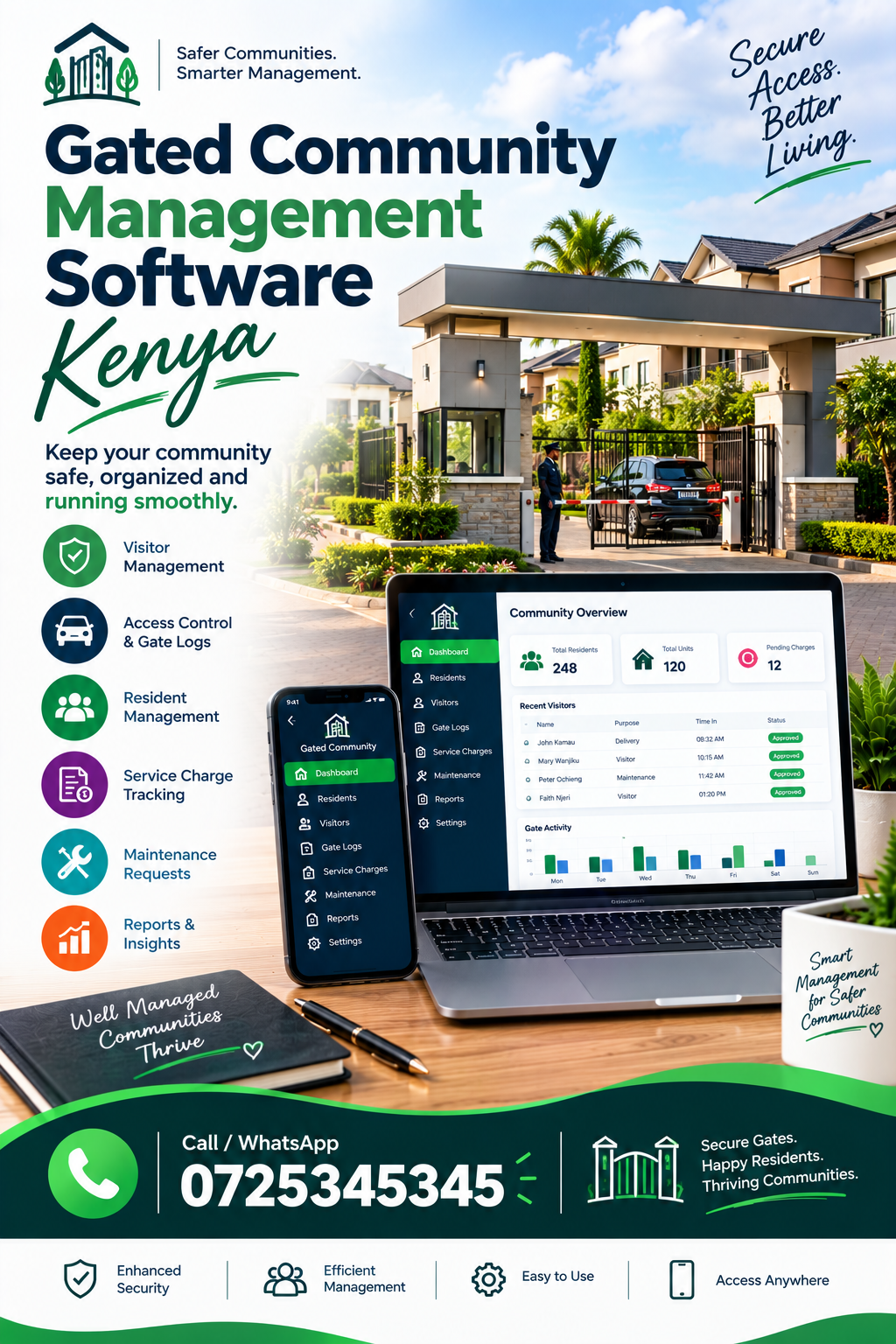
Gated Community Management Software Kenya: A Complete Guide for Modern Estate Management
Managing a gated community involves much more than maintaining a physical gate and providing security. Behind every well-run residential community is a management process that keeps track of residents, units, service charges, payments, maintenance responsibilities, outstanding balances and financial reports.
As the number of residents increases, managing these activities manually can become difficult. Estate managers may find themselves using spreadsheets, notebooks, WhatsApp messages, payment notifications and separate accounting records to keep track of information.
This creates room for errors and makes it harder to know which information is current.
A digital solution such as Gated Community Management Software Kenya can bring many of these activities into a more organized environment. Instead of maintaining several disconnected records, estate managers can have a centralized system for managing important community information.
For gated communities in Kenya, this can be particularly useful because many residential developments operate through recurring service charges. Residents may contribute toward security, garbage collection, landscaping, cleaning, maintenance of common areas and other shared services.
The management team needs a reliable way to determine what each resident owes, what has been paid and what remains outstanding.
What Is Gated Community Management Software?
Gated community management software is a digital platform designed to help residential communities organize their administrative and financial activities.
Depending on the system, it can provide tools for:
- Resident management
- Unit management
- Service-charge billing
- Invoice generation
- Payment tracking
- Arrears management
- Resident statements
- Financial reporting
- User management
- Estate administration
The purpose is to make recurring estate-management activities more structured.
For example, instead of calculating monthly service charges manually, an administrator can configure the applicable charges and generate invoices for the relevant units.
Instead of searching through multiple spreadsheets to determine who has paid, the administrator can review payment records within the system.
This is one of the major advantages of Gated Community Management Software Kenya for communities that want to reduce administrative work while maintaining better visibility over their finances.
Why Kenyan Gated Communities Need Digital Management
The number of residential developments in Kenya has grown significantly, particularly around major urban areas.
Gated communities can range from small developments with a few dozen homes to large communities containing hundreds of units.
Regardless of size, these communities have recurring responsibilities.
Management may need to:
- Maintain resident information
- Track individual units
- Bill residents
- Record payments
- Follow up on arrears
- Prepare financial reports
- Monitor community expenses
- Communicate financial information to residents
- Maintain historical records
When these processes are handled manually, administrative work increases as the community grows.
A spreadsheet that works well for 20 households may become difficult to manage when there are 300 households.
This is where Gated Community Management Software Kenya can become useful.
The software provides a structured environment where information can be organized according to the way the community operates.
The Difference Between Property Management and Gated Community Management
Property management and gated community management overlap, but they are not exactly the same.
A property manager may manage individual rental properties on behalf of owners.
A gated community manager may be responsible for shared community services affecting many homeowners or residents.
These services may include:
- Security
- Landscaping
- Garbage collection
- Common-area cleaning
- Road maintenance
- Street lighting
- Gate operations
- Community facilities
The community therefore needs a system that can manage collective responsibilities while maintaining individual resident accounts.
A platform such as Gated Community Management Software Kenya can help organize this information by connecting residents and units to their respective charges and payments.
Managing Residents in a Gated Community
Resident information is one of the most important parts of community administration.
A management office may need to know who occupies each unit and how to contact them.
Resident information can change frequently.
A family may move into a house.
Another family may move out.
A homeowner may change their phone number.
A tenant may be replaced.
If these changes are not recorded properly, communication and billing can be affected.
A system such as Gated Community Management Software Kenya can provide a centralized location for resident records.
This makes it easier for authorized administrators to update information when changes occur.
Managing Units and Houses
Every residential community needs an accurate record of its units.
Depending on the development, units could be identified by:
- House numbers
- Apartment numbers
- Block numbers
- Plot numbers
- Unit codes
For example:
Block A – A101
Block A – A102
Block B – B101
Block B – B102
The exact structure depends on the community.
What matters is that every unit has a unique and understandable identifier.
When evaluating Gated Community Management Software Kenya, managers should confirm that the software can represent the actual structure of their development.
Incorrect unit records can cause billing errors, especially when several units have similar names.
Service Charges in Gated Communities
Service charges are an important part of community management.
Residents may contribute toward shared costs such as security, cleaning, landscaping and maintenance.
For example, a community may establish a monthly service charge of KSh 8,000 per household.
If there are 100 units, expected monthly billing would be:
100 × KSh 8,000 = KSh 800,000
The management team then needs to track how much has been billed and how much has actually been collected.
This is where Gated Community Management Software Kenya can help create a more organized billing process.
Instead of manually calculating every resident’s invoice, the management team can use configured billing rules where supported by the system.
Automating Recurring Billing
Recurring charges are particularly suitable for automation.
If residents are expected to pay the same approved amount every month, manually preparing invoices can waste time.
A digital platform can help management establish a repeatable process.
For example:
- Configure the monthly service charge.
- Select the applicable units.
- Generate invoices.
- Review the invoices.
- Make invoices available to residents.
- Record incoming payments.
- Review outstanding balances.
The administrator still needs to verify the billing process, but repetitive calculations can be reduced.
This makes Gated Community Management Software Kenya useful for communities where monthly service-charge billing takes a significant amount of administrative time.
Bulk Invoice Generation
Large gated communities may have hundreds of units.
Creating invoices individually for every unit can be inefficient.
Bulk invoice generation allows the administrator to process multiple accounts at once.
For example, a community with 250 homes and a monthly charge of KSh 7,500 would have expected monthly billing of:
250 × KSh 7,500 = KSh 1,875,000
Manually preparing 250 invoices every month creates unnecessary administrative work.
A system such as Gated Community Management Software Kenya can be evaluated based on whether it supports bulk billing and how easily administrators can review the resulting invoices.
Before going live, management should always test bulk billing using sample records.
Tracking Payments
Generating invoices is only half of the billing process.
The management team must also know what residents have paid.
A resident may:
- Pay in full
- Make a partial payment
- Pay several invoices together
- Pay late
- Have an outstanding balance
The system should record these transactions accurately.
For example:
| Item | Amount |
|---|---|
| Service charge | KSh 10,000 |
| Payment received | KSh 7,000 |
| Outstanding balance | KSh 3,000 |
The resident’s account should reflect the remaining KSh 3,000.
A good Gated Community Management Software Kenya solution should make these account movements easy for administrators to understand.
M-Pesa Payments and Kenyan Estates
M-Pesa is an important consideration for Kenyan residential communities.
Many residents use mobile money for everyday payments, including payments made to residential management organizations.
However, receiving a payment is only one part of the process.
The management team must also determine:
- Who made the payment?
- Which unit does it belong to?
- What invoice should it settle?
- Was the payment full or partial?
- What balance remains?
When evaluating Gated Community Management Software Kenya, estate managers should ask providers how their system handles M-Pesa-related payment records and reconciliation.
The exact integration available will depend on the software provider.
Payment Reconciliation
Payment reconciliation is the process of comparing received payments with the relevant resident accounts.
Suppose a resident is billed KSh 15,000 and pays KSh 15,000.
The account should show that the invoice has been settled.
Now suppose another resident is billed KSh 15,000 but pays KSh 10,000.
Their account should show a remaining KSh 5,000.
If payments are not reconciled correctly, management may have difficulty identifying genuine arrears.
A platform such as Gated Community Management Software Kenya can help provide a structured environment for recording these transactions.
Managing Arrears
Arrears are a common challenge for residential communities.
When residents fail to pay service charges, the community can experience cash-flow pressure.
The management team may still need to pay:
- Security companies
- Cleaners
- Landscapers
- Maintenance contractors
- Waste collection providers
- Utility-related costs
- Other approved community expenses
This means management needs visibility into outstanding accounts.
A solution such as Gated Community Management Software Kenya can help identify accounts with unpaid balances.
Arrears information can include:
- Resident
- Unit
- Invoice
- Amount billed
- Amount paid
- Outstanding amount
- Payment history
This gives management a clearer basis for follow-up.
Why Arrears Reports Matter
An arrears report can show the financial position of the community more clearly.
For example:
| Category | Amount |
|---|---|
| Total billed | KSh 2,000,000 |
| Total collected | KSh 1,750,000 |
| Outstanding | KSh 250,000 |
The committee can then review the outstanding amount and determine appropriate follow-up according to the community’s policies.
Without reliable reporting, it can be difficult to know whether a collection problem is isolated or widespread.
This makes Gated Community Management Software Kenya valuable for management teams that want better visibility over outstanding balances.
Resident Statements
Residents sometimes need clarification about their accounts.
A statement can provide a chronological record of:
- Previous balances
- New charges
- Payments
- Adjustments
- Current balance
This is much more useful than simply telling someone that they owe a certain amount.
For example, a resident may believe they have fully paid their service charge.
A statement can show exactly how the balance was calculated.
A system such as Gated Community Management Software Kenya can help management produce structured account information when resident statements are supported.
Improving Transparency
Transparency is important in residential communities because residents contribute toward shared expenses.
Residents may want to understand:
- What they have been charged
- What they have paid
- What remains outstanding
- How their account has changed
Management committees may also need financial information for meetings and decision-making.
A centralized system can make it easier to present consistent records.
This is one of the reasons Gated Community Management Software Kenya can contribute to more organized financial administration.
Transparency does not mean giving every resident access to every financial record.
Access should remain controlled according to the community’s governance structure.
Financial Reporting for Management Committees
Management committees need information they can use to make decisions.
Reports may show:
- Total billing
- Total collections
- Outstanding balances
- Payment trends
- Resident account activity
- Other financial information supported by the system
For example, if collection rates decline for several months, the committee may need to investigate why.
If outstanding balances are concentrated among a small number of accounts, management may decide to focus its follow-up accordingly.
A system such as Gated Community Management Software Kenya can make these reports easier to produce when the required data is already stored in the platform.
User Roles and Permissions
A gated community may have several people involved in administration.
These could include:
- Estate manager
- Accountant
- Administrator
- Committee member
- Support staff
Not everyone should necessarily have the same access.
For example, an accountant may need access to financial information while another staff member may only need to update resident contact details.
Role-based permissions can help control access.
When evaluating Gated Community Management Software Kenya, ask what roles are available and what each role can do.
This is particularly important for larger communities with several staff members.
Maintaining an Audit Trail
Financial records should be traceable.
If an important record is changed, management may need to know who made the change and when.
An audit trail can support accountability by maintaining a history of relevant activities.
This becomes especially useful when:
- A resident disputes a balance
- A payment appears incorrectly allocated
- A charge has been changed
- A user modifies account information
- Management is reviewing historical records
A platform such as Gated Community Management Software Kenya should therefore be evaluated for the level of history and accountability it provides.
Managing Multiple Gated Communities
Property management companies may manage several residential communities.
Each community may have different:
- Units
- Residents
- Service charges
- Billing schedules
- Management committees
- Reporting requirements
Using separate spreadsheets for every community can create administrative challenges.
A multi-property solution can help managers organize information by estate.
When comparing Gated Community Management Software Kenya, property management companies should ask whether the platform can support multiple estates and how users are separated between them.
Choosing Software for a Small Gated Community
A small community may have only 20, 30 or 50 units.
The management team may therefore have fewer transactions.
However, accurate records are still important.
For a smaller community, priorities may include:
- Ease of use
- Resident records
- Unit management
- Billing
- Payment tracking
- Statements
- Basic reports
- Affordable pricing
A platform such as Gated Community Management Software Kenya should be selected based on actual requirements rather than the number of features advertised.
A simple system that staff understand can be more useful than an unnecessarily complicated platform.
Choosing Software for a Large Gated Community
Large communities require more robust administration.
A development with hundreds of units may need:
- Bulk billing
- Large-scale resident management
- Payment tracking
- Arrears reports
- Multiple users
- User permissions
- Detailed financial reports
- Strong record management
The larger the community, the more costly administrative mistakes can become.
For this reason, Gated Community Management Software Kenya should be tested using realistic scenarios before implementation.
The management team should not rely entirely on a sales presentation.
Testing Software Before Adoption
A demonstration is useful, but practical testing is even better.
Create a sample community containing several units.
Then test:
Test One: Adding a Unit
Create a new unit and verify that it appears correctly.
Test Two: Adding a Resident
Assign a resident to the unit.
Test Three: Creating a Charge
Create a monthly service charge.
Test Four: Generating an Invoice
Generate an invoice for the resident.
Test Five: Recording Full Payment
Record a payment equal to the invoice amount.
Test Six: Recording Partial Payment
Record a payment smaller than the invoice.
Test Seven: Checking the Balance
Verify that the outstanding amount is correct.
Test Eight: Generating a Statement
Produce a resident statement.
Test Nine: Generating a Report
Create a management report.
This type of testing provides a realistic assessment of Gated Community Management Software Kenya.
Moving From Excel to Estate Management Software
Many residential communities start with spreadsheets.
This is understandable.
Excel is flexible, widely available and familiar to many administrators.
The challenge comes when the spreadsheet becomes the central system for hundreds of financial transactions.
Problems can include:
- Duplicate entries
- Accidental changes
- Multiple versions
- Missing payments
- Incorrect formulas
- Difficult reconciliation
- Slow reporting
Moving to Gated Community Management Software Kenya can provide a more structured approach.
However, migration should be planned carefully.
Cleaning Data Before Migration
Before moving information into a new system, the management team should review existing records.
Check:
- Unit numbers
- Resident names
- Phone numbers
- Email addresses
- Outstanding balances
- Payment records
- Duplicate records
For example, if the same resident appears twice in the spreadsheet, importing both records could create problems.
Data cleaning is therefore an important part of implementation.
A platform such as Gated Community Management Software Kenya will only be as accurate as the information entered into it.
Handling Opening Balances
When moving from an old system, the management team may need to establish opening balances.
Suppose a resident already owes KSh 20,000 when the new system is introduced.
That balance should be recorded appropriately so that future payments are reflected correctly.
Management should agree on how historical information will be handled before migration.
This helps prevent confusion after the new Gated Community Management Software Kenya system becomes the main record.
Training Estate Management Staff
Technology works best when users understand how to use it.
Training should cover:
- Adding residents
- Updating units
- Creating charges
- Generating invoices
- Recording payments
- Checking balances
- Generating statements
- Producing reports
- Managing users
Staff should also understand the community’s internal procedures.
For example, not every employee should be able to change billing amounts.
A platform such as Gated Community Management Software Kenya becomes more effective when technology and internal procedures work together.
Communication With Residents
Introducing software may change how residents receive financial information.
Management should explain:
- Why the system is being introduced
- How residents will receive invoices
- How payments should be made
- How statements can be requested
- Where residents can ask questions
Clear communication can reduce resistance to the change.
Residents are more likely to use a new system when they understand its purpose.
This makes Gated Community Management Software Kenya part of a broader administrative improvement rather than simply a new piece of technology.
Security Management and Community Administration
Security is one of the defining features of many gated communities.
While financial and resident management software may not replace physical security systems, it can help organize administrative information associated with the community.
Management should distinguish between:
- Financial management
- Resident administration
- Physical security
- Access control
- Maintenance
Some platforms may provide features outside financial management, while others focus primarily on administration and billing.
When evaluating Gated Community Management Software Kenya, managers should identify which security-related functions are actually required instead of assuming that every platform includes them.
Maintenance Management
Gated communities also have shared physical infrastructure.
This may include:
- Roads
- Drainage
- Street lighting
- Gates
- Landscaping
- Common buildings
- Recreational facilities
Management needs to track maintenance responsibilities and associated expenses.
Not every estate management platform provides detailed maintenance management, so this should be confirmed during software selection.
A community considering Gated Community Management Software Kenya should distinguish between features it needs immediately and features that may be handled through other systems.
Managing Community Expenses
Service-charge collections are used to support shared community operations.
Management may need to monitor expenses related to:
- Security
- Cleaning
- Landscaping
- Repairs
- Waste collection
- Utilities
- Contractors
A good administrative system should help management understand collections and, where supported, connect financial reporting to the wider management process.
This gives Gated Community Management Software Kenya a role in helping committees understand the financial side of community operations.
Supporting Management Decisions
Management committees regularly make decisions about community services.
They may need to determine whether:
- Collections are sufficient
- Arrears are increasing
- Service charges need review
- Certain expenses are rising
- Additional follow-up is required
Reliable data makes these discussions easier.
For example, if total monthly billing is KSh 1.5 million but only KSh 1.1 million has been collected, the committee can see that KSh 400,000 remains outstanding.
A system such as Gated Community Management Software Kenya can make this information easier to retrieve when appropriate reports are available.
Creating a Standard Monthly Workflow
A consistent monthly workflow can reduce mistakes.
A gated community might use the following process:
Step 1: Review resident records.
Step 2: Confirm active units.
Step 3: Review billing rules.
Step 4: Generate invoices.
Step 5: Monitor payments.
Step 6: Reconcile payments.
Step 7: Review outstanding balances.
Step 8: Send statements where required.
Step 9: Prepare management reports.
This workflow makes Gated Community Management Software Kenya part of a repeatable management process.
Why Standardization Matters
Different administrators may have different ways of doing things.
One person may record payments in Excel.
Another may keep a notebook.
Another may rely on WhatsApp messages.
This creates inconsistency.
A centralized system encourages the team to follow the same process.
When everyone uses the same system, it becomes easier to train new employees and review historical information.
This is another reason Gated Community Management Software Kenya can be valuable for communities with multiple administrators.
Managing Resident Disputes
Financial disputes can occur even when management is acting correctly.
A resident may say:
“I paid last month.”
“I was charged twice.”
“My balance should be zero.”
“The amount on my statement is incorrect.”
The first step is to review the records.
If the system maintains invoices and payments in a structured manner, the administrator can investigate the account more efficiently.
This makes Gated Community Management Software Kenya useful as an administrative record-keeping tool.
However, the software should support investigation rather than replace proper dispute-resolution procedures.
Improving Collection Follow-Up
Collection follow-up becomes easier when management knows exactly which accounts are outstanding.
Instead of contacting every resident, the team can focus on accounts with unpaid balances.
The management committee can also establish internal policies regarding:
- Due dates
- Reminders
- Statements
- Arrears follow-up
- Payment arrangements
- Escalation procedures
The software provides the information.
The community’s policies determine how the information is used.
A platform such as Gated Community Management Software Kenya can support this process by providing visibility over resident balances.
Reporting Collection Performance
Management can monitor collection performance using basic calculations.
For example:
Total billed: KSh 2,000,000
Total collected: KSh 1,800,000
Outstanding: KSh 200,000
Collection rate:
KSh 1,800,000 ÷ KSh 2,000,000 × 100 = 90%
A report showing collection performance can help committees understand how effectively service charges are being collected.
A system such as Gated Community Management Software Kenya can make these figures easier to access when reporting functionality is available.
Scaling as the Community Grows
A community may start with 50 homes and eventually expand to 200.
The management system should be able to accommodate growth.
This means managers should consider:
- Maximum units supported
- Number of users
- Billing capacity
- Reporting capacity
- Data storage
- Multiple estates
- Support availability
Scalability is particularly important when selecting Gated Community Management Software Kenya.
It is better to consider future requirements before the existing system becomes a major limitation.
Cloud-Based Estate Management
Cloud-based software can allow authorized users to access information without being tied to one computer.
This can be useful for professional estate managers who move between different properties.
For example, a property management company may have employees working from:
- Management offices
- Different residential estates
- Home offices
- Meetings
Cloud access can make information more convenient to access.
However, managers should also ask about authentication, user permissions, backups and data protection.
These are important considerations when evaluating Gated Community Management Software Kenya.
Mobile Access
Many administrators and residents rely heavily on smartphones.
A software platform that works well on mobile devices can make everyday tasks more convenient.
However, mobile compatibility should be tested rather than assumed.
Ask the provider to demonstrate common activities on a smartphone, such as:
- Viewing an account
- Checking an invoice
- Recording information
- Reviewing a statement
This can help determine whether Gated Community Management Software Kenya is practical for the actual users of the system.
Data Accuracy
One of the most important considerations in estate management is data accuracy.
Incorrect information can lead to:
- Wrong invoices
- Incorrect balances
- Misallocated payments
- Confusing reports
- Resident disputes
Software can improve the process, but it cannot automatically fix inaccurate information.
Management should establish procedures for reviewing data.
For example, unit and resident records can be reviewed periodically.
This helps ensure that Gated Community Management Software Kenya continues to provide useful information.
Backup and Business Continuity
Estate records are important.
Management should understand how software providers handle data backup and recovery.
Ask questions such as:
- How is information backed up?
- How frequently is it backed up?
- What happens if the system becomes unavailable?
- How can records be recovered?
- What happens if an employee leaves?
These questions should form part of the procurement process.
They are especially important for communities that depend heavily on digital records.
Cost of Gated Community Management Software
Software pricing varies depending on:
- Number of units
- Number of users
- Features
- Support
- Integrations
- Subscription model
A management committee should consider the total value rather than simply choosing the cheapest option.
For example, software that reduces several hours of manual billing and reconciliation every month may justify its cost.
A platform such as Gated Community Management Software Kenya should therefore be evaluated based on the administrative problems it solves.
Common Mistakes When Selecting Software
Choosing Based Only on Price
The cheapest software may not provide the functionality the community actually needs.
Choosing Too Many Features
A system with dozens of unnecessary features can make daily administration harder.
Not Testing Partial Payments
Partial payments are common and should be tested before adoption.
Ignoring User Permissions
Everyone should not automatically receive administrator access.
Failing to Clean Data
Incorrect data can create problems after migration.
Not Training Staff
Even simple software requires users to understand the correct workflow.
Not Testing Reports
A system may record information correctly but produce reports that are not useful to management.
These mistakes can be avoided by carefully testing Gated Community Management Software Kenya before full implementation.
Questions to Ask a Software Provider
Before choosing a platform, management should ask:
- How many units can the system support?
- Can we manage multiple communities?
- Can we create recurring service charges?
- Can invoices be generated in bulk?
- Can partial payments be recorded?
- Can outstanding balances be tracked?
- Can residents receive statements?
- Can management reports be generated?
- Can user permissions be customized?
- Is there an audit history?
- How are payments reconciled?
- Does the platform support our preferred payment workflow?
- How is data backed up?
- What happens if the system is unavailable?
- What support is provided during implementation?
The answers will help the committee determine whether Gated Community Management Software Kenya fits the community’s requirements.
Practical Example of a 200-Unit Community
Consider a gated community containing 200 homes.
Each household contributes KSh 7,000 per month.
Expected monthly billing is:
200 × KSh 7,000 = KSh 1,400,000
Suppose:
- 160 households pay in full.
- 20 households make partial payments.
- 20 households do not pay.
Management needs to determine the total amount collected and the outstanding balances.
Without a centralized system, administrators may need to calculate these figures manually.
With Gated Community Management Software Kenya, the management team can use the platform’s billing and payment records where those functions are supported.
The important point is that every payment should be connected to the appropriate resident account.
Practical Example of a Partial Payment
Suppose House 47 receives a KSh 9,000 service-charge invoice.
The resident pays KSh 5,000.
The account should show:
Invoice: KSh 9,000
Payment: KSh 5,000
Balance: KSh 4,000
The resident later pays KSh 4,000.
The account should then show the invoice as fully settled.
This is why payment allocation is an important feature to test when choosing Gated Community Management Software Kenya.
Practical Example of Outstanding Charges
Suppose House 81 has three unpaid monthly invoices:
January: KSh 8,000
February: KSh 8,000
March: KSh 8,000
Total outstanding:
KSh 24,000
The management team needs to see this amount clearly and communicate with the resident according to the community’s policies.
A structured account history makes it easier to explain where the KSh 24,000 comes from.
This is one of the practical benefits of Gated Community Management Software Kenya.
Using Reports During Committee Meetings
Committee meetings often involve financial discussions.
Instead of manually calculating figures before every meeting, management can prepare standardized reports.
The committee may review:
- Total amount billed
- Total amount collected
- Outstanding balances
- Number of accounts with arrears
- Payment activity
The committee can then focus on decisions rather than spending most of the meeting checking basic calculations.
A platform such as Gated Community Management Software Kenya can support this type of reporting workflow.
Estate Managers and Professional Property Companies
Professional property managers have additional challenges.
They may manage:
- Several gated communities
- Apartment developments
- Mixed residential properties
- Different service-charge structures
They need to keep information separated while still managing everything efficiently.
A multi-property management platform can help create a consistent process.
When evaluating Gated Community Management Software Kenya, property managers should determine how easily they can switch between different estates without mixing resident or financial information.
Managing Handover From Developers
When a new gated community is completed, management responsibilities may eventually move from the developer to an estate management team or resident association.
This transition can involve:
- Unit information
- Resident information
- Billing structures
- Opening balances
- Payment records
- Service-charge information
A structured system can help establish organized records from the beginning.
Developers and management companies considering Gated Community Management Software Kenya should discuss how information will be transferred and who will be responsible for maintaining it after handover.
Establishing Clear Financial Controls
Technology should be combined with proper financial controls.
For example:
- One person may prepare invoices.
- Another person may review them.
- Payments may be reconciled by an authorized user.
- Reports may be reviewed by management.
- Significant changes may require approval.
The exact structure depends on the community.
The principle is that important financial activities should not depend on one person’s unchecked actions.
A platform such as Gated Community Management Software Kenya can support these controls where appropriate permissions and activity records are available.
Managing Access to Resident Information
Resident information should be handled responsibly.
Management may have access to:
- Names
- Contact information
- Unit details
- Financial records
Access should therefore be limited to people who need the information for legitimate administrative responsibilities.
When reviewing Gated Community Management Software Kenya, ask about user permissions and how accounts are protected.
How to Measure Software Success
After implementing software, the management committee should measure whether it has actually improved operations.
Useful indicators can include:
- Time required to generate monthly invoices
- Time required to prepare reports
- Accuracy of resident balances
- Speed of payment reconciliation
- Visibility into arrears
- Time required to produce statements
- Number of billing errors
If these indicators improve, the software is providing measurable operational value.
A community using Gated Community Management Software Kenya should periodically review whether the platform continues to meet its needs.
Implementation Checklist
Before going live, the management team should confirm:
- All units have been entered correctly.
- Resident records have been verified.
- Billing categories are correct.
- Service charges have been configured.
- Opening balances have been reviewed.
- User roles have been assigned.
- Invoice generation has been tested.
- Full payments have been tested.
- Partial payments have been tested.
- Outstanding balances have been checked.
- Resident statements have been reviewed.
- Reports have been tested.
- Staff have been trained.
- Residents have been informed about relevant changes.
This checklist helps reduce implementation problems when introducing Gated Community Management Software Kenya.
Frequently Asked Questions
What is gated community management software?
Gated community management software is a digital platform used to organize administrative and financial activities within a residential community. Depending on the system, it can manage residents, units, billing, invoices, payments, arrears, statements and reports.
Is gated community software useful for small estates?
Yes. Even small estates benefit from accurate records and organized billing. The important thing is choosing software that matches the community’s size and requirements.
Can gated community software manage service charges?
Many platforms support service-charge management. This may include recurring charges, invoice generation, payment tracking and outstanding balances.
The exact features should be confirmed with the provider.
Can residents make partial payments?
Some systems support partial payments. This should be tested before selecting a platform because partial payments can affect outstanding balances and reconciliation.
Can the software track arrears?
Yes, platforms with arrears functionality can help management identify residents with outstanding balances and review their payment history.
Can residents receive statements?
Where resident statement functionality is available, the system can provide records of charges, payments and balances.
Is M-Pesa integration important for Kenyan communities?
For many communities, it can be important because mobile money is widely used for payments. Management should ask exactly how a particular system handles M-Pesa transactions.
Can one system manage several estates?
Some platforms support multiple estates. Property managers should confirm this if they manage more than one residential development.
Does the software replace estate managers?
No. Software supports administrative work but does not replace management decisions, resident communication, financial oversight or community governance.
Is Excel still useful?
Yes. Excel remains useful for analysis and temporary calculations. However, dedicated software can provide a more structured environment when the community has large numbers of residents, recurring billing and frequent payments.
Frequently Asked Questions About Billing
How are monthly service charges generated?
This depends on the software. Some systems allow administrators to configure recurring charges and generate invoices for applicable units.
What happens when a resident pays less than the invoice?
The account should show the payment received and the remaining balance if the system supports partial payments.
What happens when a resident pays more than the invoice?
Management should review how the platform handles excess payments, credits or unapplied amounts.
Can different units have different charges?
Some systems support different billing categories. This should be demonstrated during the software evaluation process.
Can late fees be managed?
Some platforms provide late-fee or related billing functionality. The management team should confirm whether the software supports the community’s approved policies.
Can invoices be generated for hundreds of residents?
Platforms that support bulk invoicing can significantly reduce the administrative workload associated with large communities.
Frequently Asked Questions About Reporting
What reports should a gated community have?
Useful reports may include billing summaries, payment reports, outstanding balances, resident statements and collection information.
Why are reports important?
Reports help management committees understand the financial position of the community and identify areas that require attention.
Can reports be exported?
Some platforms provide export functionality. The exact formats should be confirmed with the provider.
Who should have access to financial reports?
Access should be determined by the community’s governance structure. Authorized management and committee members may require different levels of access.
Frequently Asked Questions About Security
Should every employee have full access?
No. Access should generally correspond to the employee’s responsibilities.
Why are user permissions important?
They help reduce unauthorized changes and limit access to sensitive information.
What is an audit trail?
An audit trail is a record of activities or changes made within a system. It can help management investigate discrepancies.
Should resident information be protected?
Yes. Resident and financial information should be handled responsibly and access should be limited to authorized users.
Frequently Asked Questions About Implementation
How long does implementation take?
Implementation time depends on the size of the community, quality of existing data, number of users and complexity of the billing structure.
Should existing data be cleaned first?
Yes. Duplicate or inaccurate records should be reviewed before migration.
Should staff be trained?
Yes. Training helps users understand the correct workflow and reduces avoidable mistakes.
Should the system be tested before going live?
Yes. Testing should include invoices, full payments, partial payments, balances, statements and reports.
Can we start with one estate?
If the software supports it, a pilot estate can be a practical way to evaluate the platform before expanding it to additional communities.
How Gated Communities Can Prepare for Digital Management
Before implementing software, management should document the existing process.
Start by listing all units.
Then list residents.
Identify service charges.
Review outstanding balances.
Document payment methods.
Identify who currently performs each administrative task.
This gives management a clear picture of what needs to change.
When comparing Gated Community Management Software Kenya, the management team can then test the platform against this documented process.
A Practical Digital Workflow for Kenyan Gated Communities
A simple digital workflow can look like this:
Residents → Units → Charges → Invoices → Payments → Reconciliation → Balances → Statements → Reports
Each step depends on the previous one.
If resident records are incorrect, billing can be incorrect.
If invoices are incorrect, balances will be incorrect.
If payments are not recorded properly, arrears reports will be unreliable.
If reports are unreliable, management decisions may be affected.
This is why Gated Community Management Software Kenya should be evaluated as a complete workflow rather than as a collection of isolated features.
What Makes a Good Gated Community Management Platform?
A useful system should make everyday work easier.
The management team should be able to answer questions such as:
How many active units are there?
How much was billed this month?
How much has been collected?
Which accounts are outstanding?
What has a particular resident paid?
Can I generate a statement?
Can I produce a report for the committee?
Who changed a particular record?
These questions represent the practical needs of estate administration.
A platform such as Gated Community Management Software Kenya should be assessed based on how effectively it answers these questions.
Comparing Software Before Making a Decision
Management committees should create a comparison table before choosing a platform.
| Feature | Priority |
|---|---|
| Resident management | High |
| Unit management | High |
| Service-charge billing | High |
| Invoice generation | High |
| Payment tracking | High |
| Partial payments | High |
| Arrears management | High |
| Resident statements | High |
| Financial reports | High |
| User permissions | High |
| Audit history | Medium/High |
| Multiple estates | Depends on business |
| M-Pesa workflow | High for many Kenyan estates |
| Ease of use | High |
| Support | High |
| Scalability | Depends on community size |
This provides a more objective way of comparing Gated Community Management Software Kenya.
Gated Community Management for Resident Associations
Resident associations have an important role in many gated communities.
They may be responsible for overseeing shared services and ensuring that residents’ contributions are managed appropriately.
Accurate financial records can help resident associations communicate with members and prepare for meetings.
A digital platform can provide a common source of information for authorized administrators.
For associations considering Gated Community Management Software Kenya, the focus should be on transparency, accountability, accurate billing and reliable reporting.
Gated Community Management for Property Managers
Property managers often have to balance several responsibilities at the same time.
They may communicate with residents, supervise service providers, manage financial records and report to committees.
Reducing repetitive administrative work can give managers more time to focus on operational issues.
A platform such as Gated Community Management Software Kenya can help organize recurring financial and administrative activities.
The goal is not simply automation.
The goal is better control over information.
Gated Community Management for Developers
Developers can benefit from establishing organized management processes early.
Once residents begin occupying units, billing and resident administration become ongoing responsibilities.
Setting up a structured system can help create continuity between development, handover and long-term estate management.
A developer evaluating Gated Community Management Software Kenya should consider both immediate requirements and future management needs.
The system should ideally be capable of supporting the community after the developer’s direct involvement decreases.
Reducing Administrative Errors
Manual processes create opportunities for errors.
An administrator might:
- Enter the wrong amount
- Forget to bill a unit
- Record a payment against the wrong resident
- Use an outdated spreadsheet
- Calculate a balance incorrectly
A structured digital system can reduce some of these risks by connecting related records.
For example:
Unit 105 → Resident → Invoice → Payment → Balance
When these records are connected, the administrator has a clearer view of the account.
This is a practical benefit of Gated Community Management Software Kenya.
Creating a Reliable Source of Information
One of the biggest administrative problems in growing communities is having several versions of the truth.
One spreadsheet says a resident owes KSh 10,000.
Another says KSh 5,000.
A WhatsApp message says the resident paid yesterday.
A payment notification says something else.
This creates confusion.
A centralized system can provide one primary source for current account information.
This makes Gated Community Management Software Kenya useful for communities that want to reduce fragmented record keeping.
Monitoring Monthly Performance
A community can monitor its monthly financial performance by reviewing:
- Total invoices
- Total payments
- Total outstanding
- Collection rate
- Number of accounts with arrears
For example:
Total billed: KSh 1,200,000
Total collected: KSh 1,080,000
Outstanding: KSh 120,000
Collection rate: 90%
Tracking these figures over several months can help management identify trends.
A system such as Gated Community Management Software Kenya can support this reporting process when the relevant reporting features are available.
Preparing for Future Growth
The management needs of a community can change over time.
New houses may be added.
More residents may move in.
The community may introduce new services.
Management may change.
A system selected today should therefore be assessed for future requirements.
When considering Gated Community Management Software Kenya, managers should ask whether the platform can grow with the community without creating unnecessary administrative complications.
A Practical Implementation Plan
A community can approach implementation in phases.
Phase One: Assessment
Identify current administrative problems.
Phase Two: Data Cleaning
Verify units, residents and balances.
Phase Three: Configuration
Set up charges, users and relevant settings.
Phase Four: Testing
Test invoices, payments, balances and reports.
Phase Five: Training
Train administrators and other authorized users.
Phase Six: Pilot
Run a controlled billing cycle.
Phase Seven: Full Implementation
Move the community fully onto the system after reviewing the pilot.
This phased approach can make Gated Community Management Software Kenya easier to introduce without disrupting normal estate operations.
Monthly Review Checklist for Estate Managers
At the beginning of each billing cycle:
- Review active units.
- Review resident changes.
- Confirm service-charge rules.
- Generate invoices.
- Check billing totals.
During the month:
- Record payments.
- Reconcile transactions.
- Monitor outstanding accounts.
- Respond to resident queries.
At the end of the month:
- Review arrears.
- Generate statements where necessary.
- Prepare management reports.
- Review unusual transactions.
This creates a predictable workflow around Gated Community Management Software Kenya.
Final FAQ: Choosing the Right Platform
What is the most important feature?
There is no single feature that is most important for every community. However, accurate resident records, unit management, billing, payment tracking, balances and reporting are fundamental.
Should a community choose the cheapest software?
Not necessarily. The cheapest option may not provide the functionality or support required.
Should software be tested with real scenarios?
Yes. Testing actual workflows is one of the best ways to determine whether a system fits the community.
Can software eliminate all accounting errors?
No. Software can reduce certain manual errors, but accurate data entry, reconciliation and financial oversight remain important.
Can software improve resident communication?
It can provide clearer invoices, statements and account information where those features are available.
Can software manage service-charge arrears?
Platforms with arrears functionality can help management identify and monitor outstanding balances.
Can software work for gated communities outside Nairobi?
Yes. A digital platform can be used by residential communities in different parts of Kenya, provided the software meets their operational requirements and users have appropriate internet access.
Is a gated community management system the same as an accounting system?
Not necessarily. Some estate management systems include financial management features, while dedicated accounting software may provide more extensive accounting functionality. Communities should determine whether they need one system or a combination of systems.
How often should management review its records?
Regular review is recommended. Monthly reviews are particularly useful for billing, payment reconciliation and arrears monitoring.
What should a committee do before approving a system?
The committee should identify its requirements, test the software, review pricing, understand user permissions, assess support and confirm that the system can handle its actual billing and reporting workflows.
Practical Selection Checklist
Before choosing a platform, management should confirm that the software can:
- Manage residential units
- Maintain resident records
- Configure service charges
- Generate invoices
- Track payments
- Handle partial payments
- Show outstanding balances
- Produce resident statements
- Generate financial reports
- Provide user permissions
- Maintain appropriate activity records
- Support the community’s payment workflow
- Scale with the number of units
- Provide adequate support
For communities comparing Gated Community Management Software Kenya, these requirements provide a practical starting point for evaluating different solutions.
Building a More Organized Gated Community
Technology alone does not create a well-managed community.
The community still needs:
- Clear service-charge policies
- Accurate resident records
- Reliable payment procedures
- Proper financial controls
- Responsible management
- Good communication
- Regular reporting
Software provides the structure that helps these activities work together.
When resident records, billing, payments and reports are connected, management can spend less time searching for information and more time addressing the actual needs of the community.
For Kenyan estate managers evaluating Gated Community Management Software Kenya, the most useful approach is to start with the problems the community currently experiences and then determine whether the software solves those problems.
The Role of Technology in Modern Estate Administration
Residential communities are becoming increasingly dependent on digital tools.
Residents expect faster communication.
Management committees expect clearer reports.
Property managers need access to information.
Administrators need to handle growing numbers of transactions.
These expectations make organized digital administration increasingly valuable.
A platform such as Gated Community Management Software Kenya can support this transition by providing a centralized environment for managing important estate information.
The focus should remain on practical outcomes:
Less repetitive work.
Better records.
Clearer balances.
Easier reporting.
Improved visibility.
More organized administration.
A Simple Way to Evaluate Your Current Estate Management Process
Take the last month’s billing cycle and ask:
How long did it take to prepare invoices?
How many spreadsheets were used?
How many payment records had to be checked manually?
How many residents asked about their balances?
How long did it take to prepare the committee report?
How many outstanding accounts had to be identified manually?
How many people were involved in the process?
The answers can reveal whether the current system is still practical.
If the process takes excessive time or produces frequent errors, Gated Community Management Software Kenya may be worth evaluating.
Questions for the Management Committee
Before implementation, the committee can discuss:
What are our biggest administrative problems?
How many units do we currently manage?
How many units do we expect to manage in the future?
How are service charges currently calculated?
How are payments currently recorded?
How are arrears followed up?
What reports does the committee need?
Who should have system access?
What information should residents receive?
How will we verify the system after implementation?
These questions help ensure that the software decision is based on actual community needs rather than simply choosing a platform because it has a long list of features.
Gated Community Management Software for Growing Kenyan Estates
As a community grows, administration tends to become more complex.
More units mean more residents.
More residents mean more invoices.
More invoices mean more payments.
More payments mean more reconciliation.
More transactions mean greater reporting requirements.
This creates a natural need for better organization.
A solution such as Gated Community Management Software Kenya can provide the foundation for a more structured administrative process when its functionality matches the community’s requirements.
The most important consideration is whether the platform can make daily operations easier while keeping financial information clear and accountable.
Key Areas to Test During a Software Demonstration
When a provider demonstrates the platform, ask them to perform actual tasks.
Create a unit.
Add a resident.
Create a monthly service charge.
Generate an invoice.
Record a full payment.
Record a partial payment.
Create an outstanding balance.
Generate a statement.
Produce a collection report.
Show user permissions.
Review activity history.
These actions provide a much clearer understanding of how the platform works than a general presentation.
For any committee comparing Gated Community Management Software Kenya, a practical demonstration should be part of the decision-making process.
Estate Administration as a Continuous Process
Managing a gated community is not a one-time activity.
Every month brings new invoices, payments, resident changes and management decisions.
A good system should therefore support a repeatable cycle.
Maintain residents.
Maintain units.
Bill residents.
Track payments.
Review balances.
Follow up on arrears.
Prepare reports.
Review performance.
Then repeat the process in the next billing cycle.
This recurring workflow is where Gated Community Management Software Kenya can provide the most practical value.
Using Technology Without Losing Human Oversight
Automation should support management rather than remove accountability.
Managers should still review invoices.
Payments should still be reconciled.
Unusual transactions should still be investigated.
Reports should still be reviewed.
Residents should still be able to ask questions.
The software provides structure, but people remain responsible for decisions.
A platform such as Gated Community Management Software Kenya works best when it becomes part of a clearly defined management process.
What Estate Managers Should Look for in 2026
Modern estate managers increasingly need systems that can handle more than basic record keeping.
Important considerations include:
- Centralized resident information
- Automated or recurring billing
- Digital payment records
- Arrears visibility
- Resident statements
- Management reports
- User permissions
- Auditability
- Scalability
- Ease of use
For Kenyan communities, payment workflows and mobile-money usage can also be important considerations.
A system such as Gated Community Management Software Kenya should therefore be assessed against both current needs and future expectations.
A Practical Example of Better Administration
Imagine two communities, each with 150 units.
Community A uses multiple spreadsheets.
The administrator prepares invoices manually, receives payment confirmations through different channels and prepares monthly reports by combining several files.
Community B uses a centralized management platform.
Residents and units are recorded in one place.
Charges are configured within the system.
Invoices are generated systematically.
Payments are recorded against accounts.
Outstanding balances can be reviewed.
Reports are generated from the stored information.
The difference is not necessarily that Community B has better residents or better managers.
The difference is the structure of the administrative process.
This illustrates why Gated Community Management Software Kenya can be valuable when a community’s existing processes have become difficult to manage.
Keeping the System Useful Over Time
After implementation, the management team should periodically review whether the system remains effective.
Review:
- User access
- Resident records
- Unit records
- Billing settings
- Outstanding balances
- Payment records
- Reports
- Staff training
New staff should be trained.
Former employees should have their access reviewed.
New units should be added correctly.
Resident information should be updated when necessary.
These practices help ensure that Gated Community Management Software Kenya remains useful as the community changes.
Final FAQ: Daily Estate Administration
Who should operate the system?
Authorized administrators should operate the system according to their assigned responsibilities.
Who should review billing?
The exact process depends on the community, but billing should ideally be reviewed by an authorized person before it is finalized.
Who should reconcile payments?
An authorized employee responsible for financial administration should handle or oversee reconciliation.
Who should review arrears?
Management or another authorized person should monitor outstanding balances according to the community’s policies.
How often should reports be generated?
Monthly reporting is common for service-charge administration, although the exact frequency depends on the community.
What happens if resident information changes?
The authorized administrator should update the resident record so that future communication and billing use the correct information.
What happens when a resident moves out?
The management team should follow its established process for closing or transferring the relevant resident account and recording the new resident where applicable.
What happens when a new unit becomes occupied?
The unit and resident information should be entered before billing begins.
Can the software replace community policies?
No. Software should support policies rather than replace them.
What is the best way to introduce a new system?
Start with clean data, configure the required workflows, test the system, train users and then implement it systematically.
A Checklist for Modern Gated Community Management
A professionally managed community should aim to have:
Accurate unit records
Every residential unit should be clearly identified.
Updated resident records
Management should know which residents are associated with each unit.
Clear billing
Residents should understand what they are being charged.
Accurate payment records
Payments should be properly associated with accounts.
Visible arrears
Outstanding balances should be easy to identify.
Clear statements
Residents should be able to understand their account history.
Reliable reports
Committees should have information they can use.
Controlled access
Users should only have the permissions necessary for their responsibilities.
Consistent procedures
Staff should follow a repeatable monthly workflow.
A digital platform can support these objectives, but the community’s management team remains responsible for maintaining accurate information and applying proper procedures.
For communities exploring Gated Community Management Software Kenya, these areas provide a useful framework for assessing whether a solution is capable of supporting modern residential estate administration.
Choosing a Digital Future for Gated Communities
The move from paper records and scattered spreadsheets to organized digital management can be an important step for residential communities.
The objective is not simply to “go digital.”
It is to create a system where information is easier to maintain, transactions are easier to track and reports are easier to understand.
For a growing Kenyan gated community, this can mean moving from:
Spreadsheets → Centralized records
Manual invoices → Structured billing
Scattered payment records → Organized payment tracking
Manual arrears calculations → Visible outstanding balances
Manually prepared reports → Standardized reporting
A solution such as Gated Community Management Software Kenya can form part of this transition when its features and workflows match the needs of the community.
The most important step is to evaluate the system using real estate-management scenarios, verify the accuracy of the information it produces and establish clear responsibilities for everyone who will use it.
Gated Community Management Software Kenya
Gated Community Management Software Kenya
Gated Community Management Software Kenya
Gated Community Management Software Kenya
Gated Community Management Software Kenya
Gated Community Management Software Kenya
Gated Community Management Software Kenya