
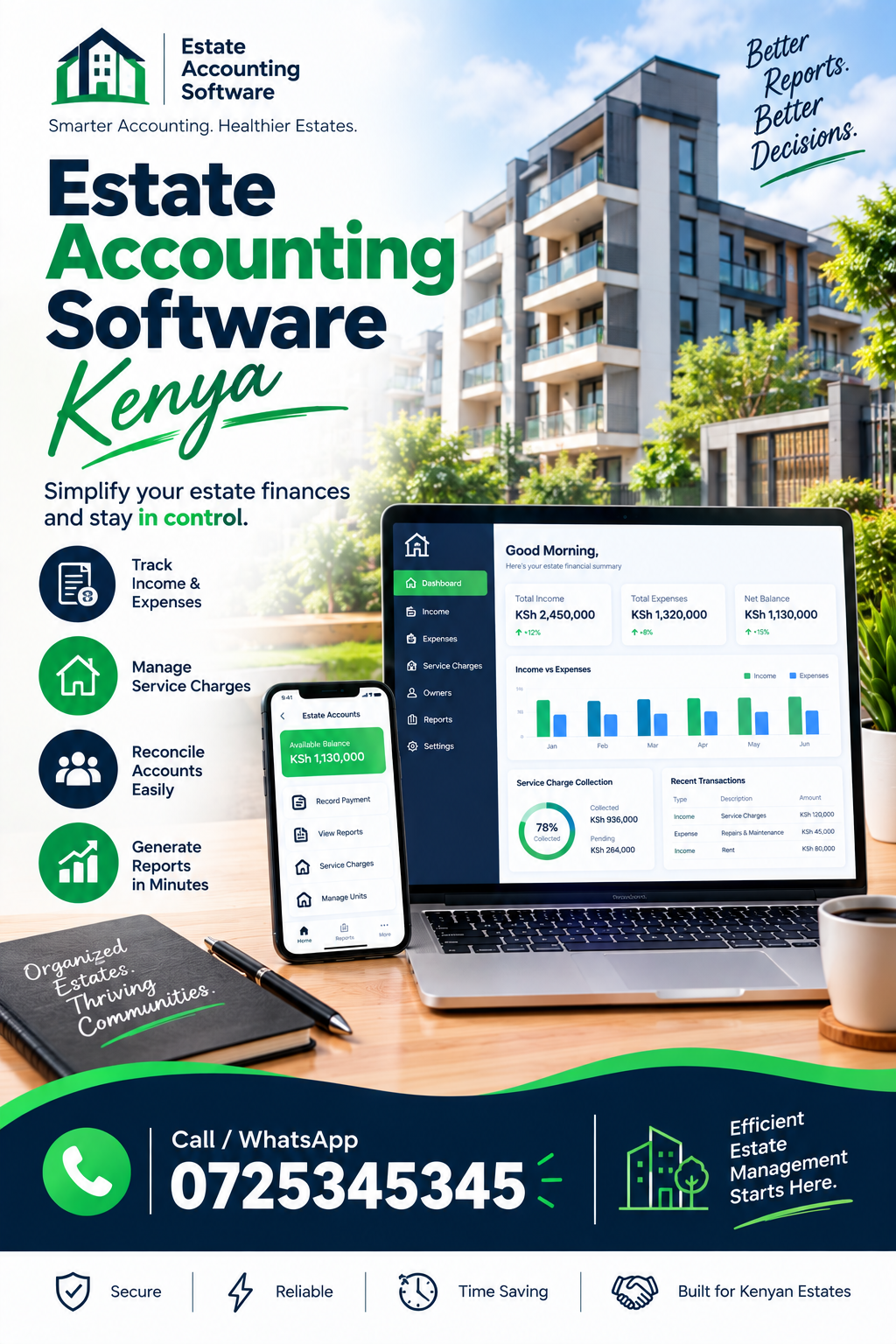
What Is Estate Accounting Software?
Managing the finances of a residential estate involves much more than recording payments. Property managers and estate administrators have to keep track of residents, invoices, service charges, outstanding balances, payments, expenses, statements and financial reports. When these activities are handled using notebooks, spreadsheets and separate payment records, it becomes easy for information to become inconsistent.
This is where Estate Accounting Software Kenya becomes useful. It provides a structured way to organize financial information connected to an estate and gives managers a clearer view of what has been billed, what has been paid and what remains outstanding.
For an estate with dozens or hundreds of residential units, having one organized system can make daily financial administration much easier. Instead of searching through several spreadsheets to answer a resident’s question, the relevant information can be available within the estate’s financial records.
Estate accounting software is particularly useful for gated communities, apartment developments, residential estates, property management companies and committees responsible for managing shared property expenses.
The goal is not simply to replace paper records with software. A good system should make financial processes more consistent, reduce repetitive manual work and give managers information they can use when making decisions.
Why Estate Accounting Has Become More Important in Kenya
Property management in Kenya involves several financial activities that must be coordinated carefully. An estate may collect service charges every month, receive payments through M-Pesa, maintain common areas, pay security providers, handle cleaning costs and monitor outstanding resident balances.
When these transactions are recorded separately, the finance team may spend considerable time comparing records.
A system such as Estate Accounting Software Kenya can help create a centralized workflow where invoices, payment records and resident balances are connected.
Consider a residential estate in Nairobi with 150 units. Suppose every unit has a monthly service charge. If the administrator prepares invoices manually, receives M-Pesa confirmations separately and then updates a spreadsheet, there are several points where an error can occur.
A payment may be entered twice. A resident may pay partially but still appear completely unpaid. An invoice may be missed. A balance may not be updated after a payment.
These issues can create unnecessary disputes.
Automated accounting workflows do not remove the need for proper financial controls, but they can make records easier to maintain and review.
The Difference Between Estate Accounting and Ordinary Bookkeeping
Traditional bookkeeping focuses primarily on recording financial transactions. Estate accounting has a more specific operational requirement because financial records are closely connected to individual units, residents, service charges and shared property expenses.
For example, an estate manager may need to know:
- Which units have outstanding service charges?
- How much was billed during the month?
- How much was actually collected?
- Which residents made partial payments?
- Which invoices remain unpaid?
- How much has been collected through different payment channels?
- What statements should be issued?
- What information should be presented to the management committee?
A platform such as Estate Accounting Software Kenya can be positioned as part of a broader digital approach to business administration, while an estate-focused system can organize these requirements around the actual workflow of residential property management.
This distinction matters because an estate does not operate exactly like an ordinary retail or service business.
The financial records must often be understood at unit level, resident level, invoice level and estate level.
Key Features to Look for in Estate Accounting Software
Choosing accounting software for an estate should not be based only on how attractive the dashboard looks. The system should support the actual processes that staff perform every month.
Here are some important features to consider.
1. Resident and Unit Records
A reliable accounting process starts with accurate resident and unit information.
The system should make it possible to organize residential units and associate financial activity with the correct resident or account.
This becomes increasingly important as the number of units grows.
With Estate Accounting Software Kenya, property teams can think beyond simple payment recording and consider how financial information connects with broader administrative workflows.
A unit record may need to be associated with:
- Resident details
- Billing category
- Service charges
- Invoice history
- Payment history
- Outstanding balances
- Statements
- Other relevant account information
When these details are organized, administrators can spend less time looking for information.
2. Automated Invoice Generation
Creating invoices manually every month is one of the most repetitive tasks in estate administration.
An accounting system can make recurring billing easier by allowing managers to establish charges and generate invoices systematically.
For example, if an estate charges KSh 8,000 per unit every month, the manager should not have to create 200 invoices individually.
Instead, the billing process can be structured around the estate’s predefined rules.
The concept of Estate Accounting Software Kenya is particularly relevant here because accounting, property management and billing are closely connected.
Automated invoice generation can also make it easier to maintain consistent billing dates and reduce the possibility of accidentally leaving a unit out of a billing cycle.
3. Payment Tracking
Recording payments accurately is central to estate financial management.
A resident may pay the full amount, make a partial payment or settle an older outstanding balance. The system needs to maintain an accurate record of these transactions.
For example, if a resident owes KSh 15,000 and pays KSh 10,000, the account should reflect the remaining KSh 5,000 rather than simply marking the invoice as paid or unpaid.
A platform such as Estate Accounting Software Kenya can support the idea of maintaining resident ledgers where payments and invoice balances remain connected.
This is particularly useful when an estate has many residents making payments throughout the month.
4. M-Pesa Payment Management
M-Pesa is an important part of everyday financial activity in Kenya, including property-related payments.
Estate administrators therefore need a reliable process for identifying payments and associating them with the correct resident or invoice.
The value of Estate Accounting Software Kenya in a Kenyan property context can be understood through this need for structured digital records and payment workflows.
The objective should not simply be receiving money.
The finance team should also be able to answer:
- Who made the payment?
- Which invoice was it intended for?
- How much was paid?
- Was the payment full or partial?
- What balance remains?
- Has the account been updated correctly?
A connected accounting workflow can make these questions easier to answer.
5. Payment Reconciliation
Reconciliation is one of the areas where spreadsheets can become difficult to manage.
A manager may have an M-Pesa statement, an invoice spreadsheet and a separate resident ledger. All three need to agree.
If they do not, the administrator has to investigate the differences.
A system such as Estate Accounting Software Kenya can be considered within the wider move toward digital business processes, while estate-focused accounting tools are designed around property billing and payment records.
Good reconciliation should make it easier to identify missing payments, duplicate entries and incorrect allocations.
EstateAdmin’s current reconciliation workflow, for example, is designed around applying payments to invoices, updating balances and maintaining a consistent source of financial records.
Managing Service Charges More Efficiently
Service charges are among the most important financial responsibilities for many residential estates.
These charges can contribute toward expenses such as security, cleaning, maintenance, landscaping, waste management and other shared services, depending on the estate’s arrangements.
When service-charge billing is handled manually, the process may involve spreadsheets, printed invoices, bank statements, M-Pesa messages and separate records.
This creates room for discrepancies.
A structured system such as Estate Accounting Software Kenya can help property teams think about financial management as an organized workflow rather than a collection of disconnected tasks.
A typical monthly cycle might involve:
- Confirming resident and unit information
- Reviewing approved charges
- Generating invoices
- Recording payments
- Updating balances
- Identifying arrears
- Issuing statements
- Preparing reports
The advantage of a repeatable process is that staff members know what should happen at every stage.
Tracking Arrears
Arrears are a major concern for property managers.
When residents fail to settle charges on time, the estate may experience difficulty paying suppliers or maintaining adequate cash flow.
The first step in managing arrears is knowing exactly who owes what.
A spreadsheet may show a resident as owing KSh 30,000, but the administrator may need to investigate several months of invoices and payments to determine how that amount was calculated.
With Estate Accounting Software Kenya, digital financial processes can provide a useful foundation for keeping transaction records organized.
An estate-focused accounting platform should make it easier to identify:
- Current outstanding balances
- Older arrears
- Partial payments
- Unpaid invoices
- Payment history
- Resident statements
This information can help the management team prioritize follow-up.
Why Accurate Resident Statements Matter
Residents often want a simple answer to a financial question: “How much do I owe?”
A good statement should make that answer understandable.
Instead of simply showing one large balance, a statement can show invoices, payments and the resulting running balance.
For example:
| Description | Amount |
|---|---|
| January service charge | KSh 8,000 |
| January payment | KSh 8,000 |
| February service charge | KSh 8,000 |
| February payment | KSh 5,000 |
| Current balance | KSh 3,000 |
This type of record is easier for both the resident and the administrator to understand.
A solution such as Estate Accounting Software Kenya supports the broader idea that organized digital records can improve transparency in business administration.
Clear statements can also reduce arguments because residents can see how a balance was calculated.
EstateAdmin currently describes its statement workflow as showing billed amounts, payments and a running balance for residents and committees.
Financial Reporting for Estate Committees
Estate committees need financial information to make decisions.
A committee meeting should not depend entirely on an administrator manually compiling figures at the last minute.
Reports may be used to review:
- Total invoices issued
- Payments received
- Outstanding balances
- Monthly collection trends
- Resident account activity
- Other financial information maintained by the estate
The purpose of Estate Accounting Software Kenya is not merely to store numbers. A well-designed system should turn those records into information that management can understand.
For example, if an estate collected less service charge revenue in one month, the committee may want to know whether this was caused by delayed payments, lower billing or another operational issue.
Reports make these patterns easier to investigate.
Using Accounting Software for Multiple Estates
Property management companies may oversee several estates at the same time.
Managing each estate using separate spreadsheets can create another layer of complexity.
An administrator may accidentally use the wrong spreadsheet, enter a payment under the wrong estate or combine figures when preparing reports.
A centralized property management environment can help teams maintain separate estate records while using consistent processes.
This is where Estate Accounting Software Kenya becomes relevant to discussions about scalable digital administration.
For a property management company, useful capabilities may include:
- Separate estate workspaces
- Resident records
- Estate-specific charges
- Invoice management
- Payment records
- Reports
- User permissions
The exact features required will depend on the size and structure of the property company.
Role-Based Access and Financial Controls
Not every employee should necessarily have access to every financial function.
An administrator may need to manage resident information. An accountant may need to record payments. A manager may need access to reports. A committee member may primarily need viewing access.
Role-based access can support this separation.
The concept of Estate Accounting Software Kenya therefore goes beyond basic bookkeeping. Modern property systems need to consider who can access, change and review financial information.
Clear user permissions can reduce the risk of unauthorized changes and make responsibilities easier to understand.
EstateAdmin currently describes separate roles including Admin, Manager, Accountant and Viewer, alongside audit-ready history showing what changed, when and by whom.
Audit Trails and Accountability
Financial records should be explainable.
If a resident’s balance changes, the estate management team should ideally be able to understand why.
This is difficult when several people edit the same spreadsheet.
An audit trail can help establish accountability by recording changes made within the system.
For an estate committee, this can be particularly useful when reviewing financial records.
A solution such as Estate Accounting Software Kenya reflects the broader shift toward structured digital records, although estate managers should always select software based on the specific controls and features they require.
The important principle is simple: financial information should not become impossible to trace.
Reducing Spreadsheet Dependence
Spreadsheets are useful tools. They are flexible, inexpensive and familiar to many Kenyan businesses.
The problem begins when a spreadsheet becomes the main system for managing a large estate.
A single file may contain hundreds of rows and multiple formulas. Several employees may also maintain their own copies.
Over time, differences can appear.
One person may have updated the January figures while another is still using an older version.
With Estate Accounting Software Kenya, estate managers can consider moving repetitive financial workflows into a more structured environment.
The goal is not to eliminate spreadsheets completely.
Instead, spreadsheets can remain useful for analysis and exports while the core resident, invoice and payment records are maintained in a system designed for the workflow.
Cloud-Based Estate Accounting
Cloud-based systems allow authorized users to access information without relying on a single computer.
This can be valuable for property management teams where the estate manager, accountant and committee members may not always work from the same location.
For example, a manager could need to review collection figures from home while the accountant is updating payments from the office.
A cloud-oriented approach such as Estate Accounting Software Kenya can support broader digital collaboration.
However, property managers should also evaluate security, user permissions, backups, availability and support before selecting any cloud accounting platform.
Convenience should not come at the expense of financial controls.
What Should an Estate Accounting Dashboard Show?
A useful dashboard should help a manager understand the estate’s financial position without opening multiple files.
Important information may include:
- Total amount billed
- Total payments received
- Outstanding balances
- Partially paid invoices
- Recent payments
- Collection trends
- Resident account information
- Available reports
For example, a manager arriving at work on Monday morning should be able to quickly identify whether payments have been received and which accounts require attention.
The usefulness of Estate Accounting Software Kenya should therefore be judged partly by how easily users can find the information they need.
A complicated dashboard that contains many features but makes basic tasks difficult may not be ideal for a busy property team.
Estate Accounting Software for Small Estates
Not every estate has hundreds of units.
A small residential development with 20 or 30 units may initially rely on a spreadsheet because the number of transactions appears manageable.
However, even a small estate needs accurate records.
A missed payment or incorrectly calculated service charge can still create a dispute.
Starting with organized processes early can make growth easier.
Using Estate Accounting Software Kenya can be considered when an estate wants to move from informal records toward a more structured approach.
The key is choosing a system that is practical for the estate’s size rather than paying for features that the management team will never use.
Estate Accounting Software for Large Residential Estates
Larger estates face a different set of challenges.
When hundreds of units are involved, manual invoice creation becomes increasingly time-consuming.
Payment reconciliation also becomes more demanding because many residents may make payments around the same time.
A system such as Estate Accounting Software Kenya can form part of a broader discussion about business automation, while an estate-focused platform should provide workflows specifically relevant to property billing.
For large estates, useful features include bulk invoice generation, payment tracking, arrears visibility, resident statements and reporting.
The larger the estate becomes, the more important consistency becomes.
Handling Partial Payments Correctly
Partial payments deserve special attention in estate accounting.
Suppose a resident receives a KSh 12,000 invoice but pays KSh 7,000.
The system should not treat the entire invoice as paid.
Instead:
Invoice: KSh 12,000
Payment: KSh 7,000
Remaining balance: KSh 5,000
This simple distinction is important.
If the remaining KSh 5,000 disappears from the records, the estate’s financial position becomes inaccurate.
A good system should maintain the connection between the original invoice and the payment.
The value of Estate Accounting Software Kenya can therefore be evaluated by asking how accurately the platform handles real-world payment situations rather than only looking at its basic billing functionality.
Handling Different Resident Categories
Not every resident may necessarily be billed in exactly the same way.
An estate may have different categories of residential units or different approved billing arrangements.
A flexible accounting system should allow administrators to organize residents into appropriate categories.
This can make reporting and billing easier.
With Estate Accounting Software Kenya, the broader lesson is that accounting technology should support the organization’s actual rules instead of forcing every property into the same structure.
Before implementing software, estate managers should document their existing billing rules.
They should identify which charges are fixed, which vary and which residents belong to each billing category.
Choosing the Right Estate Accounting Software
There are many accounting and property management tools available, but they are not all designed for the same purpose.
Before choosing a system, ask the following questions:
Does it support resident ledgers?
Financial information should be traceable to the relevant resident or unit.
Can it generate recurring invoices?
Recurring billing is important for monthly service charges.
Can it track partial payments?
This is essential for accurate balances.
Does it support payment reconciliation?
The system should help administrators connect payments with invoices.
Can it produce useful reports?
Reports should be practical for managers, committees and finance teams.
Does it support user roles?
Different employees should be able to access the information appropriate to their responsibilities.
Can the system scale?
The platform should remain useful as the number of units or estates increases.
Does it work well with Kenyan payment workflows?
Because M-Pesa is widely used in Kenya, payment management should be considered during software selection.
A system such as Estate Accounting Software Kenya should therefore be evaluated based on actual operational requirements rather than the number of features listed on a sales page.
How Much Does Estate Accounting Software Cost?
The cost of accounting software varies depending on the provider, number of units, features, integrations, support and pricing model.
Some platforms charge according to the number of users. Others use property or unit-based pricing, while some offer different packages based on functionality.
Estate managers should avoid choosing software based only on the lowest monthly price.
Instead, compare the cost with the amount of administrative work it can reduce.
For example, if a system saves several hours every month on invoice preparation and reconciliation, that time has operational value.
The pricing structure should also be clear.
Before signing up, ask whether there are additional costs for onboarding, integrations, additional users, payment processing or advanced reports.
A provider such as Estate Accounting Software Kenya can be part of the wider digital business ecosystem, but estate managers should always compare software according to their own needs.
EstateAdmin currently presents plans based on residential units, with different levels intended for smaller estates, larger estates and property firms.
Moving From Manual Accounting to Digital Accounting
Changing from spreadsheets to software does not have to happen overnight.
A property manager can begin by documenting the current accounting process.
Start with the resident list.
Then identify:
- Current billing categories
- Monthly charges
- Existing invoices
- Outstanding balances
- Payment records
- Current arrears
- Reporting requirements
Once the information is organized, it can be entered into the new system.
A platform such as Estate Accounting Software Kenya can represent the wider move toward digital business administration, while estate-specific software should be selected based on its ability to handle the property’s actual accounting workflow.
The transition period is also a good opportunity to clean outdated resident records.
A Practical Example: 100-Unit Estate
Imagine an estate with 100 residential units.
Each unit is billed KSh 7,500 per month for approved service charges.
The monthly expected billing is:
100 × KSh 7,500 = KSh 750,000
If the estate uses spreadsheets, the administrator may have to prepare 100 invoices, track 100 payments and calculate outstanding balances manually.
With an organized billing system, the administrator can configure the charge and generate invoices systematically.
If 85 residents pay in full, five make partial payments and 10 do not pay, management can immediately see the difference between billed and collected amounts.
This is where Estate Accounting Software Kenya becomes valuable as a search term for property managers looking for ways to improve financial administration.
The system does not make residents pay automatically simply because software has been installed.
Collection still depends on communication, payment options, follow-up and estate policies.
What software does provide is better visibility.
How Accounting Software Can Improve Transparency
Financial transparency is important in residential communities because residents contribute money toward shared services.
They want to know how their charges are calculated and whether their payments have been recorded correctly.
Committee members also need reliable information when reviewing the estate’s financial position.
Clear invoices and statements can help.
A system such as Estate Accounting Software Kenya can be part of the broader shift toward digital transparency, while property-focused accounting software can connect this transparency directly to resident billing.
When residents ask about an outstanding balance, the administrator should be able to provide a clear explanation.
This is much easier when the invoice and payment history are already organized.
Reports That Estate Managers Should Monitor
Different estates will have different reporting requirements, but several reports can be particularly useful.
Monthly Billing Report
Shows how much was billed during a specific period.
Payment Report
Shows payments recorded during a selected period.
Outstanding Balance Report
Highlights accounts that still have amounts due.
Resident Statement
Shows transactions for an individual resident.
Collection Trend
Helps management compare collections across different periods.
Reports are useful because raw transaction records can be difficult to interpret.
A system such as Estate Accounting Software Kenya can be considered when evaluating digital property administration tools, but the most important question remains whether the available reports answer the questions your estate management team actually asks.
EstateAdmin currently highlights monthly invoices, monthly payments, resident statements and snapshot exports among its reporting capabilities.
Why Data Accuracy Matters
Accounting software cannot fix inaccurate information entered into it.
If the resident list is wrong, invoices may be sent to the wrong accounts.
If a payment is allocated incorrectly, the resident balance will still be wrong.
If billing rules are configured incorrectly, automation may simply repeat the wrong calculation.
This is why implementation matters.
A property manager should verify data before beginning automated billing.
The principle behind Estate Accounting Software Kenya is therefore not simply “automate everything.” The better approach is to establish accurate processes and then use technology to make those processes repeatable.
Estate Accounting and Property Management Working Together
Accounting is only one part of estate management.
Managers may also need to maintain resident information, handle maintenance requests, communicate with residents and coordinate service providers.
When financial information is isolated from other property records, staff may have to move between several systems.
An integrated estate management platform can reduce unnecessary switching.
For example, resident information can be connected to billing records, while payment activity can be connected to invoices.
This creates a more complete operational picture.
The term Estate Accounting Software Kenya may be used by people searching for accounting solutions, but property managers should distinguish between general accounting platforms and systems designed specifically around estate management.
Security Considerations for Estate Financial Data
Financial information should be treated carefully.
When selecting an online accounting system, estate managers should ask about:
- User access controls
- Password security
- Data protection
- Backups
- Audit history
- Account permissions
- System availability
- Support procedures
A property management company may handle information belonging to many residents, so careless access management can create unnecessary risks.
The broader digital-business context represented by Estate Accounting Software Kenya should always be balanced with practical security requirements.
Do not select software simply because it has an attractive interface.
Ask how financial information is protected and how user activity is controlled.
Estate Accounting for Management Committees
Committee members often need financial visibility without becoming involved in every daily administrative task.
For example, an accountant may record payments while the committee reviews monthly reports.
A role-based system can support this arrangement.
The committee can focus on questions such as:
- Are collections improving?
- How much is outstanding?
- Which expenses require attention?
- Are residents receiving clear statements?
- Are financial records consistent?
This makes Estate Accounting Software Kenya particularly relevant when discussing financial visibility for residential communities.
EstateAdmin has a dedicated estate accounting workflow for committees focused on billed-versus-paid clarity, arrears and committee-ready reports.
What Estate Managers Should Do Before Buying Software
Before choosing a platform, write down the current process.
Do not begin with software features.
Begin with the problems.
For example:
Problem: Invoices are prepared manually.
Requirement: Recurring invoice generation.
Problem: Payments are difficult to match with invoices.
Requirement: Payment allocation and reconciliation.
Problem: Residents dispute balances.
Requirement: Clear statements and transaction history.
Problem: Committee reports take too long to prepare.
Requirement: Automated reporting and exports.
This approach makes it easier to identify whether a platform actually solves the estate’s problems.
A solution such as Estate Accounting Software Kenya should ultimately be judged on practical usefulness rather than marketing language.
Common Mistakes When Managing Estate Accounts
Several mistakes can make estate accounting unnecessarily difficult.
Using Multiple Versions of the Same Spreadsheet
Different files can quickly develop different figures.
Recording Payments Without Allocating Them
Knowing that money was received is not enough. The payment should be connected to the correct account or invoice.
Ignoring Partial Payments
A partially paid invoice should remain partially paid.
Delaying Reconciliation
Waiting until the end of several months makes it harder to identify errors.
Failing to Issue Statements
Residents need a clear record of their account activity.
Giving Everyone the Same System Access
Users should only have the access required for their responsibilities.
Focusing Only on Collections
A good accounting process also needs accurate billing and reporting.
Addressing these issues can make a significant difference to financial administration.
How Estate Accounting Software Supports Better Decision-Making
Good financial data helps managers make better decisions.
Suppose an estate’s collection rate appears to be falling.
Instead of guessing, management can examine billing records, payment history and outstanding balances.
Perhaps several large accounts have become overdue.
Perhaps a billing category was incorrectly configured.
Perhaps residents are paying later than usual.
Accurate records provide a starting point for investigation.
This is one reason Estate Accounting Software Kenya is more than a keyword associated with bookkeeping. The underlying need is access to reliable information that can support property management decisions.
Frequently Asked Questions
What is Estate Accounting Software Kenya?
Estate Accounting Software Kenya refers to software solutions used to organize and manage financial activities connected with residential estates, including billing, invoices, payments, balances, arrears, statements and reporting.
The most useful platforms connect these activities rather than forcing administrators to maintain separate records.
Can estate accounting software manage service charges?
Yes, depending on the platform. Estate-focused systems can support recurring service-charge setup, invoice generation, payment tracking, outstanding balances and reporting.
EstateAdmin, for example, positions service-charge billing as a core part of its platform, including recurring charges, invoices, payments and reporting.
Can it track M-Pesa payments?
The exact functionality depends on the software and its integrations.
For Kenyan estates, M-Pesa payment workflows can be particularly important because many residents use mobile money to settle property-related charges.
A good system should make it clear how payments are recorded and associated with resident accounts.
Is estate accounting software suitable for apartments?
Yes. Apartment developments can use accounting and property management systems to organize unit records, billing, payments, balances and statements.
The platform should be selected based on the apartment’s actual billing and management requirements.
For apartment-focused service-charge workflows, the ability to track individual unit balances is particularly important.
Can software help reduce arrears?
It can improve arrears visibility, but software cannot guarantee that residents will pay.
A system can make outstanding balances easier to identify, provide clearer statements and reduce the administrative work involved in following up.
Effective collections still require appropriate policies and consistent communication.
What should a property manager look for in accounting software?
Look for accurate resident records, recurring billing, invoice generation, payment tracking, reconciliation, partial-payment handling, statements, reports, user permissions and appropriate security controls.
For a growing property company, scalability and multi-estate management may also be important.
Can small estates use accounting software?
Yes. Small estates can benefit from organized records even when they have relatively few units.
The important consideration is choosing a system whose cost and functionality match the estate’s size.
Starting with organized digital records can also make future growth easier.
Does accounting software replace an accountant?
Not necessarily.
Software can automate repetitive processes and organize information, but professional financial oversight may still be required.
An accountant or finance professional can review records, interpret financial information, handle complex accounting matters and support compliance requirements.
The software should be viewed as a tool that supports the finance team.
How can committees benefit from estate accounting software?
Committees can benefit from clearer reports, resident statements, collection information and outstanding-balance visibility.
Instead of relying on manually prepared figures, members can review structured reports when making decisions.
EstateAdmin specifically positions its committee solution around billed-versus-paid visibility, arrears management and committee-ready reporting.
What is the difference between estate accounting software and ordinary accounting software?
Ordinary accounting software is generally designed around business financial transactions.
Estate-focused accounting software adds property-specific workflows such as residential units, resident accounts, service charges, recurring invoices and resident statements.
For a property manager, those property-specific capabilities can make the system easier to use for day-to-day estate administration.
Estate Accounting Software and the Future of Property Management
Property management is becoming increasingly dependent on accurate digital records.
As residential developments become more organized, residents expect clearer invoices, accessible statements and reliable payment records.
Management committees also need financial information they can review without waiting for someone to manually compile spreadsheets.
This makes Estate Accounting Software Kenya relevant to a wider conversation about digital transformation in Kenyan property management.
The strongest systems will not simply add more features.
They will make common workflows easier to understand and repeat.
For estate managers, that means starting with a simple financial cycle:
Charge → Invoice → Payment → Reconciliation → Balance → Statement → Report
When each stage is connected, the estate’s financial records become easier to maintain and explain.
A Simple Implementation Checklist
Before launching an estate accounting system, managers can use this checklist:
- Confirm all residential units.
- Review resident records.
- Confirm approved billing categories.
- Verify recurring charges.
- Review outstanding balances.
- Confirm payment records.
- Define user roles.
- Set up reporting requirements.
- Test invoice generation.
- Test full payments.
- Test partial payments.
- Test statement generation.
- Review reconciliation.
- Train relevant staff.
- Run a sample billing cycle before going fully live.
A careful implementation reduces the chance of carrying inaccurate information into the new system.
For managers evaluating Estate Accounting Software Kenya, the most important test is whether the software can handle a realistic estate billing cycle from beginning to end.
A Practical Monthly Workflow
A typical month could begin with the administrator reviewing resident information and confirming that all units are correctly configured.
The next step is to generate invoices according to the approved charges.
Once invoices are issued, residents make payments through the available channels.
The finance team records or reconciles those payments.
Balances are then reviewed to identify accounts that remain outstanding.
Statements can be generated for residents who need clarification.
Finally, management can prepare reports showing billing, collections and outstanding balances.
This process can be repeated each month.
The benefit of Estate Accounting Software Kenya lies in making that cycle more consistent and easier to monitor.
What Good Estate Financial Management Looks Like
Good estate accounting is not simply about having a large amount of financial data.
It is about having the right information organized correctly.
A manager should be able to move from a total estate balance to an individual resident account.
From there, they should be able to see the relevant invoice.
Then they should be able to see payments against that invoice.
If there is an outstanding amount, the system should make that balance clear.
This is the type of workflow property teams should look for when evaluating Estate Accounting Software Kenya.
The objective is clarity.
When records are clear, billing discussions become easier, reconciliation becomes more manageable and committee reporting becomes less stressful.
Why EstateAdmin Fits This Workflow
EstateAdmin positions itself as an estate management system focused on service-charge billing, invoicing, payments and reporting. Its current platform includes resident records, recurring charges, invoice generation, payment tracking, roles and approvals, resident categories and audit-ready history.
For an estate manager, these capabilities can bring several financial activities into one workflow.
Instead of treating billing, payments and reporting as unrelated jobs, the estate can manage them as connected stages.
The service-charge billing workflow also supports bulk invoice generation, payment tracking and reporting, while the reconciliation functionality is designed to keep payment and invoice balances aligned.
This approach can be useful for estates that want to reduce spreadsheet dependence without creating a complicated financial process.
Questions to Ask During a Software Demo
Before adopting any system, estate managers should ask practical questions.
Can I generate invoices for all units at once?
Can I see exactly which residents have paid?
How are partial payments handled?
Can I produce an individual resident statement?
Can I identify outstanding balances quickly?
Can different staff members have different permissions?
Can the system export reports?
How are changes to financial records tracked?
What happens when a resident changes units?
How does payment reconciliation work?
What happens if a payment cannot immediately be matched to a resident?
These questions reveal much more about a platform than a generic list of features.
For anyone researching Estate Accounting Software Kenya, testing these real-world scenarios can help determine whether the software is actually suitable for the estate.
The Bottom Line for Estate Managers
Estate accounting becomes harder as the number of units, transactions and staff increases.
Manual records may work for a small operation for a while, but they can become difficult to maintain when an estate grows.
The right technology can help organize recurring billing, payment records, resident balances, statements and reports.
For Kenyan estates, payment workflows should also account for the practical role of M-Pesa and other digital payment methods.
Most importantly, the system should provide a reliable record that management can understand and review.
For estates comparing solutions, Estate Accounting Software Kenya should represent more than a search phrase. It reflects a real operational need: keeping property finances organized, visible and easier to manage.
A successful accounting system should make it easier for an administrator to answer basic questions quickly:
What was billed?
What was paid?
Who still owes money?
How much is outstanding?
What changed?
Can the figures be supported by clear records?
Those are the questions that should guide the selection of an estate accounting platform.
Related Digital Management Needs for Kenyan Property Businesses
Estate accounting rarely exists in isolation.
Property managers may also need systems for resident communication, property administration, payment collection, business operations and other workflows.
This is why evaluating software as part of the wider technology environment can be useful.
The important thing is to maintain clear boundaries between different systems while ensuring that the core financial records remain accurate.
For property companies managing multiple developments, standardizing processes can also make staff training easier.
When every estate follows a similar workflow for billing, payments and reporting, managers spend less time explaining different procedures.
The goal is consistency without ignoring the unique rules of each property.
Estate Accounting Software Kenya for Growing Property Firms
As a property business grows, the financial workload usually grows with it.
A manager who previously handled one estate may eventually oversee several properties.
At that point, manual processes become increasingly difficult to maintain.
Using Estate Accounting Software Kenya can be considered as part of a broader digital strategy for property businesses seeking more structured financial administration.
The most useful approach is to standardize the recurring parts of the process:
- Resident onboarding
- Billing setup
- Invoice generation
- Payment recording
- Reconciliation
- Arrears follow-up
- Statements
- Reporting
Once those steps are standardized, a property management company can build a more predictable operating routine.
Final Practical Checklist Before Choosing a System
Before signing up for any estate accounting platform, confirm that it can handle the following:
| Requirement | Why It Matters |
|---|---|
| Resident records | Keeps accounts connected to the correct units |
| Recurring billing | Reduces repetitive invoice preparation |
| Invoice generation | Creates consistent billing records |
| Payment tracking | Shows what residents have paid |
| Partial payments | Prevents incorrect balances |
| Reconciliation | Helps match payments with invoices |
| Arrears visibility | Identifies outstanding accounts |
| Statements | Makes balances easier for residents to understand |
| Reporting | Supports management and committee decisions |
| User roles | Helps control access |
| Audit history | Improves accountability |
| Exports | Makes financial information easier to review |
| M-Pesa workflow | Supports common Kenyan payment practices |
| Scalability | Allows the system to grow with the estate |
When these capabilities work together, accounting becomes part of a repeatable estate-management process rather than a monthly scramble to update spreadsheets.
For property managers still comparing options, Estate Accounting Software Kenya can be used as part of the wider search for digital business solutions, while the final selection should always be based on the actual requirements of the estate.
Frequently Asked Questions: Quick Reference
Is estate accounting software only for large estates?
No. Smaller estates can also benefit from organized billing, payment tracking and reporting. The main consideration is whether the platform’s pricing and functionality match the estate’s needs.
Can it help with service-charge collection?
It can improve billing consistency, payment visibility and arrears tracking. Collection still depends on resident communication, payment methods and the estate’s collection policies.
Can residents receive statements?
Platforms with statement functionality can provide residents with records showing invoices, payments and balances. EstateAdmin currently includes resident statements as part of its service-charge workflow.
Can a management company use one system for several estates?
This depends on the software. Property firms should look for multi-estate or multi-workspace functionality if they manage several developments.
Should an estate stop using spreadsheets completely?
Not necessarily. Spreadsheets can remain useful for analysis and custom calculations. However, the core resident, invoice and payment records are often easier to control when maintained in a dedicated system.
What is the most important accounting feature for an estate?
There is no single feature that fits every estate, but accurate billing, payment tracking, reconciliation, resident balances and reporting are among the most important capabilities to evaluate.
How can an estate test software before committing?
Run a realistic test. Add representative units, configure a recurring charge, generate invoices, record both full and partial payments, review balances and produce a statement or report. EstateAdmin currently offers a free-trial workflow that allows teams to test its service-charge process.
Can accounting software reduce financial disputes?
Clear invoices, accurate balances and understandable statements can reduce confusion around what was billed and paid. Software cannot eliminate every dispute, but better records make financial questions easier to investigate.
Does accounting software eliminate the need for financial controls?
No. User permissions, approval procedures, reconciliation, review and proper record-keeping remain important. Software should strengthen these controls rather than replace them.
What should an estate manager prioritize first?
Start with accuracy. Confirm resident records, billing rules and outstanding balances before automating the monthly process. Once the underlying information is correct, automation becomes much more useful.
Estate Accounting Software Kenya
Estate Accounting Software Kenya
Estate Accounting Software Kenya
Estate Accounting Software Kenya
Estate Accounting Software Kenya
Estate Accounting Software Kenya
Estate Accounting Software Kenya
Estate Accounting Software Kenya
Estate Accounting Software Kenya
Estate Accounting Software Kenya
Estate Accounting Software Kenya
Estate Accounting Software Kenya
Estate Accounting Software Kenya
Estate Accounting Software Kenya
Estate Accounting Software Kenya
Estate Accounting Software Kenya
Estate Accounting Software Kenya
Estate Accounting Software Kenya
Estate Accounting Software Kenya
Estate Accounting Software Kenya
Estate Accounting Software Kenya
Estate Accounting Software Kenya
Estate Accounting Software Kenya