
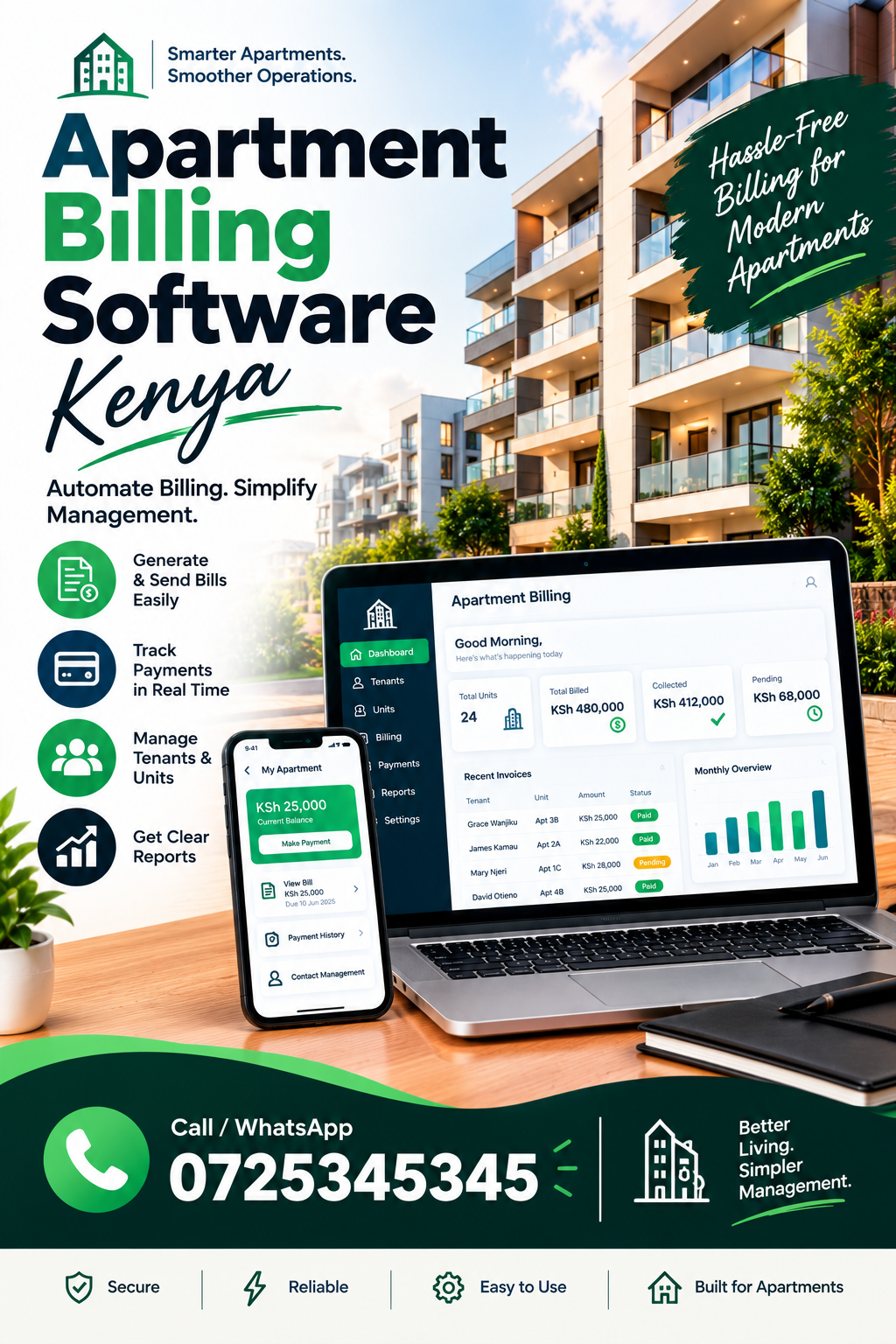
Apartment Billing Software Kenya: A Complete Guide for Property Managers
Managing an apartment building involves much more than collecting rent. Property managers have to keep track of units, tenants, recurring charges, utilities, service charges, payments, balances, invoices and arrears. This is where Apartment Billing Software Kenya can make a major difference. Instead of relying on notebooks, spreadsheets and scattered payment records, apartment managers can use a centralised system to organise billing and financial information. This guide explains how apartment billing works, the challenges of manual billing, the features to look for, how automation can improve collections, and what Kenyan landlords and property managers should consider when selecting billing software.
What is apartment billing software?
Apartment billing software is a digital system designed to help landlords, estate managers and property management companies manage charges associated with residential units.
Unlike ordinary accounting software, a property-focused billing system is structured around apartments, units, residents and recurring property charges. Depending on the platform, it can help with rent invoices, service charges, utility billing, payment records, receipts, statements, arrears and financial reports.
For a property manager handling several units, Apartment Billing Software Kenya can provide a central place to organise these records.
The basic idea is straightforward. Each property is added to the system, units are recorded, residents are assigned to the appropriate units and relevant charges are configured. The system can then help create invoices and maintain payment records.
This becomes especially useful when the number of units increases. A manager handling ten apartments may still be able to maintain records manually. Managing 100, 300 or more units using the same approach can become considerably more demanding.
Why apartment billing becomes complicated
Apartment billing can look simple from the outside. A tenant receives a bill, makes a payment and the manager records it. In practice, several charges and transactions may be involved.
An apartment may have:
- Monthly rent
- Water charges
- Electricity charges
- Garbage collection fees
- Security charges
- Service charges
- Parking charges
- Maintenance-related charges
- Late payment fees
- Other approved property charges
A good Apartment Billing Software Kenya solution should therefore do more than create a basic invoice. It should help property managers understand exactly what each resident owes and why.
Different tenants may have different charges
Not every apartment necessarily has the same billing structure.
One tenant may have a parking space while another does not. One unit may have a separate water meter. Another may be billed through a shared utility arrangement.
When these differences are handled manually, mistakes can happen.
Software can provide a structured way to maintain individual account information while still allowing managers to apply standard charges across an entire property.
The problems with spreadsheet-based apartment billing
Spreadsheets are useful tools, and many property managers start with them. The problem is that a spreadsheet is not specifically designed to manage an entire apartment billing workflow.
A manager might have one spreadsheet for tenants, another for payments and another for expenses. Payment confirmations might also be stored in WhatsApp messages or email.
As the property grows, finding the right information can become difficult.
A dedicated Apartment Billing Software Kenya system brings these processes closer together.
1. Manual calculations
Calculating bills for dozens or hundreds of units every month creates opportunities for errors.
A formula can be changed accidentally. A unit can be missed. A charge can be entered twice.
Automated billing reduces the amount of repetitive calculation required from staff.
2. Missing payment records
When payments arrive through different channels, manually matching them to the correct unit can take time.
A structured billing system makes it easier to maintain a payment history for each account.
3. Difficulty tracking arrears
If an apartment has unpaid rent or service charges, the manager needs to know how much is outstanding and how long it has been unpaid.
With Apartment Billing Software Kenya, property managers can maintain clearer account balances and identify outstanding amounts more easily.
4. Slow reporting
Preparing a report manually can involve collecting information from several spreadsheets.
A centralised system can make reporting more straightforward because billing and payment records are already organised.
How automated apartment billing works
The basic billing process can be divided into several stages.
Step 1: Add the property
The property manager creates the apartment development in the system.
The record may include the property name, location and other relevant information.
Step 2: Add the units
Each apartment is entered as a separate unit.
For example:
| Unit | Type | Monthly Rent |
|---|---|---|
| A01 | One bedroom | KSh 25,000 |
| A02 | One bedroom | KSh 25,000 |
| B01 | Two bedroom | KSh 35,000 |
| B02 | Two bedroom | KSh 35,000 |
The actual amounts depend on the property.
Step 3: Add residents
The appropriate tenant or resident is connected to each unit.
This creates a relationship between the person, the apartment and the financial account.
Step 4: Configure charges
The manager sets up recurring charges such as rent, service charges or other approved fees.
Step 5: Generate invoices
The system generates the relevant billing records according to the configured schedule.
Step 6: Record payments
When a resident pays, the payment is recorded against the appropriate account.
Step 7: Monitor balances
The manager can review paid, partially paid and outstanding accounts.
This workflow is one of the main reasons property managers consider Apartment Billing Software Kenya instead of continuing with disconnected spreadsheets.
Key features to look for
Choosing software based only on price can be a mistake. The better approach is to compare features against the actual problems faced by the property management team.
Automated invoice generation
One of the most useful features is recurring invoice generation.
Instead of manually preparing bills for every apartment, the system can create invoices based on predefined billing arrangements.
For a large apartment block, this can significantly reduce repetitive administrative work.
Payment tracking
Payment tracking allows managers to see what has been received and what remains outstanding.
A Apartment Billing Software Kenya platform can help maintain a clearer financial history for each unit.
Resident statements
Statements are useful when residents want to understand their account.
A statement can show:
- Previous balance
- New charges
- Payments received
- Adjustments
- Current balance
This is particularly useful when resolving billing disputes.
Arrears management
Arrears can affect the financial health of an apartment property.
A system should make it easy to identify outstanding accounts rather than forcing managers to search through multiple spreadsheets.
Receipts
Digital receipts provide residents with evidence that their payments have been recorded.
They also give the property manager a consistent transaction record.
Reporting
Reports can help management understand:
- Total billed
- Total collected
- Outstanding balances
- Payment trends
- Arrears
- Collections by property
- Collections by unit
A Apartment Billing Software Kenya platform with useful reporting capabilities can make management meetings easier because the relevant information can be retrieved without manually rebuilding reports.
Rent billing for apartment buildings
Rent is normally one of the largest recurring financial transactions in a residential property.
Manual rent collection creates several administrative tasks every month. The manager has to determine who has paid, who has not paid and whether the amount received matches the amount billed.
A Apartment Billing Software Kenya system can help organise these records.
For example, imagine a 100-unit apartment building. If each apartment has a different payment status, the manager needs a reliable way to distinguish between:
- Paid accounts
- Partially paid accounts
- Unpaid accounts
- Accounts with previous balances
- Accounts with approved adjustments
A centralised billing system makes this information easier to review.
Utility billing in apartments
Utility billing can be one of the more complicated parts of apartment management.
Water and electricity may be charged based on individual meters, shared meters, consumption or another arrangement.
The billing process therefore needs to be clearly defined before software is configured.
A Apartment Billing Software Kenya platform can help organise utility charges where the relevant functionality is available.
Water billing
Water charges may depend on meter readings or an agreed allocation method.
For example, if an apartment has an individual meter, the manager may record the reading and calculate the applicable charge.
If water is shared across several units, the property may use a different allocation method.
The software should support the method actually used by the property rather than forcing every apartment into the same billing structure.
Electricity billing
Electricity arrangements also differ between properties.
Some apartments have individual meters while others may have shared arrangements.
The manager should establish clear billing rules and communicate them to residents.
Service charge billing
Service charges cover shared costs associated with maintaining and operating a property.
Depending on the development, these can include cleaning, security, landscaping, maintenance of common areas, waste management and other shared services.
A Apartment Billing Software Kenya platform can help property managers include recurring service charges within the wider billing process.
This means the resident’s account can contain more than rent alone.
Instead of maintaining separate records for rent and service charges, the manager can work from a more comprehensive account history.
M-Pesa and apartment payments
Payment convenience matters in Kenya.
M-Pesa is widely used for everyday payments, including many property-related transactions. Property managers therefore need to think carefully about how their billing software handles mobile payments.
A Apartment Billing Software Kenya solution should be evaluated based on the specific payment integrations it provides.
Ask the provider:
- Is M-Pesa supported?
- How are payment references captured?
- Are payments matched to invoices?
- How quickly are balances updated?
- Can administrators handle partial payments?
- How are payment errors corrected?
Do not choose software simply because the words “M-Pesa integration” appear on a website. Ask for a demonstration of the actual workflow.
Apartment billing and payment reconciliation
Reconciliation means checking that recorded payments correspond with the expected transactions.
Suppose an apartment has been billed KSh 30,000 and the resident pays KSh 30,000. The property manager should be able to see that the invoice has been settled.
If the resident pays KSh 20,000, the system should retain the remaining KSh 10,000 balance.
A Apartment Billing Software Kenya platform can make these account-level records easier to manage when payments are recorded consistently.
Reconciliation becomes especially important when a property handles a large number of transactions.
Managing partial payments
Residents do not always pay the full amount at once.
A tenant may make one payment today and another payment later.
The software should not simply mark the entire invoice as paid after the first transaction.
Instead, the account should reflect the amount received and the remaining balance.
For example:
| Invoice | Amount | Payment | Balance |
|---|---|---|---|
| March rent | KSh 30,000 | KSh 20,000 | KSh 10,000 |
| March service charge | KSh 5,000 | KSh 5,000 | KSh 0 |
A good Apartment Billing Software Kenya solution should make this status easy for the manager to understand.
Arrears management
Arrears are one of the biggest concerns for landlords and property managers.
An unpaid balance affects expected cash flow and can create additional administrative work.
A practical arrears process begins with accurate records.
The manager should know:
- What was billed.
- When it was due.
- What has been paid.
- What remains outstanding.
- Whether the resident has raised a dispute.
- What follow-up has already occurred.
A Apartment Billing Software Kenya platform can support this process by maintaining account balances and payment histories.
Automated reminders can also be useful where the software provides them, but reminders should be used carefully. A resident who has already paid should not continue receiving an overdue notice because a transaction has not been reconciled.
Reducing billing disputes
Billing disputes can consume a significant amount of administrative time.
A resident may ask why their balance is different from the previous month. They may question a utility charge or say that a payment was already made.
Clear records make these conversations easier.
A Apartment Billing Software Kenya system can provide a structured account history that helps managers investigate questions.
Instead of searching through several files, the administrator can review the relevant charges and payments in one place.
Why resident statements matter
Residents want to understand what they are being charged.
A professional statement should make the account easy to read.
For example, a monthly statement could show:
- Opening balance
- Current rent
- Service charge
- Utility charges
- Payments
- Adjustments
- Closing balance
A Apartment Billing Software Kenya solution that provides clear statements can improve transparency between property managers and residents.
Clear statements also reduce unnecessary questions because residents can see how the balance was calculated.
Managing multiple apartment properties
Property management companies may manage several apartment blocks.
Using a separate spreadsheet for every building can become difficult.
A centralised Apartment Billing Software Kenya platform can allow managers to organise multiple properties within a structured environment, depending on the software’s capabilities.
For example, a management company could have:
- Property A
- Property B
- Property C
- Property D
Each property can have its own units, residents, charges and payment records.
This is particularly valuable when management needs to compare collection performance across properties.
Multi-property reporting
Management companies need to understand how individual properties are performing.
A report may answer questions such as:
- Which property has the highest outstanding balance?
- Which property collected the most during the month?
- How many units are in arrears?
- Which properties require follow-up?
A Apartment Billing Software Kenya system can make these comparisons easier when reporting is structured by property.
This can also help senior managers identify operational problems earlier.
User permissions and staff access
Property management often involves several people.
An administrator may create invoices. An accountant may review payments. A manager may view reports.
These users do not necessarily need identical permissions.
A Apartment Billing Software Kenya platform should therefore be assessed for user roles and access controls.
The aim is to ensure employees have the access they need without unnecessarily exposing sensitive information or giving every user permission to change important financial records.
Audit trails and accountability
A reliable billing system should make it easier to understand what happened to an account.
If a charge is changed, an administrator should ideally know what was changed and when.
This is especially useful when several employees use the same system.
A Apartment Billing Software Kenya platform with appropriate audit and account-history functionality can improve accountability.
Good records are valuable not only when something goes wrong but also during routine reviews.
Apartment billing reports
Different stakeholders need different reports.
A property manager may need a daily collections report.
An accountant may need payment records.
A landlord may want a summary of income and outstanding balances.
A management committee may need a monthly report showing billed versus collected amounts.
A Apartment Billing Software Kenya system should therefore offer reports that are useful rather than simply providing a long list of technical data.
Useful billing reports include:
- Rent collection report
- Outstanding balances report
- Payment history
- Resident statement
- Service charge report
- Utility billing report
- Property income report
- Arrears report
Moving away from manual apartment billing
Switching from spreadsheets to dedicated software should be planned carefully.
The first step is to understand the current process.
List every billing activity currently performed manually.
For example:
- Creating invoices
- Updating payment records
- Calculating balances
- Sending reminders
- Preparing statements
- Following up on arrears
- Creating monthly reports
Then identify which tasks consume the most time.
A Apartment Billing Software Kenya solution can be evaluated against these specific pain points.
The objective should not be to digitise every existing process without thinking. The objective should be to create a cleaner workflow.
Preparing data before implementation
Good software still depends on good data.
Before moving information into a new system, property managers should check the accuracy of their records.
Important information may include:
- Property names
- Unit numbers
- Tenant names
- Contact information
- Rent amounts
- Service charges
- Utility arrangements
- Outstanding balances
- Existing payment records
A Apartment Billing Software Kenya system will be easier to use when the information entered during setup is accurate.
Duplicate unit records and incorrect balances can create problems later, so data cleaning should not be skipped.
Training the property management team
Software adoption depends heavily on staff training.
Employees should know how to perform the tasks they are responsible for.
Training can cover:
- Logging into the system.
- Finding a property.
- Finding a unit.
- Viewing a resident account.
- Creating or reviewing charges.
- Recording payments.
- Checking balances.
- Producing statements.
- Running reports.
- Correcting permitted errors.
A Apartment Billing Software Kenya platform should be tested by the actual employees who will use it rather than only by the person who purchases it.
How automation saves administrative time
Consider a property with 150 apartments.
If a manager manually prepares monthly bills, checks payments and updates balances for every unit, the administrative workload can quickly become substantial.
Automation can reduce repetitive tasks.
A Apartment Billing Software Kenya system can help managers generate recurring billing records, monitor payments and review outstanding accounts without rebuilding the same spreadsheet every month.
The time saved can then be redirected towards other property management responsibilities such as maintenance coordination, resident communication and supplier management.
Billing accuracy
Accuracy matters because even a small billing error can create a dispute.
Common manual errors include:
- Entering the wrong amount
- Applying a charge to the wrong unit
- Forgetting a recurring charge
- Recording a payment twice
- Failing to update a balance
- Miscalculating a utility charge
A Apartment Billing Software Kenya solution can reduce repetitive data entry, although administrators should still review important records.
Automation does not eliminate the need for oversight.
Apartment billing for small landlords
Billing software is not only useful for large property companies.
A landlord with a smaller apartment block can also benefit from structured financial records.
For example, a landlord with 20 units may want to know which residents have paid, who has outstanding balances and how much has been collected during the month.
A Apartment Billing Software Kenya platform can provide this information without requiring the landlord to maintain several spreadsheets.
The decision should still be based on cost, property size and the complexity of the landlord’s current process.
Apartment billing for large property managers
Large portfolios create different challenges.
A property manager may be responsible for hundreds or thousands of residential units across several buildings.
At this scale, consistency becomes extremely important.
A Apartment Billing Software Kenya solution can provide a standardised workflow across properties, allowing management teams to use consistent billing and reporting processes.
The exact features available depend on the platform and subscription plan, so larger organisations should test the system against their actual portfolio structure.
The importance of clear billing policies
Software cannot compensate for unclear property policies.
Before configuring billing, management should establish:
- What residents are charged
- When charges are due
- How utilities are calculated
- How service charges are allocated
- How late payments are handled
- Which payment channels are accepted
- How disputed charges are reviewed
Once the policies are clear, software can help implement them consistently.
Apartment billing and resident communication
Good billing is also a communication exercise.
Residents should understand what they owe and how to pay it.
A Apartment Billing Software Kenya system can support this through invoices, statements and other account records where those features are available.
The manager should still communicate important changes clearly. If a service charge changes, residents should not discover the change for the first time when they receive an invoice.
Choosing software for the Kenyan market
Kenyan property managers should consider local operating conditions when evaluating software.
Important factors include:
- Mobile payment options
- Internet access
- Local customer support
- Ease of use
- Reporting
- Property-specific billing
- Data security
- Pricing
- Scalability
A Apartment Billing Software Kenya platform should be evaluated according to the needs of the specific property rather than simply being chosen because it is marketed as a property management system.
What to ask a software provider
Before subscribing, ask the provider to demonstrate the actual billing process.
Request a demonstration showing how to:
- Add a property
- Add units
- Add residents
- Configure rent
- Add service charges
- Add utility charges
- Generate invoices
- Record payments
- Handle partial payments
- View arrears
- Generate statements
- Produce reports
A Apartment Billing Software Kenya provider should be able to explain how its system handles these practical tasks.
Pricing considerations
Software pricing can vary considerably.
Some platforms charge based on users. Others may charge based on properties, units or features.
When comparing a Apartment Billing Software Kenya solution, look beyond the advertised subscription price.
Consider:
- Setup costs
- Data migration
- Training
- User accounts
- Payment integrations
- Support
- Additional features
- Number of units supported
The cheapest option may not be the most economical if it requires significant manual work.
Security and data protection
Apartment billing systems may contain sensitive financial and resident information.
Property managers should therefore ask providers how data is protected.
Questions to ask include:
- Where is data stored?
- How frequently is it backed up?
- Who can access financial information?
- Are user permissions available?
- How are passwords protected?
- What happens if an employee leaves?
- Can records be exported?
A Apartment Billing Software Kenya platform should be assessed not only for convenience but also for its approach to account security and data management.
Cloud-based apartment billing
Cloud-based software allows authorised users to access information through an internet connection.
This can be useful for property managers who are not always working from one office.
A manager visiting an apartment development may need to check an account or review a payment without returning to a desktop computer.
A Apartment Billing Software Kenya platform that supports secure cloud access can make property administration more flexible.
However, managers should also consider internet reliability and the provider’s backup and availability arrangements.
Handling billing adjustments
Sometimes a billing adjustment is necessary.
For example, management may approve a correction after identifying an error.
The important thing is that the adjustment should be properly recorded.
A Apartment Billing Software Kenya platform should be evaluated based on how it handles corrections, reversals and account changes.
Avoid systems where staff must simply delete transactions without leaving a clear record. Financial administration benefits from traceability.
Apartment billing and management committees
Some residential developments have management committees that need regular financial information.
The committee may want to understand:
- Total amounts billed
- Total collections
- Outstanding balances
- Major arrears
- Payment trends
- Property expenses
A Apartment Billing Software Kenya system can make it easier for management teams to prepare information for meetings.
Clear reports also reduce dependence on manually prepared spreadsheets.
Apartment billing and property developers
Developers may also benefit from organised billing processes after apartments become occupied.
As units are handed over and residents move in, management needs a consistent way to track charges and payments.
A Apartment Billing Software Kenya platform can help create a structured billing workflow for occupied units.
Developers should consider how the system will support the transition from initial occupancy to ongoing property management.
Scalability
The software that works for 20 units may not be suitable for 500 units.
Property managers should think about future growth.
A Apartment Billing Software Kenya solution should be assessed based on whether it can accommodate the expected number of units, users and properties.
Scalability is particularly important for property management companies planning to acquire additional buildings.
Practical example: a 50-unit apartment building
Consider a 50-unit apartment building where every resident receives monthly rent and service charge invoices.
Under a manual system, the manager might:
- Open a spreadsheet.
- Copy the list of tenants.
- Enter monthly charges.
- Prepare invoices.
- Send invoices.
- Receive payments.
- Search for payment references.
- Update balances.
- Identify arrears.
- Prepare a monthly report.
A Apartment Billing Software Kenya system can bring many of these activities into one workflow.
The manager still needs to review transactions and handle exceptions, but repetitive administration can be reduced.
Practical example: utility billing
Consider an apartment building where water is billed based on meter readings.
The manager records the previous and current reading for each unit.
The system can then use the property’s billing rules to determine the applicable amount where the feature is supported.
The resulting charge can be included in the resident’s account.
A Apartment Billing Software Kenya solution can therefore help keep utility billing connected to the wider resident account rather than maintaining a completely separate spreadsheet.
Practical example: arrears follow-up
Suppose ten residents have unpaid balances at the end of the month.
Instead of reviewing every resident account, the manager can use an arrears report to identify the outstanding accounts.
A Apartment Billing Software Kenya system can help present these balances in an organised format.
The manager can then verify each account before contacting residents.
This distinction matters because not every apparent arrears balance is necessarily a genuine non-payment. A payment may have been received but not yet allocated, or the account may contain an approved adjustment.
Benefits for landlords
Landlords can benefit from improved visibility into their properties.
A landlord may want to know:
- How much rent was collected
- Which units have arrears
- Which charges are outstanding
- How much was billed
- How much was received
- Which properties need attention
A Apartment Billing Software Kenya platform can provide this information in a structured format.
This is particularly useful for landlords who own multiple properties.
Benefits for property managers
Property managers deal with the operational side of billing every day.
A Apartment Billing Software Kenya system can help reduce repetitive administrative work while providing clearer account information.
Instead of spending most of the day updating spreadsheets, managers can focus on exceptions, resident issues and property operations.
Benefits for accountants
Accountants need reliable financial information.
A Apartment Billing Software Kenya platform can help provide transaction records, payment histories and reports that support reconciliation and financial review.
The exact accounting functionality varies between platforms, so organisations should confirm what reports and exports are available.
How to test apartment billing software
A trial should involve real-world scenarios.
Do not only test whether you can log in and view the dashboard.
Create a test property and several units.
Then:
- Assign residents.
- Add recurring charges.
- Generate invoices.
- Record full payments.
- Record partial payments.
- Create an outstanding balance.
- Generate a statement.
- Review an arrears report.
- Correct a test transaction.
- Export a report.
A Apartment Billing Software Kenya platform should be judged by how easily your team can complete the complete workflow.
Common mistakes when selecting billing software
Choosing based only on price
Low-cost software can become expensive if it creates additional administrative work.
Ignoring the number of units
Always confirm the maximum number of units supported by the plan.
Failing to test payment workflows
If mobile payments are important, test the actual process rather than accepting a marketing claim.
Not checking reporting
Reports should answer the questions your property management team asks regularly.
Giving insufficient attention to support
Technical problems can become serious during billing periods. Ask how support requests are handled.
Frequently Asked Questions
What is Apartment Billing Software Kenya?
Apartment Billing Software Kenya refers to property-focused software that helps landlords and property managers manage apartment billing, invoices, payments, balances, arrears and related financial records in Kenya.
Can apartment billing software manage rent?
Yes. Depending on the platform, it can support recurring rent charges, invoice generation, payment tracking and resident account statements. A Apartment Billing Software Kenya platform can be particularly useful when a property has many units that require recurring billing.
Can it manage service charges?
Many property billing systems support service charges alongside rent. Before selecting a Apartment Billing Software Kenya platform, confirm how service charges are configured, billed and reported.
Can apartment billing software track arrears?
Yes, arrears tracking is an important property management function. A Apartment Billing Software Kenya system can help managers identify outstanding balances and review the account history associated with each unit.
Can it support M-Pesa payments?
Some systems offer M-Pesa-related payment workflows or integrations. Always ask the provider to demonstrate the specific integration available. A Apartment Billing Software Kenya platform should be evaluated based on how payments are actually captured and reconciled.
Can it handle multiple apartment buildings?
Many property management platforms support multiple properties, but the exact limits depend on the system and subscription plan. A Apartment Billing Software Kenya solution should be tested with the actual number of properties and units your company manages.
Can residents receive statements?
Many billing systems provide resident statements showing charges, payments and balances. A Apartment Billing Software Kenya system with clear statements can help reduce confusion and make billing disputes easier to investigate.
Is apartment billing software suitable for small landlords?
Yes. Small landlords can also benefit from organised billing records, especially when they manage several units. The decision should be based on the landlord’s workload, budget and need for automation.
What features should apartment managers look for?
Important features include recurring billing, invoice generation, payment tracking, arrears management, resident statements, reporting, user permissions and suitable payment integrations.
How can I choose the right apartment billing system?
Start by documenting your current billing process and identifying its biggest problems. Then compare software based on those requirements. Request a demonstration, test the billing workflow and confirm pricing, support, security and scalability before making a decision.