
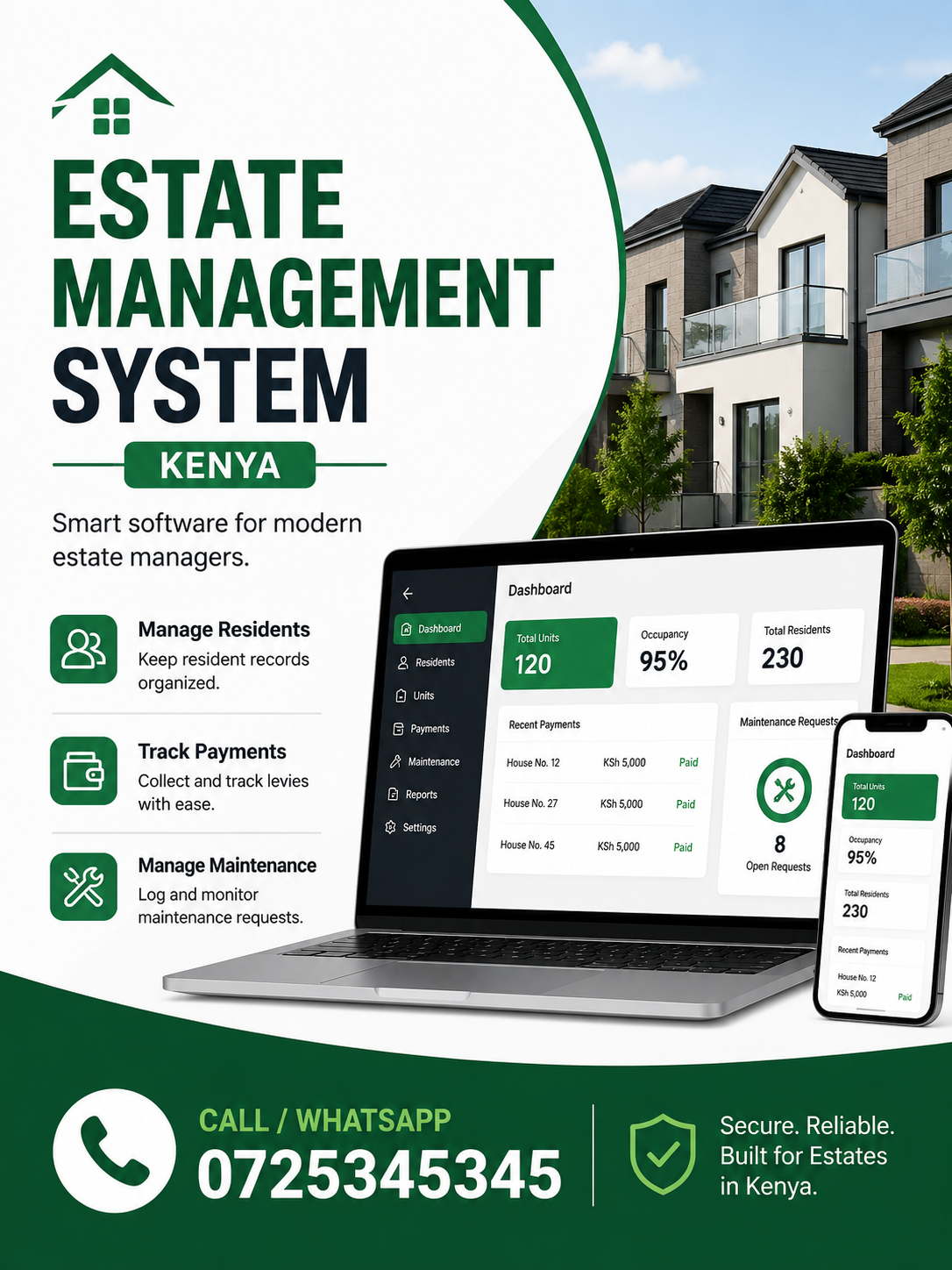
Estate Management System Kenya: Running a Gated Community Without Running Yourself Into the Ground
Estate management system Kenya searches usually start on a bad week. The service charge collection has stalled at sixty per cent, three residents are demanding to know where their money went, and the WhatsApp group has turned into a public inquiry.
That is the shape of estate administration across Nairobi, Kiambu, Machakos and Kajiado. A volunteer committee of people with day jobs is running what amounts to a small utility company, using a spreadsheet and a phone.
The scale is genuinely underestimated. A 120-unit estate charging six thousand shillings a month is administering eight and a half million shillings a year, plus a borehole, a generator, four guards, garbage collection and a gate that opens two hundred times a day.
An estate management system Kenya committees can actually operate turns that from an act of endurance into an administrative process. Not because it does the work, but because it makes the work visible and repeatable.
This guide covers service charge billing and arrears, budgets and sinking funds, gate access and visitor management, security operations, maintenance workflows, utility billing, resident communication, committee governance and the legal framework under the Sectional Properties Act.
It is written for the people who will actually make the decision — the chairperson, the treasurer, the estate manager, and the resident who got volunteered onto the committee and now cannot get off it.
If you take one thing from it: the value of an estate management system Kenya lies in what residents can see for themselves, not in what the committee can record. Transparency ends more disputes than enforcement ever will, and choosing an estate management system Kenya on back-office features while ignoring the resident view is the most common expensive mistake.
What an estate management system actually covers
The term is used loosely, so it helps to draw the boundaries before comparing products.
At minimum the category handles five things: who lives here, what they owe, what the estate owns and maintains, who comes through the gate, and what the committee has decided.
Service charge billing is the obvious core, and it is where most products start. Invoicing, collection, receipting, arrears tracking and statements.
Access control is the second pillar and the one Kenyan estates care about most in practice. Resident verification, visitor authorisation, delivery handling and the gate log itself.
Maintenance is the third — work orders, contractor management, planned servicing and the record of what was fixed and when. A capable estate management system Kenya links a repair back to the budget line that funded it.
Communication wraps around everything. Notices, water interruption alerts, AGM invitations and the complaint channel that keeps issues out of the WhatsApp group.
Governance sits underneath — committee decisions, resolutions, meeting records, budget approvals and the audit trail that protects volunteers from accusations.
The framing that works with committees is this: you are not buying billing software. You are buying a defensible record of how the estate’s money was spent and who decided to spend it that way, and a good estate management system Kenya proves its value at handover and at the AGM.
Why manual estate administration fails
Committees are not careless. They are overwhelmed by a volume of small administrative tasks that grows faster than volunteer capacity ever can.
Consider a hundred-unit estate. That is a hundred monthly invoices, a hundred payment reconciliations, thirty or forty maintenance requests, hundreds of gate entries, and a dozen resident queries. Every month, unpaid.
Reconciliation is the first thing to break. Payments arrive by paybill, by bank transfer, by cash at the office and occasionally to the treasurer’s personal number, and matching them to units by hand is genuinely hard work.
Arrears become invisible next. Nobody can say precisely who owes what without a two-hour reconstruction, so enforcement becomes arbitrary and resentment follows. An estate management system Kenya makes the arrears position a report rather than a research project.
The gate log degrades third. A physical visitor book fills up, gets replaced, and the old one goes into a store. When an incident happens, nobody can retrieve anything useful.
Then there is the handover problem. A committee serves two years and hands over to the next one with a laptop, a WhatsApp group and a great deal of undocumented knowledge.
Records vanish entirely at that point. The new treasurer inherits balances they cannot verify and disputes they cannot adjudicate, which is precisely the gap an estate management system Kenya is meant to close.
Finally, volunteer burnout. The treasurer spending fifteen hours a month on reconciliation eventually resigns, and finding a replacement is harder each time.
Service charge billing and collection
Service charge is the estate’s revenue, and how you bill it determines how much of it you actually collect.
Start with a clean unit register. Unit number, size or share, owner, occupant if different, contact details, and status — owner-occupied, tenanted or vacant.
The owner-tenant distinction matters more than committees expect. The service charge obligation usually sits with the owner, but the person on site is the tenant, and both need to be in the system with different permissions.
Billing should generate automatically on a schedule, with the charge derived from unit size or share where your rules apply it that way. Manual invoicing at a hundred units is a wasted evening every month.
Automated invoicing is where an estate management system Kenya starts paying for itself immediately, because it removes a recurring task rather than merely improving one.
Payment channels matter enormously here. A dedicated estate paybill with unit number as the account reference means most payments reconcile automatically without anyone typing.
Push-to-pay is worth having for collection drives, since it eliminates the wrong-reference problem that generates most of your unmatched payments.
Receipting should be instant and automatic. A resident who pays and receives nothing back assumes the payment was lost, and that assumption produces a phone call to the treasurer.
Statements should be self-service. Every owner and tenant should see their own account on a phone without asking anyone, and an estate management system Kenya that keeps balances locked in the office is generating avoidable work.
Arrears, enforcement and the awkward conversation
Arrears are the single hardest part of estate administration, because the defaulter is your neighbour and you will see them at the gate tomorrow.
Automation is what makes enforcement tolerable. When reminders, late fees and escalation happen by rule rather than by a person’s decision, nobody has to be the villain.
Define the escalation ladder in your rules: reminder at seven days, second notice at thirty, late fee applied, committee letter at sixty, and formal action at ninety.
An estate management system Kenya should track which stage each account has reached and trigger the next step automatically rather than depending on someone remembering.
Ageing analysis is the report the committee needs monthly. Current, one to thirty days, thirty-one to sixty, sixty-one to ninety, and over ninety, with totals.
Watch the trend, not just the level. A collection rate sliding from ninety-two per cent to seventy-eight over two quarters is a governance problem forming, and it is far cheaper to address early.
Concentration matters too. If a third of your arrears sits with two units, that is a different problem from arrears spread thinly across forty, and a decent estate management system Kenya shows you which situation you are in.
Payment plans deserve a proper workflow. Residents in genuine difficulty should be able to agree a schedule that the system tracks, rather than a verbal arrangement the next committee knows nothing about.
Legal escalation should be a documented last step with every prior notice retrievable. Advocates ask for the paper trail, and estates that cannot produce one lose cases they should win.
Budgets, reserves and the sinking fund
Most Kenyan estates budget poorly, which is why service charge increases always feel arbitrary to residents.
An annual budget need not be complex. Expected income, planned expenditure by category, and a contribution to reserves is enough to change how the estate is run.
Categories should be few and stable: security, water, garbage, electricity for common areas, landscaping, cleaning, repairs, insurance, management fees, professional fees and reserves.
Budget versus actual reporting monthly is where the discipline lives, and an estate management system Kenya that cannot produce that comparison is missing the core of financial control.
The sinking fund is the thing estates most often neglect and most regret neglecting. Boreholes fail, generators need replacing, tarmac needs resurfacing, and lifts need overhauls.
Fund it deliberately as a monthly line rather than raising a special levy in a panic when the pump dies. Special levies generate more resident anger than any other single event.
Reserve reporting should be visible to residents continuously. People pay more willingly into a fund whose balance and purpose they can see.
Procurement records belong in the same place. Three quotations, the committee decision, the contract and the invoices, attached to the expenditure they justify. That is what protects a volunteer committee from accusations, and an estate management system Kenya that stores the decision alongside the payment makes the protection automatic.
Gate access and visitor management in an estate management system Kenya
Access control is where residents feel the system daily, and it is the feature that determines whether they think it works.
Start with resident verification. Guards need to know who lives in unit 47 and what vehicles belong there, without relying on recognition and memory.
Visitor pre-authorisation is the transformative feature. A resident expecting a guest generates a code in advance, the guest presents it at the gate, and entry takes fifteen seconds.
That single capability removes the queue at the gate on a Sunday afternoon, and it is the thing residents notice first about a new estate management system Kenya.
Deliveries need their own handling. Boda riders, online shopping and food deliveries arrive constantly, and a system that treats each as a formal visitor creates a bottleneck.
The delivery workflow should be light — capture the rider, the unit, the time, notify the resident, and let them approve from their phone without going to the gate.
Contractor and domestic staff access is the third category. Regular workers need repeat access without daily re-authorisation, with a record of who authorised them and until when.
The gate log itself is the output that matters. Searchable by date, unit, name, vehicle and visitor type, retained for a defined period, and retrievable in minutes when something happens.
Physical infrastructure integration varies widely. Some estates run boom barriers, RFID tags, number plate recognition or biometric readers, and any estate management system Kenya you consider should state plainly what it integrates with rather than implying it works with everything.
Security operations and incident records
Security is the reason most Kenyan estates have a committee at all, and it is administered far more loosely than it should be.
Guard shift records belong in the system. Who was on duty, from when, at which post, and who signed them in.
Patrol logging turns an assumption into a record. Whether by checkpoint scan or timed entry, the estate should know that patrols actually happened rather than assuming.
Incident reporting needs structure: what happened, when, where, who was involved, what action was taken, and what follow-up is outstanding.
An estate management system Kenya that holds incident history lets the committee spot patterns — the same gate at the same hour, a recurring vehicle, a pattern of attempted entries.
Escalation contacts should be in the system rather than on a laminated card at the gate. Committee numbers, the security company, the local police post, the ambulance service.
Handover between shifts is where information is lost. A structured shift handover note, recorded rather than verbal, keeps continuity across a twenty-four hour operation.
Guard company performance becomes measurable once incidents and patrols are logged. Estates renewing a security contract without any performance data are negotiating blind.
CCTV footage requests need a process too — who may request it, who approves, what is released and to whom. Reliable estate management system Kenya records the request and the approval rather than leaving it to an informal arrangement with the guard supervisor.
Maintenance, work orders and contractors
Maintenance is where estates lose money quietly, through work that is duplicated, forgotten, or paid for twice.
Residents should be able to report a fault from their phone, with a photograph, and receive a reference number. That alone removes a large share of committee phone calls.
The work order should then move through states — logged, assigned, in progress, completed, verified — with each transition timestamped.
Assignment matters. Whether the job goes to the in-house handyman, a contracted plumber or a specialist, the record should show who was assigned and when they responded.
Response and resolution times become measurable once this exists, and an estate management system Kenya that reports average resolution time gives the committee something concrete to manage.
Planned preventive maintenance is the discipline that saves the most money. Generator servicing, borehole pump checks, gutter clearing before the long rains, fire extinguisher inspection, lift servicing.
Schedule these annually and let the system raise the work orders automatically. Estates that wait for failure pay two to three times as much as estates that service on schedule.
Contractor records belong alongside — contact details, scope, rates, contract dates, insurance status and performance history.
Cost should attach to the work order and roll up to the budget line. That is what lets the committee answer why repairs ran forty per cent over budget, and a well-configured estate management system Kenya makes that answer available without a reconstruction exercise.
Utilities: water, garbage and common power
Utilities are the largest variable cost in most Kenyan estates and the most common source of billing disputes.
Water is the difficult one. Estates on borehole supply, county supply, or a mix, with or without individual unit meters, all bill differently.
Where units are metered, the system should record readings, compute consumption, apply the tariff and bill it alongside service charge. Manual meter billing at a hundred units is a monthly ordeal.
Reading capture should work on a phone at the meter, with the previous reading visible so obvious errors are caught on the spot. That is a small feature that saves an estate management system Kenya implementation from constant billing corrections.
Unaccounted-for water is the metric estates should watch and rarely do — the gap between what the borehole or mains delivered and what unit meters recorded. A widening gap means leaks.
Garbage collection is usually a flat contracted cost, but the contract, the schedule and the missed-collection log should still live somewhere retrievable.
Common area electricity — lighting, pumps, the gate motor, CCTV — should be tracked as its own budget line, because a sudden rise usually means a fault rather than a tariff change.
Generator fuel and running hours deserve their own record, since fuel is a classic leakage point in estate operations.
Prepaid token management, where the estate handles tokens for common meters, needs recording too. An estate management system Kenya that tracks purchases against consumption makes discrepancies visible early.
Communication that keeps issues out of the WhatsApp group
The estate WhatsApp group is where good communication goes to die, and replacing it is one of the clearest wins available.
The problem is not the platform. It is that announcements, complaints, disputes, marketplace posts and political arguments all occupy the same thread.
Broadcast notices should go out through the system — water interruption, road works, AGM notice, security alert — reaching every resident by SMS or app rather than only those still in the group.
Targeted messaging matters as well. A notice affecting one block should not go to the entire estate, and an estate management system Kenya with segment targeting reduces notification fatigue considerably.
Complaints should have their own channel with a reference number and a visible status. A resident who can see their complaint is assigned and in progress stops reposting it.
Document access removes another category of question entirely. The budget, the AGM minutes, the estate rules and the audited accounts should be available to residents on demand.
Acknowledgement tracking is useful for important notices. Knowing that seventy of a hundred units opened the AGM notice tells you whether to send it again.
Emergency broadcast is the capability you hope never to use. Fire, security incident, water contamination — a message reaching every resident in under a minute is worth having.
Keep the WhatsApp group for neighbourliness and move the official business into the system. Estates that do this find the group becomes pleasant again, and the estate management system Kenya becomes the place residents go for anything that matters.
Committee governance, AGMs and protecting volunteers
Committee members are volunteers exposed to accusations they usually cannot disprove, and governance records are what protect them.
Meeting management should be structured — notice, agenda, attendance, quorum confirmation, minutes and resolutions with proposer and seconder recorded.
Every financial decision should link to the resolution that authorised it. When a resident asks in 2029 why the estate spent two million on the borehole, the minute should be one click from the payment.
Approval thresholds should be tiered and enforced. Small expenditure needs the treasurer and one signatory; large expenditure needs the full committee; anything above a ceiling needs a general meeting.
An estate management system Kenya that enforces those thresholds protects the committee from both temptation and suspicion, which is a genuine service to volunteers.
Conflict of interest declarations belong on record. When a committee member’s relative bids for the landscaping contract, that relationship should be documented before the vote.
AGM preparation is where the system earns its keep annually. Audited accounts, budget proposal, arrears summary, committee report and election materials, produced from data the system already holds.
Proxy and voting management matters at estates where attendance is thin. Digital proxies with a verifiable record prevent the disputes that follow contested elections.
Handover should be a permissions change rather than a knowledge transfer. That is only true if the reasoning lived in the estate management system Kenya from the start rather than in the outgoing treasurer’s head.
The legal framework and what your system must respect
Estate administration in Kenya sits within a legal framework that many committees operate inside without ever having read.
The Sectional Properties Act, 2020 governs subdivided developments, replacing the older 1987 regime, and it established requirements around corporations, unit registration and management of common property.
Under it, unit owners generally form a corporation responsible for common property, with a constitution and by-laws. Your estate management system Kenya should mirror those by-laws rather than imposing a generic structure.
Many older estates operate instead as resident associations or management companies limited by guarantee, and the governance requirements differ accordingly.
Service charge apportionment is often set by unit factor or share, and the basis matters legally. Billing every unit equally when your by-laws specify apportionment by size is a challengeable practice.
Reserve and sinking fund obligations may apply depending on your structure, and an estate with no reserve facing a major failure has a governance problem as well as a financial one.
Record retention of at least seven years applies to financial records. Cloud storage handles this far more reliably than a cupboard in the estate office.
Audit requirements vary by structure. Many estates commission an annual audit voluntarily, and clean exportable records from an estate management system Kenya reduce the fee substantially.
I am not a lawyer, and estate structures in Kenya vary considerably. Take advice from an advocate on your specific arrangement rather than assuming the estate down the road has it right.
Developer handover and taking over your own estate
Handover from developer to residents is one of the messiest moments in an estate’s life, and preparation makes an enormous difference.
The developer usually manages the estate initially, then transfers to a residents’ corporation or association at a defined point.
What should transfer: the unit register, service charge accounts and balances, the reserve fund, as-built drawings, equipment manuals and warranties, contractor agreements, utility accounts and any outstanding liabilities.
What actually transfers is often a spreadsheet and a set of keys. Estates that specify the handover pack in advance get far more of it.
Loading that history into an estate management system Kenya at handover is the cleanest possible starting point, because every balance is agreed at a single cut-off date.
Defect liability periods matter here. Structural and systems defects within the liability window are the developer’s responsibility, and estates that fail to log defects promptly lose the claim.
Log every defect with photographs and dates from day one, and an estate management system Kenya with a maintenance module gives you exactly the evidence base a defect claim requires.
Where handover has already happened badly, reconstruct what you can and agree an opening position at a general meeting rather than carrying disputed balances forward indefinitely.
Data protection, access and security
An estate system holds unusually sensitive material: identity details, vehicle registrations, movement patterns, financial histories and visitor records.
Under Kenya’s Data Protection Act, 2019, the estate corporation or association is a data controller with real obligations.
Collect only what you need, tell residents what you hold and why, secure it, and retain it only as long as there is a lawful basis.
Gate log data deserves specific thought. A record of everyone entering and leaving is genuinely sensitive, and an estate management system Kenya should restrict access to it rather than making it browsable by any committee member.
Ask vendors where data is hosted, whether it is encrypted in transit and at rest, whether they are registered with the Office of the Data Protection Commissioner, and how they handle a breach.
Role-based access is essential. Guards, the estate manager, committee members, owners and tenants should each see very different things.
Shared logins destroy accountability entirely and are common at the gate specifically. Every guard on shift should be identifiable in the log, and an estate management system Kenya with per-guard credentials makes that possible.
Access review should happen at every committee change, revoking outgoing members promptly rather than leaving accounts active indefinitely.
Backups need specifics rather than reassurance — frequency, location, retention, and whether a restore has ever actually been tested.
Choosing an estate management system Kenya that fits
Do not start with demos. Start with your by-laws and your budget, because together they define what the product must express.
Write the requirements down: billing basis and apportionment, payment channels, arrears escalation, budget categories, access control workflows, maintenance process and reporting needs.
Then score candidates against that written list rather than against their feature page. Vendors demo their strengths; your list surfaces their gaps.
Run five scenarios in every demo. A visitor pre-authorised by a tenant. A meter reading captured and billed. A maintenance request from logging to verified completion. A resident on a payment plan. An owner-tenant account where the owner pays.
Any estate management system Kenya that stumbles on those five will stumble in your second year, whatever the dashboard looks like.
Test the resident experience separately from the committee experience. Give three residents access with no instruction and see whether they find their balance and raise a maintenance request unaided.
Test the guard experience too, and this is the one committees skip. A gate interface that a guard on a night shift cannot operate quickly will be abandoned within a month.
Interrogate support: response times, channel, whether it is local, and whether anybody answers at 9pm when the gate system fails.
Check export rights in writing and test them during the trial. An estate management system Kenya provider reluctant to commit contractually has told you something worth hearing.
Pricing and what estates actually pay
Headline pricing is rarely the real number, so understand the models before comparing.
Per-unit per-month is the most common structure and usually fairest. Predictable, scales with the estate, and easy to build into the service charge.
Flat subscription banded by estate size. Better value for larger estates, poor value for small ones under thirty units.
Module-based pricing where billing, access control and maintenance are charged separately. Model the full stack rather than the entry module.
Transaction fees on service charge collections, layered on top of the mobile money tariff. On a hundred units billing monthly this compounds, so calculate it annually before signing.
Hardware is the cost estates most often forget. Boom barriers, RFID readers, tablets for the gate, number plate cameras and network infrastructure are frequently larger than the software subscription.
Ask explicitly about setup, data migration, training, SMS bundles, extra admin seats and support tiers. Quotes for an estate management system Kenya should be all-in and written down.
Fund it as a budget line approved at the AGM rather than absorbing it silently. Residents accept costs they voted for.
Compare against the alternative honestly. A single year at seventy per cent collection instead of ninety typically costs a hundred-unit estate far more than a decade of subscription to an estate management system Kenya.
Implementing an estate management system Kenya in six weeks
Estates take longer than chamas to implement because there is hardware and there are guards to train. Six weeks is realistic.
Week one — decide and mandate. Present at a committee meeting or AGM, approve the budget line, minute the resolution, and appoint two people to run it rather than the treasurer alone.
Week one — clean the unit register. Every unit, owner, tenant, contact details and current balance, agreed and verified before anything is loaded.
Week two — agree opening balances. Resolve disputed arrears now rather than migrating them. A contested figure loaded into the system stays contested permanently.
Week two — configure. Billing basis and apportionment, payment channels, arrears escalation, budget categories, access rules and approval thresholds, mirroring your by-laws exactly.
Week three — load history and set up collections. Balances, arrears, payment plans, contractor records and asset register, with a second person verifying independently.
Week three — install and test hardware. Gate devices, readers and network, tested under real conditions including a power cut and a busy Sunday afternoon.
Week four — train the guards. This is the step estates underinvest in and it determines whether access control survives. Train every guard on every shift, then train them again.
Week five — parallel run. Operate old and new records together for one full billing cycle and reconcile at month end. Discrepancies found now are cheap.
Week five — onboard residents. Invitations, a physical session at a residents’ meeting, and a walkthrough of checking a balance and pre-authorising a visitor. Expect to help a third personally.
Week six — go live. Announce the new paybill reference, stop accepting payments to personal numbers, and put a monthly system review on the committee agenda from the first meeting.
Budget forty to sixty hours of committee time for a hundred-unit estate. Estates that allocate it succeed; estates that squeeze it into evenings end up running a half-configured estate management system Kenya alongside the spreadsheet they meant to retire.
Why estate systems fail after six months
The software rarely fails. The routine around it does, and the collapse follows a recognisable pattern.
The guards revert. Under pressure at a busy gate, guards go back to the visitor book because it is faster, and within a month the digital log is worthless.
Residents never onboard. If only the committee uses it, the estate has bought an expensive spreadsheet and none of the transparency benefit.
Payments drift back to personal numbers. This single habit undoes automated reconciliation entirely and must be policed firmly.
The committee changes. New members were not part of the decision, do not know the system, and quietly revert to what they understand.
Reports go unread. The monthly financial item drops off the agenda when meetings run long, and nobody notices the collection rate sliding.
Maintenance requests go around it. Residents phone the chairperson directly because it is easier, and the work order log stops reflecting reality.
What sustains it is structural rather than motivational. Fix the agenda item, refuse to act on maintenance requests made informally, retrain guards quarterly, and make the system part of committee handover rather than an optional tool.
An estate management system Kenya that survives its first committee transition usually survives indefinitely, and the transition is the moment to invest attention.
Frequently asked questions
How small an estate is too small for this?
Below about twenty-five units, a well-kept spreadsheet with monthly statements circulated to residents is honest and adequate. The case strengthens sharply once you pass fifty.
Does the owner or the tenant pay service charge?
Usually the owner, though many arrangements pass it to the tenant contractually. Your system needs both parties on the account with different permissions and different visibility.
Can it work if our gate has no hardware?
Yes. Visitor pre-authorisation and digital gate logging work on a tablet or phone alone, and hardware can be added later once the process is established.
What about residents without smartphones?
SMS notices, SMS statements and a guard who can look up a unit on request cover them. Nobody should be excluded from an estate management system Kenya by their handset.
How do we handle a disputed arrears balance during migration?
Resolve it at a general meeting and minute the agreed figure before loading. Migrating a contested balance preserves the dispute rather than settling it.
Will this improve our collection rate?
Usually, yes — automated invoicing, instant receipting, visible statements and systematic reminders together typically lift collection meaningfully. It will not make an unwilling payer willing.
Do we still need a property manager?
For larger estates, generally yes. The role shifts from administration to supervision and resident relations, which is where a manager adds most value.
What happens if the vendor closes?
Contractual export rights, tested during your trial, plus your own quarterly export. Never rely on vendor stability alone.
Is the gate log a data protection risk?
It is sensitive data and should be treated as such — restricted access, defined retention, and a documented purpose. Confirm your estate management system Kenya vendor is registered with the ODPC.
What is the single biggest mistake estates make?
Skipping guard training. The gate is where residents experience the system daily, and an estate management system Kenya that guards cannot operate quickly gets abandoned regardless of how good the back office is.
Estate management system Kenya
Estate management system Kenya
Estate management system Kenya
Estate management system Kenya
Estate management system Kenya
Estate management system Kenya
Estate management system Kenya