
Estate System Definition: Understanding the Future of Property Management
If you’ve been searching for the estate system definition, you’re likely looking to understand what an estate system is, how it works, and why thousands of property owners and real estate companies are embracing digital solutions. In today’s competitive property market, manually managing apartments, rentals, commercial buildings, and gated communities is becoming increasingly difficult. This is why an estate management system has become an essential tool for landlords, property managers, SACCOs, developers, and real estate agencies.
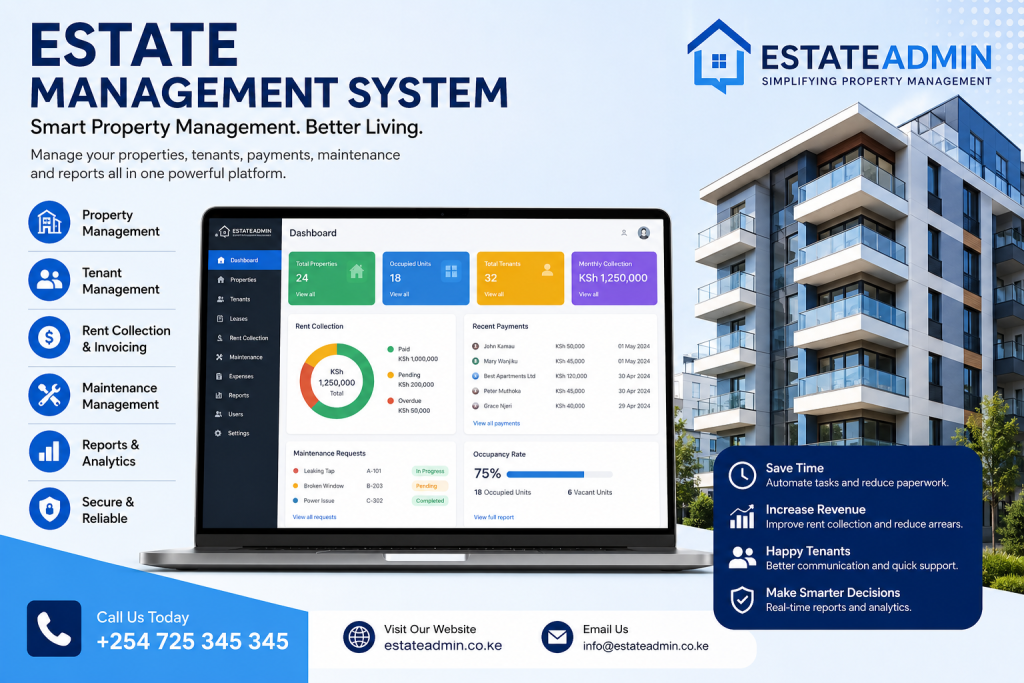
At EstateAdmin, we provide a powerful cloud-based estate management solution designed specifically for the Kenyan real estate market. Visit estateadmin.co.ke or call +254 725 345 345 to learn how your property business can become more efficient, profitable, and organized.
What Is an Estate System?
The simplest estate system definition is:
An estate system is a computerized software platform that helps property owners, landlords, estate managers, and real estate companies manage their properties, tenants, finances, maintenance requests, leases, and reports from one centralized dashboard.
Instead of relying on notebooks, spreadsheets, paperwork, or multiple disconnected applications, an estate system automates everyday property management tasks.
Whether you manage:
- Residential apartments
- Commercial buildings
- Office complexes
- Student hostels
- Mixed-use developments
- Rental houses
- Gated communities
- Shopping centres
an estate management system provides a single source of truth for all your operations.
Estate System Definition in Property Management
When discussing property management, the estate system definition extends beyond simple record keeping.
It includes the complete digital management of:
- Tenant records
- Rent collection
- Property information
- Maintenance scheduling
- Financial accounting
- Utility billing
- Occupancy monitoring
- Lease agreements
- Security records
- Owner reports
Modern estate systems eliminate repetitive administrative work while improving transparency and accountability.
Why Estate Systems Have Become Essential
Property portfolios continue growing across Kenya. Managing multiple properties manually creates several challenges:
- Missed rent payments
- Lost tenant files
- Poor maintenance tracking
- Financial inaccuracies
- Delayed reporting
- Human errors
- Time-consuming paperwork
- Communication breakdown
An estate management system solves these problems through automation.
Instead of chasing paperwork, property managers focus on growing their businesses.
Key Components of an Estate System
Understanding the estate system definition requires knowing the major components that make the software effective.
1. Property Management Module
Every property is stored digitally, including:
- Property name
- Location
- Unit numbers
- Building type
- Number of floors
- Amenities
- Ownership details
Managers can instantly retrieve any property information.
2. Tenant Management
Tenant records include:
- Full names
- ID numbers
- Phone numbers
- Email addresses
- Occupation
- Emergency contacts
- Lease agreements
- Payment history
Instead of filing cabinets, everything becomes searchable within seconds.
3. Rent Collection
One of the biggest features of an estate management system is automated rent collection.
The system records:
- Monthly rent
- Outstanding balances
- Partial payments
- Late payments
- Penalties
- Receipts
Property managers can immediately identify tenants with pending balances.
4. Lease Management
Lease agreements are securely stored.
The system reminds managers about:
- Lease renewals
- Contract expiry
- Notice periods
- Rent reviews
This prevents missed renewals and vacant units.
5. Maintenance Management
Tenants can report issues including:
- Plumbing
- Electrical faults
- Broken doors
- Water leaks
- Internet issues
- Security concerns
Managers assign technicians, monitor progress, and close completed jobs.
6. Financial Reporting
Financial reports include:
- Rental income
- Expenses
- Cash flow
- Profit analysis
- Occupancy reports
- Collection summaries
These reports support better decision-making.
Estate System Definition Compared to Manual Management
Traditional property management depends heavily on paper records.
Manual methods often lead to:
- Lost receipts
- Duplicate entries
- Delayed reports
- Forgotten maintenance
- Missing lease files
- Accounting mistakes
By comparison, an estate system centralizes all information in one secure platform.
This improves efficiency, reduces costs, and enhances customer service.
Who Needs an Estate System?
Many people assume estate software is only suitable for large companies.
In reality, almost anyone managing rental property benefits.
Examples include:
Individual Landlords
Even landlords with five rental houses can automate rent tracking.
Property Management Companies
Managing hundreds of tenants becomes significantly easier.
Real Estate Developers
Developers oversee sales, rentals, occupancy, and customer records.
Housing Cooperatives
Estate systems simplify member management and property allocation.
SACCOs
Housing SACCOs can monitor property investments efficiently.
Commercial Property Owners
Office buildings require organized tenant management.
Mixed-Use Developments
Retail and residential properties can be managed within one system.
Features Found in a Modern Estate Management System
A professional estate management system typically includes:
- Tenant registration
- Property database
- Rent invoicing
- Online payments
- Automatic receipts
- Utility billing
- SMS reminders
- Email notifications
- Financial accounting
- Vacancy tracking
- Expense management
- Document storage
- Maintenance tickets
- Owner reporting
- Audit trails
- User permissions
- Mobile accessibility
- Cloud backups
These features work together to streamline operations.
Benefits of Using an Estate System
Understanding the estate system definition also means understanding the benefits.
Improved Efficiency
Routine administrative work becomes automated.
Managers spend less time entering data and more time serving clients.
Better Financial Management
Income and expenses are accurately recorded.
Managers generate reports instantly instead of preparing them manually.
Reduced Errors
Automation minimizes human mistakes.
Duplicate records and calculation errors become rare.
Faster Rent Collection
Automatic reminders encourage timely payments.
Property owners improve cash flow.
Improved Tenant Satisfaction
Tenants appreciate:
- Faster responses
- Online payment options
- Maintenance tracking
- Better communication
Happy tenants often stay longer.
Better Decision Making
Real-time reports help owners answer questions like:
- Which property generates the highest income?
- Which units remain vacant longest?
- What are maintenance costs?
- Which tenants consistently pay late?
Data-driven decisions improve profitability.
Estate Systems in Kenya
Kenya’s real estate industry continues expanding rapidly.
Developers are constructing:
- Apartments
- Affordable housing
- Office parks
- Shopping malls
- Student accommodation
- Mixed-use developments
Managing these investments manually is increasingly impractical.
Modern estate systems support:
- Mobile money integration
- Digital receipts
- Tenant communication
- Multi-property management
- Cloud accessibility
These capabilities align with the needs of today’s property businesses.
Cloud-Based Estate Systems
Modern software is cloud-based rather than installed on a single office computer.
Advantages include:
- Access from anywhere
- Automatic backups
- Enhanced security
- Real-time updates
- Multi-user access
- Lower maintenance costs
Property managers can monitor operations even while travelling.
Security in Estate Management Systems
Property information is highly valuable.
Professional estate software protects data through:
- Password authentication
- Role-based permissions
- Secure cloud storage
- Regular backups
- Activity logs
- Data encryption
Only authorized personnel can access sensitive information.
How an Estate System Improves Communication
Communication is one of the most overlooked aspects of property management.
An estate management system enables managers to communicate efficiently with tenants through:
- Payment reminders
- Maintenance updates
- Lease renewal notices
- General announcements
- Utility billing notifications
This reduces misunderstandings while strengthening tenant relationships.
Common Problems Solved by Estate Systems
Businesses adopting estate management software often eliminate problems such as:
- Missing rent records
- Delayed payments
- Lost tenancy agreements
- Manual calculations
- Poor maintenance follow-up
- Duplicate tenant records
- Slow reporting
- Disorganized financial records
- Poor communication
- Limited accountability
Automation transforms these challenges into manageable workflows.
Why EstateAdmin Is the Smart Choice
Choosing the right software is just as important as understanding the estate system definition.
EstateAdmin provides an all-in-one estate management solution built for property owners, estate managers, developers, and agencies across Kenya.
Our platform offers:
- Easy property registration
- Tenant management
- Automated rent tracking
- Maintenance management
- Financial reporting
- Secure cloud storage
- Multi-user access
- Fast implementation
- Professional customer support
- Affordable pricing
Whether you manage ten units or thousands, EstateAdmin scales with your business.
Visit estateadmin.co.ke or contact +254 725 345 345 to schedule a demonstration and discover how digital estate management can transform your operations.
Why the Estate System Definition Matters for Every Property Owner
Understanding the estate system definition is more important today than ever before. The estate system definition explains how modern technology helps property owners replace manual processes with digital workflows that improve efficiency, transparency, and profitability. Whether you own apartments, rental houses, commercial buildings, or mixed-use developments, knowing the estate system definition enables you to make informed decisions when investing in an estate management system.
A complete estate system definition goes beyond simply describing software. It explains how an estate management system integrates tenant management, rent collection, maintenance scheduling, accounting, reporting, and communication into one centralized platform. As the real estate industry becomes increasingly competitive, understanding the estate system definition helps landlords and property managers appreciate why digital transformation is no longer optional.
Many landlords initially search for the estate system definition because they want to understand how technology can simplify property management. Once they understand the estate system definition, they quickly realize that an estate management system reduces paperwork, improves accountability, and provides real-time visibility into every aspect of their business.
Estate System Definition and Business Growth
The estate system definition is closely connected to business growth. Every successful property business requires accurate records, efficient rent collection, excellent tenant communication, and reliable financial reporting. An estate management system brings all these functions together, allowing property owners to focus on expanding their investments instead of handling repetitive administrative work.
When businesses fully understand the estate system definition, they discover that modern estate management software supports sustainable growth by automating routine processes, reducing operational costs, and improving customer satisfaction.
An effective estate management system allows businesses to:
- Manage multiple properties simultaneously.
- Track tenant information accurately.
- Generate financial reports instantly.
- Monitor occupancy rates.
- Reduce rent arrears.
- Improve maintenance response times.
- Increase operational efficiency.
These benefits demonstrate why understanding the estate system definition is essential for both new and experienced property investors.
Estate System Definition and Digital Property Management
The estate system definition has evolved significantly over the past decade. Traditional property management relied on paper files, handwritten receipts, spreadsheets, and manual calculations. Today, the estate system definition includes cloud computing, mobile accessibility, automated billing, online payments, and real-time reporting.
A modern estate management system allows property managers to monitor their business from virtually anywhere. Whether you are in the office, travelling, or managing multiple estates, your entire property portfolio remains accessible through one secure platform.
This modern interpretation of the estate system definition reflects the growing demand for efficiency, transparency, and data-driven decision-making in the real estate industry.
EstateAdmin: Your Trusted Estate Management System
If you have been searching online for the best explanation of the estate system definition, you also need software that puts that definition into practice. EstateAdmin provides a comprehensive estate management system designed specifically for property owners, landlords, developers, and estate managers in Kenya.
EstateAdmin simplifies every stage of property management by providing:
- Complete tenant management.
- Automated rent collection.
- Digital receipt generation.
- Maintenance management.
- Financial reporting.
- Vacancy tracking.
- Lease management.
- Cloud accessibility.
- Multi-user access.
- Secure data storage.
Our estate management system helps property businesses become more organized, efficient, and profitable while reducing manual work and improving customer satisfaction.
Visit estateadmin.co.ke today or call +254 725 345 345 to schedule a demonstration and discover why EstateAdmin is becoming one of Kenya’s preferred estate management systems.
How an Estate Management System Creates Long-Term Value
When discussing the estate system definition, it is important to understand that the value of an estate management system extends far beyond simplifying daily operations. A well-designed estate management system becomes the foundation of a successful property management business by improving operational efficiency, strengthening financial management, and enhancing tenant satisfaction. As more property owners embrace digital transformation, the estate system definition continues to evolve from a simple software description into a complete business management solution.
One of the greatest advantages highlighted in the estate system definition is centralized information management. Instead of maintaining separate files for tenants, lease agreements, maintenance requests, financial transactions, and property details, an estate management system stores everything securely in one platform. This eliminates duplication, reduces paperwork, and ensures that property managers can retrieve information within seconds. Whether managing ten rental units or several hundred apartments, centralized records improve productivity and reduce administrative costs.
Another important aspect of the estate system definition is financial transparency. Every successful property business depends on accurate financial records. An estate management system automatically records rental income, expenses, deposits, utility charges, penalties, and outstanding balances, making financial management easier than ever before. Property owners can generate detailed financial reports at any time, helping them evaluate performance and make informed investment decisions. The ability to monitor income and expenses in real time is one of the main reasons why many investors choose an estate management system over manual record keeping.
The estate system definition also includes improved communication between landlords, property managers, and tenants. Effective communication reduces misunderstandings and creates stronger relationships with tenants. Through an estate management system, managers can send rent reminders, maintenance updates, lease renewal notices, and important announcements using SMS or email notifications. These automated communication tools save time while ensuring tenants remain informed about important property matters.
As property portfolios expand, manual management becomes increasingly challenging. The estate system definition emphasizes scalability, allowing an estate management system to grow alongside your business. Whether you add new apartment blocks, commercial buildings, student hostels, gated communities, or mixed-use developments, the software can accommodate your expanding portfolio without disrupting daily operations. This flexibility makes an estate management system a valuable long-term investment for growing property businesses.
Security is another critical element within the estate system definition. Property businesses manage confidential information such as tenant identification documents, lease contracts, payment records, and financial statements. A professional estate management system protects this data through secure authentication, encrypted storage, automated backups, and user access controls. By restricting access to authorized personnel only, the system minimizes security risks while protecting sensitive information from unauthorized access.
The estate system definition also demonstrates how technology improves decision-making. Modern estate management software provides dashboards and reports that summarize occupancy rates, maintenance costs, rental income, vacancy trends, and tenant payment behavior. Instead of relying on assumptions, property owners can use real-time data to identify opportunities for growth, improve profitability, and address operational challenges before they become serious problems. These insights allow businesses to remain competitive in today’s rapidly evolving real estate market.
In addition, the estate system definition highlights the importance of automation. Repetitive administrative tasks such as generating invoices, issuing receipts, calculating rent balances, tracking maintenance requests, and preparing financial reports are completed automatically by an estate management system. Automation not only reduces human error but also allows employees to focus on customer service, business development, and strategic planning rather than repetitive paperwork.
For landlords, developers, property managers, and real estate companies seeking sustainable growth, understanding the estate system definition is essential. Investing in a reliable estate management system is no longer a luxury—it is a necessity for organizations that want to improve efficiency, reduce operational costs, enhance tenant experiences, and maximize returns on their property investments. By adopting a comprehensive estate management system, businesses position themselves for long-term success while adapting to the changing demands of the modern real estate industry.
Final Thoughts on the Estate System Definition
The estate system definition represents far more than software—it represents a smarter way of managing property. Every landlord, estate manager, property developer, and real estate company can benefit from adopting a modern estate management system. As technology continues to transform the real estate sector, understanding the estate system definition becomes increasingly important for businesses that want to remain competitive.
By implementing a reliable estate management system, property owners gain greater control over their operations, improve tenant satisfaction, enhance financial reporting, and position themselves for long-term success. If you are ready to embrace digital property management, EstateAdmin offers the complete estate management solution you need to manage your properties with confidence.