Real Estate ERP System: The Complete Guide to Streamlining Property Management in Kenya

real estate erp system

If you are searching for the best Real Estate ERP System for your business, you are in the right place. Managing apartments, commercial buildings, gated communities, rental houses, office spaces, and mixed-use developments requires more than spreadsheets and manual records. Modern property managers need a centralized solution that automates operations, improves efficiency, enhances tenant satisfaction, and increases profitability.

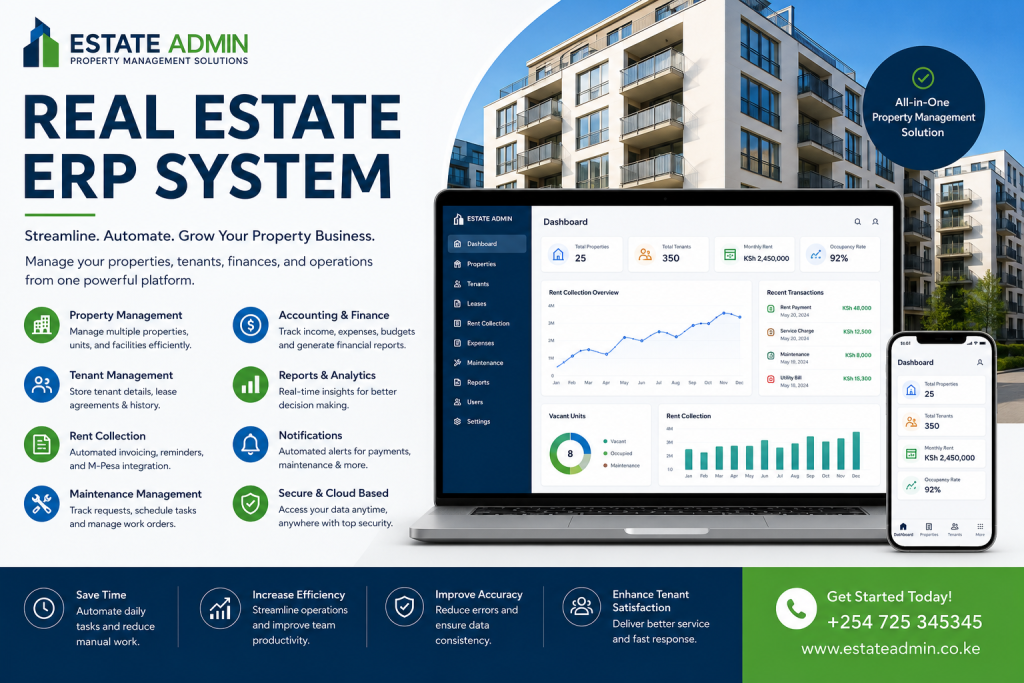
A Real Estate ERP System brings together every aspect of property management into one intelligent platform. From tenant management and rent collection to maintenance requests, accounting, reporting, utility billing, and owner management, an ERP solution transforms how real estate businesses operate.

At Estate Admin, we provide a comprehensive Real Estate ERP System designed specifically for Kenyan property managers, landlords, estate developers, SACCOs, housing companies, and real estate agencies.

Website: https://estateadmin.co.ke
Call/WhatsApp: +254 725 345345


What is a Real Estate ERP System?

A Real Estate ERP System (Enterprise Resource Planning System) is a centralized software platform that integrates every department within a real estate business. Instead of using multiple disconnected systems for accounting, tenant records, maintenance, security, finance, and reporting, everything is managed from one dashboard.

A modern Real Estate ERP System allows property managers to:

  • Manage tenants
  • Track rent payments
  • Generate invoices
  • Monitor vacant units
  • Handle maintenance
  • Manage leases
  • Record expenses
  • Produce financial reports
  • Control staff activities
  • Send tenant notifications
  • Monitor utilities
  • Generate owner statements
  • Automate reminders
  • Track service charges

Everything becomes easier when every department works from one system.


Why Every Real Estate Business Needs a Real Estate ERP System

The property industry has become increasingly competitive. Tenants expect fast responses, landlords demand accurate financial reports, and property managers must oversee hundreds or even thousands of units simultaneously.

Without a Real Estate ERP System, businesses often experience:

  • Missing rent records
  • Lost tenancy agreements
  • Manual calculation errors
  • Delayed maintenance
  • Poor communication
  • Duplicate records
  • Financial inconsistencies
  • Slow reporting
  • Revenue leakage
  • Poor accountability

A professional Real Estate ERP System eliminates these challenges through automation.


Benefits of Using a Real Estate ERP System

1. Centralized Property Management

Instead of storing information across different Excel sheets and notebooks, a Real Estate ERP System keeps every property record in one secure location.

Managers can instantly access:

  • Property details
  • Unit information
  • Tenant history
  • Payment records
  • Lease agreements
  • Utility bills
  • Maintenance history
  • Financial reports

This saves time and improves operational efficiency.


2. Automated Rent Collection

One of the biggest advantages of a Real Estate ERP System is automated rent management.

The system automatically:

  • Generates invoices
  • Sends rent reminders
  • Records payments
  • Tracks overdue rent
  • Produces receipts
  • Calculates balances
  • Generates arrears reports

Property managers spend less time chasing tenants and more time growing their business.


3. Better Financial Management

Financial accuracy is critical in property management.

A quality Real Estate ERP System provides:

  • Income tracking
  • Expense tracking
  • Budget monitoring
  • Profit analysis
  • Cash flow reports
  • Owner statements
  • Bank reconciliation
  • Tax reporting

Everything is available in real time.


Key Features of a Real Estate ERP System

Property Management Module

Manage unlimited:

  • Apartments
  • Estates
  • Commercial buildings
  • Offices
  • Hostels
  • Shopping malls
  • Warehouses
  • Industrial properties

Each property can have unlimited blocks, floors, and units.


Tenant Management

A complete Real Estate ERP System stores detailed tenant information including:

  • Full names
  • National ID
  • Passport
  • Phone number
  • Email
  • Emergency contacts
  • Lease dates
  • Occupancy history
  • Payment records
  • Documents

Managers can retrieve tenant records within seconds.


Lease Management

Managing lease agreements manually often results in missed renewals.

A Real Estate ERP System automates:

  • Lease creation
  • Renewals
  • Expiry alerts
  • Deposits
  • Contract history
  • Rent adjustments

This reduces administrative work significantly.


Vacancy Management

The system instantly shows:

  • Vacant units
  • Occupied units
  • Reserved units
  • Under maintenance units

Property managers can quickly identify available units and improve occupancy rates.


Accounting Integration

Accounting is one of the strongest features of a Real Estate ERP System.

The software manages:

  • Rent income
  • Utility charges
  • Service charges
  • Maintenance costs
  • Payroll expenses
  • Petty cash
  • Vendor payments
  • Bank transactions

This provides complete financial visibility.


Utility Billing Management

Managing utilities manually is time-consuming.

A modern Real Estate ERP System automates billing for:

  • Water
  • Electricity
  • Garbage collection
  • Security
  • Parking
  • Internet
  • Service charge

Bills are generated automatically based on configured rules.


Maintenance Management

Maintenance directly affects tenant satisfaction.

A Real Estate ERP System allows tenants or managers to log maintenance requests that are assigned to technicians for resolution.

The maintenance module includes:

  • Work orders
  • Technician assignment
  • Progress tracking
  • Completion reports
  • Maintenance costs
  • Service history

This ensures repairs are handled efficiently.


Owner Management

Property owners need transparency.

A Real Estate ERP System automatically generates:

  • Monthly statements
  • Income reports
  • Expense summaries
  • Vacancy reports
  • Occupancy reports
  • Maintenance expenses

Owners can monitor property performance without requesting manual reports.


Real-Time Reporting

One of the greatest strengths of a Real Estate ERP System is reporting.

Managers can generate reports such as:

  • Rent collection reports
  • Occupancy reports
  • Vacancy reports
  • Income statements
  • Expense reports
  • Tenant reports
  • Lease reports
  • Utility reports
  • Maintenance reports
  • Staff performance reports

Reports are available instantly.


Mobile Accessibility

Modern property managers are always on the move.

A cloud-based Real Estate ERP System allows users to access their dashboard from:

  • Desktop
  • Laptop
  • Tablet
  • Smartphone

This enables property management from anywhere.


Security and User Permissions

Data security is essential.

Our Real Estate ERP System includes:

  • Role-based access
  • Secure login
  • Activity logs
  • Password protection
  • Backup management
  • Audit trails

Each employee only accesses the information relevant to their role.


Who Needs a Real Estate ERP System?

A Real Estate ERP System is ideal for:

  • Property management companies
  • Landlords
  • Estate developers
  • Housing cooperatives
  • SACCOs
  • Apartment owners
  • Commercial property managers
  • Facility management firms
  • Shopping mall operators
  • Student hostels
  • Hotels with rental units
  • Mixed-use developments

Whether managing 20 units or 20,000 units, the software scales with your business.


Why Choose Estate Admin Real Estate ERP System?

Estate Admin has developed a robust Real Estate ERP System tailored for the Kenyan market. Our solution is built to simplify property operations while giving managers complete visibility into every aspect of their business.

With Estate Admin, you benefit from:

  • Comprehensive property management tools
  • Automated rent and utility billing
  • Powerful financial reporting
  • Secure cloud access
  • User-friendly interface
  • Scalable architecture for businesses of all sizes
  • Dedicated customer support and training

Our goal is to help property managers reduce administrative work, eliminate errors, improve tenant satisfaction, and maximize returns on investment.


Improve Efficiency with a Modern Real Estate ERP System

Technology has transformed the real estate industry. Businesses that continue relying on manual processes risk falling behind competitors that leverage automation and data-driven decision-making. Investing in a Real Estate ERP System means investing in efficiency, transparency, and sustainable growth.

From rent collection and tenant management to maintenance scheduling and financial reporting, every process becomes faster, more accurate, and easier to manage.

Ready to modernize your property management?

Visit https://estateadmin.co.ke to learn more about our Real Estate ERP System or contact our team today.

Call/WhatsApp: +254 725 345345

Cloud-Based Property Management

Cloud technology has revolutionized the way property management businesses operate. Instead of relying on software installed on a single office computer, cloud-based systems allow authorized users to access information from anywhere with an internet connection. This flexibility is particularly valuable for businesses managing multiple properties across different towns or counties.

A cloud platform ensures that data is always available to managers, accountants, property owners, and maintenance teams based on their assigned permissions. Whether you’re visiting a construction site, inspecting rental units, or attending a meeting, you can review tenant information, approve maintenance requests, or generate financial reports without returning to the office.

Cloud hosting also improves data security by providing automatic backups, reducing the risk of losing important information due to computer failure, theft, or accidental deletion.


M-Pesa Integration for Faster Payments

One of the most valuable features for Kenyan property managers is seamless M-Pesa integration. Since many tenants prefer paying rent through mobile money, integrating payments directly into the management platform significantly reduces manual work.

With automated payment processing, managers can:

  • Receive instant payment notifications
  • Automatically update tenant balances
  • Generate digital receipts
  • Reduce payment reconciliation time
  • Monitor daily collections
  • Eliminate manual receipt entry
  • Improve financial accuracy

This convenience benefits both tenants and property managers while improving cash flow visibility.


Digital Document Management

Managing physical paperwork becomes increasingly difficult as property portfolios grow. Lease agreements, inspection reports, tenant identification documents, receipts, invoices, and ownership records can quickly accumulate.

Digital document management allows businesses to securely store important files within the system. Instead of searching through filing cabinets, staff members can retrieve documents within seconds.

Common documents that can be stored include:

  • Lease agreements
  • Tenancy application forms
  • National ID copies
  • Passport copies
  • KRA PIN certificates
  • Utility agreements
  • Property ownership documents
  • Inspection reports
  • Insurance documents
  • Contractor agreements

Organized digital records reduce paperwork while improving compliance and operational efficiency.


Maintenance Scheduling and Preventive Maintenance

Property maintenance extends beyond responding to repair requests. Preventive maintenance helps property owners reduce costly breakdowns and extend the lifespan of buildings and equipment.

Routine maintenance schedules can be created for:

  • Water pumps
  • Elevators
  • Generators
  • Boreholes
  • Solar systems
  • Fire extinguishers
  • CCTV systems
  • Security gates
  • Roofing inspections
  • Plumbing systems

Automatic reminders ensure maintenance activities are completed on schedule, minimizing unexpected failures and reducing long-term repair costs.


Tenant Communication Made Easy

Clear communication contributes to higher tenant satisfaction and fewer misunderstandings. Modern management platforms provide multiple communication options to keep tenants informed.

Property managers can send notifications regarding:

  • Rent reminders
  • Maintenance schedules
  • Water interruptions
  • Security updates
  • Community announcements
  • Lease renewals
  • Utility billing
  • Inspection notices
  • General estate information

Centralized communication creates a professional experience while ensuring important messages reach residents promptly.


Managing Multiple Properties from One Dashboard

As property businesses expand, managing separate systems for each development becomes inefficient. A centralized dashboard allows managers to oversee all properties from one location.

Whether managing:

  • Apartment complexes
  • Commercial office buildings
  • Shopping centres
  • Residential estates
  • Mixed-use developments
  • Student hostels
  • Warehouses
  • Industrial parks

everything can be viewed through one unified interface.

Managers can easily compare occupancy rates, monthly income, maintenance expenses, and performance across different properties without switching between multiple applications.


Financial Transparency for Property Owners

Property owners expect accurate financial reporting and complete transparency. Regular reports help owners understand how their investments are performing while strengthening trust with property managers.

Comprehensive reports may include:

  • Monthly rental income
  • Occupancy statistics
  • Outstanding balances
  • Maintenance expenditure
  • Service charge collections
  • Utility expenses
  • Capital improvements
  • Profit summaries
  • Cash flow reports

Providing timely reports helps owners make informed investment decisions while demonstrating professional property management.


Custom User Roles and Permissions

Every employee has different responsibilities. Not every staff member requires access to financial information or administrative settings.

Role-based access ensures users only see the information necessary for their work.

Typical user roles include:

  • System administrator
  • Property manager
  • Accountant
  • Cashier
  • Receptionist
  • Maintenance supervisor
  • Technician
  • Security manager
  • Property owner
  • Auditor

This improves security while minimizing the risk of accidental changes or unauthorized access.


Vacancy Analysis and Occupancy Trends

Maintaining high occupancy rates is one of the most important goals for property managers. Detailed vacancy analysis helps identify trends that may affect profitability.

Managers can evaluate:

  • Average occupancy rates
  • Vacant units by property
  • Vacancy duration
  • Tenant turnover
  • Lease expiry forecasts
  • Seasonal occupancy patterns

These insights help management teams adjust pricing, improve marketing strategies, and plan future investments.


Expense Management

Managing operational expenses is just as important as collecting rental income. Proper expense tracking allows businesses to monitor spending and identify opportunities to reduce unnecessary costs.

Expenses may include:

  • Security services
  • Cleaning services
  • Electricity bills
  • Water bills
  • Repairs
  • Landscaping
  • Office expenses
  • Insurance
  • Staff salaries
  • Contractor payments

Accurate expense management supports better budgeting and long-term financial planning.


Contractor and Vendor Management

Property management often involves working with numerous service providers, including plumbers, electricians, painters, security companies, cleaning firms, internet providers, and waste collection companies.

Keeping organized vendor records simplifies procurement and maintenance coordination.

Information stored may include:

  • Company details
  • Contact persons
  • Service categories
  • Payment history
  • Contract dates
  • Performance records
  • Assigned projects

This helps property managers evaluate service quality and maintain strong supplier relationships.


Inspection Management

Routine property inspections help identify maintenance issues before they become serious problems.

Inspection records can include:

  • Move-in inspections
  • Move-out inspections
  • Routine inspections
  • Safety inspections
  • Fire compliance checks
  • Structural assessments
  • Utility inspections

Photographs and notes can be attached to inspection reports, providing a complete historical record for each property.


Business Intelligence and Performance Analytics

Data plays an increasingly important role in modern real estate management. Performance dashboards allow businesses to identify trends and make informed decisions.

Key performance indicators may include:

  • Collection rates
  • Occupancy percentages
  • Maintenance response times
  • Revenue growth
  • Operating expenses
  • Tenant retention
  • Average lease duration
  • Property profitability

These insights help management teams continuously improve operational performance.


Scalability for Growing Businesses

Many property companies begin with only a few rental units before expanding into larger developments. Choosing software that scales with business growth eliminates the need for costly system replacements later.

Whether managing:

  • 10 units
  • 100 units
  • 1,000 units
  • 10,000 units

the platform should continue performing efficiently as new properties, tenants, and staff members are added.


Data Backup and Disaster Recovery

Protecting business information should always be a priority.

Reliable backup systems ensure that critical records remain available even in the event of:

  • Hardware failure
  • Theft
  • Fire
  • Flooding
  • Human error
  • Cybersecurity incidents

Automatic backups and disaster recovery procedures minimize downtime and help businesses resume operations quickly.


Why Digital Transformation Matters

The property industry is becoming increasingly technology-driven. Organizations that embrace digital solutions often experience improvements in efficiency, customer service, reporting accuracy, and overall profitability.

Manual paperwork, disconnected spreadsheets, and repetitive administrative tasks consume valuable time that could otherwise be invested in business development and tenant satisfaction.

Digital transformation enables property managers to:

  • Respond faster to tenant needs
  • Improve financial visibility
  • Reduce operational costs
  • Increase staff productivity
  • Strengthen accountability
  • Support informed decision-making
  • Enhance owner confidence

These benefits contribute to stronger long-term business performance.


Frequently Asked Questions

Can the software manage multiple estates?

Yes. Multiple residential or commercial properties can be managed from one centralized platform while maintaining separate financial records and reports for each property.

Can tenants receive automated payment reminders?

Yes. Notifications can be configured to remind tenants before rent due dates, reducing late payments and improving collection rates.

Is the system suitable for small property owners?

Absolutely. Whether managing a handful of rental units or a large portfolio, the platform can be configured to meet different business needs.

Can financial reports be generated automatically?

Yes. Reports can be generated whenever required, providing detailed insights into income, expenses, occupancy, maintenance costs, and other key business metrics.

Is staff access controlled?

Yes. User permissions ensure employees only access the information relevant to their responsibilities.


Why Choose Estate Admin?

Estate Admin provides an all-in-one property management solution designed to simplify daily operations while supporting long-term business growth. The platform combines ease of use with powerful functionality, helping landlords, estate managers, developers, and property management companies operate more efficiently.

Clients benefit from:

  • Easy implementation
  • Professional training
  • Ongoing technical support
  • Secure cloud infrastructure
  • Continuous product improvements
  • Reliable customer service

Whether your organization manages residential apartments, commercial buildings, gated communities, shopping centres, hostels, or mixed-use developments, Estate Admin provides the tools needed to improve productivity and deliver exceptional service.


Conclusion

The future of property management lies in automation, data-driven decision-making, and integrated digital solutions. Businesses that adopt modern management platforms are better positioned to improve operational efficiency, strengthen financial accountability, and provide a superior experience for tenants and property owners alike.

From tenant onboarding and lease management to accounting, maintenance, reporting, document storage, and payment processing, an integrated solution simplifies complex workflows and enables businesses to focus on growth instead of administrative challenges.

If you’re ready to modernize your property management operations, improve efficiency, and gain greater visibility into every aspect of your portfolio, Estate Admin is ready to help.

Visit https://estateadmin.co.ke to learn more about our solutions or request a personalized demonstration.

Contact Us

Estate Admin
Website: https://estateadmin.co.ke
Call / WhatsApp: +254 725 345345

Thank you for reading this guide. We look forward to helping you streamline your property management operations with a reliable, secure, and scalable solution.

Leave a Reply

Your email address will not be published. Required fields are marked *